General market thoughts

I haven’t been writing too much lately. Lately I have been reading annual reports and 10-Ks as this is the season where such reports get released.

I’ll throw in a few observations, in no particular order.

1. I initiated a position in a small-to-mid-cap (let’s vaguely define this as the $0.5 to $5.0 billion range) biotechnology company (USA-domiciled) that has reasonably good prospects for commercialization of their lead product with sales to commence within the next 18 months. Reading the results from the clinical trials that have been conducted, especially with respect to the competitive landscape for what it is that this company is trying to address, I suspect there is a serious under-valuation in the stock price. What remains is execution – and indeed, “execution” is what happens to investors of these types of companies when their lead products have setbacks with the FDA. However, their balance sheet is well-capitalized with a healthy 9-digit sum of cash for commercialization expenses and my inner sense suggests that it should be a 5-10 bagger over the next three years.

I don’t talk very often about the bio/pharmaceutical sector, but I do have the capacity of understanding what is necessary to invest in such types of companies. It is a very slow moving sector with its own set of economics. The last companies that I had net positive positions in were Gilead Sciences (back in 2002!) when it was apparent to me that their HIV medication (Tenofovir) was top-notch and a game changer – and also Oynx Pharmaceuticals, which had a drug that was somewhat effective in cancer treatments (Sorafenib), but I was much more tepid with. I generally have not been engaged in the sector as much over the past decade since the financial crisis but the aforementioned target of opportunity was too much to pass up.

2. Did you invest in Atlantic Power? Don’t tell me I didn’t give you, the readers, fair warning. Although their stock at US$2.83/share is not nearly as attractive as it was at US$2.20, there is still upside here. High volume on (relative) price highs suggests there’s interest out there. Again, crappy industry, but well run company. The preferred shares are also still quite attractive – in a takeover scenario, what yields 825bps today will be 625bps post-merger.

3. I learn a lot about how millennial retail investors think when reading the Reddit Canadian Investor thread. In particular, we have religious conviction in the infallibility of exchange traded fund investing, coupled with the infallibility of dividend investing, coupled with a gambling-like desire to get better returns than one would expect from a low cost index ETF. Very little have I read much about the analysis of businesses and financial statements, which isn’t surprising. But one example today is what happened to Enbridge after they announced that Line 3 will be completed a year later than expected – the stock tanked 6% today. Some people said this was a buying opportunity because of Enbridge’s relatively high yield (at $2.95/share, it means a 6.3% yield at present, not including future dividend increases). What such retail investors do not consider is the very real threat of a catastrophe killing the business – specifically an oil spill on Line 5 in Lake Michigan, or a financial catastrophe as they have a gigantic amount of debt on the balance sheet which can only be paid with after-tax cash flows (a large part currently is going out the window in dividend payments). The illusion of safety in a large business paying out large amounts of dividends is quite high.

4. My small bet in late December on Canadian interest rates rising will fizzle out for a mild loss. I no longer expect the Bank of Canada to do anything on interest rates when they announce it on Wednesday morning. The central banks now are clearly too scared to do anything – raising rates will cause all of the embedded leverage in the economy to compress which will cause a recession, while lowering rates is an admission that conditions are weaker than they originally suspected and it would be an embarrassing about-face from 2018’s strategy. There is still a stealth interest rate increase going on in the form of quantitative tightening (link) but how much longer will this last? If the S&P 500, however, still stays at the present level and doesn’t exhibit much in the way of volatility that things did in the last two months of 2018, nothing will happen on the short term rate front.

Still, however, 5-year Canadian rates are 1.8% and the yield curve is extremely flat. This generally does not bode well for the economy as a whole.

5. I also took another equity position in what I would call a “very old friend” – a company I’ve been tracking for over a decade and similar to Atlantic Power, has been much-neglected and generally regarded as trash – anybody sane would have exited the company years ago. It is getting to the point, however, where it will become once again recognized by the financial market as having substance and cash flow generation capability. In a good scenario, it is trading at approximately 1 times EBITDA. Yes, 1 times. Should I call that “1 time EBITDA” instead?

The stock, sadly, is illiquid to the point where I have to be really diligent in performing trades to accumulate. I could probably move the stock 10% in a second by placing a market order. My original plan was to sit silently on the bid and nibble, but there has not been a heck of a lot of activity that hits the bids. Even then, the high-frequency traders decide to snipe me by a nanopenny and it is quite frustrating to see those trades go by. So this is a rare case where I had to pound the ask on a few occasions to assemble a reasonable position. If it trades lower I’m interested in accumulating more, but considering it’s now nearly 10% above my acquisition price I have to wait for the market to calm down further before placing further bids above my average price.

The observation here is that stocks that you’ve done some heavy due diligence on last year, five years ago, ten years ago, and even further, you still have knowledge that is better than most of the casual trading that is done in the market – keep those stocks on your watchlist even if you don’t find anything compelling today – it may be tomorrow.

6. The Canadian oil sector is still in very rough shape. Timing the comeback will result in very handsome returns, but presently, it isn’t happening. Gas entities (e.g. Birchcliff, Peyto) are somewhat more attractive, but there is also a supply glut happening that isn’t alleviating itself anytime soon. As such, fixed income is still the way to go if one has to play the fossil fuel sector, at least in Canada. There was an opening here in late December of last year, but that has mostly closed up in my opinion.

7. Alberta is going to go through an election in the next three months. Despite the fact that Jason Kenney will have a better than 90% chance of being Premier after the election, his ability to attract capital back into the Alberta oil/gas industry will be severely limited by market pricing and the federal government. There will be some other items which are investment-worthy that he will have the capacity of affecting, so investors should heed caution to Alberta-concentrated assets at this particular juncture.

8. The net of above is while I still have a healthy cash position (roughly a quarter as of this writing), I did manage to find some capital to deploy. That said, both the S&P 500 and TSX are up about 12% from the beginning of the year and I’m underperforming! Panic!

Actually, what this means is likely an illusion of safety in the broad marketplace. I’d be cautious at this point since the December dump – most of the recovery is done.

Markets chasing yield again

Life looks rosy again in the financial markets!

So going from the “the world is about to end” mantra in December, we’re back once again to sunny skies.

In particular, interest rate futures are projecting a rate cut later this year, which is a complete turnaround to events just three months ago.

So as a result, almost anything with a yield has been bidded up since the beginning of the calendar year.

It’s as if everything that has been thrown away in the previous rising rate environment is now back in vogue again. It’s like the proverbial crowd rushing out of the exits in December, only to rush back in January?

Very fascinating.

Markets bounce back on boxing day

I will offer some commentary about today’s market action. I wasn’t expecting to write this so soon.

Back on December 20 (which was less than a week ago!), I wrote the following:

My gut feeling suggests that we need to see more of a washout. We are likely to see a huge market rally at some point in the near future (you’ll see the S&P 500 jump up 5% over the course of a few days), and this will simply punctuate the next part of the downtrend – recall that the biggest rallies occur in these down trending markets. It is exactly designed to coax non-committed capital into the marketplace under a false pretense.

When closing the part day on Christmas Eve, the S&P 500 powered down over 2% and given what has happened during the month of December, I do not think traders wanted any risk positions exposed during Christmas.

Now we’ve got our market rally. It’s happening right now, all in a day. There will be a week or two of more positive market action. We will get a partial recovery and institutions and investors will feel more comfortable again. We are going to hear headlines such as “the economy is fundamentally in great shape”, and “unemployment is low”, and “America is still the economic engine”, etc, etc., but all of this is going to be a complete smokescreen.

Now that the mini-break period is over, today we saw the S&P 500 rocket up nearly 5%. The TSX is closed for Boxing Day, but it is very likely to trade up on Thursday as a result. It will get sold after the morning – when this will start, I don’t know.

In bear markets, the rallies are the swiftest and the most punishing for short sellers. There are a few reasons for this. Rationally, you have some balancing re-allocation from fixed income to equity from portfolio managers that keep fixed allocations of asset classes. The more emotional component is that money flows back into the market to avoid missing out on the bottom (the so-called “buying opportunity of the year”). For the past decade, participants have been conditioned to believe the the markets will bounce back. We saw this in August 2011, October 2014, February 2016 and even as recent as this Spring, where markets took a 10% dip and recovered to all-time highs.

I will claim things are different. What is different this time? The state of monetary policy. I have written about this in detail in previous posts.

Keep solvent. Cash is always a valuable commodity, but especially during these times. Preparing to watch out for forced and spontaneous liquidations will be the best way to make money in 2019, not by index investing. Indeed, those with the buy-and-hold mantra will have their nerves continually tested in 2019 – how much bleeding can they take before they will cash themselves out?

Investing is never easy, nor will it ever be. Looking at the retail side of things, firms that make ETF investing and robo-investing sound easy as opening an account, funding it, and choosing some mix of ETFs make the financial markets look like automated cash machines. Now these same people are realizing that there is indeed a flip side to the proposition – markets can also go down.

Christmas Market Meltdown

First of all, Merry Christmas to my readers. Even if your financial health is suffering due to this very exciting quarter, be thankful if your physical health is in good stead. I won’t blame you if your mental health is somewhat suffering simply due to all of this calamity going on.

My “stock radar” is coming up with so much material to look at right now that, coupled with the other usual obligations that go along with the Christmas season, I am running out of time to properly look at everything.

I’m going to summarize a lot of information in this post and it will be in no particular order.

S&P Volatility

Volatility is anti-correlated to the price index and past history would suggest that if this index reaches to around 50-60 it would probably be a good time to deploy capital. This happened last in early February, but going back in time, the previous opportunity was the Euro-crisis in the Summer of 2015.

S&P 500 itself

Technical analysts will point to a very obvious price target – around 2,100. If this happens, that equates to nearly a 30% plunge in the S&P 500. From a high of 2940.91 (September 21, 2018) to 2351 today, the index has dropped 20%. The big factor is that this has happened in a very short period of time – about 3 months.

TSX

The longer-term chart for the TSX doesn’t look nearly as bad simply because the commodity-heavy capitalization of the index never took off in the first place. Despite appearances, the high was 16,586.50 on July 13, 2018 and at today’s value of 13,780, that’s a 17% drop, so mirroring pretty much the same that happened to the US major index. There’s still another 15% or so from present prices before getting to the commodity plunge pricing in February 2016.

Oil and Production

US producers have crushed everybody else into oblivion. Coupled with an economic slowdown, there is going to be a lot more financial pain in oil markets if pricing does not improve. The commodity price is getting to the point where it is nearing the marginal cost of extraction at the volumes of crude required, but a longer term analysis of commodity trends says that prices can actually go below marginal extraction costs for quite some period of time before normalizing. Just look at the Uranium market as a good example.

Western Canadian select is around US$30, which is a healthy recovery from the dark November days when they traded as low as US$12. The differential has narrowed to US$15/barrel, but this was probably not what they wanted – there isn’t a lot of profitability in Canadian oil at US$30/barrel.

If we are going into a recession and consumption does decline, we are still going to see further pain in oil and gas. That said, a lot of oil and gas stocks, especially Canadian producers, are trading like the businesses are going to go bankrupt. At current prices, some will be, but successful timing of the commodity cycle and maximum pessimism should be rewarded with handsome capital gains. Getting this timing correct is never easy.

Safety of various well-known issuers

Many people out there, especially on the retail side of things, are looking at major Canadian banks (BNS, BMO, etc.) and high-yielding utilities (e.g. Enbridge) as bargains at present. While they sport high dividend yields, they also sport liquidity risk that I do not believe these investors fully appreciate.

A good metric for how dangerous these companies truly are is represented in the junk bond market (e.g. HYG:US) is a reasonable proxy for the junk bond market.

If BBB credits (and worse) can’t get good debt financing, then most other debt-sensitive sectors are going to face higher refinancing costs. Leveraged entities are going to face earnings reductions.

Canadian Convertible Debenture sweep

I’ve done a sweep of the entire TSX exchange-traded debt market. Only two issuers really caught my attention out of the entire universe that is trading. I’ll be doing some more research on it later.

Some other gems that I will mention in the TSX exchange-traded debt space: the fiasco at Zargon, and you can always pick up some debentures of Lanesborough (TSX: LRT.DB.G) for less than a penny on the dollar if you believe Fort McMurray real estate is going to make a swift comeback from the dead. This REIT is so deep into the hole, the only question is how the present controlling management will be able to siphon any value out of it before they pull the CCAA pin and euthanize the publicly trading entity.

In general, I’m surprised how little value there is in this space given the calamity going on in the equity side.

Short-term cash management

US Dollar:
Little duration risk –
BSCJ earning 3.18% (minus MER 10bps), 0.5 year duration
IBDK earning 3.16% (minus MER 10bps), 0.46 year duration

Both these ETFs terminate at the end of 2019 and contain mostly Baa-A corporate debt scheduled to mature in 2019. Duration risk will drop as their bond portfolios mature (good for a rising rate environment, although one suspects it won’t be rising for too much longer!).

Some more duration risk can be had with SHY, 1.88 years, with a 2.65% YTM, and 15bps MER.

Interactive Brokers gives 1.9% on USD, so one takes about a 1.2% pre-tax sacrifice for holding it vs. a near brain-dead bond fund.

Canadian Dollar:
RQG earning 2.54% (minus MER 28bps), 0.65 year duration
XSB earns 2.45% (minus MER 17bps), 2.75 year duration, slightly safer bond selection than RQG.

Interactive Brokers gives 0.71% on CAD, so the spread is about 1.5-1.6% pre-tax.

Home Capital Group and Equitable Bank’s short-term savings accounts give a 230bps yield for on-demand money, so if one is willing to do the paperwork hassle and is willing to take some deposit risk (remember the imminent solvency worries about Home Capital Group earlier this year?), this is not a bad place to park capital in relation to having to suffer through the hassles of trading the above. Indeed, if you feel brave and want to lock in for a year, they will offer 310bps.

Considering the Government of Canada 3-month rate is 1.67% and 5-year rate is 1.92%, this is telling. The competition for deposits is likely to increase and this would explain why banks are not going to do so well in the future.

Canadian / US interest rate environment

BAX quotations have flat-lined. The current 3-month Bankers’ Acceptance rates are 2.23%, and with the March 2019 BAX futures trading at 2.26%, the market is now projecting that Poloz will hold steady on his January 9, 2019 rate announcement. I’m somewhat thinking that the demise of at least one future rate increase is mis-guided, but we will see.

The US interest rate environment has changed dramatically over the past couple weeks. Now the Federal Funds rates are locked at 97.60 (2.4%) through December 2019, plus or minus a very minor chance of one rate increase. The two-year treasury bill yield is down to 2.63%, and the 10-year is at 2.75% – very slim differential.

Future market projections and where to make outsized returns in the future

Am I going to give away all my financial secrets for free? Sorry!

But needless to say, I think there are a few areas with very low-lying fruit that is getting sold off in forced-liquidation type trading. Figuring out when there will be a bounce-back will be difficult. This isn’t a 2016-type environment where you have the federal reserve willing to throw hundreds of billions of dollars into the market – we are facing the opposite environment and thus must act accordingly.

I’ll have my year-end update posted sometime near the new year. Barring a significant market event, Q4-2018 will be my first quarterly loss since September 2015!

Quick market update

The Federal Reserve has raised interest rates another 0.25% to 2.25% to 2.5% with the target being 2.4%. This is a change from 2.00% to 2.25% with a 2.2% target rate.

Also, the quantitative tightening will not be tightened further – the amount of treasuries in the Fed’s balance sheet will continue to reduce by $30 billion and mortgage backed securities by $20 billion monthly. Previously the Federal Reverse increased the reductions quarterly.

So there is obviously an inflection point on the rise in interest rates and the quantitative tightening. According to FRED data, the level of treasuries held by the Fed will still be above 2012-2013 levels before they engaged in another round of quantitative easing.

Using the “hand in the vice” analogy, the vice is being tightened, but now at the same constant rate instead of the rate going faster. It will still result in some bones being crushed. We are easily seeing who some victims are (typically entities reliant on debt renewals – money is getting tighter). Junk bonds are going to be no escape.

Canadian interest rates typically have kept in “lock-step” with US interest rates and I would expect to see another quarter point increase on January 9th. I wouldn’t expect the Federal Reserve to act again on rates until their May 1st meeting unless if the stock market crashes or normalizes.

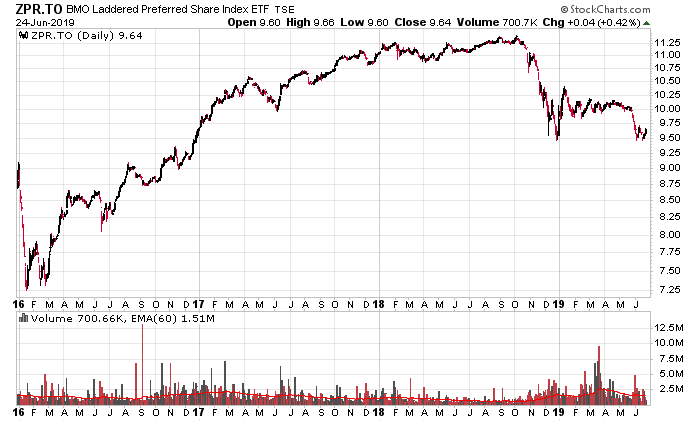
Market volatility has really increased since the beginning of October and one observation is that I am really surprised how much the fixed income component of my portfolio (specifically preferred shares) has depreciated during that time period. 5-year government bond yields have dived over 50 basis points over the past couple months, which is not good if you have rate reset shares coming up.

I have been researching companies like crazy at this period of time since a lot has been hitting my radar. You outperform the market by investing at panic bottoms.

My gut feeling suggests that we need to see more of a washout. We are likely to see a huge market rally at some point in the near future (you’ll see the S&P 500 jump up 5% over the course of a few days), and this will simply punctuate the next part of the downtrend – recall that the biggest rallies occur in these down trending markets. It is exactly designed to coax non-committed capital into the marketplace under a false pretense.

My liquidity position is excellent to take advantage. I’ve been waiting for this opportunity for some time. I am in no rush at the present moment to get in – it’s too early. More pain needs to be felt by the marketplace.