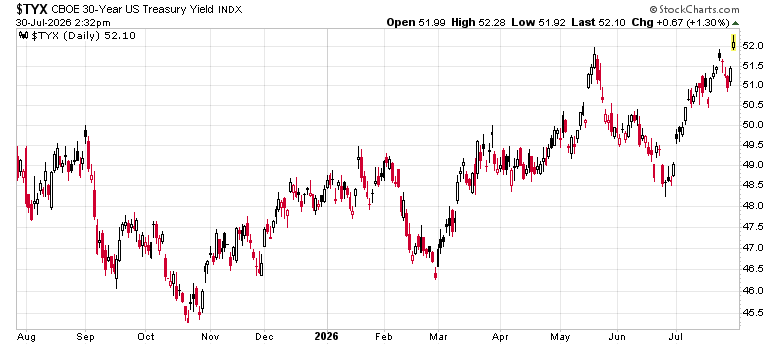
It is exceedingly difficult to make money in a rising interest rate environment. Capitalized values of assets descend when discount rates go higher. Since financing is typically secured on the basis of asset value, when asset values drop, the leverage must decline and all sorts of spinoff effects occur down the financial chain.
From a political perspective, the way to bridge this inconvenient fact is to shovel money out into the economy and bail out the whole financial system by inducing demand to keep the asset prices high through deficit spending.
This is why any governments linked to the global financial system will be in perpetual deficit financing mode – to do otherwise will invite an economic collapse of epic proportions. This would lead to political instability and for the USA, a significant loss of control over a dollar-denominated economy (which currently gives them huge economic advantages).
The classic economic calculation of GDP is the addition of consumption, investment, net exports and… government spending.
The US government currently has a 6% budget deficit to GDP. The Canadian government deficit, combined with provincial deficits, is around 3%. Other than the removal of the Covid-19 one-time spending where every world government was shovelling money out to the populace (the inflationary aftermath of which we are still dealing with today), government spending continues to increase. If in some dream scenario the government wanted to balance the budget and decided to do so by reducing spending instead of raising taxes, it would trigger an instant recession. The analogy is that the economy is hopelessly addicted to government spending – and a withdrawal would cause huge tremors like a physically addicted heroin addict getting off the needle. Other major national governments are in similar situations across the globe – arbitrarily, the top 10 are all in deficit; looking at the top 20, rank 20 Switzerland is the only one in relative balance.
With US 10-year treasuries an inch away from hitting the symbolic 5% yield to maturity mark, this is causing a crisis of sorts – the least of which is that the asset collateral represented by such bonds has dropped in value. With a higher long-term interest rate, the cost of borrowing for private entities also becomes equivalently expensive as corporate bonds are priced with a spread to the “risk-free” rate of the US Treasury bond.
In Canada, we are seeing the 5-year Government of Canada bond trading at 3.6%, which is the highest it has been since early 2024. This has a direct bearing on the real estate market and rising interest rates have treated this asset class like a campfire with a wet blanket on top.
When deficit spending becomes too expensive, another lever to be pulled is to induce inflationary panic. This has been going on for quite some time, but nothing does this better than triggering a war – and wars cost lots of money, which needs to be funded with additional deficit spending – almost as good as Covid spending. Adding “fuel to the fire” is having a core industrial input cost (the price of diesel) rise to a point that is going to raise prices in a manner that no carbon tax could ever.
Keep in mind that the real rate of interest is the nominal rate minus the expected rate of inflation.
Even if the markets, which are vomiting on government debt, are demanding higher rates of interest, you can still trigger a decrease in the real rate of interest.
It is by triggering the fear of massive amounts of inflation. Whether the inflation actually occurs or not is another matter – consumption and capital spending get pulled forward ahead of anticipated price increases, and that behaviour by itself shows up in GDP. What is being discounted is the nominal rate against expected inflation, not against the inflation that eventually prints.
This is not what the reported statistics are showing at present. Canadian CPI is running at 3%, but the Bank of Canada’s core measures (CPI-trim at 2.0% and CPI-median at 1.9%) are sitting roughly at the 2% target. That gap between headline and core is partly due to the energy pass-through. I would argue it is the perception of higher inflation, rather than the reported statistics, that is driving behaviour.
There is a fair objection to all of this. If governments wanted inflationary panic, why did Ottawa suspend the federal fuel excise tax in April, and then extend the suspension through January 2027 at a total cost of about $5 billion? The answer is that a tax expenditure is still spending. The 10 cents a litre on gasoline and 4 cents on diesel is borrowed money handed straight to consumers at the point of highest propensity to spend – it suppresses the measured number without touching the underlying deficit condition. The tax returns at half rate in February and in full in April, which means the headline CPI quoted above has a mechanical increase already scheduled into it.
All of these financial machinations will create an oscillatory market where you have competing notions of valuation – cash flowing assets will degrade as the capitalized value of said asset will decrease with higher discount rates; physical asset values will rise, and the price of consumption will skyrocket. This makes real estate, for example, difficult to model – on one hand, you have cash flows that can be generated through rents – the present value of these cash flows will decrease due to the increase in the discount rate; conversely the asset value will rise in nominal terms due to the inflation that higher interest rates are signalling. An investor in Canadian Apartment Properties REIT (TSX: CAR.un) is currently sitting on an asset with (June 30, 2026) NAV of $54.38 per unit, but the units are trading, as of this writing, 40% under this. On the commercial end, Allied Properties (TSX: AP.un) is in a fight for its life and is trading at about 50% of its stated NAV. High interest rates today are causing the devaluation of these trusts, but assuming they survive without another dilutive recapitalization, there will be a time where cash flows from said properties will once again enter into the valuation of the units – say if CAR.un traded at a valuation of a 12% yield on its annualized FFO instead of its current 7.7%, would that be a better alternative in an environment where 5-year GoC rates are 3.6%?
Stock markets measure profitability in nominal terms. The eroding value of currency should never be confused with the underlying profitability of companies producing things that are in demand with limited competition, or that are the first-hand recipients of the money created through deficit spending.
There is an element of “damned if you do and damned if you don’t”, referring to the fact that one seemingly cannot invest in equities at all-time highs, yet if you are sitting in cash you are seeing the purchasing power erode very quickly. Even the precious metal complex (gold, platinum and silver) is not immune – the ebbs and flows of demand for them (both in their industrial metals capacity and their monetary metals capacity) do not give any assurance that in the short term you are holding onto a “safe” asset. Gold posting three consecutive weekly declines into a $100 oil shock makes the point rather neatly: it was the real rate doing the work, not the inflation headline.
Inflation expectations and government spending are the trigger to rising interest rates and consequential declines in purchasing power; these deficits are now baked in and will be competing against private capital. These times are reminiscent of what occurred in the second half of the 1970’s, with the material difference that real rates then were deeply negative on measured inflation while today they are positive on measured inflation and arguably negative only on the perceived kind. If this playbook is an apt analogy, it will be difficult to get ahead, in real terms, in this financial environment.
Fortunately, I am not an institutional pension fund investor who has to realize a return on a hundred billion dollars of capital. The advantage of being a small-time investor is there will always be nooks and crannies to retreat into for those better-than-average risk-reward opportunities. However, a rising-rate environment makes them much more difficult to find.