Spot oil windfall

When will we start hearing, once again, “Windfall profit taxes” in relation to oil prices?

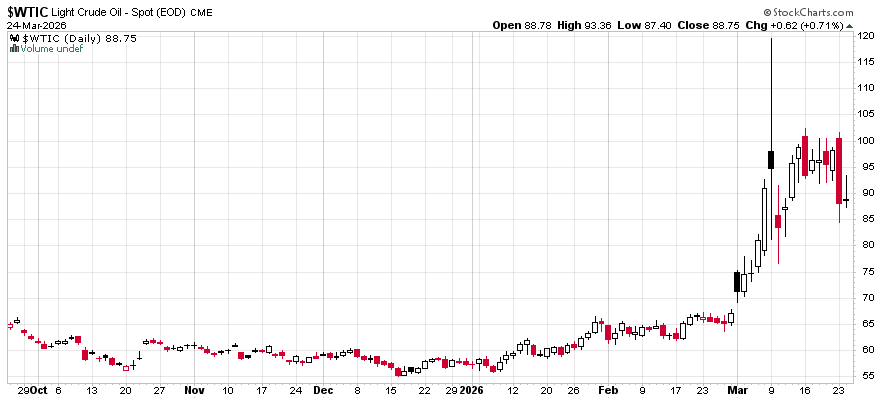
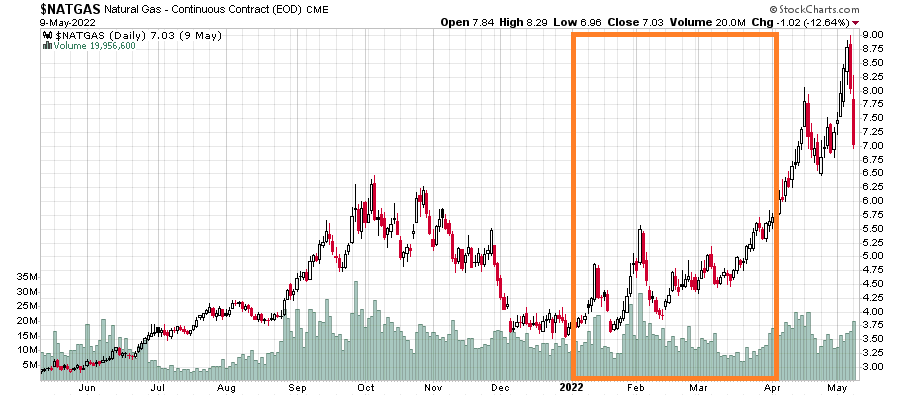
Eyeballing the chart, we have spot WTI US$60 for January, US$65 for February and so far in March, let’s call it US$85.

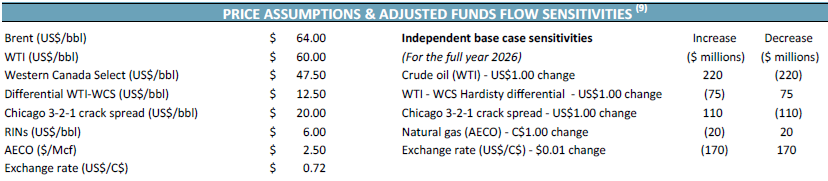
Just as an example, we look at Cenovus’ sensitivities:

CAD$220M/year in “adjusted funds flow” sensitivity per dollar of WTI, so a first-cut analysis of a US$20 one-month change in WTI would be about CAD$370M in cash flow, or about 20 cents a share. For a single month of elevated pricing.

Suncor is about C$215M/year per US$1 change in WTI. CNQ forces you to do your own homework, but very roughly, my paper napkin has a model going from US$65 to US$85 WTI resulting in a change from $4 to $7/share in free cash flow (assuming things go for a whole year).

Given the extreme slope on the oil futures curve (spot oil being US$88, give or take, while December 2026 crude is US$75, a 15% discount for patiently waiting 9 months for your delivery), this windfall is not expected to last. Or will it?

Suncor firing on all upgraders

The turnaround in Suncor (TSX: SU) after Rich Kruger took over has been remarkable. It has almost been like a Hunter Harrison story.

Financial metrics at Suncor have been as good as it gets, with 2024 generating about $9.5 billion in cash flow, or $8 billion if you make some adjustments for working capital.

Using the $8 billion figure, Suncor has 1.25 billion shares outstanding, so $6.40/share in free cash flow. Market value is around CAD$55/share at present.

The balance sheet is mostly de-levered with about $7 billion of net debt. They intend to keep it at around the $8 billion level.

The capital allocation after capital expenses is currently going toward an approximate $3 billion/year dividend and the rest of it dumped into a share buyback.

If Suncor was trading as an income tax-free income trust like in the old days where income trusts were freely traded, they’d be generating about 15% distributions on their cash flows. With a 23% combined federal-provincial tax, that goes down to about 11.6% net on market cap.

At $55/share, the buyback is an acceptable use of capital, especially when measured against the cost of their 10-year debt (5.6% pre-tax at present).

The risks are fairly well known – regulatory (although the pendulum is definitely swinging on the environmental policy front), geopolitical (Suncor is relatively better positioned than Cenovus with respect to potential US tariffs on crude), and the commodity market (will oil crash?).

The biggest risk is that they spend money on a really stupid acquisition. Their most recent large profile acquisition (consolidating the remainder of the Fort Hills oil sands project from Teck and Total Energies) was a remarkably good one.

On the flip side, the upside is fairly contained – the company is operating at capacity.

Hence the valuation dilemma – will there ever be a catalyst to warrant a valuation that takes the company from ~12% after-tax to 10, or 8%?

It is too cheap to sell, but since zero growth and volatile commodity companies tend to be out of vogue at present, too expense to purchase.

Still, in theory, if everything remains equal, by this time next year, the company’s shares plus the dividend distribution should take the total value of a share purchased today at $55 and turn it into roughly $61, a lot better than a risk-free 3% on short term cash.

From an engineering and operational perspective, Suncor is a very exciting company doing really amazing things with gigantic volumes of dirt and water – it is truly a modern version of energy alchemy they are performing. Few people appreciate the magic that is being performed with these energy companies.

Financially, however, they are starting to resemble REITs. Whether this is a good or bad thing, I do not know.

I remain long on a moderate position taken shortly after Kruger took over. I am not expecting fireworks from this position, but take solace in having some degree of exposure to perpetually rising prices and having something better than cash silently raking in those free cash flows.

Rights of First Refusal coming in handy – Surmont Oil Sands

Suncor, April 27, 2023:

Suncor Energy (TSX: SU) (NYSE: SU) today announced that it has agreed to purchase TotalEnergies’ Canadian operations through the acquisition of TotalEnergies EP Canada Ltd., which holds a 31.23% working interest in the Fort Hills oil sands mining project (Fort Hills) and a 50% working interest in the Surmont in situ asset. This will add 135,000 barrels per day of net bitumen production capacity and 2.1 billion barrels of proved and probable reserves to Suncor’s oil sands portfolio. The acquisition is for cash consideration of $5.5 billion, with the potential for additional payments of up to an aggregate maximum of $600 million, conditional upon Western Canadian Select benchmark pricing and certain production targets. Subject to closing, the transaction will have an effective date of April 1, 2023.

Two assets were purchased. It wasn’t entirely clear what the price allocation between both assets were. Now we know:

31.23% Fort Hills – CAD$1.5 billion / $160 million contingent consideration
50% Surmont oil sands – CAD$4.0 billion / $440 million contingent consideration

Suncor purchased from Teck 21.3% (minus Total Energies’ right of first refusal component of 6.65%) for $1 billion. Suncor ended up with another 14.65% in total. The 31.23% consideration for $1.5 billion is roughly in-line with what Teck paid.

How did we figure this out the split between the two major assets?

May 26, 2023:

ConocoPhillips (NYSE: COP) today announced that it is exercising its preemption right to purchase the remaining 50% interest in Surmont from TotalEnergies EP Canada Ltd. for approximately $3 billion (CAD$4 billion), subject to customary adjustments, as well as contingent payments of up to approximately $325 million (CAD$440 million). ConocoPhillips currently holds a 50% interest as operator of Surmont and will own 100% upon closing. This transaction is subject to regulatory approvals and other customary closing conditions.

Here’s the kicker:

Based on $60 WTI, the transaction will add approximately $600 million of annual free cash flow in 2024, inclusive of approximately $100 million of annual capex for maintenance and pad development costs.

That’s US dollars – US$60 WTI = US$600 free cash flow, or about CAD$817 million. Suncor was paying about 5.4x free cash flow. Logically it is even better when WTI is greater than US$60! This should have been a pretty easy decision for ConocoPhillips to exercise the right of first refusal.

All of this was unfortunate because Total Energies was planning on doing a spinoff of these two assets and depending on valuation, I was planning on getting into this firesale. No longer!

It is no kidding that Suncor stock is down today – Surmont is 75,000 boe/d of low-cost production. Fort Hills has a rated capacity of 194,000 boe/d. While it is a nice consolation prize (especially as the entire operation is now consolidated in Suncor), the Surmont asset is something I’d like to get into at the price Suncor was paying!

Can Teck unload their met coal operation?

Teck (TSX: TECK.A/B) had some interesting news yesterday – they dumped their 21% interest in the Fort Hills oil sands project for $1 billion to Suncor (the majority owner and operator), and they also released their quarterly report.

The Fort Hills project was the black sheep of Teck, primarily because it goes against their “wokeist” image they are trying to project and is clearly not in their strategic mandate to be a lead producer of “low carbon metals” (aren’t all metals non-carbon?). Once the Frontier Oil Sands project was shelved, pretty much the days were numbered for the Fort Hills division.

For Q3, Teck’s share of the project was 37,736 barrels of oil a day, and the consolidated project is 180,000 barrels – not a trivial size.

The project historically has been plagued by operational issues and, in my quick evaluation, the deal is good for both Teck (who wanted to get out) and Suncor (who is likely to consolidate 100% of the project in the near future). The Frontier project might get revived in a future decade when regulatory concerns get alleviated, but I would not hold your breath.

Of note is that both companies (Teck and Suncor) will be taking non-cash accounting losses on the disposition – in Teck’s case, the amount of capital dumped onto the project is less than the amount that they were able to get back from it with this disposition. The impairment charge on the books was $952 million. The conference call transcript indicated there was a ‘small capital loss’ on the transaction.

Teck’s major project in the works is the QB2 copper mine in Chile. One reason why their stock had a tepid response to the quarterly report is because of the usual announcements of delays and construction cost escalation, coupled with a decreased expectation for production in 2023. However, this is yet another sign that one cannot click a few buttons on Amazon and expect a mine to start producing – the scale and scope of these projects is gigantic and this one has taken about 5 years to get going from the “go-ahead” decision to when things will be materially completed. If this decision was pursued today, the costs would likely be even higher (not to mention the regulatory climate would be even worse than it is today).

QB2 is the example of their “low carbon metals” strategy, where apparently they can be dug up from the ground without emitting carbon, but I digress. The “to-go” capital expenditure on QB2 is anticipated to be US$1.5-$1.9 billion from October 1, and once this is completed, Teck will be a free cash flow machine barring some sort of total collapse in the copper market (beyond the 30% drop from half a year ago).

The balance sheet is very well positioned, with $2.6 billion in cash and no major debt maturities until 2030 other than a US$108 million bond due February 2023, which they can easily pay off. As a result, Teck will be in a position to either buy back stock or issue increased dividends later in 2023.

But the focus of this post isn’t about QB2 or Teck’s future prospects, it is about their metallurgical coal operation.

Their met coal operation generated $1.24 billion in gross profits in Q3, and $5.55 billion year-to-date. It is single-handedly the reason why Teck is in such a fortunate financial position to be able to dither on QB2 and not get terribly concerned about it.

However, it flies in the face of their “low carbon metals” strategy and this reminds me of last year’s article which rumoured that Teck was looking at getting rid of, or spinning off their met coal operation.

My question is still the same – who would buy this? It is making so much money that even if you paid 2x annualized gross profits (an incredibly generous low multiple), somebody would still need to cough up $15 billion to buy the operation. This puts pretty much every coal operator out there except for the super-majors (like Glencore) out of the picture.

However, if Teck were to dispose of the coal unit, it would likely be in conjunction with a significant distribution to shareholders – a $15 billion sale would result in roughly a $22/share distribution, assuming a 25% tax rate (the actual tax paid will likely be less since Teck’s cost basis will be considerably higher from the Fording Coal acquisition). At a zero-tax rate, that would be roughly $29/share.

However, a giveaway is the non-answer during the conference call:

Orest Wowkodaw
Analyst, Scotia Capital, Inc.
Hi. Thank you. Jonathan, your number two priority seems to be rebalancing the portfolio to low carbon metals. I’m wondering if that if your strategy there is solely around growing the copper business and i.e. diluting the coal business, or do you see the potential for accelerating that transformation perhaps by either divesting some of the coal business?

Jonathan Price
Chief Executive Officer & Director, Teck Resources Limited
Yeah. Hi, Orest, and thanks for the question. There’s a number of approaches that we’ve been taking to that. The first as you’ve seen overnight is the announced divestments of Fort Hills. Clearly oil sands carbon, an opportunity there to reduce weight in the portfolio through that divestment, something we’re very pleased to have agreed and have gotten away.

Secondly, as you highlight really the key approach for us is the growth around copper with the doubling of copper production as we bring QB2 online next year. And then with the projects I mentioned being new range being San Nicolás being the QB mill expansion all bring more copper units into the portfolio which further swing us towards green metals and away from carbon. As we’ve said before, we’ll always remain very active and thoughtful in reviewing the shape of the portfolio and the composition of our portfolio. But right now those factors I’ve mentioned are the key execution priorities and that’s what the team is focused on. And that’s what we’re gearing up to deliver.

I’m pretty sure reading between the lines that they are, at the minimum, thinking of doing this. But who in their right mind would buy such an operation in a very hostile jurisdiction?

First quarter review of oil and gas – and a look at Suncor

This is a brief review of the companies that have reported their quarterly results to date in the oil and gas space – specifically the ones in the Divestor Canadian Oil and Gas Index. (ARX, CNQ, CVE, MEG, SU, TOU, WCP have reported).

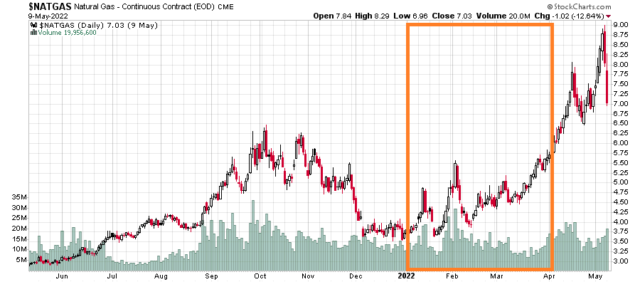
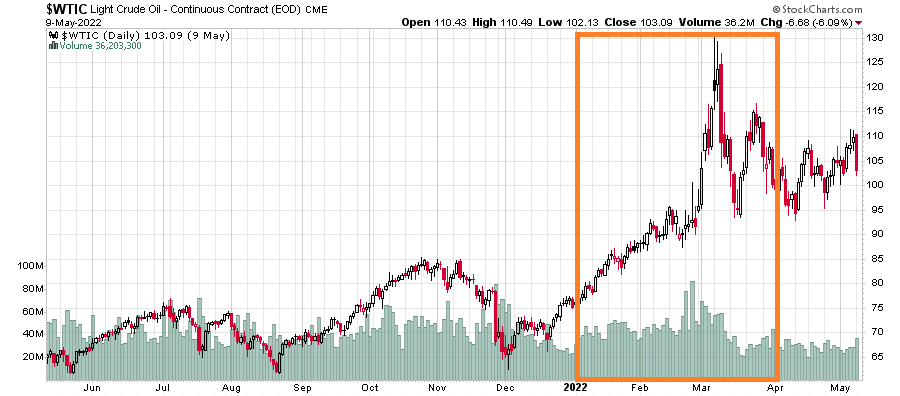
When your spot commodity exposure charts look like this, you know things are looking good:
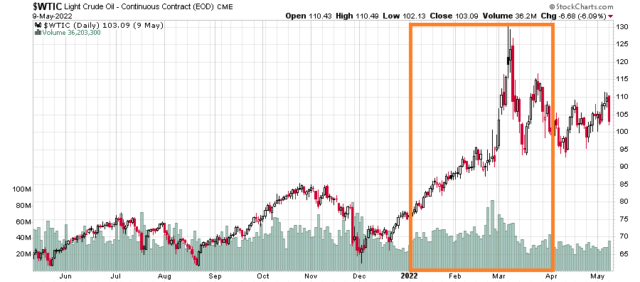
The amount of bullishness out there in the previous week was a bit nuts and ripe for a correction. When markets ascend for this much time for this duration, there is a natural process where momentum and technical analysis players get cashed out, regardless of any fundamental underpinnings.

The financial market moves much, much, much faster than what goes on at a glacial pace in reality. While the amount that has evaporated out of my portfolio in the past week is impressive, it goes with the nature of finance that things will indeed be volatile, but the intrinsic value of the portfolio remains intact, reflected by real-world economics instead of financial economics.

All of the companies in the oil and gas index have been reporting record free cash flows, but most notably all of the players have been quite tight on growth capital in the sector – the free cash flow for the most part has gone into debt reduction, dividends and share buybacks. Now that most of these companies have reached their leverage targets, they are now continuing to deploy more cash into share buybacks, or (in the case of TOU) special dividends.

The financial mathematics of companies giving off sustained free cash flows (key word being ‘sustained’, noting that fossil fuel extraction is a cyclical industry) is interesting to analyze. I will use Suncor as an example.

Suncor guided in Q1 that their income tax payments will go up from the lower $2 billion range to $4 to $4.3 billion (note that income tax is a function of operating income minus interest expenses and after the removal of royalties, which is another huge layer of money given to the government!). Suncor does not have a material tax shield so they will be fully paying cash corporate income taxes. The Canada and Alberta corporate tax rate combined is 23%, and they have other operations in other provinces and overseas, so we will assume 23.5% as a base rate, which puts Suncor at $17.7 billion in pre-tax income ($13.5 billion after-tax).

Those with an accounting mindset will ask whether net income translates directly into free cash, and Suncor’s capital expenditures are roughly in line with depreciation. My own on-a-paper napkin free cash modelling also corresponds roughly to this $13.5 billion amount in the current commodity price environment.

Suncor has 1.413 billion shares outstanding as of May 6, 2022, so the upcoming year of income is $9.55/share. Suncor trades at $44/share as I write this, and has an indicated quarterly dividend of 47 cents per share ($1.88 annually). Although management has hinted this will go up over time, for now let us assume it is a static variable.

Deciding between debt reduction, dividends and share buybacks usually are a dilemma, but when the math is this skewed it is not.

Suncor’s debt currently costs them about 5.25%, or 4% after-tax. A share buyback not only alleviates the company from paying out the 4.27% dividend, but is also purchasing a 21.7% return on the equity.

This is a no-brainer decision from an optimization standpoint – every penny after regular capital expenditures, should go into a share buyback. The dividend should be brought to zero and shares should be bought back with that amount instead, until such a point where the return on equity goes below a particular threshold (my own personal threshold if I was calling the shots at management would be 12% or anything below $80/share in the current price environment!).

However, there are other variables to consider.

One is that the commodity price environment might not (and indeed is very unlikely to) last forever. There is a pretty good case to made that this particular price environment will last longer than most (instead of spending on capital expenditures like drunk sailors, companies across the grid are shockingly being very disciplined about limiting the amount of growth in production), and also the margin of error of the price level itself is quite high – West Texas Intermediate is at US$100 and even if it goes down to US$75, my models still have Suncor making around $8 billion in free cash. My $80 threshold price for share buybacks would drop to $47/share in this scenario – very close to the current market price.

So the argument to reduce debt is not out of financial optimization, but rather reducing the brittleness of the financial structure of the company. Hence the decision to allocate the residual 75% of free cash minus capital expenditures and dividends to debt reduction, and the other quarter to share buybacks. Although it is not financially optimal if you assume the current environment exists, it is a safe decision. They will do this until they go to under a $12 billion net debt position, which will happen at the end of Q3/beginning of Q4. (Note that Suncor introduced a new conservative fudge factor by adding in lease liabilities into this definition which inflates the net debt number).

After they reach the $12 billion net debt figure, then 50% gets allocated to debt and 50% to the share buyback. At the current commodity environment and share price, they will be able to complete nearly the 10% full buyback with this regime. After they get down to $9 billion in net debt, then the debt reduction goes to 25% and share buyback will go to 75%. I just hope that management has the prudence to taper the buyback and increase the dividend if their share price gets too high.

The other variable is the dividend. While the tax inefficiency of dividends are well documented elsewhere, it does provide a “bird in the hand” component to the stock, and also gives the buyback itself some metric to be measured against. While other people consider a dividend to be very important, I am agnostic about a particular dividend level, except in context of alternatives.

Obviously if a company has capital investment opportunities, you do not want to see a dividend. You instead want to see them deploying this capital in productive ventures. However, in the fossil fuel industry, there is a very good argument to be made to just keep things as-is and just go on cruise control – this is exactly what is happening for all of these companies. They are paying down debt and allocating cash to dividend and share buybacks, especially when all of them are giving out 20%+ returns. There is no reason not to.

The ultimate irony here is that in such an environment where cash flows are being sustained, it works incredibly in the favour of investors that the market value of these companies remains as low as possible, to facilitate the execution of cheap share buybacks.

This leads me to my next point, which is that it does not take a CFA to realize that on paper, many of these oil and gas companies are perfect candidates for leveraged buyouts. Only the perceived toxicity of fossil fuels and ESG has prevented this to date, and I am wondering which institution will be making the first step in outright trying to convert a leveraged loan (even in the elevated interest rate environment, they can get cheap debt) to buy out a 25% cash flowing entity. It is inevitable at the current depressed market prices.

The first warning shot on this matter (which is cleverly disguised as a strategic performance improvement scheme) comes from Elliott Investment Management’s Restore Suncor slide deck. They can’t outright say what they’re thinking – let’s LBO the whole $60 billion (market value) firm!

Needless to say, an investor in this space makes most of their money “going to the movies”, as Warren Buffett said about one of his earlier investment mistakes (selling a company too early). I think this will be the case for most of the Canadian oil and gas complex.