Cenovus Energy preferred share redemption

Cenovus Energy called their remaining preferred share issue (TSE: CVE.PR.A/B, inherited from the Husky Energy transaction) and it will be redeemed out at the end of March.

Notably, the preferred share was incredibly low-yielding: 2.577% and a rate reset of 1.73% above the Government of Canada 5 year.

At today’s GoC 5yr at 2.68%, the preferred share would have reset at 4.45% yield at par.

Yesterday, the preferred shares closed at $24.75 (a mild discount to par). The redemption at $25 is obviously the company deciding to clear out the books entirely on one class of its securities.

A 4.45% after-tax drain, at a notional tax rate of 25% is the equivalent of issuing a perpetual debt at 5.93%, notwithstanding the 5 year changes in the reset rate – a 1.73% spread is quite narrow.

This is extraordinarily cheap capital, yet it is being redeemed. Despite blowing a bunch of cash on the MEG Energy transaction (don’t get me wrong – it was strategically the correct thing for the company to do), Cenovus has ample cash and free cash flow to spend $300 million to save $13.35 million after-tax annually.

This kind of exemplifies the yield wasteland in the preferred share market in general.

Slate Office REIT’s nearly cooked

It’s not looking good for Slate Office REIT, now rebranded as Ravelin Properties (TSX: RPR.UN):

Toronto, Ontario–(Newsfile Corp. – February 20, 2026) – Ravelin Properties REIT (TSX: RPR.UN) (“Ravelin” or the “REIT”), an internally managed global owner and operator of well-located commercial real estate, announced today that it does not expect to make principal or interest payments on the upcoming maturity date of its 9.00% convertible unsecured subordinated debentures (the “9% Debentures”).

The maturity date of the 9% Debentures is February 28, 2026. In connection with the upcoming maturity date, the 9% Debentures, which currently trade on the Toronto Stock Exchange under “RPR.DB”, will be halted at the market open and delisted at the close of trading on the business day following the maturity date, being March 2, 2026.

The REIT has been in default of its obligations to pay interest on the 9% Debentures since March 1, 2024. The repayment price due on maturity is $1,180 per $1,000 principal amount of 9% Debentures, representing aggregate principal amount of $28,750,000, and $5,175,000 for accrued and unpaid interest thereon to, but excluding, the maturity date.

The big question I have in my mind is – how will George Armoyan, who went through a huge effort to take over the REIT, be able to salvage this situation? It is incredibly unlikely anybody from the public will be able to make lemonade from the lemons (the units and debentures are well subordinated), but Armoyan’s corp, G2S2, has lent Slate/Ravelin a ton of money and maybe this was the plan all along when they will get to eat away at the entrails of this soon to be extinct REIT.

Despite AI, real is in, virtual is out

The phrase “nobody rings a bell at the top” is the cliche, but the converse of this is that nobody screams at you telling to buy at the bottom.

There has been a profound shift in the market over the past few months, and it can be abstracted with “real is in, virtual is out”.

You see this in stock charts of software companies versus anything selling tangible product. Gold and silver are surging, while Bitcoin and the purchasing power of any fiat currency is cratering.

I have been experimenting with various AI technologies and trying to get an idea of how real this will be disrupting the landscape.

The best analogy I can make at present is the operating system abstraction. In the old days (and to a lesser extent today), software was compiled to run explicitly on CISC (Intel x86), RISC chips (e.g. ARM, PowerPC, MIPS, etc.), but it became a pain in the rear to rebuild the software for differing computational systems. Operating systems (Unix-based systems, DOS/Windows, MacOS, etc.) were developed to abstract from all of this. Of course it became a pain in the ass to develop for all three (plus more) at the same time, so the next level of abstraction was initially done with Java, which ran a virtual machine on top of the respective operating systems – the appeal is in “write once, run anywhere” – it didn’t have to care about the hardware OR operating system you were running on. Browser-based technologies also provided another layer of abstraction parallel with Java – for the most part it doesn’t matter whether you are using Chrome, Edge, Firefox, Safari or whatever, you get the same application delivered to you.

The issue now is that you actually have to code and use tools to generate what you want (fancy websites, database interfaces and the like). Entire university curricula are dedicated to the craft to assembling all of these disparate skills together.

Fast forward to today, where we have AI. The acronym is not artificial intelligence, but rather artificial interface. It is essentially an abstraction on top everything I have mentioned here, and using natural language parsing as a “graphical user interface”. Of course, there is nothing graphical about it – it is entirely textual.
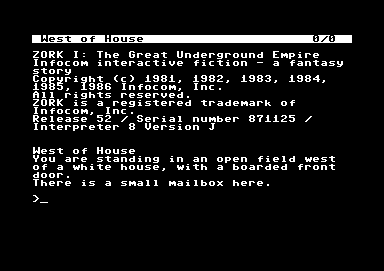
Do you remember this?

In terms of economics, it is a huge question where the value will be extracted from. Going back to the old days, Microsoft was clever enough to extract a royalty out of nearly every PC sold in the form of a license to Windows (and later on, Office). When you think about it, there is little consumer utility in the purchase of an operating system itself – the end-user value is in the applications run on top of that layer.

We sort of see this extraction of value with the amount of queries you can ram through OpenAI, Claude, etc. – there is a limit before you have to pay a monthly subscription fee as the amount of computational energy required to process requests is, from what I can tell, an incredibly inefficient process. Is this sufficient for them, or is the value going to be in the applications?

I have been looking long and hard at Adobe, which produces well-known products like Photoshop, Illustrator, and other digital editing software. By all accounts, they are trading at forward P/Es that are very un-techlike (11.6x estimated 2026 earnings as I write this). Despite the existence of near-equivalent open source products (GIMP for Photoshop, Inkscape for Illustrator, OpenShot for Premiere, etc.) Adobe continues to extract incredible pricing power. An entire industry of graphic designers, marketing agencies and so on rely on Adobe software to produce style guides for millions of clients out there.

The ease of using AI to replace Photoshop and Illustrator is a material threat, however. If it no longer takes a professional graphic designer to generate different styles, it leads to the question of why one needs to spend nearly a thousand dollars a year on a professional software license (for them), or a few thousand bucks to contract the person out in the first place. The application layer where one can extract pricing power must be elsewhere. I don’t have easy answers for where this goes in the digital world, but it is one potential explanation why software companies are getting murdered in the stock market at present.

Just in case if you are wondering, nothing I write here uses AI. I still find the “Turing test” for AI-driven writing to be pretty obvious but I don’t think many people have this discernment skill, and it is one reason why AI-driven media (so-called “AI Slop”) is so prevalent. Paradoxically, it is also one reason why, as this trend of increasing procedurally-generated media continues to contaminate and permeate through everything, real is making a comeback.

Bitcoin goes to zero.
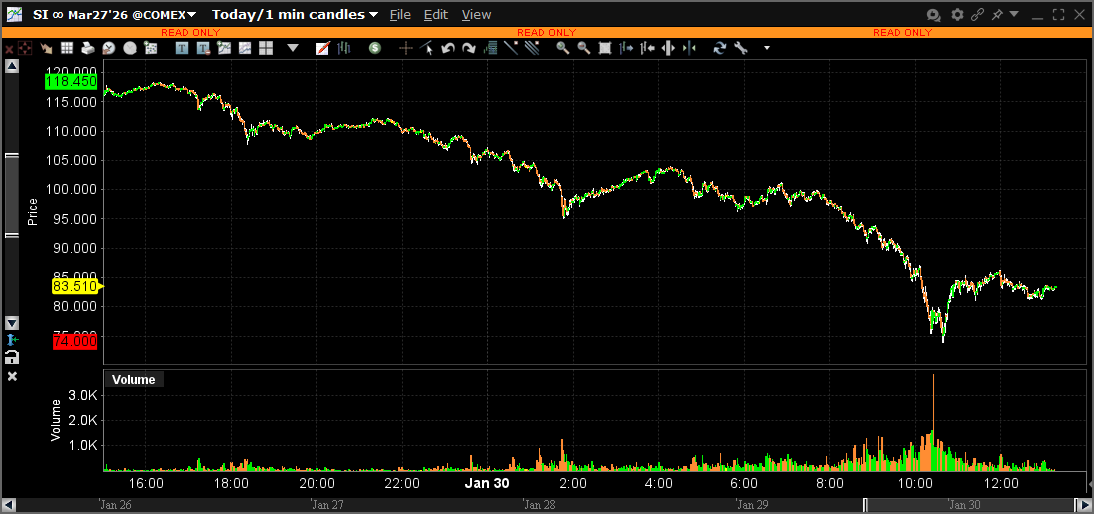
The most crazy (Black Friday) day for silver

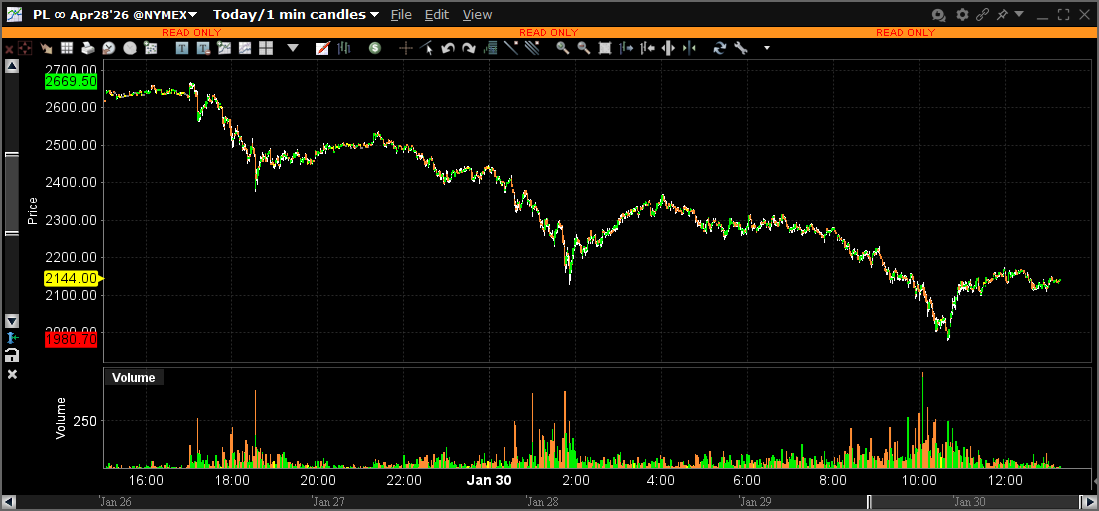
I have very little skin in the game for precious metals (aside from the indirect benefit Teck Resources, soon to be Anglo Teck, mines from the ground) but I was just looking at the futures trading today in gold, platinum and silver, and oh my god. Here is platinum (down 18%) and silver (down 26%):

Charts are Pacific Time Zone.

This type of trading reminds me of October 2008-styled selling. As in panic selling. Somebody got caught with long exposure on the futures and were clearly forced to dump – you don’t see 25% down moves in a day like this very often in any broad market! Silver actually got all the way to -35% before rebounding – timing this exact bottom would be an impossible feat. Just imagine you woke up, saw silver down 10% and thought to yourself “surely, this would be a great time to average down on my long” before receiving a summary financial execution hours later. Or at around 1:50am, you bottom-ticked the futures at US$95 long and was giving yourself a pat on the back until 7 hours later when you were underwater.

Volatility begets volatility and Monday will be very interesting. This should also be a warning shot across the bow of crypto traders, but will it be a portent to the main indexes?

Precious metals are the new crypto

The more things change, the more things stay the same.

We have two asset classes, precious metals (Gold, Platinum, Silver), and cryptocurrency (I will narrowly define this as Bitcoin, Ethereum, Solana and XRP as they are the only ones trading on the CME at present). They share some features in common – they are perceived to be a store of value and (using a crypto phrase) represent “proof of work”. They both have a yield of zero unless ‘leased’ or ‘staked’ in other parallels.

There’s now another characteristic in common – they are volatile. The chart of platinum, for example, has gone all over the place in the past week of trading. As I write this it down over 10% from 12 hours ago. There’s an obvious amount of speculation, day-trading, short covering, and media hype now covering the ascent of precious metals.

I am wondering whether we are entering in a phase where tangible is going to outdo digital, more broadly than what we are seeing with this trivial comparison. My level of general concern with the whole monetary system is also rising. I keep thinking about to my reflections on my brief attempts of being a corporate raider with Slate Office REIT, except instead of dealing with a borderline-insolvent REIT, we are all “financial flea” participants in our own national economy where there is no way to “win”, or even “staying even” – in real terms, not nominal. Even deciding what the measuring stick (which historically used to be the sovereign currency of the nation you live in) is going to be obscured – perhaps linking to Maslow’s Hierarchy of Needs is a better measure.