The phrase “nobody rings a bell at the top” is the cliche, but the converse of this is that nobody screams at you telling to buy at the bottom.
There has been a profound shift in the market over the past few months, and it can be abstracted with “real is in, virtual is out”.
You see this in stock charts of software companies versus anything selling tangible product. Gold and silver are surging, while Bitcoin and the purchasing power of any fiat currency is cratering.
I have been experimenting with various AI technologies and trying to get an idea of how real this will be disrupting the landscape.
The best analogy I can make at present is the operating system abstraction. In the old days (and to a lesser extent today), software was compiled to run explicitly on CISC (Intel x86), RISC chips (e.g. ARM, PowerPC, MIPS, etc.), but it became a pain in the rear to rebuild the software for differing computational systems. Operating systems (Unix-based systems, DOS/Windows, MacOS, etc.) were developed to abstract from all of this. Of course it became a pain in the ass to develop for all three (plus more) at the same time, so the next level of abstraction was initially done with Java, which ran a virtual machine on top of the respective operating systems – the appeal is in “write once, run anywhere” – it didn’t have to care about the hardware OR operating system you were running on. Browser-based technologies also provided another layer of abstraction parallel with Java – for the most part it doesn’t matter whether you are using Chrome, Edge, Firefox, Safari or whatever, you get the same application delivered to you.
The issue now is that you actually have to code and use tools to generate what you want (fancy websites, database interfaces and the like). Entire university curricula are dedicated to the craft to assembling all of these disparate skills together.
Fast forward to today, where we have AI. The acronym is not artificial intelligence, but rather artificial interface. It is essentially an abstraction on top everything I have mentioned here, and using natural language parsing as a “graphical user interface”. Of course, there is nothing graphical about it – it is entirely textual.
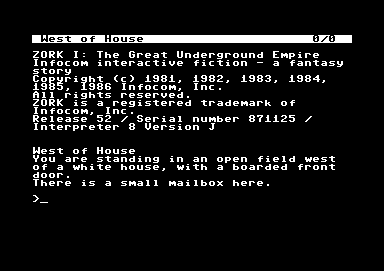
Do you remember this?
In terms of economics, it is a huge question where the value will be extracted from. Going back to the old days, Microsoft was clever enough to extract a royalty out of nearly every PC sold in the form of a license to Windows (and later on, Office). When you think about it, there is little consumer utility in the purchase of an operating system itself – the end-user value is in the applications run on top of that layer.
We sort of see this extraction of value with the amount of queries you can ram through OpenAI, Claude, etc. – there is a limit before you have to pay a monthly subscription fee as the amount of computational energy required to process requests is, from what I can tell, an incredibly inefficient process. Is this sufficient for them, or is the value going to be in the applications?
I have been looking long and hard at Adobe, which produces well-known products like Photoshop, Illustrator, and other digital editing software. By all accounts, they are trading at forward P/Es that are very un-techlike (11.6x estimated 2026 earnings as I write this). Despite the existence of near-equivalent open source products (GIMP for Photoshop, Inkscape for Illustrator, OpenShot for Premiere, etc.) Adobe continues to extract incredible pricing power. An entire industry of graphic designers, marketing agencies and so on rely on Adobe software to produce style guides for millions of clients out there.
The ease of using AI to replace Photoshop and Illustrator is a material threat, however. If it no longer takes a professional graphic designer to generate different styles, it leads to the question of why one needs to spend nearly a thousand dollars a year on a professional software license (for them), or a few thousand bucks to contract the person out in the first place. The application layer where one can extract pricing power must be elsewhere. I don’t have easy answers for where this goes in the digital world, but it is one potential explanation why software companies are getting murdered in the stock market at present.
Just in case if you are wondering, nothing I write here uses AI. I still find the “Turing test” for AI-driven writing to be pretty obvious but I don’t think many people have this discernment skill, and it is one reason why AI-driven media (so-called “AI Slop”) is so prevalent. Paradoxically, it is also one reason why, as this trend of increasing procedurally-generated media continues to contaminate and permeate through everything, real is making a comeback.
Bitcoin goes to zero.
“Bitcoin goes to zero.”
Is that a proclamation or the headline for your next piece? Genuinely asking.
Would AI write this?