Stress in Canadian oil and gas

I wrote earlier this year about the downward slopes of Canadian energy companies and six months later, nothing appears to have changed – the trajectory for most of these companies continues to go down.

Commodity pricing is also highly unfavourable – WTIC crude is at US$43/barrel as I write this and the CAD/USD exchange is around 75 cents on the dollar.

So at these price levels, there are going to be plenty of companies that will find it very difficult to make any money.

What hit my radar today is Cenovus (TSX: CVE) taking a hit after their investor day presentation – their CEO is calling it quits at the end of October and planning a $4-5 billion asset disposal. The stock is down to about CAD$9.20/share – noting they raised $3 billion in capital back in April at CAD$16/share when they purchased back their 50% of their partnership in the Foster Creek/Christina Lake projects. Those shareholders must be feeling pretty “steamed” right now, having experienced a 42% depreciation on their capital in a few months.

In their presentation, they stated that the company is break-even at US$41/barrel. You can be sure that if present pricing stays at the current levels, there are going to be a lot more medium-cost producers that are going to start feeling the pinch on their balance sheets – the “bunker down and wait for better pricing” strategy only works when your rivals are out of money and you’re sitting on a treasure chest. Right now, everybody has enough liquidity to last another year or so before things really start hitting the fan.

Equity holders, in addition to feeling already light-pocketed, should continue to worry as debts rise and creditors start taking more and more of any available cash flows out of these corporations.

And as readers know, when there is desperation in the financial markets, that’s usually a good time to invest money. But now still doesn’t feel like the right time.
Reviewing underperforming Canadian oil and gas producers

One observation: It is abundantly clear that oil and gas producers in North America are going to be trimming their 2015 capital budgets. This will disproportionately affect the service companies, but most of this has already been baked into equity prices.

I have no idea where oil prices will be going in the short term. There is plenty of incentive for those that have already sunk a boatload of costs into their wells to keep them flowing. In the short term you might see some price shocks, but in the medium and long term, I cannot see oil losing too much demand relative to supply levels. While getting into my vehicle and experiencing heavy traffic is hardly a statistical sample that you can extrapolate across the world, intuitively I do not think electrification of transportation is going to be an imminent threat on crude oil (or natural gas) as being the transport fuel of choice. Nor do I see the requirements for plastics or any derivative products of crude being replaced anytime soon.

The point of the preceding paragraph is that crude oil is not going to disappear off the map anytime soon (unlike its predecessor, which was whale oil).

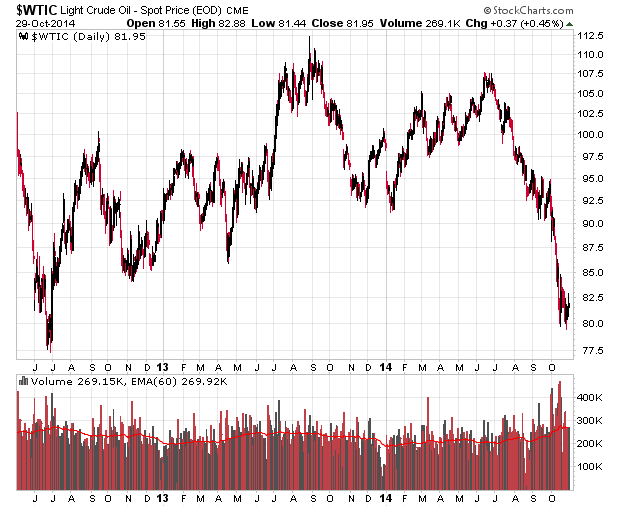
With my very generalized valuation theory on oil and gas producers that “oil prices are a reasonable proxy for company performance plus financial leverage effects”, I note that WTIC (West Texas Intermediate Crude) reached the US$80/barrel level back in June of 2012:

wtic

A very simple theory is that oil and gas producers that are trading below what they were trading in June of 2012 should be given a second look to see what caused their relative dis-valuation from present oil levels. A surprisingly large number of Canadian oil and gas companies are trading well above their June 2012 levels despite the oil price difference.

One reason is simply due to good (or lucky timing!) hedging strategies.

Another is due to the mix of oil (and the different types of oil), transport issues, and the percentage of natural gas and natural gas liquids in the revenue mix of a company – in general, while you aren’t suffering pure hell at US$2.50/GJ back in June 2012, your typical gas driller hasn’t been wildly profitable compared to the good ol’ days back in 2008 when you were at US$10.

There’s also the simple reason of having excessive financial leverage and not being able to finance the corporation at revenues obtained at current prices.

There’s plenty of reasons why an oil and gas company would be trading lower today than in even worse price environments seen in June 2012.

So given everything trading on the TSX, I’ve done some homework as a starting point and gone through the companies with the following criteria:
– Share price over CAD$2
– Market cap over $1 billion
– Not a foreign entity (although they can have foreign operations).
– Trading lower today than they generally were in June 2012.

We have, in descending order of market cap:

CVE.TO
TLM.TO (not that they’ve been having difficulties lately!)
BTE.TO
PWT.TO
PGF.TO
TET.TO
BNP.TO
LTS.TO (I was a prolific writer that commented on its ridiculously high valuation when it was known as Petrobakken).

I note that Canadian Oil Sands (COS.TO) is trading barely above what it was in June 2012. This is probably the most purest equity play on WTIC possible beyond putting money in USO (not advisable).

Any thoughts? Comments appreciated.

Raising cheap debt capital

Cenovus Energy (TSX: CVE) raised $1.25 billion in debt financing today. Here were the relevant terms:

TRANCHE 1
AMT $500 MLN    COUPON 3 PCT       MATURITY     8/15/2022
TYPE NTS        ISS PRICE 99.129   FIRST PAY    2/15/2013
MOODY'S Baa2    YIELD 3.102 PCT    SETTLEMENT   8/17/2012   
S&P BBB-PLUS    SPREAD 137.5 BPS   PAY FREQ    SEMI-ANNUAL
FITCH N/A       MORE THAN TREAS    MAKE-WHOLE CALL 20 BPS
    
TRANCHE 2
AMT $750 MLN    COUPON 4.45 PCT    MATURITY     9/15/2042
TYPE NTS        ISS PRICE 99.782   FIRST PAY    3/15/2013
MOODY'S Baa2    YIELD 4.463 PCT    SETTLEMENT   8/17/2012   
S&P BBB-PLUS    SPREAD 165 BPS     PAY FREQ    SEMI-ANNUAL
FITCH N/A       MORE THAN TREAS    MAKE-WHOLE CALL 25 BPS

So they can raise 10-year money at 3.1% and 30-year money at 4.46%. After taxes (assume 26%) this is about 2.3% and 3.3%, respectively. At these rates, I’d be raising as much 30-year capital as I can and figure out what to do with it later – there has to be a way to deploy it at a better pre-tax return rate of 4.46%.

The easy trade is the dangerous trade

The easy trade these days appears to be in crude oil, and to a lesser degree, commodities.

My trading gut instinct says that the crude market may be a tad overextended at the moment, presumably due to geopolitical instability.

Modern historians should note that Iran and Iraq went through a decade-long war, yet the Persian Gulf still managed to export billions of dollars of crude.

The big shoe to drop is the answer to the question of “What happens in Saudi Arabia?” since they control a significant source of supply globally. That said, it is highly likely that the oil will still flow since whoever is left to control government will still want the cash cow – what will be significantly more disruptive is that the incumbent administration knows it will be kicked out, but has plenty of notice of its pending demise. In this scenario, they will likely use the “scorched earth” option, similar to what Saddam Hussein did in Kuwait prior to the first Iraq invasion.

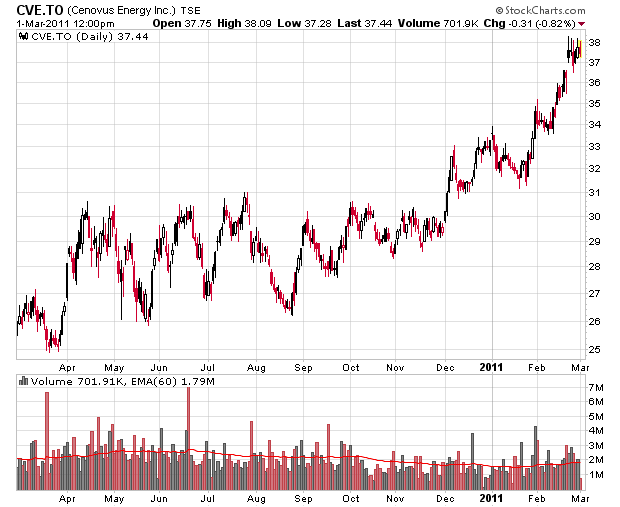
Readers will likely note that their holdings in Canadian oil sands related companies have received a significant amount of appreciation over the past 6 months – partly related due to the market conditions and improving economy. Here is a chart of Cenovus (TSX: CVE), but you can pretty much fill this in with the usual suspects (Suncor, Canadian Natural, etc.):

The last spike up over the past month is a function of higher crude prices and geopolitical instability – I’d estimate of the $6 that it has gone up from $32 to $38, half of that is due to crude, and half of it is implied instability.

That said, it seems like an easy trade to pile in at the moment, so be very cautious – when others think alike, your risk/reward ratio becomes more adverse.