Hussman / S&P 500 and Nasdaq valuations

It takes a certain level of boldness to predict a major market index going down roughly 60%, but John Hussman makes a pretty good case for it.

He also gives considerable input on answering a reader’s potential question of “If the market is over-valued, why hasn’t it been sold off already?” or the correlated question of “What prevents an already over-valued market from becoming even more over-valued?”.

Either way, it looks pretty miserable for large index investors – an investor that is forced to be fully invested in the marketplace would likely be well-advised to hold fixed income securities.

(Update, August 5, 2018: It has been brought to my attention that his flagship fund’s average performance hasn’t exactly been stellar – as of June 30, 2018 his 10-year average return is a negative 6.65%, during one the largest bull markets in history after the economic crisis! Ouch!)

Exchanges, margin rates, Bitcoin

An amusing story about a Bitcoin Exchange auto-liquidating a futures trader that took a bet that was too big – not only did they wipe out their own account, but they managed to take out a bunch of others as well.

Reading the exchange’s press release on the matter, it looks like that they are discovering that allowing clients to take large concentrated positions in single securities may not be the best idea to ensure the stability of the brokerage.

It reminds me when the Swiss national bank decided to no longer support the Swiss Franc at the 1.2 Euro level peg, and then one nanosecond later it crashed through a glass ceiling with such force that it took out FXCM. Bitcoin exchanges are learning the lessons that others have learned – be very careful when allowing your clients to trade on margin as your ability to liquidate their holdings when they hit “the wall” may be imperiled by external market conditions.

Interactive Brokers (Nasdaq: IBKR), by far and away, has the best track record concerning customer usage of margin, but even they took a $120 million haircut during the Swiss Franc re-valuation. Their most recent action was raising margin rates on Tesla, which is somewhat telling.

Imagine being a client of IBKR and seeing an email that because of another customer’s highly leverage bets going bad, that they’re going to be taking away 18% of your accumulated profits to compensate for the exchange’s loss on extending the external customer credit!

US Federal Reserve tightens the noose

The US Federal Reserve, much to nobody’s surprise, raised interest rates another 0.25% for a target rate of 1.75-2.00%.

In the implementation note, they also stated the interest to be paid on bank reserves would be 1.95%, which is a departure from the usual top of the range (2%) by 5 basis points. This will probably pin the effective short-term rate at 1.95% instead of at 2%.

The other news, which is equally not surprising, is an increase in the repurchase amounts of treasury and mortgage-backed securities held by the reserve:

The Committee directs the Desk to continue rolling over at auction the amount of principal payments from the Federal Reserve’s holdings of Treasury securities maturing during June that exceeds $18 billion, and to continue reinvesting in agency mortgage-backed securities the amount of principal payments from the Federal Reserve’s holdings of agency debt and agency mortgage-backed securities received during June that exceeds $12 billion. Effective in July, the Committee directs the Desk to roll over at auction the amount of principal payments from the Federal Reserve’s holdings of Treasury securities maturing during each calendar month that exceeds $24 billion, and to reinvest in agency mortgage-backed securities the amount of principal payments from the Federal Reserve’s holdings of agency debt and agency mortgage-backed securities received during each calendar month that exceeds $16 billion. Small deviations from these amounts for operational reasons are acceptable.

This quota (currently $18 billion in treasuries and $12 billion in mortgage-backed securities per month) has been continually rising every quarter. Now this will be $24 billion and $16 billion per month, respectively.

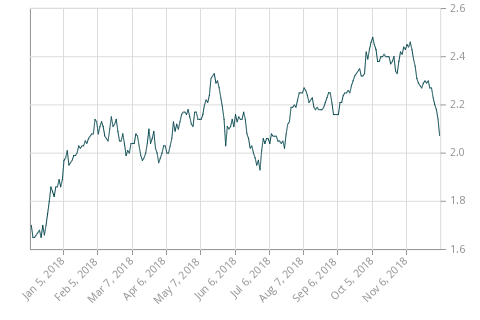
As you can see by very far right-hand side within the chart above, the amounts involved are still a drop in the bucket – between July and September will be another USD$120 billion removed. But the slope of the curve, every quarter, will continue to get steeper and steeper.

Although short-term interest rates are still exceptionally low from a historical perspective, without a doubt the monetary situation is going to create an increasing headwind. This is akin to running on the treadmill and adjusting the elevation from flat to a 1% incline – while the running is still relatively easy, it takes a bit more energy to achieve the same distance. For each increment that the Federal Reserve raises rates, the incline gets higher and higher and eventually you’ll have to stop and catch your breath.

That’s probably the ideal time to invest again. Until then, safety and capital preservation is the name of the game.

Finally, my other comment is that I would view it as more probable than not that the Bank of Canada will match the Federal Reserve’s rate increase on their July 11th meeting.

Holding Pattern

It’s been about three weeks since I’ve written. I’ve read and dissected a billion quarterly reports and now the cycle is mostly done. This time of year is always stressful on time – companies release their annual reports at the end of March and then another quarterly report either at the end of April or the first week or two in May, so there is a lot of reading that has to be done in a relatively short period of time. The most painful part is when I sometimes have to listen to conference calls when transcripts are not available.

Since then I have been on a liquidation spree. My favourite cash parking utility in the public markets (long-time readers here will have a deep suspicion as to what it may be) lately started to trade at a gigantic premium to intrinsic value that I just had to start liquidating – basically investors are pre-paying 7 months’ worth of future dividends on this fixed income instrument (i.e. it is trading at a lofty premium to par value) and I highly suspect it will be a ripe target to get called out by its issuing company (they are paying dividends a good deal higher than their cost of capital if they were to float a bond offering to replace it). So despite the fact that the yield on this was awfully attractive, it had to go for risk concerns.

Another position that was liquidated was a good chunk of my Gran Colombia Gold (TSX: GCM) debentures. I was fortunate enough to cash a good chunk of it out at a premium to par value and convert the rest into stock. I still haven’t decided what I will do with the stock. Financially, the company has made a remarkable turnaround since I invested in the debt early 2016 and basic math suggests that the common shares are undervalued – especially now that the company’s solvency is no longer in doubt because they’ve equitized a good chunk of their debt – US$150 million into what will be US$98 million in August (when TSX: GCM.DB.U auto-converts into stock). The company at that point will have around US$20 million cash in the bank which is no longer encumbered by the cash sweeps mandated by the previous debt holders. The new debt is auto-liquidating, so each year they will pay down about a sixth of the debt principal.

So on paper, in light of the relatively high EBITDAs it is generating, Gran Colombia looks cheap compared to its peer group. One possible explanation is the common stock has been a victim of convertible debt arbitrage and there simply hasn’t been sufficient demand for common shares – this theory will be tested in the upcoming months. The other risk of downside includes being effectively a single mine operation in Colombia, and also the feasibility of future capital expenditures to expand mine growth (I still have a 624 page NI 43-101 to plough through! I’ve prioritized other company quarterly reports before this technical mine report!). GCM is not exactly an unknown company either – other intelligent people have written about this company over the internet and there are various risks to consider which could explain the relatively low share price (especially resentment that equity holders got nearly wiped out in the late 2015 recapitalization).

Besides for this and a few other routine bond maturities (this was just small yield picking on short duration investment grade securities which weren’t worth the research I dumped into them), I’ve raised a lot of cash for future investment. The problem is I have no idea what to invest it in.

I have the highest weighting of cash in the portfolio than I have had in a long, long time. I ended 2015 at +42% cash and percentage cash today is even higher.

I have some marginal investment ideas on queue, but in a rising rate environment the risk one takes is a bit higher. It is nothing like early 2016 when things were being thrown out the window with double digit yields (I do miss those days). However, there are some glimmers of despair and panic out there – I’ve been looking quite closely at pipelines, which are currently the media focus of doom and gloom and all things wrong with society. Pipelines today is what tobacco was in the 90’s.

Physical Fitness, Mental Fitness and Financial Performance

Yesterday, I finished the Vancouver Sun Run, a 10km road running event and the 3rd largest in North America. This year I finished in 54 minutes and 37 seconds, which despite my increasingly older age and having a body mass index higher than ideal, was my lifetime best. A decade ago, I took nearly a minute and a half longer. Other than trying to weave around the masses of people, I find thinking about abstract issues to be a good way to pass the time while in the process of running.

I will make a claim that mental discipline is necessary in order to sustain above-average performance in finance.

You might be able to do well in part of a financial cycle without mental discipline, but eventually all the monolithic dot-com investors in 2000, US real estate in 2007 and presumably now cryptocurrency and marijuana investors that thought (or still think) their investment vehicle was a one-way street to perpetual riches have had to face severe setbacks in their ambitions. In particular, when the market goes south determines whether your mental fortitude breaks and gets you to sell at the bottom, which many equity investors did in 2008 before seeing things rocket up again after February 2009.

Finance is a rare industry on the planet that exhibits inverse demand characteristics in that in many cases, a higher price induces more willing buyers for the product. Conversely, stocks that are trading low (and have downward trajectories) are frequently shunned and less people are interested.

In many cases, the price action is warranted. There is a feedback mechanism where people believe the market price is indicative of the relative fortunes of the underlying companies – basically believing that the crowd is smarter than they are.

One of the greatest tests of mental discipline is having something you buy in the marketplace go south in price. You invest a dollar today in something you think is worth double that. However, you wake up in a day seeing it is now valued at 90 cents. And the next week it goes to 80 cents. If your initial analysis was correct, the obvious and rational decision is to buy more. But there is always an inkling in the back of your head that you can be wrong and the market is clearly making you out to be a sucker. You never know except with the hindsight of retrospect – and then it is always too late.

Mental discipline is all about knowing what to do in these situations. There is no prescriptive formula because all situations are inherently different – it could be the case that your $2 analysis was completely junk. It could be the case that the CFO in the firm was actually cooking the books or the CEO was a complete fraud himself. Or it could be that what is now an 80 cent investment is still truly worth $2 and that future investments are going to be worth 150% of what you paid for instead of 100% at your original cost.

Mental discipline is what allows you to sort this out without making stupid decisions like averaging down to zero or holding excessive concentration. Mental discipline is also what allows you to exit at a loss and not feel the compulsion to “break even”. There are plenty of psychological traps of investing and mental discipline is what allows one to rationally navigate through it all.

Mental discipline is part of being mentally fit – i.e. having the psychological processes set in mind, and consistently reinforced to be able to function in the financial marketplace. Other aspects of being mentally fit include having the proper repertoire of knowledge, including knowing how to read financial statements, understanding businesses, math and statistics, economics, etc. All of this contributes towards mental fitness that makes one a better investor than those that do not have these key aspects of knowledge. Being able to distill all of this acquired information and knowledge and separate what is important from not important is also another critical skill of being mentally fit.

As an example, a conspiracy theory investor that claims that the Federal Reserve is turning the US Dollar into toilet paper and advocating gold will go to US$5,000/Oz in a year is not likely demonstrating a mastery of certain aspects of mental fitness. It should be pointed out, however, that people who are mentally unfit for investing will occasionally be right, but just for the wrong reasons – this is known to be “getting lucky”, or being right for the wrong reasons.

So who do you want managing your money? Presumably somebody that has a high degree of mental fitness.

The problem is that aside from looking at their track record, it is not easy to determine whether the person demonstrates capabilities of being mentally fit – they could have gotten lucky for many years. Reading letters to investors and examining other such soft information gives one insight on the thought processes of investors. Most people in finance read Buffett’s letters and know the type of person that they are placing their faith in. Likewise, anybody reading and listening to Thomas Peterffy, the CEO of Interactive Brokers, will know he is a genius. Prem Watsa of Fairfax is another. All of these people have very long-term track records and it is pretty clear what information they do transmit to the public is just the tip of the iceberg in relation to their overall mental capabilities. Until they get old enough where dementia and other mental afflictions impair their investment capability (particularly in the case of Buffett and Munger who are above the average life expectancy), it can be reasonably inferred that their above-average performance will continue.

But for the rest of the mere mortals in the investing industry, there usually isn’t enough real data to analyze to determine mental fitness beyond the track record. I will claim the track record alone is not a sufficient indicator of financial mental fitness.

I will also claim that mental fitness is greatly assisted by physical fitness, and physical fitness is greatly assisted by mental fitness (and indeed, both of them are correlated and cause each other to occur).

One aspect of physical fitness is that it can be objectively measured. While society looks for quick fixes for everything (fad diets, cosmetic surgery, instant on-demand entertainment, etc.), physical fitness is something that cannot be easily bought or accomplished without actually putting in the individual work and effort to do so. It is also easy to measure – you can swim 100 meters in a certain time, you can run a distance at a certain time, or you can keep your heart rate above a certain rate for a certain length of time, or you weigh so-and-so given your height and gender. All of these physical fitness parameters have result-oriented endpoints that make it easy to measure performance.

Getting to a physical fitness goal means that one has to engage in a process to get there, which requires plenty of mental discipline. Realistic physical fitness goals require a lengthy period of time to achieve – well beyond the “January 1st new year’s resolution to get fit” that a lot of people engage in without a proper plan and the proper mental discipline to execute on a long-term physical fitness program.

There is no way that I can run 10km in 55 minutes without consistently training and applying both mental and physical discipline to doing so throughout the course of a year. If I apply even more discipline and stop eating body-inflating carbohydrates and indulging in foods that I obviously know are not the best for me, I can shave off even more time in my next year’s measured performance. It is not an all-or-nothing proposition – it comes in small, incremental steps. Physical fitness also cannot be faked. Mental discipline is much more difficult to measure in such small increments.

Plenty of psychological literature suggests that exercising will improve mental health.

There is an amplifying positive feedback loop – in order to increase physical fitness, you need the mental fitness to give you the discipline to improve physical fitness. You can get that mental fitness by increasing your physical fitness.

So for anybody that is interested in improving their financial performance without wanting to read any of the academic theory behind financial statements, valuations and trading patterns (all of which would be very helpful), I would recommend they start by improving their physical fitness as a route to building on mental fitness.