Bombardier (TSX: BBD.B) has been on my radar screen since the beginning of the year when the pulled off a secondary offering that was force-fed to the public.
Over the past week I have bought Bombardier’s preferred shares. Specifically I have bought the preferred shares BBD.PR.B and BBD.PR.C, which have somewhat different characteristics.
BBD.PR.B gives out a dividend that is adjusted according to the prime rate given by the various big banks. Right now prime is 2.7% on a $25 par value, so that works out to 67.5 cents per share, paid out in monthly installments. At today’s market value it is trading at a yield of 11.1%. The shares can be converted to BBD.PR.D in August 2017 at a rate that is to be previously declared by management that is a function of the 5-year Government of Canada bond yield. In August 2012 it was 220% of the 5-year bond yield. Generally speaking with bond yields as they are at present I would not expect too much of a fixed premium to be assigned to the conversion.
BBD.PR.C gives out a 6.25% dividend on a par value of $25, so $1.5625/share paid in quarterly installments. At today’s closing price that works out to a 13.1% yield. This series of preferred share can be converted by the company into BBD.B equity at 95% of the closing price of the shares over a pre-determined time span or $2/share, whichever is more.
Both series of preferred shares are cumulative.
So why buy into something so obviously risky? The short story is that this appears to be a high risk / very high reward situation. There are a few reasons to believe that the risk is higher than what the market is perceiving.
On a technical basis, it is clearly obvious that investors have given up on the company. Anybody sitting on the preferred shares since the beginning of the year has lost about half their equity and the same can be said for the common shares. While this is a relatively unscientific comment, sentiment as seen through the stock graph is horrible. The sentiment could get even worse (i.e. go to zero) but despite what most retail financial literature specifies, portfolio returns are highly magnified if you can avoid catastrophic time periods and likely most of Bombardier’s catastrophic period is in the past. Price and volume suggest panic and it is best to invest in a panic situation.
I can’t see people within various pension funds and institutional investors credibly recommending to their investment committees the purchase of Bombardier at this time. The risk has simply gone too high. As a result, the shares (both common and preferred) have cratered. The question at this point is assessing whether sentiment can get worse (resulting in lower prices) or has bottomed.
Operationally and in terms of sentiment, the mass media has focused on the consistent delays on the C-series airplane that is designed to compete against others in the 100-149 person segment. The development of this aircraft continues to cost the company considerable amounts of cash – debt has risen to $9 billion at the end of March 2015 compared to $5.4 billion at the beginning of 2013.
In fairness, the cash balance between those two time periods has also gone up, from $2.6 billion in January 2013 to $4.7 billion in March 2015. The net debt position would be $4.3 billion which is not terrible.
In the last raising of capital, the company forced through a bond offering that functionally extended their nearest term maturity out to 2018. They managed to get a 5.5% coupon on 3.5 year money and 7.5% on 10 year money.
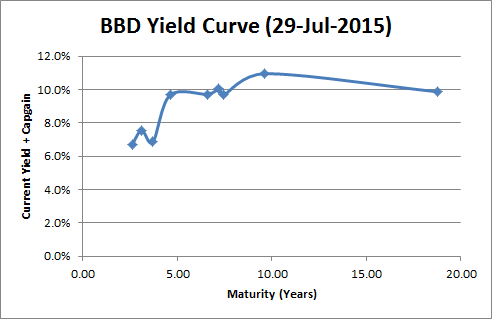
Investors that bought into the 10 year bond would doubtlessly be pleased to know that what they had bought at par is now 83 cents on the dollar (or approximately 11% yield to maturity). The 3.5 year maturity issue last traded at 94.7 cents (or 7.6% YTM).
Their yield curve would still suggest they are not going to be shut out of debt financing.
So they have a couple years to figure things out. Considering they have seemingly gone through a whole host of management changes in the first half of the year, presumably there will be a renewed focus to solve the issues the company is facing. I also do not know of any aircraft projects that were ever delivered on time and budget.
The company has a profitable transportation division which they are planning on bringing public. This would also give the underlying entity a bit more market value than what is being prescribed (a 3.8 billion market cap plus $4.3 billion net debt position gives an enterprise value of approximately $8.1 billion). For a company doing $20 billion a year in revenues, one would pause to think if a more rational valuation were prescribed to the firm on the basis of revenues.
It is likely any recovery in the company would clearly result in equity appreciation for the company, but also as the credit profile improves, preferred shareholders (especially the BBD.PR.B series) would see considerable capital appreciation, nearly in line with the common shares, with the added bonus of the income payments on the side.
If interest rates rise, BBD.PR.B investors would receive a small bonus. I’m not holding on my breath for an increase in interest rates, however. However, I do believe that 0.5% is the lowest the Bank of Canada will go.
There are obvious risks. The chief risk is the company will suspend dividends and the shares would most likely drop to half of what they are trading at presently. The company suspended dividends on common shares earlier this year and may decide to drop preferred share dividends as they constitute a cash drain of CAD$23 million/year that they would want to otherwise save. They can also save half of this by converting the BBD.PR.C series into equity, a decision that I doubt they would make (they would rather suspend the dividend instead).
There are two good reasons why they won’t: they would likely compromise their ability to access the bond market, and the controlling family (that owns a majority of the votes in the corporation) would lose one more element of the privilege of controlling who is on the board of directors: declaring common share dividends. It does not seem likely at this time that they will suspend dividends unless if things get worse than present. There are other issues concerning the control issue that I will not write about in this post.
There are other positive and negative catalysts, most of which are not being priced into the market. I won’t go into those.
I have omitted a lot of the analysis (including the relationship between the various world governments and Bombardier), but I have written several elements to consider. While I am not too interested in the common shares, the preferred shares do give me interest, thus my purchase. This is not for the faint of heart – this is a high risk investment. If a stabilization comes to fruition and Bombardier manages to plod along, the preferred shareholders are good and will be earning significant income for the indefinite future.