When will Cenovus or CNQ buy out MEG Energy?

MEG Energy (TSX: MEG) is an oil sands producing company with a very good asset – it occupies a prime bitumen producing location at Christina Lake, Alberta. The type of mining is the typical steam-assisted gravity drainage project that, one you put in the required capital expenditures and intellectual prowess, has a relatively low rate of decay. It will produce for decades.

Geographically speaking, the company is out of options. There’s little in the way of synergies as they are surrounded by Cenovus and CNQ’s properties. There isn’t much of a choice beyond optimizing the primary asset they own (which is very valuable) and generate cash. The asset will be producing for decades.

They are properly capitalized – approximately US$2.3 billion in debt securities, with maturities on 2025, 2027 and 2029, in addition to an undrawn credit facility. They made some (retrospectively) stupid hedges on WTI which will cost them a few hundred million in lost opportunity costs in 2021 (approximately a third of their production is hedged at US$46 WTI), but they claim this was to fund the existing year’s capital budget in the event that crude crashed. CEO Derek Evans was formerly the CEO of Pengrowth Energy, and the only reason why Pengrowth lasted as long as it did before it was unceremoniously bought out for 5 cents a share was because they hedged a ton of production before oil prices tanked.

After Line 3 and TMX become operational, egress issues will likely subside and at current prices, they will be generating a significant amount of cash. While they do not give out dividends at present, it probably won’t make much difference in the end equation – they are likely to get consolidated by one of the two in the title of this post.

Notably, MEG rejected a hostile takeover from Husky in 2018 (which was offered at a higher price). From a strategic perspective, Cenovus (which took over Husky at the beginning of this year) would make the most amount of sense – they would own the majority of the bitmuen complex around Christina Lake. They have been busy digesting the Husky merger, but there’s probably ample room for a stock swap. MEG at the end of December 31, 2020 also had a $5.1 billion non-capital loss carryforward, so this would survive a merger and constitute a non-trivial tax asset for an acquirer.

This analysis is by no way a secret – they have been a logical target for ages. We will see.
Rocket Lab SPAC

Vector Acquisition Corporation (VACQ) is a SPAC that has an agreement to merge with Rocket Lab.

Rocket Lab is SpaceX’s number one private competitor, but it has several competitive disadvantages. One is that Rocket Lab’s product offerings do not include heavy launches. The other is that their rockets do not land by themselves (although they are reusable to a certain extent).

As such they are receiving a valuation of much less than SpaceX’s private placement valuation (SpaceX was estimated to be around $70 billion). Rocket Lab’s enterprise value was estimated to be around $4 billion.

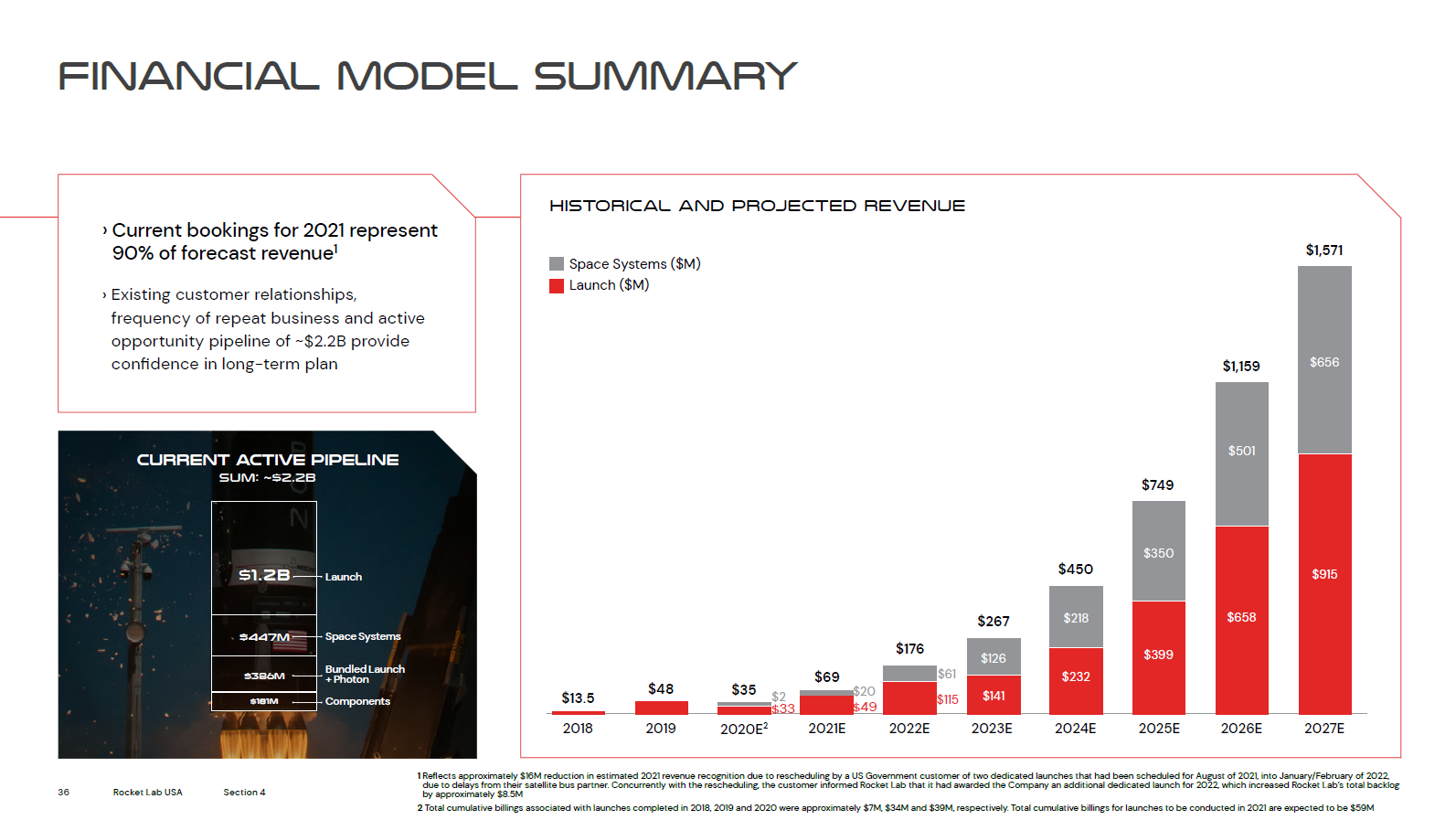
The revenues scale accordingly – Rocket Lab estimates around $70 million in 2021, while SpaceX is reported to be around $2 billion in 2019.

Just like most SPACs, they promise a quadratic increase in revenues:

If I had a nickel for every SPAC that promised such a revenue trajectory… I’d be richer than had I invested in these SPACs!

Space launch systems are very capital intensive and there is a certain economy of scale that is required to do this successfully. Blue Origin (Jeff Bezos’ firm) is another competitive in this domain (and of note, they have seemingly failed to get that point of scale). It could entirely be the case that the launch for small satellites (especially constellations of micro-satellites) is a competitive space where no firm will receive outsized profits – instead, the profitability will be through differentiation and also cost controls (SpaceX’s landable rockets would likely give them a cost edge over competitors at present). The differentiation will most certainly be with maximum launch capacity – there is only so much you can do with weight limitations on satellites.

The other component of competitive advantage in space is government relations. They are a significant source of revenue, especially in the military domain. Nobody is better in GR than Elon Musk.

I’ll be watching this one, but at the offering price I’m not interested. SpaceX receives a premium valuation for very good reasons.

Bye-bye FLIR

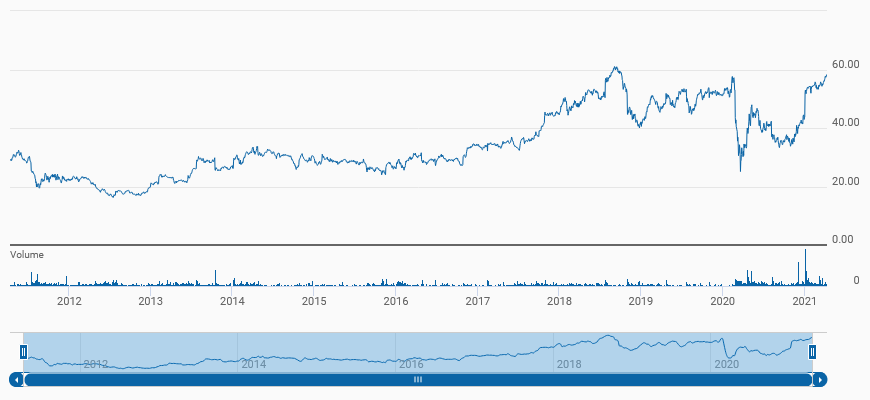
I unloaded my FLIR (Nasdaq: FLIR) today at US$58.25/share. Past 10 year chart for reference before the company disappears this quarter:

I’ve been stalking this company for ages. I originally did a very short post on it from July 2011, but never got around to purchasing the stock until the Covid crisis in April 2020.

I wrote about the Teledyne acquisition here which occurred at the beginning of the new year.

I am not typically a large-cap S&P 500 company investor. I make rare exceptions now and then, but for the most part I prefer the smallcap space. FLIR investors will receive 0.0718 shares of Teledyne per FLIR share and US$28 in cash. Teledyne has had an excellent track history of integration acquisitions, although their style of acquisitions have been bolt-on and tuck-ins, and FLIR is a mammoth acquisition for them, the largest in their history. I don’t know if they can execute, although strategically given their product portfolio, it makes sense. Financially, TDY is expensive, but they are also in a business domain that is relatively stable and should continue producing stable cash flows going forward. They will also be a positive recipient of passive index money from the S&P 500 (a larger fraction given how their market capitalization will increase post-merger). But that said, they are too large for me, and hence my decision to eliminate them from my portfolio. I paid about a 30 cent merger arbitrage spread (or about 0.5%) which worked out much better than Atlantic Power!

There few decent alternatives for re-investing at the moment. I am feeling quite conflicted about things in the market, so I continue to reduce exposure.

1 Year Losers

About a year ago was the bottom of the COVID-19 market crash (March 23, 2020). It was a very fateful day where the maximum amount of margin selling hit the street and prices were at their lowest.

So it is instructive to run a stock screen and find out which stocks have NOT risen over the past year. We get the following (I’ve limited it to those with a market cap of above $50 million):

Over 50% loss:
Just Energy – JE (they’re still trading in the USA for US$1.78 a share, but in today’s topsy-turvy world where Hertz is still over a dollar, maybe bankruptcy will be good for their common stock!)
Medipharm – LABS
Calfrac Well – CFW
BELLUS Health – BLU

30-50% loss:
Helix BioPharma – HBP
AKITA Drilling – AKT.b
Aptose Biosciences – APS
Oryx Petroleum – FORZ
Wall Financial – WFC

20-30% loss:
None

10-20% loss:
Nighthawk Gold – NHK
Patriot One – PAT
Morguard – MRC
Transat – TRZ
Postmedia – PNC.b
Shore Gold – DIAM
Noranda Income Fund – NIF.UN
Resverlogix – RVX
Tetra Bio Pharma – TBP

0-10% loss:
Trilogy International – TRL
Currency Exchange – CXI
VIVO Cannabis – VIVO
Knight Therapeutics – GUD
Metro – MRU
Aurinia Pharma – AUP
Invesque – IVQ.u
Loblaw – L

Casual observations

A lot of biotechs in the list, and then seconded by some oil drillers.

The names that stick out at me are Morguard (perennially trading well under book), but this is not my typical type of investment. There might be a time for them to shine once again – when you mention “perpetually trading under book value”, E-L Financial comes to mind (TSX: ELF) and even they have received a tailwind recently. I also note two of the major grocery chains are on this list (albeit with minor amounts of changes for the year), but these companies are well known, well valued and quite frankly not interesting. In the smallcap realm, Currency Exchange is a very odd business which got my attention during COVID as a travel recovery stock, but for various reasons I declined to pursue it.

A bird in the hand vs. two in the bush – Atlantic Power

“Bittersweet” is the word I used to describe the acquisition of Atlantic Power (TSX: ATP), and also the words that James Moore used as well in his conference call.

“Bittersweet” is also the word I’m going to use to describe my exit out of the stock yesterday.

I did not view the chances of a higher bid to be likely and I should have pounded my shares out of the exit a couple days after the merger was announced (which got up to a high of US$3.06, compared to the proposed cash acquisition of US$3.03 – this was on January 20th and the merger announcement was on the evening of January 14th). Instead, I took a ~5% hit from the proposed price and paid a fairly hefty merger arbitrage spread.

The reason was simple – they announced they received 90% of the medium term note holders’ consents for the merger, but the following paragraph was in yesterday’s press release:

Atlantic Power also announced today that the meeting (the “Debentureholder Meeting”) of holders (“Debentureholders”) of its 6.00% Series E convertible unsecured subordinated debentures due January 31, 2025 initially scheduled to be held on March 18, 2021 at 10:00 a.m. ( Toronto time) is being adjourned to Wednesday, April 7, 2021 at 12:00 p.m. ( Toronto time) to allow additional time to solicit proxies.

This is not good news.

All parts of the capital structure require a 2/3rds vote to approve the merger. Quorum is 25%, which should not be the limiting constraint at this point.

If proxies were received that already expressed approval for the merger to that quantity, the meeting would have been held and one more hoop would have been jumped through for merger completion. It is a virtual guarantee that an insufficient number of votes or an insufficient number of affirmative votes has been received to date.

If they held the meeting and did not receive the 2/3rds supermajority, the vote would have failed and the merger would have to been renegotiated (which leads to all sorts of other risks).

The adjournment of this vote does not bode well for the overall merger.

We do not know how many votes have been received in favour or against.

The risk has been elevated significantly leading up to the April 7th shareholder vote.

Although iSquared is raising debt financing in preparation for the merger, if the entire capital structure of Atlantic Power does not go along with this, iSquared has the right to terminate the merger.

This will most certainly involve the common shares trading back down to the US$2.00-$2.20 level (and the preferred shareholders will most certainly head down to around the $17-18 level).

Just imagine you are the management of the company and the merger fails due to a negative vote. Mentally, you’ve already checked out and are preparing to transition out of the company. Instead, your shareholders (or possibly in this case, your debtholders) have blocked your exit. What do you do? It’s not an easy position to be in. You can sell your stake in the company (Moore owns more than a million shares and was prepared to receive a significant golden parachute) and get out of there. Another option is staying on board and just keep status quo and clipping paycheques while the stock languishes.

Another possibility is that iSquared will pay off the debentureholders. Indeed, given how ATP.DB.E is virtually guaranteed to get paid out no matter what happens (maturity is January 2025), why not be a pain in the ass and ask for more?

I’d estimate the risk of a failed vote happening to be about 20% at present. Not too high, but enough for me to punch out the clock and take the bird in the hand rather than two in the bush. To say the least, this has been a sloppy exit, but at least the rapidly depreciating cash that is sitting in the account will eventually find a better home.