Raising cheap debt capital

Cenovus Energy (TSX: CVE) raised $1.25 billion in debt financing today. Here were the relevant terms:

TRANCHE 1
AMT $500 MLN    COUPON 3 PCT       MATURITY     8/15/2022
TYPE NTS        ISS PRICE 99.129   FIRST PAY    2/15/2013
MOODY'S Baa2    YIELD 3.102 PCT    SETTLEMENT   8/17/2012   
S&P BBB-PLUS    SPREAD 137.5 BPS   PAY FREQ    SEMI-ANNUAL
FITCH N/A       MORE THAN TREAS    MAKE-WHOLE CALL 20 BPS
    
TRANCHE 2
AMT $750 MLN    COUPON 4.45 PCT    MATURITY     9/15/2042
TYPE NTS        ISS PRICE 99.782   FIRST PAY    3/15/2013
MOODY'S Baa2    YIELD 4.463 PCT    SETTLEMENT   8/17/2012   
S&P BBB-PLUS    SPREAD 165 BPS     PAY FREQ    SEMI-ANNUAL
FITCH N/A       MORE THAN TREAS    MAKE-WHOLE CALL 25 BPS

So they can raise 10-year money at 3.1% and 30-year money at 4.46%. After taxes (assume 26%) this is about 2.3% and 3.3%, respectively. At these rates, I’d be raising as much 30-year capital as I can and figure out what to do with it later – there has to be a way to deploy it at a better pre-tax return rate of 4.46%.
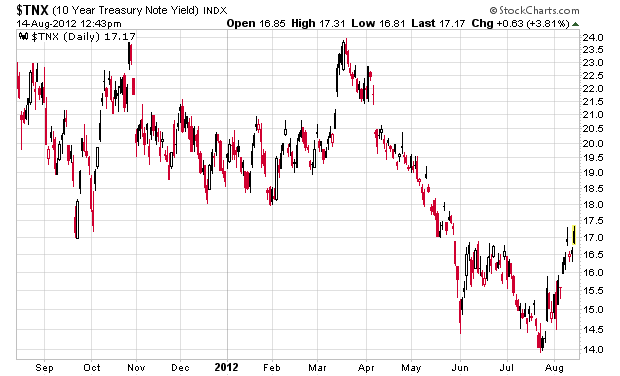
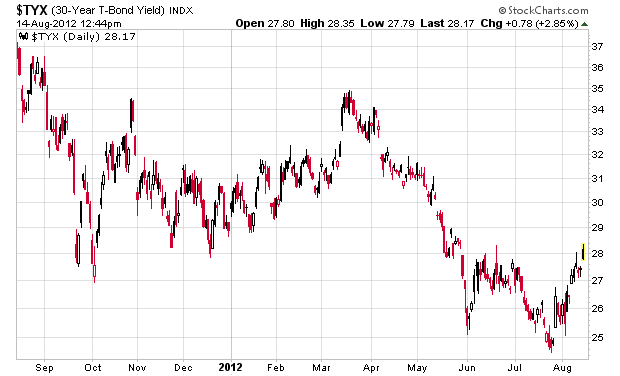
Long term bond yields – creeping up

The following is a chart of the US Government 10-year and 30-year bond yield to maturity:

Up about 0.3% from their yield lows, which is fairly significant. Now the $64,000 question is: Is this just a short squeeze, or do yields shoot higher from present?

Canadian yield scan

The market for high-yielding products continues to dwindle as anything with a yield has been bidded up to the roof, and the products remaining with a yield have qualities that warrant them trading as such. The following is a comprehensive list of convertible debentures that have a yield to maturity of 8% or above:

Company Ticker Coupon Date Term Price YieldToMaturity
Yellow Media Inc YLO.DB.A 6.25% 1-Oct-17          5.6 12.1 70.00%
Perpetual Energy PMT.DB.D 7.25% 31-Jan-15          2.9 75.75 18.40%
Perpetual Energy PMT.DB.E 7.00% 31-Dec-15          3.8 73.75 16.54%
Armtec Infrastructure ARF.DB 6.50% 30-Jun-17          5.3 70 14.85%
Boyuan Construction BOY.DB.A 10.00% 31-Oct-15          3.7 87 14.72%
Tree Island Wire TIL.DB 10.00% 26-Nov-14          2.7 90 14.57%
Perpetual Energy PMT.DB.C 6.50% 30-Jun-12          0.3 98 12.99%
Royal Host REIT RYL.DB.B 6.00% 31-Oct-15          3.7 81.5 12.46%
Royal Host REIT RYL.DB.D 5.90% 30-Jun-14          2.3 88.1 11.93%
Ivanhoe Energy IE.DB 5.75% 30-Jun-16          4.3 80.5 11.62%
Lanesbourough REIT LRT.DB.G 9.50% 28-Feb-15          3.0 95 11.53%
Royal Host REIT RYL.DB.C 6.25% 30-Sep-13          1.6 92.64 11.52%
Data Group DGI.DB.A 6.00% 30-Jun-17          5.3 82.5 10.36%
Altus Group AIF.DB 5.75% 31-Dec-17          5.8 81.25 10.09%
Gen Donlee Income GDI.DB 7.00% 30-Jun-14          2.3 94 9.96%
Brigus Gold Corp. BRD.DB.U 6.50% 31-Mar-16          4.1 90.01 9.52%
Clearwater Seafoods CLR.DB.B 10.50% 31-Dec-13          1.8 102 9.26%
Discovery Air DA.DB.A 8.38% 30-Jun-16          4.3 98.5 8.79%
Superior Plus SPB.DB.E 5.75% 30-Jun-17          5.3 88 8.61%
GreatBasin Gold GBG.DB 8.00% 30-Nov-14          2.7 98.85 8.47%
Superior Plus SPB.DB.F 6.00% 30-Jun-18          6.3 88.55 8.37%
Anderson Energy AXL.DB.B 7.25% 30-Jun-17          5.3 97 8.07%

Suffice to say, most of these companies have “issues” pertaining to the solvency of the underlying entity. They were also trading much lower during the mini-credit crisis back in October-November; for example, Data Group and Superior Plus, which are both cash-producing entities, were trading 25 cents on the dollar lower.

I don’t need to say anything about Yellow Media, which also makes money. Perpetual Energy has positive cash flow, but being in the oil and gas industry, has tremendous capital investment requirements and has debt ratios that is not terribly favourable to the subordinated debt holders.

30-year treasury bonds

I am so tempted to short 30-year bonds right now. I might soon.

There are a few ways to represent this position:

1. Short bond futures (CME) – this is the world’s most liquid proxy to treasury bonds (other than dealing with the underlying product directly!). It has the advantages of liquidity and dealing strictly with the capital and not income component of the bond.

2. Purchase/short a liquid ETF that deals with long-term treasuries. There are a few to choose from:

– iShares 20-year+ government bond fund (TLT) – MER is 0.15%; average term of bond is 27.8 years – fund is highly liquid and shortable;
– Proshares Ultra/short (2x) 20-year+ (UBT/TBT) – MER is 0.95%; linked to TLT performance above as basis index. UBT is not very liquid, while TBT is very liquid.

ETFs have the advantage of being tradable in smaller amounts than futures (Future contracts are for $100,000 face value of product, which currently trade around 142% of par for the June contract). Futures typically have a spread advantage ($31.25 per $142,000 notional value), but liquid ETFs such as TLT have typically had penny spreads, resulting in comparable slippage. As previously mentioned the futures have an advantage with stripping the income-related aspects of the bond, and also tax advantages (both in the USA and Canada).

Slight tightening of mortgage credit

I notice that the local credit union, which used to offer prime minus 0.9% (equating to 2.1%) floating rate is now at prime minus 0.3% (2.7%).

The only conclusion that one can make is that retail credit is somewhat tightening and/or banks are getting concerned about their leverage linked to the real estate market. You wouldn’t see this in government debt rates – 1 year treasuries in Canada yield 0.90%. Five-year government bonds yield 1.35% and the best five-year mortgage rate you can find in Canada is about 3.19%.

Given the difference between the two (prime minus 0.3% versus 3.19% fixed), combined with the (albeit unlikely) potential for an interest rate spike would suggest that paying the half-percent spread for a five-year lock would be well-spent insurance money.

That said, anything around the 3% range is historically very, very, very low and would explain the high prices in the real estate market.