Thoughts on Canadian preferred shares (Reply)

Chris posted a comment with the following question:

Do you have any thoughts on Canadian Pref shares? I’m watching a few for potential multi-year hold.

I asked for his thoughts first, and he replied:

I’m seeing a few yielding around 7% (taxed as dividend), with resets 3 to 4 years out. I can’t predict where they 5 year bond will be at that time, nor can I pick the bottom on these moves, but 7% for a few years followed by a reset at 5 year bond + 2.9% (based on $25, as you know) seems like a decent place to put some longer term money to work. BAM.PF.A is an example. Prefs are a bit outside my wheelhouse, but it seems that they present an opportunity every now and then. Thanks for any insight.

I forgot to mention that Brookfield has been buying back some of their prefs in the open market recently.

Chris – One thought is fairly obvious and you touched upon – those 5 year rate resets are awfully sensitive to the bond yield!
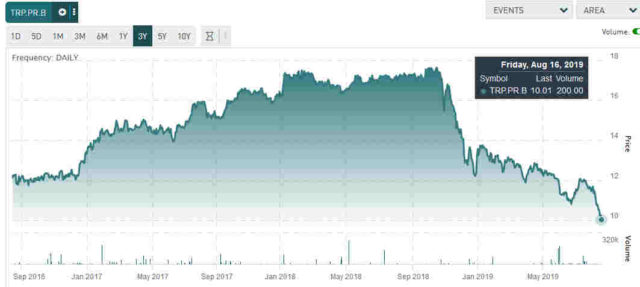
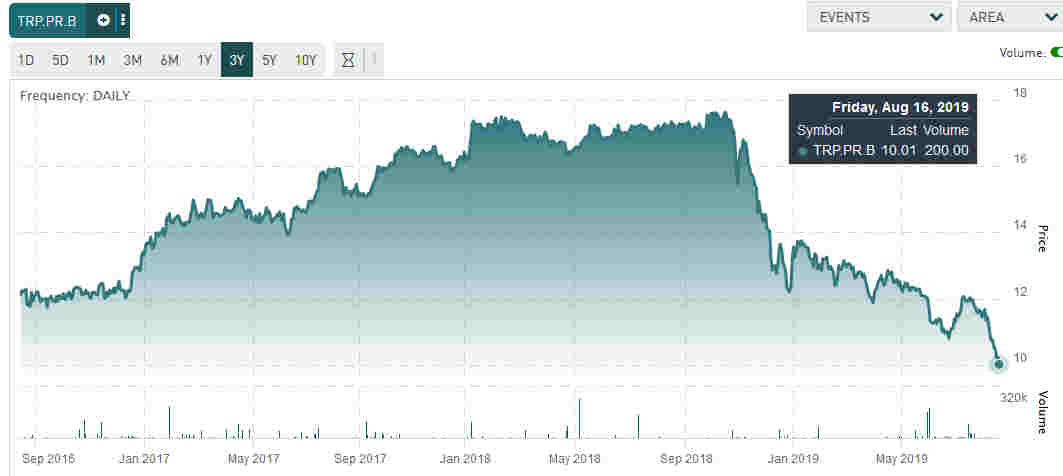
Example (above): TRP.PR.B (current coupon 2.152%, resets at 1.28% above 5yr, the reset is June 2020) – an investor since October 2018 will have lost 45% of their capital to date (when the 5yr yield was roughly 240bps)! That’s very heavy, and a double-whammy because the equity from October 2018 to present has gone up! Normally you’d expect capital gains/losses for preferred shares to be muted to the equity. The company itself hasn’t materially changed in credit profile.

Currently the 5yr government yield is 121bps – at present rates you’ll get a reset at 6.2%, but you can be sure if 5yr yields go down to 60bps (which is conceivable and mirrors the lows a few years back) TRP.PR.B will be trading at around $7.60-ish, all things being equal, or almost another 25% of capital loss!

There also appears to be a law of dividing by small numbers effect going on. Let me illustrate with an example – pretend something yields 3% at present. Going from 3.0% to 2.5% is a 17% difference. Going from 2.5% to 2.0% is an 20% difference. Going from 2.0% to 1.5% is a 25% difference – low-rate reset preferred shares such as TRP.PR.B are getting absolutely killed because of the small denominator.

So if you want to take your 6-7% coupons and run with them, you need to take into consideration that there’s a good chance that you won’t be able to unlock the capital without taking losses, and ultimately you want to eventually see a day where interest rates are higher than when you initially purchased the preferred securities – who knows if/when this will be?

Hence, those 5 year rate resets are much more risky than people probably thought – they have been wildly volatile in the past five years.

You can dampen the risk by buying rate resets that are further out in time (e.g. resetting 3, 4 years from now) but they still trade quite sensitively to the overall 5yr government bond rate. Fixed rate (straight) preferreds are another option (albeit with different rate sensitivity). Most minimum-rate guaranteed preferreds trade very expensive (e.g. PPL.PR.K).

Of course if you anticipate 5yr government rates will increase, the inverse of the above scenario applies (i.e. potential for significant capital gains).

With the US Fed anticipated to drop short term rates, there’s a good chance Canada will be following to some extent and this will continue to depress the entire yield curve. I’m not offering an opinion on future rates, but the trend clearly has been negative (i.e. bias towards lowering rates) since the beginning of the year.

Another comment I will make is that I’ve generally noticed equity presents a much more attractive risk/reward than the preferred shares in a lot of issuers. If you’re just buying for income, why not just buy equities that give out nearly the same yield with a lot more potential for upside (including dividend increases)?

Also, I have not seen another asset class that is so ripe for tax-loss selling. If you were sitting on a 45% loss on TRP.PR.B but really wanted the exposure, I’d sell it and buy something very related instead (e.g. TRP.PR.C) and this avoids the 30-day wash sale rule.

So to conclude, there appears to be quite an element of risk unless if you’re planning on holding these securities strictly for income for a considerable period of time.
Create your own Canadian energy index fund

The following is a list of all TSX-traded companies in the energy production sector that have a market capitalization of greater than CAD$1 billion. There are only 20 left. There are only 29 remaining between CAD$100 million and $1 billion. Some of them are not even domestic producers. Included are my VERY pithy notes.

Keep in mind that “profitable” here is a general and not strict description. Accounting (IFRS/GAAP) profitability may vary wildly with the colloquial notion of ‘profitability’, which is “can this company get more cash than it has to dump into its own production?”.

Out of the 20 companies:
* 6 are majority foreign operations (in descending market cap rank order: ECA, VET, PXT, EFR, CNU, FEC)
* 2 are royalty operations (PSK, FRU); similar to gold royalty companies, inherently there is nothing wrong with this, other than that these companies don’t have to directly incur much of the burden facing the rest of the industry at present
* 5 have some foreign operations, including SU (small), CNQ (small), HSE (small), CPG (~25%) and BTE (~40%).

Effectively, this leaves 12 majority-Canadian producers to invest in.

As a side note for Canadian nationalism, the “purest” operating Canadian oil major (no substantive operations outside of Canada) is Imperial Oil, but it is 69.6% owned by Exxon. Husky is majority controlled by Hong Kong finance titan Li Ka-shing. This leaves 10 firms left to invest in if you wish to exclude IMO and HSE because of their majority foreign-held ownership.

TSX Oil/Gas producers over $1 billion market cap

NameTickerMktCap ($Mil)Notes
Suncor Energy Inc.SU64,001Profitable
Canadian Natural Resources LimitedCNQ42,081Profitable
Imperial Oil LimitedIMO27,763Profitable
Cenovus Energy Inc.CVE14,192Profitable
Husky Energy Inc.HSE13,099Profitable; FCF mildly positive
Encana CorporationECA9,714Profitable; Majority USA
Tourmaline Oil Corp.TOU4,538Profitable; FCF mildly positive
Vermilion Energy Inc.VET4,407Profitable; mainly Europe operator
PrairieSky Royalty Ltd.PSK4,299Royalty Company
Parex Resources Inc.PXT3,072Profitable; Colombia operator
Crescent Point Energy Corp.CPG2,370Profitable; FCF mildly positive; 1/4 US ops
Enerplus CorporationERF2,306Mostly USA; FCF neutral
CNOOC LimitedCNU2,299China
Seven Generations Energy Ltd.VII2,269FCF mildly negative
ARC Resources Ltd.ARX2,268FCF negative (neutral w/o dividend)
Whitecap Resources Inc.WCP1,754FCF positive
MEG Energy Corp.MEG1,490FCF positive; fairly high debt
Frontera Energy CorporationFEC1,331LatAm producer
Baytex Energy Corp.BTE1,13040% Texas; FCF positive
Freehold Royalties Ltd.FRU1,003Royalty Company
Market Cap as of June 30, 2019.
 
Other notes

Just by eyeballing the valuations, a very passive investor could do far worse than just sticking their money in an equal-weighted fund of the top-five or top-ten and just sitting on it. Again, my “paper napkin valuation” is just that – a paper napkin take which ignores the quality (or lack thereof) of assets, or hedging portfolios, etc., but a 100,000 foot-above-the-sky valuation metric is instructive:

Looking at Suncor, they have operating earnings, plus depreciation, minus CapEx, minus CASH taxes and interest of $3.9 billion for the half-year. That’s about $2.50/share. It’s not as if they’re over-leveraged either – debt is about $15 billion. Considering they’re trading at CAD$38/share, they look cheap on immediate glance (multiple 7.6x). Management clearly thinks so as well considering they’ve been buying back shares like crazy.

CNQ’s 1H number is $2.9 billion, or $2.45/share. They’re slightly more leveraged ($24 billion in debt) but probably because they scooped up Devon Energy’s assets adjacent next to theirs in Alberta. Stock trades at CAD$32/share and the multiple is 6.5x.

The other top five, relatively speaking, look pretty cheap. CVE generated about $1.1 billion in free cash for the first half of the year (93 cents a share) which in relation to its $11.28 stock price, is a 6.1x multiple – they slashed their dividend earlier and have been using the money to pay down debt, which sits at around $7.1 billion and management has not made it a secret that they want it to get to around $5 billion. This should happen sometime in 2020.

What’s the danger in a broad-based index investment in these names? Commodity prices going down, and a continued hostile government environment for continued production. There’s going to be a lot of money on the sidelines awaiting the result of the upcoming federal election.

Re-visiting Canadian preferred shares

Back on June 24, 2019 I put a notification out that Canadian preferred shares were looking interesting, but really flubbed with the timing. At the time 5-year government bond yields were 20 basis points less than today.

Sadly my sense of market timing let me down and I was only able to procure a 1% position in a rock-solid issuer’s preferred shares. Too bad – was looking at deploying a significant amount of cash there but this one got away from me. Early June perhaps was the time to get in.

It’s pretty obvious a bunch of institutional money stampeded into the market and this gets bubbled into algorithmic purchases of these securities, which typically have quite large spreads.

In general, however, I do note that physical infrastructure preferred shares (e.g. energy, Brookfield, etc.) exhibited a much higher price increase than financials – the typical rise for a physical infrastructure preferred share trading at 2/3rds of par value has been around a dollar, while the financials have had about half of it. In most instances, securities trading with “minimum rate resets” have been ridiculously overpriced, but there was one that looked reasonably attractive for “boring capital”.

If 5 year yields drop again we could see prices on preferred shares drop again – I’d welcome it. In the meantime I’ll look elsewhere.

Canadian natural gas producers

I have taken a small equity position (roughly 2.5% each) in two Canadian natural gas producers. I’ve exhaustively looked at the (not obviously insolvent) producers that are at least 75% natural gas boe equivalent and chosen the two companies I’ve deemed ‘best’ in lieu of just making a home-brew index of all of them.

This is not a particular call on the natural gas industry in general – right now the economics are absolutely horrible for Canada. There have been some days where spot pricing has been such that you have to pay to give away your natural gas! The federal government is hell-bent on destroying the fossil fuel industry. The USA has shale gas coming out of their… well, you know. There’s no hope and only despair!

Sounds like a good time to invest.

However, run the thought experiment on every company you look at: “Let’s pretend you could acquire 100% of the company’s equity for ZERO, but had to take a personal guarantee on their outstanding debt. Would you take them over?”

Under the right conditions, a lot of these companies will double, triple or even quadruple their equity prices. The timing is unclear, but we will see. I remember getting into oil and gas for a short-lived foray in 2014 that exhibited a colossal amount of stupidity, but will this time be different?

More cash parking options

I’ve written a lot about some cash parking options – whether they are short-term bond ETFs, or short-duration target-maturity ETFs. Interactive Brokers currently gives out 111bps on Canadian cash, but there are higher yielding options with less risk.

I’ve discovered another vessel for cash parking: a high interest savings ETF (TSX: PSA), which simply invests in cash accounts held at credible financial institutions (National Bank, Scotia, Manulife, and some BC credit unions). They give out a net yield of about 2% (215bps minus 15bps expenses) with zero duration risk, and this is paid out monthly. There is a market maker which keeps transaction spreads to a penny at ample levels of liquidity.

Even VSB.TO (Vanguard’s short term bond ETF) has a YTM of 190bps and an MER of 10bps, plus you take the 2.6 year duration risk if interest rates change.

I’m surprised I haven’t encountered the zero-duration option (aside from cold hard cash) before.

I’ve recently sold out what used to be my largest position and I’ve once again found deployment of cash to be a pleasant, yet annoying problem. Future returns are likely to be muted by the levels of cash in the portfolio.