Entertainment purposes only – Nasdaq
A week ago I posted this speculation:
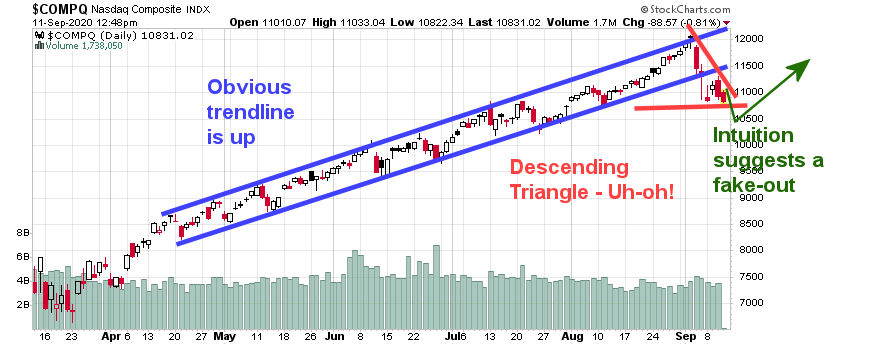
Today, it’s basically a continuation of this. My guess is that there will be a “flush”, a pretty significant one under that red line, will occur (let’s say to around 9800-9900). Especially in light of the president election dominating the course of the next couple months, prepare for a wild ride!
Again, a caution: this post is purely for entertainment value. My capital is far from these high-flyers that dominate the index (in rank order, Apple, Microsoft, Amazon, Facebook, Tesla, Google, Nvidia, Adobe, Paypal, Netflix).
Leverage and “assured safety” doesn’t end up well
BMO and its advisors are getting sued by clients. In the article, it claims the advisor in question in 2017 and the first half of 2018 traded on behalf of clients a leveraged short treasury, long preferred share strategy.
Both client groups allege that throughout 2017 and the first half of 2018, Mr. Liu recommended a new investment strategy that “assured safety” of their principal and provided “reasonable” investment returns.
Shortly after, clients allege they were instead placed in a high-risk strategy that involved short-selling bonds – particularly Canadian government bonds – to purchase long positions in preferred shares, many of which had variable rates or rates that reset based on interest rate movement.
According to court documents, Mr. Liu further advised the clients to begin trading on margin – investing using borrowed money – in order to purchase a larger amount of preferred shares. In some instances, clients allege Mr. Liu engaged in this strategy without informing them or seeking their permission.
I’d love to read the court documents.
I’m guessing the pitch was that you could borrow around 1.5-2.0% (short treasuries) and re-invest the proceeds in (relatively high quality rate reset) preferred shares yielding around 5-5.5%. Just throw in some cash and we can leverage this thing 5:1 and earn you a cool 15% return on equity. Sounds great!
Canada’s 5 year bonds in the first half of 2017 spent most of their time around 100-125bps, and the second half around 150-175bps. In the first half of 2018, they were at 200-225bps. So this pair of the trade would have surely lost money, but it would have been more than offset by appreciation of the preferred shares. In fact, during 2017, the trade would have looked really good and I would not be shocked if clients added more money to it:

The second leg of the trade (preferred shares) didn’t do that badly until about the fourth quarter of 2018, where preferred shares lost about 15% of their capital value. The bonds during this time would have appreciated somewhat, but depending on the amount of leverage employed, the trade would have been a significantly losing one. By the third quarter of 2019, the preferred shares would have declined another 10%.
I’m guessing it would have been after the 4th quarter in 2018 that clients came asking why they were seeing negative returns in their accounts. “Oh, don’t worry, these are normal market fluctuations, just look at the yields you’re getting!”. By the time the third quarter in 2019 came along, it looks like client losses would have been another 10% times whatever leverage factor they engaged in.
Back in June 2019 I mused about this, but it looks like others actually engaged in this trade, which is a classic example of leveraged yield chasing! It rarely ends up well unless if you close out the trade when you least want to – when the trade is working.
Negative interest rates in Canada?
Do you think negative interest rates would ever be implemented in Canada?
My opinion (and realize that the error bars are huge with this response):
Not yet.
For instance, there would be a pretty good legal case to be made that Sections 18(l), (l.1) and (l.2) of the Bank of Canada Act would have to be amended since, for example, it only authorizes the Bank of Canada to pay interest on deposits, not charge banks for such deposits. Changing the legislation requires parliamentary approval, and such a decision would likely not obtain unanimous consent. This would mean there would be at least a week of debate on the matter, assuming a majority government forced time allocation on such legislation, coupled with senate approval. Let’s just say with the current political environment in Canada, co-operation in Parliament is not too likely at the moment.
I am not a lawyer. I could be wrong. However, I have not seen this particular clause in the Bank of Canada Act mentioned by any commentators on hypothetical negative interest rates in Canada – i.e. whether the Bank of Canada actually has the authority to doing this. It is assumed by all of the media and publications they can do so, but in my eyes such an assumption should not be granted.
This is not to say that the yield curve can’t go negative – indeed, the markets can push bond yields to negative rates, or push BAX futures above 100. This is completely allowed. The question is whether the Bank of Canada can set the overnight target rate to below 0%.
The Bank of Canada has examined the matter and written about it in a small amount of detail regarding the impact of international banks when they implemented negative rates (Framework for Conducting Monetary Policy at Low Interest Rates), a November 2015 paper on The International Experience with Negative Policy Rates).
If somebody out there has a legal background and would like to chime in on this matter, it would be appreciated.
Canada’s economic state
Putting it mildly, things are not going to end well. Whatever party ends up in power after the (guessing there is a good chance of this happening) November election is going to face one hell of a mess to clean up. The accumulation of debt and government entitlements will be sucking up private sector capital like a vacuum and this will result in a lowered standard of living for most in the country. It is going to be very difficult to unwind the existing entitlements, including the emergency programs, without a lot of pain. Perhaps this was the intention – to accelerate the economic collapse of the real economy (note: this is not the financial economy, which is an entirely different beast).
For instance, ask yourself why anybody at or under the $15/hour pay bracket would bother working under CERB? Working is effectively taxed at 100% of marginal income for these people. This affects the real economy, specifically the availability of low cost labour. Even middle-class labour (e.g. the $25-$30/hour bracket) has a significant marginal tax (financially, the after-tax amount one gains for spending the time is a minimal wage). The only solace is that the elements of the real economy that have been affected (restaurants, retail, tourism) are not apparently critical to the functioning of the economy.
However, this will be a “canary in the coal mine” type environment. Have any of you gone to the west coast of Newfoundland and looked at the near-ghost towns that are along the coast, most of which had their glory years decades ago when there was a thriving cod fishing industry? The first types of businesses that leave these towns are the ones that thrive on disposable surplus income. After that, other pillars go. Eventually what remains is government – hospitals, schools and city hall, but as the tax base shrinks and people emigrate, this goes as well.
The core industries that produce wealth, farming, forestry, mining (mineral and petroleum), and now to a much lesser degree, fishing, ultimately sustain the rest of it. Another major industry, the export of land titles, is also popular, but there are limitations.
The Bank of Canada confirmed on September 9 that they will be keeping rates low for a very long time, and their version of quantitative easing, $5 billion a week, which works out to a cool $260 billion/year.
QE is a conversion of long-dated maturities (held by the central bank) for short-term liquidity (held by the financial sector or whoever was the counter-party to the bond purchases). It inflates the financial economy, but it is at the expense of earning a return on investment. It also has the consequence of widening the wealth gap and this creates political problems.
Fiscally, the Government of Canada is blowing out gigantic amounts of money out the door and hoping it will reignite a flurry of economic activity and keeping away food riots and other political issues that come with economic upheaval while they figure out what the heck to do. The government can afford to do this because the Bank of Canada is supporting the activity (interest rates are being held very low), in addition to the perception that Canada still has real economic output (which buoys the Canadian dollar – relative to America, we are doing quite well). Despite the Liberal government trying to destroy one of our major industries (energy), we still produce a lot of it. And hypocritically, Trans-Mountain is being constructed by the same government and Coastal Gaslink is progressing.
The short-term effect of this fiscal stimulus will be to keep things afloat. Indeed, you can see evidence of this in the vehicle market, where people are using their new-found wealth to purchase vehicles. There is evidence of other such buying elsewhere.
The issue is that this is going to be transitory. There will certainly be a “feel good” effect to injecting $300 billion into the economy, but it will not be able to last – it will break when capital allocators cannot obtain a proper return on their investments. There are a few economic scenarios that may play out, but two likely ones are we end up in a debt-ridden deflation coupled with economic stagnation for a long period of time (the only escape is significantly long periods of austerity to restore the balance sheet), or we get governments that will fund government spending directly from central banks, which in that case we get serious amounts of inflation (in addition to interest rates skyrocketing). There are other scenarios that may come out of this, but most routes are going to involve pain.
Finally, every province in the country is incurring a massive deficit. Unlike the federal government, provincial governments cannot print their own currency. Taking the inflation route is not an option – they have to go along with whatever the federal government decides.
The Liberals full well know the withdrawal pains from the binge of QE and deficit spending will be coming soon, which is why they are trying to buy themselves another year with an election. Even if the result is status-quo (plurality of seats; minority) they have bought themselves time.