DHX Media

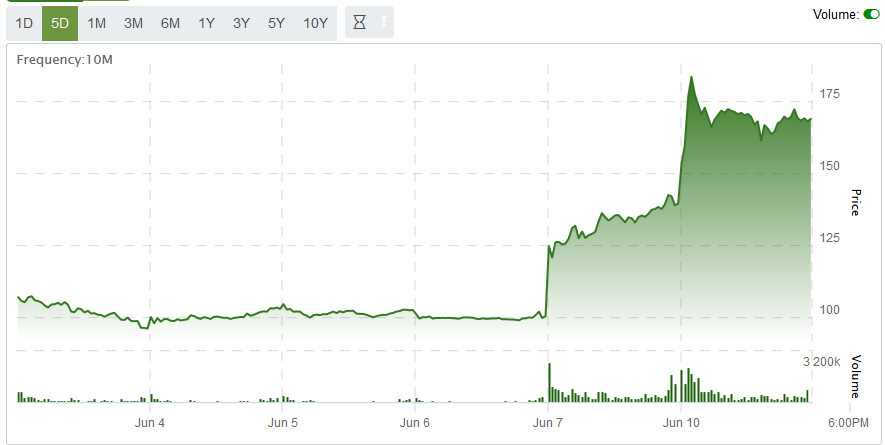
Apparently in India it is not illegal to send unsolicited bids to North American publicly traded companies to spur liquidity that enables you to get out of your own large net loss positions in said firms:

Sakthi Global Holdings, OTC MARKETS has announced that it has submitted an unsolicited Merger Proposal to DHX Media offering Shareholders of DHX Media $5.32 per share upon the completion of a Merger of Sakthi Global Holdings and DHX Media the $5.32 per share payable to DHX Media Shareholders will be comprised of $1.32 per share in cash and $4.00 Per Share in common stock of the merged entity, with Sakthi Global shareholders emerging as the majority shares holders of the combined companies. The merger offer is contingent upon 80 per cent of the shareholders of DHX Media accepting the offer and voting in favour of the Merger at Special Meeting of Shareholders to be convened for the purpose of voting on the proposal made by Sakthi Global Holdings Limited

I believe the (TSX: DHX) DHX board of investors are waiting for the unsolicited bid to come through international Canada Post, but the package has been held up in customs, and will take about 3 months to clear before they will be able to formally look at it.

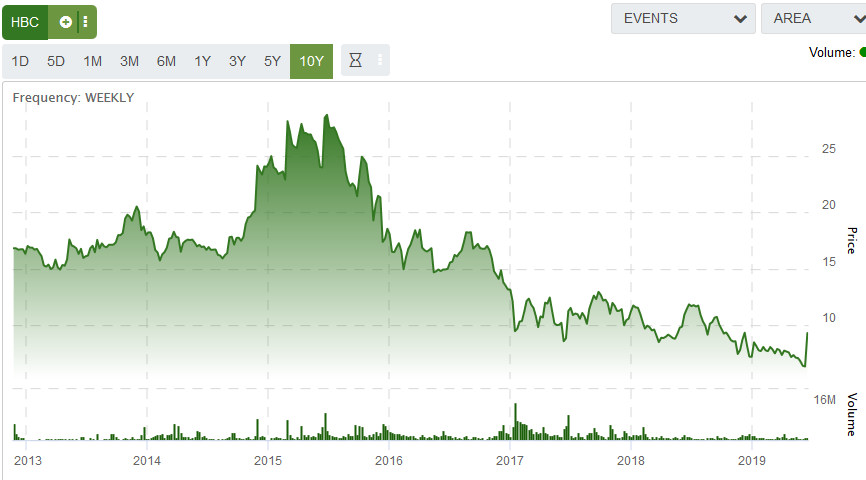
On a more serious note, before this I was looking at the DHX debentures (TSX: DHX.DB) in early May and passed on it, although I’ll add that this is getting to the point of being an interesting speculative instrument if it goes any lower – the valuation of intellectual property works such as Peanuts (the Charlie Brown franchise which they dumped a 39% stake in to Sony Japan) for $234 million in July 2018 was a pretty good sale. For those that were ever interested in speculating on the value of artwork and the public’s institutional memory, this is a reasonably close proxy. Somehow I don’t think the names of Teletubbies (which causes mental erosion in children) or Strawberry Shortcake will fetch nearly as much, but I think Inspector Gadget in the right hands could make a comeback!

Enbridge Line 3 – Another setback

I do not have shares in Enbridge, but investors today (and probably tomorrow as the news came out mid-day and institutions will look at it overnight to digest the impact on valuation) will be feeling slightly less rich after today’s news that the Minnesota court of appeals deemed the environmental assessment concerning Line 3 to be inadequate.

The net result is that Line 3 will have their construction halted until Enbridge can file an appeal or an amended environmental assessment. This will also result in another round of legal battles with the 3Cs of regulation – committees, commissions and courts and my initial estimate would be at least half a year of delays. I could be wrong.

The reason for the delay is not terribly relevant from a financial standpoint, but the impact of it will be for both Enbridge (who will not be realizing increased cashflows from the increased volume that would be flowing through the pipes the second they are activated – not to mention the capital that has already been sunk into the project), but more importantly, land-locked Albertan/Saskatchewan oil producers that were seeing a light ahead of the tunnel after the presumptive second half of 2020 activation of Line 3.

At CAD$50/share, Enbridge was priced for perfection. Although Enbridge is mostly a cash flow story, an investor is paying a lot in advance in order to realize those cash flows – in addition to the requisite risks to pay back the debt, interest and preferred share dividends. Just wait until Line 3 or Line 5 experiences a spill, or some other adverse event which is currently not baked into the stock (or perhaps another adverse legal ruling that will stall it another couple years). Although the company in 2019 is expected to generate around $4.50/share in cash ($8.9 billion), the inherent growth that is available to Enbridge is a limiting factor – and as such, the accounting income P/E in the 20s (which takes into account depreciation) is unjustified. Coupled with large future capital expenditures, if there is any sort of credit situation that may occur in the future, equity owners will be taking a lot more price risk than the current potential for reward – which wasn’t going to be a stock price that much higher than CAD$50/share.

I would especially take issue with the common share dividend, which is currently $6 billion a year – while they can certainly afford to pay this at present (and management continues to escalate the dividend each year), it is not a financial perpetual motion machine – given the capital expenditure profile, this is currently being partially financed with debt.

There aren’t many free lunches in the stock market, including the pipelines. Companies like Inter Pipeline (TSX: IPL), which has less legal risk than Enbridge, are still at valuations that aren’t incorporating much risk to their future expected cashflows (albeit, in IPL’s case, it is a lot better today than it was a couple years ago where it was trading about 30% higher). It wouldn’t surprise me to see Enbridge follow a similar trajectory, but still maintain its equity dividend.

Students of history will want to pay attention to Kinder Morgan (NYSE: KMI), a supposedly safe and stable pipeline company in 2015:

I’ll leave it at that – pipeline companies are supposed to be stable for their cash generation capabilities, but financially it can be a completely different story.

Atlantic Power – selling a power plant

Atlantic Power (TSX: ATP) today announced they are selling their largest power producing plant (Manchief) on May 2022 for $45.2 million. In the meantime, Manchief will continue operating and contributing cash – in 2018, the cash generated from Manchief was 12.2 million (and indeed this number was somewhat lower than it could be given there was a turbine installation performed in 2018).

Manchief’s power purchase agreement expired on May 2022 and the primary customer of the electricity had an option to purchase which was exercisable on May 2020 or May 2021.

I’m guessing instead of stranding the asset (such as what happened in their San Diego operation, which was located on US Navy leased land which they could not further extend the agreement on), they decided to take the money and run. Clearly getting rid of an asset generating $12 million a year in cash for $45 million is not the best economics, but this is a part of dealing with a legacy business with power purchase agreements that were signed at much more favourable terms than what is available today.

Mansfield produced 300 MW of power, which makes it nearly a quarter of ATP’s net generating power (1,259 MW, not including the biomass plants that it will be acquiring).

In the meantime, the company continues to chip away at its debt and is on a relatively comfortable trajectory to doing this even as their legacy PPAs expire. In 2020 the next PPAs due to expire had a FY2018 EBITDA of 9.6 million (out of a total of 185.1 million for all projects) and distributed cash of 13.9 million (198.0 million). There are no PPA expirations in 2021.

Read the fine print! Going-private transactions

Dynasil (Nasdaq: DYSL) is a micro-cap company in the business of selling specialized optics. Their company fundamentals (or how they got to be on my radar) is not terribly relevant to this post.

Their market cap is US$19 million at present. Compliance costs for micro-cap companies are extremely expensive in relation to their capitalization, and hence they want to go private, which they announced on May 2nd (form 8-K). The terms and conditions were that they were going to do a 8000-for-1 reverse share split, and subsequently split the stock 1-for-8000 and this would cash out sufficient numbers of stockholders to less than 300, which is the number required in order to enable them to go through with their privatization.

The stock traded down to about $1.02-$1.03 after their announcement – nobody wants to hold an illiquid stock in a privately held firm. In addition, people holding more than 8,000 shares in non-multiples of 8,000 would have their residual portion taken away without compensation (which would prompt a bunch of people to sell to a division of 8,000 shares).

Specifically, the Board recommended and approved a transaction whereby the Company would effect a 1-for-8,000 reverse stock split of the Company’s common stock (the “Reverse Stock Split”), followed immediately by a 8,000-for-1 forward stock split of the Company’s common stock (the “Forward Stock Split,” and together with the Reverse Stock Split, the “Transaction”). Stockholders owning fewer than 8,000 shares of common stock at the effective time of the Transaction would receive $1.15 in cash, without interest, for each share of common stock held by them at the effective time of the Transaction

It would make sense to buy 7,900 shares of the company at $1.03 and then have them cashed out by the company at $1.15, correct? That sounds like a nearly risk-free $948 before commissions and taxes.

Not so fast… reading the fine print later on, we have the following passage:

If consummated, the Reverse Stock Split and Forward Stock Split would apply directly only to record holders of the Company’s common stock. Persons who hold shares of the Company’s common stock in “street name” are encouraged to contact their bank, broker or other nominee for information on how the Transaction may affect any shares of the Company’s common stock held for their account.

Almost all investors that do their transactions through brokerage platforms have their shares held in street name. The registered owner is typically the brokerage firm, while the beneficial owner is the account holder. So if a brokerage firm has three customers, and each customer has 7,900 shares of DYSL, there might be a hidden consequence – the brokerage will receive 2 shares of the company after the reverse split, and has to figure out how to divide that among their 3 customers. Each customer would subsequently be beneficial owner of 5,333 shares of an illiquid private company and not receive any anticipated returns of a cash-out!

It sometimes pays (or avoids unintended consequences) to read the fine print.

Atlantic Power – slow and steady

Atlantic Power (TSX: ATP) announced a week ago that they purchased equity interests from Altagas (TSX: ALA) in two biomass plants for $20 million. Altagas is looking to shed assets, while Atlantic Power is looking for opportunities – biomass is something they have an operational specialty in, so this works out.

Key quotation in the press release:

Since last summer, we have announced the acquisitions of five plants – Craven County and Grayling; the remaining ownership interests in the Koma Kulshan hydro facility, which we acquired in July; and the Allendale and Dorchester biomass plants in South Carolina, on which we expect to close later this year. The PPAs for these acquired plants run through December 2027, March 2037 and October 2043, respectively,” said James J. Moore, Jr., President and CEO of Atlantic Power. “The acquisitions represent a meaningful addition to the level and length of our existing contracted cash flows, and we estimate they will contribute Project Adjusted EBITDA of $8 million to $10 million annually on average through the date of the first PPA expiration. We acquired the five plants at what we consider to be attractive prices.

Acquiring the remaining 50.25% of Koma Kulshan (Hydro) was $13.2 million.

Allendale and Dorchester (Biomass) was $13 million.

Craven County and Grayling (Biomass) was $20 million.

At the midpoint of the projected EBITDA contribution of $9 million, this represents an investment at a 19% EBITDA return. As ATP has a term loan that is LIBOR plus 275bps, this is a 5.1% pre-tax cost of capital, or approximately $2.36 million, so the EBTDA (EBITDA minus I) is $6.64 million. ATP has a massive tax shield so effectively this will flow to the bottom line directly. It works out to 6 cents per share.

This would explain why the company has not been buying back many of their own common shares in calendar 2019 – they found a better place for the money.

Enough decisions like these and the company will eventually see higher share prices. It will take time, but it is a very low risk and moderate return situation. Company management has stated in the past that at the right price, they will even sell themselves outright. I don’t think this will be coming anytime soon, but in the meantime, they continue to build value.

I also own some of their preferred shares, although they are trading at less attractive yields than they used to. In a takeover scenario, however, they will probably trade a couple hundred basis points tighter.

(Subsequent update, May 21, 2019: Their stock has been trading quite a bit higher than the US$2.20-ish they were half a year ago when they were buying back their own stock. They’re now up to US$2.60. Given how they’ve deployed cash, I do not view it likely that they will be too aggressive with their common share repurchases for the duration of the year – they have been very active at reducing debt.)