The big picture

But I won’t cry for yesterday
There’s an ordinary world
Somehow I have to find
And as I try to make my way
To the ordinary world
I will learn to survive

You have no choice but to operate in a world shaped by globalization and the information revolution. There are two options: adapt or die. – Andy Grove, Only the Paranoid Survive

The past two weeks have given me a February 2020-type feeling, with the notable exception that I think I have a better reading on where this is going to go. During the March 2020 Covid crisis, I initially (and dramatically) underestimated the impact it would have and took rapid course correction while everybody was losing their minds about the coronavirus.

Exactly six years ago (specifically on March 17, 2020), British Columbia shut down everything except the most essential services. People did not go to work. It was a completely unprecedented event.

I was buying S&P 500 futures that day. A little earlier than optimal, but the next week was the most gut-wrenching time of my investment life. The volatility was intense. You can see my thinking in my March 2020 series of CoronaPanic posts. The correlation of everything was 1.0 and there wasn’t much point at this time picking stocks when index futures is the most liquid risk-on asset appropriate for the time.

One of the few public services that were still operating was public transit. A few days after the shutdown order, an order came out declaring the bus service was free – because passengers must board through the rear door of the bus to avoid proximity to the bus driver. Although nobody was on the bus, bus drivers could safely go around knowing they would be the only ones on board.

Except for me.

I do not discuss this openly mainly because people do not understand it when I talk about it, but I felt freer that week than I had in a very long time. It was amazingly liberating going around the city (for free as a side bonus) and walking down the middle of the streets (we are not talking sidewalks, we are literally talking down the streets where cars normally go) of downtown Vancouver at night and seeing nothing but yourself and an empty cityscape – as if you were cast in your own deserted urban apocalypse of Alice in Borderland. It was surreal and it was something that I knew would not be repeated in my lifetime. So I took full advantage of exploring the emptiness of the city during a few rainy night times. Everybody was locked in their own prisons (whether physical or mental) and here I was, outside the Matrix, exploring and thinking.

March 23, 2020 is a day that will be seared in my brain for the rest of my life – it marked the low of the S&P 500 and the final day of panic where the market performed its final vomit. The financial world was ending worse than it was in 2008.

My brain, however, felt clear. Lucid. I could see the script playing out and I just needed to get confirmation of the turn before taking definitive action.

Two days later, I was shorting index volatility futures, at about 3:00am in the morning. It was indeed ironic that shorting volatility was the safest way to predict that we were not going to all die! Over the course of the next couple weeks, I made what seemed then like an unbelievable amount of money – money I knew I would be alive to deploy to good use in the inevitable recovery when everybody would come to their senses.

Everything in my education and experience in financial markets had led me to this once-in-a-generation opportunity (an opportunity that almost all others could only see with retrospect). About 25 years ago, I was six credits short of my B.Sc in Physics and I took a 6-credit directed studies course where I wrote a thesis on the expansion of an agent-based econophysics model, where I would incorporate different ‘personalities’ in agents that would be trading a fictional security amongst themselves (indeed, predicting the mechanism that resulted in the 2010 “flash crash”). I had survived the 2000 dot-com bust, the 2008-2009 economic crisis, the 2014 resource collapse, and what I experienced in March 2020 was, and still is, the most intense and hyperthymic (borderline manic) time of my financial life.

I called it two days from the bottom. In real-time.

I had adapted, and I survived.

There were second and third order effects of shutting down the industrial economy that were inherently predictable – the ripple effects of shutting off commodity demand for half a year, supply chain disruptions, aviation and international border shutdowns, and of course the financial disruption of flooding the pockets of the entire working population with “free” money. This was foreseeable – and indeed, the takeoff of oil from negative prices, to the resurgence of metallurgical coal despite all the narrative headwinds of ESG made for one of the greatest trades this decade.

However, all good things in the market come to an end. Despite the Russia-Ukraine war muddying the geopolitical landscape (and indeed I made an ill-timed shot on certain Russian ADRs that currently rank on my charts as my only 100% write-off in my entire investment life), the ripples in the lake that were created from Covid had begun to taper. The trade was coming to a conclusion and profits were slowly taken. After restrictions were slowly lifted, culminating in April 2022, the financial world was dealing with problems that dealt much less with Covid and much more with the consequences of disastrous government policy decisions taken in the prior two years – again, predictable outcomes – interest rates rising, supply chain moderation, and so on.

The problem is that after that, my crystal ball started to become more and more foggy. We were still in a frothy era where SPACs were going public weekly, and everybody was looking for the next GameStop and the environment became (at least to me) a hell of a lot less certain. The decision to raise cash and book profits from trading, especially when the Bank of Canada was keeping interest rates at 5%, was obvious. A risk-free rate of 5% diminished relative opportunity. Even though the Bank of Canada (and the US Federal Reserve) started to drop interest rates again in 2023 and into 2024, by Q3-2024 the portfolio was nearly half cash, a fraction that I thought was getting a bit ridiculous but I was truly out of ideas. While I had a core portfolio of leftover stocks from Covid, I was really out of conviction anywhere, despite the fact that anything relating to AI was skyrocketing.

I will give you a specific date – December 3, 2024. This was the last Late Night Finance episode I held. The reason I have been holding back from hosting these shows until now is because my grand narrative of how things are going to go was the equivalent of watching static on the television. The 7 or 8 people tuning into the December 3rd show would have known it. While I did deploy a little bit of cash in “microeconomic” opportunities in the past couple years (Magellan Aerospace was the best of them, due to the relatively long-lag time with aerospace sector procurement, but make no mistake, I had my share of losers as well), there has been no central theme that allowed me to invest with any real conviction. Even the so-called “Liberation Day” April 2, 2025 global tariff announcement which caused the markets to vomit wasn’t enough to stir me out of my coma – although it got close.

However, waiting cannot be performed indefinitely, especially with large cash fractions – it should be crystal clear to anybody that monetary debasement is far greater than the stated CPI rates and is not nearly sufficiently compensated with present interest rates.

I have been trying to wrap my head around the implications of the changes in international structure, especially incorporating some major policy changes in the USA with respect to geopolitical relations. I have also been trying to wrap my head around the advent of AI technologies and also how the Russian-Ukraine war has changed the concept of modern warfare. In addition, the structure of monetary policy post Covid-19 has altered somewhat, especially now that the risk of the US Dollar as global reserve currency is subject to compromise after Russia was kicked out of the SWIFT system. This, in addition to more domestic political considerations, has taken the better part of two years of deep thought while holding a significant fraction of cash in the portfolio.

Even my posting on Divestor has slowed down, but I did have the wherewithal to post a few articles that aged fairly well, including on February 2, 2025 (predicting the strategy the Liberal Party would use to get re-elected) and of course while analyzing AI, predicting an alien invasion (June 8, 2025 – please hold your breath – it will happen!), and in another AI-focussed article, Bitcoin going to zero (February 4, 2026). However, in the past month and a half since I really started to investigate the capabilities of AI (well beyond the obligatory ChatGPT inquiry of “What makes the sky blue?”), I’ve come to some conclusions, one of which is skillful usage of AI will render the multiplier effect of certain individuals at least 100x, if not 1,000x higher than other people, which will continue to exacerbate the wealth distribution, short of a cataclysmic event. While one might think that being broadly available that AI will result in an equal competitive advantage, it is kind of like saying that just because software compilers and hardware is readily available to everybody, everybody will have an equal competitive advantage developing software. Absolutely not the case.

About a month before Russia invaded Ukraine, I bought a Geiger counter. Not a cheap one – this one does alpha, in addition to beta and gamma decay. Once in a while things happen that make me want to take it out and just ensure that the battery is charged on it. Recent events have triggered me to keep this device at 100% charge and refresh my operational knowledge on how to measure radiological contamination (one of the most interesting courses that I took in university was on radiation biophysics and medical imaging). Right up there with guns and ammunition, Geiger counters will retain their value in the event of a nuclear war.

Figuring out what you don’t know is an important element in establishing one’s mental framework of a situation, and there is plenty I do not know. What is worse is thinking you know something when it is something else – and indeed, this is where AI comes in. AI is great at confirming your beliefs. And it is doing it for a lot of others as well, at a scale higher than what I thought was possible during the unprecedented 2021-2022 public health orders.

I don’t believe much I see out there other than the basic knowledge that the USA is a primary actor on a massive strike on Iran, and the first strike was a massive “decapitation” strike which likely took out a lot of top people. This is intuitively reflected on the price rise on Brent crude futures. You can see the impact of marine traffic in the Persian Gulf. Almost everything else we are hearing out there, whether it is from the President, third party reports, other countries, Iran itself, is noise. That is what one hears. It is also equally important to observe what one is not hearing (this takes a lot more brainpower as the space of what is not is infinitely larger than what is). The primary reason for this noise and non-information is related to the concept of the fog of war – in warfare, information is noisy and the less of your signal you are giving out, the better – better to flood the airwaves and let your rivals guess what is real and not. Much of this noise is machine-generated, and in our attention-saturated economy where public sentiment is manipulated by algorithmic factors, attention needs to go somewhere. Even the claims of the excuses used to start the conflict were conflicting. But equally telling is what is not being heard.

Suggesting to people that what they view on the “news” (whichever source, doesn’t matter) is simply not true generally gets a negative reaction out of said people. It challenges their narrative and once a narrative has been purchased, it takes a lot of time and a shift in broad public sentiment to validate any changes. This happens a lot in political contexts – for instance, you hear a lot less today about “climate” and other such buzzphrases that formed the dominant narrative just 18 months ago. It takes too much energy to invert the question – such as – the present obsession with the Hormuz Strait and flow of oil, while a very real issue, leads to the question of – what ELSE is going on that is of more dominant concern? What are we not hearing?

What is ultimately a multivariate situation, I will condense it down to two answers. These are highly speculative and I am still forming the theory but here goes:

One is economics. Money, resources and the power it can project is not a new cause to geopolitical conflict. It is no secret that the power of the USA revolves around its ability to maintain the global trade currency. You can go to any country on the planet, hand a currency exchange counter a rectangular piece of cotton paper with a picture of Benjamin Franklin on it, and receive instant purchasing power. It is also no secret that the rapid debasement of this currency is underway with fiscal and trade deficits and that the only way for the party to continue without causing a massive societal dislocation lies with keeping the status quo. As much as the world tries to wean itself away from the heroin of US currency, it keeps coming back. Take a look at Bitcoin – originally featured as a “decentralized”, “anonymous”, and “supply limited” currency, it has been completely captured by the financial network and is subject to the same usual AML, KYC and tax rules instead of forming a parallel currency free of political interventions.

There is about a trillion dollars of supply that flows through the Persian Gulf and needless to say, the US is strengthened when this is in US currency. Iran was threatening it and hence you are seeing the very unusual reaction of Iran to send missiles and consume military resources on other middle eastern neighbours – something militarily speaking, on a first order, makes absolutely no sense at all. Why pick fights with countries that aren’t bombing the crap out of you?

The answer is that Iran, with the support of its geopolitical partners, is trying to punch a hole in the forehead of Benjamin Franklin.

From the US perspective, this conflict makes little sense, or at least the reasons cited have much less urgency than what is stated. The status quo of “let the spice flow” in the Persian Gulf strategically facilitated the financial starvation of Russia, amongst other benefits. However, there may have been more economic urgency in engaging in the present course of direction than originally thought – nothing distracts from domestic issues more than invoking a war abroad. There is a residual question of “why now?” and to that, I don’t know. Perhaps the second reason is more dominant than just the almighty dollar.

The second answer, is a much stranger and abstract reason.

A couple decades ago, I was a heavy participant in the world’s first prediction market (Intrade) right up until it was forcibly closed by the CFTC. These markets were completely unheard of by the general public at the time, and indeed, I gave (what I thought was a fairly stimulating and well received) lecture about these markets to a crowd at a Barcamp conference in 2006. Real-money prediction markets back then were a novelty and today they have significantly evolved with PredictIt and Interactive Brokers getting into markets where suddenly real amounts of money are involved.

A sufficiently large enough prediction market will start to influence the very events they are trying to predict.

Sports markets identified this very early and there are severe consequences for athletes and organizations to collude with betting markets. For instance, there are tens of billions of dollars of wagers placed on the Super Bowl or the World Cup soccer/football games. Corrupting a team is difficult, but it has been well known in the past that certain individual sports (Boxing) have had suspicious circumstances as a result of betting markets. Either way, when there is a dollar to be made, people and organizations have huge incentives to developing accurate research models and part of these models assume that the events being bet on are “fair”.

Prediction markets thrive on liquidity – liquidity is what allows for price discovery and liquidity is what gives exchanges incumbent advantages as liquidity begets more liquidity. On every sports broadcast you see advertising for prediction market proxies everywhere – essentially encouraging people to get involved and put money where their own sentiment is. You end up getting people putting money on their emotions rather than doing any semblance of odds pricing, which is great for the ones that can extract signal from the noise.

However, you’re starting to see more and more liquidity going into geopolitical outcomes. In the geopolitical domain, there is no concept of fairness.

Markets are a construct of the behavioural characteristics of the individuals that make it – while most of the trading today is done by algorithmic processes, there still has to be a human at the end of the day guiding what direction the computers are going to trade. Well before the common-use large language models, algorithmic traders were there reading the Federal Reserve’s monetary policy press release at 2:15pm eastern and punching orders into the CME 100 milliseconds after parsing the text. Algorithmic traders were also there reading post-market closing press releases of technology companies and sending after-hours orders up or down depending on whether the release met or failed expectations.

However, just imagine if you had the power to write these press releases yourself, what power you would have over the prediction markets.

You see these attempts at psychological manipulations everywhere – on Twitter, Facebook, every press release, every piece of “news”. The amount of propaganda out there is saturating the minds of most out there and it does have an effect as people’s psychologies are model-able.

With the insertion of AI, it is even more powerful as we enter this topsy-turvy world where the perception is being molded by AI algorithms rather than reality driving perception. Many of us are incredibly susceptible to it, whether it be confirmation bias or living in our own “silo” that has been carved out for us by these digital algorithms. In fact, there is an effect where if one sees a fragment of reality and it clashes with the narrative view, the data point of reality is rejected and instead the narrative is reinforced in a very Asch conformity mind-jail.

Inherently on the individual level, this is non-falsifiable and this non-falsifiability is a feature of what we are seeing. Much of what we see, we have no idea what degree of truth we see, if any. What we don’t see is much more powerful information, but this signal will never be delivered on a silver platter – it is far too valuable.

This is the second answer to the question – it is a result of the disconnection between perception and reality, manipulations ultimately for gaming prediction markets.

Did I mention that stocks and futures are prediction markets?

The problem with using AI to project a reality is that it doesn’t do a very good job of creating or analyzing truly unique circumstances. Reality has a way of generating outcomes that are not projectable using history – such as, predicting the impact of an alien invasion. The narrative and perception can only be controlled as far as the information that gets flowed into the models, and you can’t ask the models to project something they don’t know. There will be a clash of reconciling perception and reality and it may result in serious dislocation. Such as, tossing a nuke out there and detonating it.

As a result of all of the above, I remain quite concerned that there is going to be some five-sigma event that will be wiping out the financial system as we know it – the era where you can take the US$100 banknote globally might be coming to a close, and the general inter-convertibility of currencies – and when that happens, it will create one heck of an economic dislocation.

However, getting back to a somewhat more grounded reality where I don’t talk about alien invasions or the detonation of the financial system as we know it, we have some conclusions where this is going to go:

* Fiat debasement is going to accelerate – you won’t see it when looking at inter-country currency exchange rates because pretty much all countries linked to the free-floating currency system will be debasing at relatively similar rates
* We are going to see more and more absurd decisions as moderation of social constraints will continue to decline
* What we have known as “safety” is no longer going to be as such
* Expect some sort of drone strike or something that will be similar in shocking scope as 9/11 on North American soil; I don’t know exactly what will happen, but when it does, it will get the general public to freak out and instigate another cultural change (keeping that Geiger counter charged…)
* This is eventually going to end up in some form of “Butlerian Jihad“. Not soon, but eventually.

In the marketplace, what worked yesterday is not guaranteed (or likely) to work tomorrow. One difference in today’s market than how it operated a hundred years ago is that we have a lot more data at our fingertips and the ability to run insane amounts of regression analysis and curve fitting in an attempt to predict the future. While I didn’t need to engage in these extremes to extract my pound of flesh from the market, the techniques that I have used in previous years I can tell are degrading and if I am to continue my out-performance, I need to change, especially in this alternate-reality world which is being shaped by AI agents and rogue actors that are making the tail wag the dog.

There are some fictional movies out there where there is a large asteroid that is going to hit the earth in a couple years and eliminate all life. I’ve always thought (perhaps with misguided priorities) what the impact would be on the financial markets in such situations, and to me it was pretty clear that interest rates would have to dramatically rise. While I don’t prophesize an annihilation event, I do get the sense that the true rate of interest is far higher than what we see trading on so-called “risk-free” bond markets today.

The only solace I can take is that as we stray further and further from reality, it could perhaps be that our warped perception is gearing itself for survival rather than truth.

I will learn to survive. Adapt or die.

Goeasy – not going so easy

I’ve been looking at the carnage left behind in Goeasy (TSX: GSY) and holy moly:

(Q4-2025 warning)

… announced today that it expects to incur an incremental charge off in Q4 2025 of approximately $178M against gross consumer loans receivable of $5.5B as at December 31, 2025, and a related write down of approximately $55M for loan interest and fees.

… $178+$55 is roughly the net interest income the company makes in a quarter. Oops!

The Company also expects a net increase in allowance for credit losses on gross consumer loans receivable in the quarter of approximately $86M compared to the amount reported as at September 30, 2025.

… this is quite a material increase given the typical top line of about $328M for Q3-2025. A +$86 allowance raise is a 26% increase in expected defaults – ouch!

The historical reporting practice resulted in certain customer payments being recorded as received while they were in fact in the process of being settled at month end, some of which were ultimately not collected, and also impacted the Company’s reported delinquencies.

… talk about counting your chickens before the eggs hatch!

Not surprisingly, the company’s stock took a huge bath today – down 56%.

Looking at the corporation in general, their reported Q3-2025 has (rounding to the nearest $100M) about $500M cash, $5.2B in loans receivable and on the liabilities side, capitalized with $4.7B in debt.

It’s pretty evident they are clearing out the books with this purge – the question remains whether this company actually ended up making any money or not on their core business. Doing a very rough projection with the above numbers suggests after fixed expenses, they did not. The company managed to get to $210/share in the middle of 2025 clearly with false profitability.

Are they a value at $50? I’ve always shied away from these types of financing companies since you never know when this sort of event will occur as it is difficult to ascertain the credit quality within the loan portfolio. On one hand, you have the Element Fleet Managements of the planet, and then on the other hand you have the Crown Capital and Accord Financials of the planet that are in much more questionable shape. I am not good at picking winners in this space.

This also might be a reflection of what’s going on in the downward-sloping part of the so-called “K-shape economy”.

Cenovus Energy preferred share redemption

Cenovus Energy called their remaining preferred share issue (TSE: CVE.PR.A/B, inherited from the Husky Energy transaction) and it will be redeemed out at the end of March.

Notably, the preferred share was incredibly low-yielding: 2.577% and a rate reset of 1.73% above the Government of Canada 5 year.

At today’s GoC 5yr at 2.68%, the preferred share would have reset at 4.45% yield at par.

Yesterday, the preferred shares closed at $24.75 (a mild discount to par). The redemption at $25 is obviously the company deciding to clear out the books entirely on one class of its securities.

A 4.45% after-tax drain, at a notional tax rate of 25% is the equivalent of issuing a perpetual debt at 5.93%, notwithstanding the 5 year changes in the reset rate – a 1.73% spread is quite narrow.

This is extraordinarily cheap capital, yet it is being redeemed. Despite blowing a bunch of cash on the MEG Energy transaction (don’t get me wrong – it was strategically the correct thing for the company to do), Cenovus has ample cash and free cash flow to spend $300 million to save $13.35 million after-tax annually.

This kind of exemplifies the yield wasteland in the preferred share market in general.

Slate Office REIT’s nearly cooked

It’s not looking good for Slate Office REIT, now rebranded as Ravelin Properties (TSX: RPR.UN):

Toronto, Ontario–(Newsfile Corp. – February 20, 2026) – Ravelin Properties REIT (TSX: RPR.UN) (“Ravelin” or the “REIT”), an internally managed global owner and operator of well-located commercial real estate, announced today that it does not expect to make principal or interest payments on the upcoming maturity date of its 9.00% convertible unsecured subordinated debentures (the “9% Debentures”).

The maturity date of the 9% Debentures is February 28, 2026. In connection with the upcoming maturity date, the 9% Debentures, which currently trade on the Toronto Stock Exchange under “RPR.DB”, will be halted at the market open and delisted at the close of trading on the business day following the maturity date, being March 2, 2026.

The REIT has been in default of its obligations to pay interest on the 9% Debentures since March 1, 2024. The repayment price due on maturity is $1,180 per $1,000 principal amount of 9% Debentures, representing aggregate principal amount of $28,750,000, and $5,175,000 for accrued and unpaid interest thereon to, but excluding, the maturity date.

The big question I have in my mind is – how will George Armoyan, who went through a huge effort to take over the REIT, be able to salvage this situation? It is incredibly unlikely anybody from the public will be able to make lemonade from the lemons (the units and debentures are well subordinated), but Armoyan’s corp, G2S2, has lent Slate/Ravelin a ton of money and maybe this was the plan all along when they will get to eat away at the entrails of this soon to be extinct REIT.

Despite AI, real is in, virtual is out

The phrase “nobody rings a bell at the top” is the cliche, but the converse of this is that nobody screams at you telling to buy at the bottom.

There has been a profound shift in the market over the past few months, and it can be abstracted with “real is in, virtual is out”.

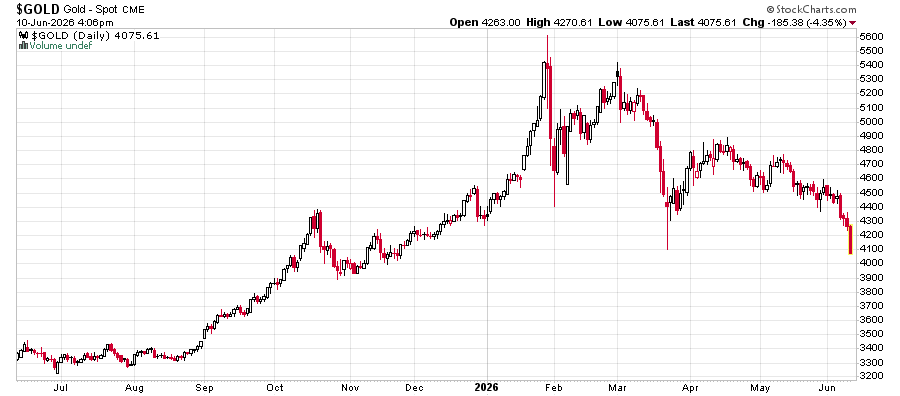
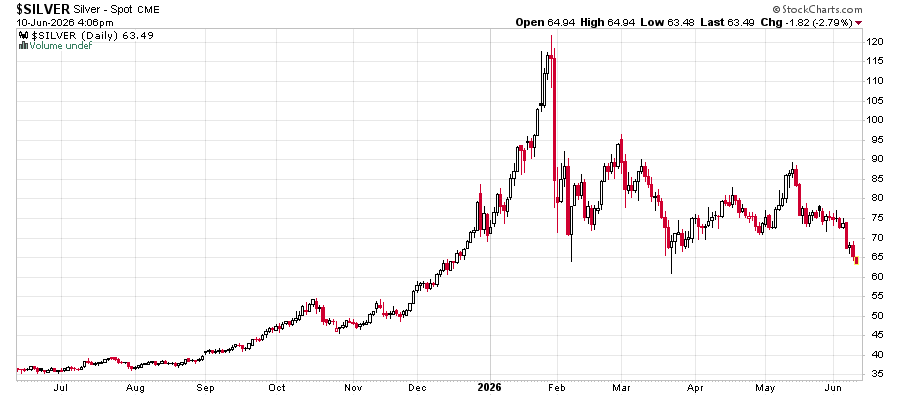
You see this in stock charts of software companies versus anything selling tangible product. Gold and silver are surging, while Bitcoin and the purchasing power of any fiat currency is cratering.

I have been experimenting with various AI technologies and trying to get an idea of how real this will be disrupting the landscape.

The best analogy I can make at present is the operating system abstraction. In the old days (and to a lesser extent today), software was compiled to run explicitly on CISC (Intel x86), RISC chips (e.g. ARM, PowerPC, MIPS, etc.), but it became a pain in the rear to rebuild the software for differing computational systems. Operating systems (Unix-based systems, DOS/Windows, MacOS, etc.) were developed to abstract from all of this. Of course it became a pain in the ass to develop for all three (plus more) at the same time, so the next level of abstraction was initially done with Java, which ran a virtual machine on top of the respective operating systems – the appeal is in “write once, run anywhere” – it didn’t have to care about the hardware OR operating system you were running on. Browser-based technologies also provided another layer of abstraction parallel with Java – for the most part it doesn’t matter whether you are using Chrome, Edge, Firefox, Safari or whatever, you get the same application delivered to you.

The issue now is that you actually have to code and use tools to generate what you want (fancy websites, database interfaces and the like). Entire university curricula are dedicated to the craft to assembling all of these disparate skills together.

Fast forward to today, where we have AI. The acronym is not artificial intelligence, but rather artificial interface. It is essentially an abstraction on top everything I have mentioned here, and using natural language parsing as a “graphical user interface”. Of course, there is nothing graphical about it – it is entirely textual.

Do you remember this?

In terms of economics, it is a huge question where the value will be extracted from. Going back to the old days, Microsoft was clever enough to extract a royalty out of nearly every PC sold in the form of a license to Windows (and later on, Office). When you think about it, there is little consumer utility in the purchase of an operating system itself – the end-user value is in the applications run on top of that layer.

We sort of see this extraction of value with the amount of queries you can ram through OpenAI, Claude, etc. – there is a limit before you have to pay a monthly subscription fee as the amount of computational energy required to process requests is, from what I can tell, an incredibly inefficient process. Is this sufficient for them, or is the value going to be in the applications?

I have been looking long and hard at Adobe, which produces well-known products like Photoshop, Illustrator, and other digital editing software. By all accounts, they are trading at forward P/Es that are very un-techlike (11.6x estimated 2026 earnings as I write this). Despite the existence of near-equivalent open source products (GIMP for Photoshop, Inkscape for Illustrator, OpenShot for Premiere, etc.) Adobe continues to extract incredible pricing power. An entire industry of graphic designers, marketing agencies and so on rely on Adobe software to produce style guides for millions of clients out there.

The ease of using AI to replace Photoshop and Illustrator is a material threat, however. If it no longer takes a professional graphic designer to generate different styles, it leads to the question of why one needs to spend nearly a thousand dollars a year on a professional software license (for them), or a few thousand bucks to contract the person out in the first place. The application layer where one can extract pricing power must be elsewhere. I don’t have easy answers for where this goes in the digital world, but it is one potential explanation why software companies are getting murdered in the stock market at present.

Just in case if you are wondering, nothing I write here uses AI. I still find the “Turing test” for AI-driven writing to be pretty obvious but I don’t think many people have this discernment skill, and it is one reason why AI-driven media (so-called “AI Slop”) is so prevalent. Paradoxically, it is also one reason why, as this trend of increasing procedurally-generated media continues to contaminate and permeate through everything, real is making a comeback.

Bitcoin goes to zero.