Rollercoaster

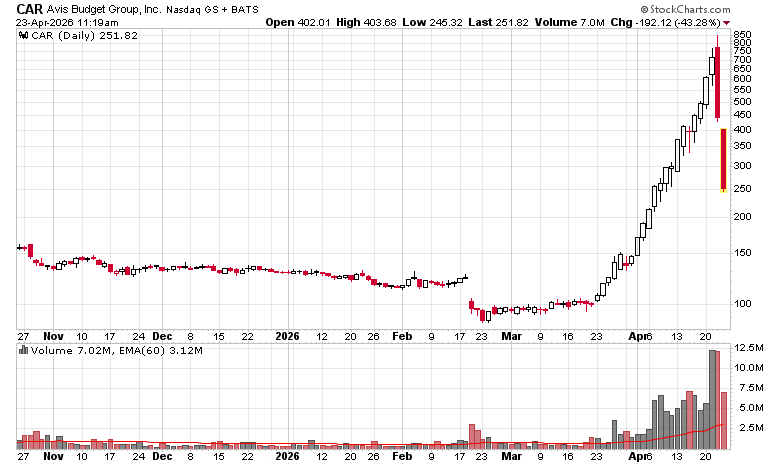
Avis/Budget Group’s stock over the past month has gone fully psychotic:

It is almost as if somebody set an infinite dollar buy program to accumulate shares at increasing prices and then two days ago realized their computer program was broken and pulled the plug on it.

Skimming their financial statements, the explosion in the stock (going both directions) surely isn’t due to them being a hugely profitable entity. They are in a completely miserable industry.

Canadian REITs

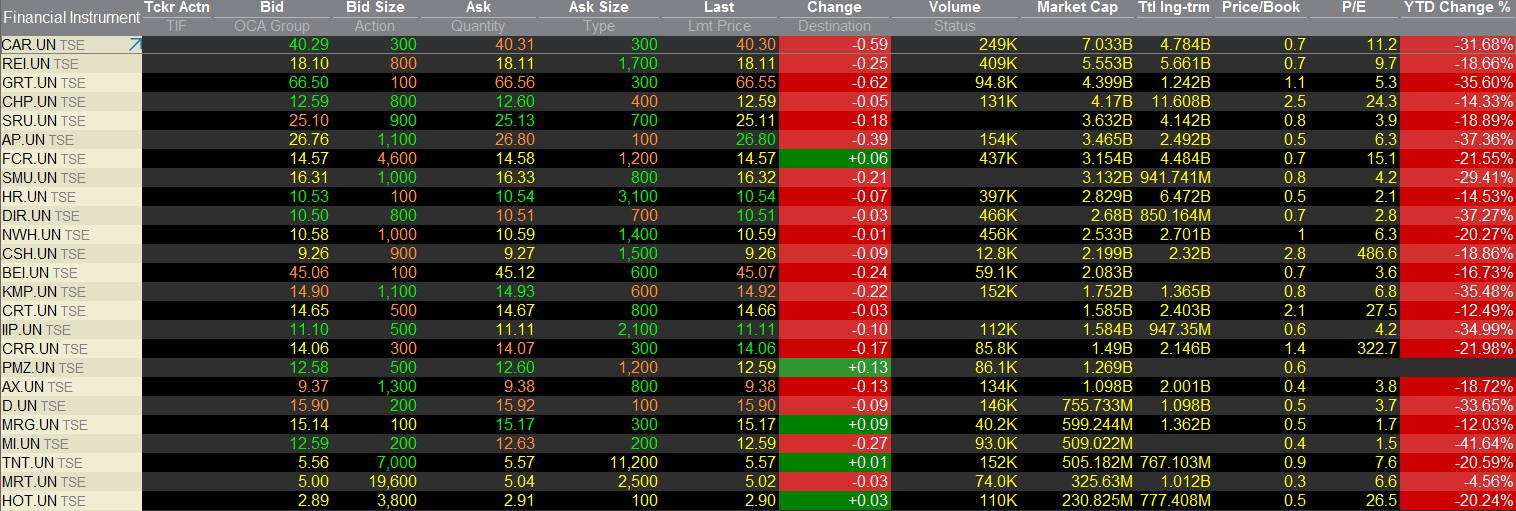
Here is a quick snapshot of most of the major Canadian REITs today. Pay attention to the very right-hand column, which is the Year-to-date performance of their units.

I’ll note that they are all universally down for the year.

Considering that such entities are heavily leveraged with debt to maintain the financing of their property acquisitions, this is not surprising. They are recipients of a double-whammy – higher interest rates will decrease their reported asset values (as they get appraised, they will drop), while at the same time, floating-rate debt will cost more, and any fixed-rate debt that renews will incur a higher financing charge. There is also the problem of what happens if the asset collateral declines in value to the point where the company cannot renew the debt.

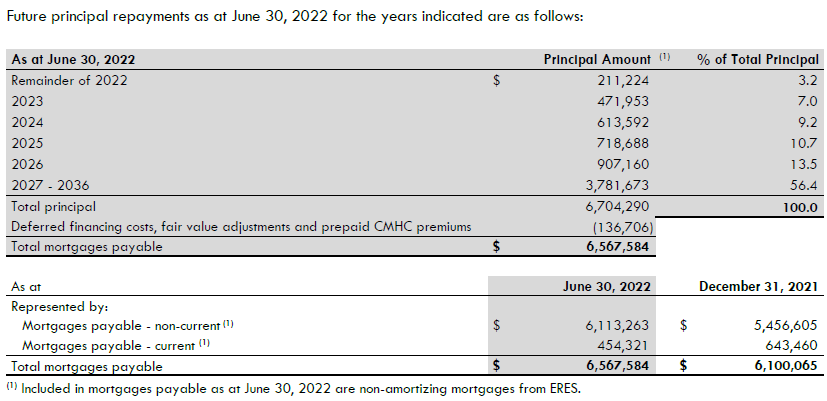
CapREIT (TSX: CAR.UN) is an interesting example. Looking at the June 30, 2022 snapshot:

* $260 million outstanding in floating rate bank loans
* They have $6.6 billion in mortgages payable, 99% of it at fixed rates. The average effective rate is 2.62%.

I’ll spare the agony of going through this in detail (page 45/46 of their MD&A) and just leave it here. Suffice to say, they’ve done a pretty good job insulating their interest rates for now. But they will have to renew these debts at higher rates, assuming the existing rate structure continues. A 1% rise in interest rates results in a $68 million increase in interest expense.

At the current financing arrangement, in the first half of the year CAR.UN made approximately $200 million in FFO, or about $400 million annualized. With 173 million units outstanding, this is $2.31/unit or a current price/FFO of 5.7%. Not a huge return over the risk-free rate.

Interest rates have risen from 0.25% to 3.25%, starting March 2, 2022. While it will not be an instantaneous increase in financing expenses for CAR.UN, it will continue to eat away at their bottom line, unless if they are able to raise rents to compensate.

In a country with one of the highest rent to income ratios for our urban centres, it will be very interesting to see how much higher rents can ratchet.

CAR.UN is nearly entirely residential. The same math works, albeit with different wrinkles, for the commercial, office and industrial REITs, the latter sector historically being in the highest amount of demand.

But as the strangle of higher interest rates persists, these REITs, all of which are very leveraged, will continue to see financing pressure, especially if they do not have the ability to raise rents to compensate.

One would wonder if we are entering into a bad recession how much demand there would be for things such as office space and how much pricing power there would be to open an office in an urban centre. This likely explains why office REITs like Dream Office (TSX: D.UN) have been massively hammered. I would suspect residential would do better than office REITs, but what happens to people when they are unemployed and can’t afford to live in the city? This probably explains our current government’s immigration policy, which is to bring in approximately 440,000 people a year for the next few years, most of which will come to the urban centres.

My other last comment is that I think the 32% drop in CAR.UN year-to-date is highly reflective of the overall state of the real marketplace in terms of residential real estate – just that in the land title markets, the bid/ask spread is so high for individual properties that this magnitude of price decrease has not registered yet. Sellers still want their November 2021 peak pricing, while buyers cannot raise their bids because they can’t get dirt cheap financing any longer.

Canadian Dollar, Genworth MI and Residential REITs

This will be a rambling post in no particular order.

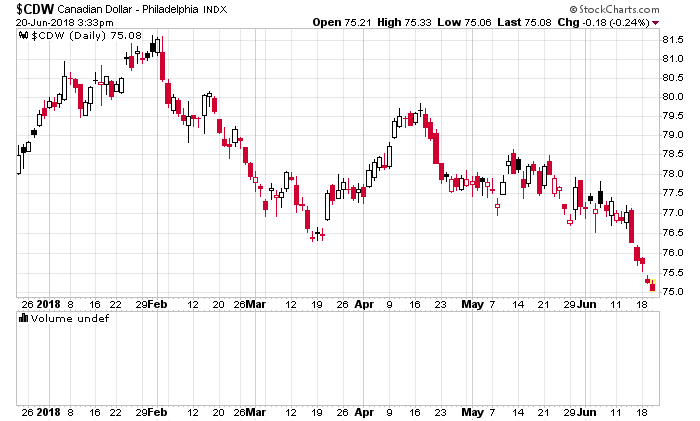
1. The Canadian dollar has tumbled with Donald Trump beating the war drums on the trade portfolio:

This will keep going lower and lower until the Government of Canada realizes that a lower currency doesn’t mean you’re more competitive when you’ve basically killed your own industry. Normally there is correlation between oil prices and the Canadian dollar but this linkage has now been considerably more muted because of WTIC to Alberta oil differentials. Investment has been flowing away from Alberta/SK oil and everything is on maintenance mode.

This will clear the way, however, for the Bank of Canada to raise interest rates another quarter point.

Domestically, this is going to be a disaster for general Canadian standards of living. It seems to be that our largest urban export is continuing to be real estate.

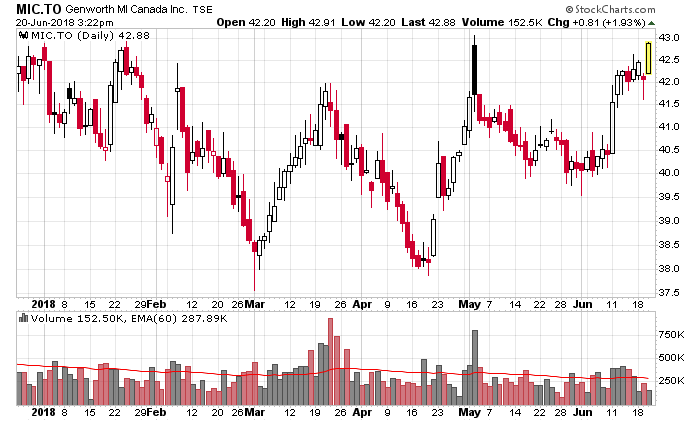
2. Speaking of real estate, bearish market participants in Genworth MI are going to face a short squeeze:

I’m not sure why anybody would want to use Genworth MI as a proxy for Canadian housing when there are so many more other investment vehicles to express this sentiment, ones that are trading well above book value and are making nowhere close to as much money as Genworth MI is on their insurance portfolio.

I’ll send a “hat tip” to Tyler, who writes infrequently at Canadian Value Stocks, for the brief mention of my continuing analysis of Genworth MI. The best analogy I can give is “picking up hundred dollar bills in front of a steamroller” instead of the usual cliche of “picking up nickels”. Genworth MI is claimed to be poised to have a giant collapse, but the variables required to make that happen seem distant at this point in time. Hint: Pay attention to China.

3. Speaking of real estate, the most hyped investment seems to be mortgage REITs and also residential REITs. The cap rates received by purchasers are incredibly low. Example press release linked here, key quotation in the first paragraph:

Northview Apartment Real Estate Investment Trust (“Northview”) (TSX:NVU.UN) today announced that it has agreed to acquire a 623 unit portfolio of six apartment properties (the “Acquisition Properties” or the “Acquisition”) from affiliates of Starlight Group Property Holdings Inc. (“Starlight”). The aggregate purchase price of the Acquisition Properties is $151.8 million (excluding closing costs), representing a weighted average capitalization rate of 4.5%.

A 4.5% cap rate? Do I even need to open a spreadsheet to know that the purchasing side of the transaction is wholly reliant on capital appreciation of the underlying properties for this to make financial sense?

The big favourite in this market is Canadian Apartment Properties (TSX: CAR.UN) and they probably can’t even believe how much their equity has traded up over the past year. They did a secondary at $35.15/unit and probably feel like idiots since just three months later they’re trading at $43/unit.

We drill down into their financials and see that from the last quarter, extended to 12 months, their normalized funds flow through operations (recall that accounting rules will add gross amounts of volatility in REITs due to mark-to-market rules when properties are re-appraised and this difference will be added or subtracted from income, making standard income statement comparisons incomprehensible without going through mental gymnastics) results in a net yield of about 4.3%.

An investment in CAR, therefore will expect to receive 4.3% plus the variable components of changes of rental amounts, property values, financing and operating expenses, and vacancy rates. Will these variable components be enough to give a rational equity investor a higher rate of return as surely nobody would want to take equity risk for a measly 4.3% gain?

Overall market thoughts – volatility – fossil fuels

This is another rambling post with no coherency. The quarterly reports from companies are flowing in and I am reading them – but there are few companies that are below my price range where I start to care about them in detail. As such, my research pipeline at this point is in the exploratory mode rather than doing detailed due diligence.

It is in the middle of summer and I am not expecting much in the way of volatility – it is truly a summer where major portfolio decision-makers have decided to take away from the trigger switches.

Accordingly I have been sitting and watching with respect to my own portfolio while I do my casual research. Probably my biggest error of omission was watching the solar market rise over the past six months – I’d written them off, along with almost everybody else, as languishing when the price of fossil fuel energy dropped. A lost opportunity there – there was one company in particular which I earmarked, financial metrics looked great, but didn’t even pull the trigger, primarily due to insider selling. If I executed correctly on it, I would have been looking at a double now. Oh well.

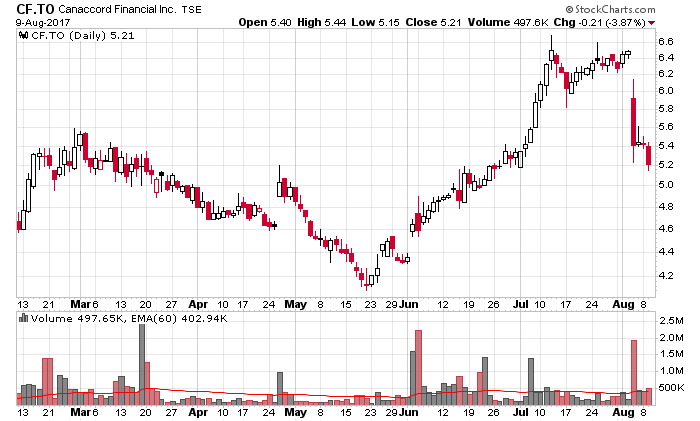
An equity chart that caught my attention was the high expectations of investors of Canaccord pulling a great quarter, which came nowhere to fruition:
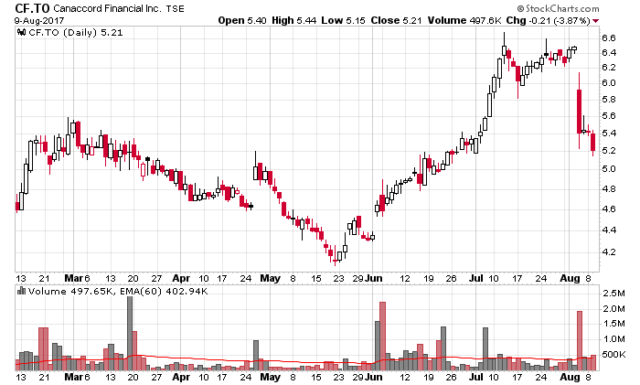
This is very obviously the chart of expectations crushed after a quarterly report – a regression to the recent mean would suggest a $4.50-ish stock price. I also notice their domestic competitor, GMP, being crushed after their quarterly report.

I also notice most liquid fossil fuel companies are getting hit badly and are close to multi-year lows. In the USA, most of the companies receiving boosts are the ones that have had been relieved of their debt burdens through the Chapter 11 process (LNGG is a great example of this). I still don’t think equity holders of fossil fuel extraction companies are going to be too happy over the next 12 months.

I also took notice with Interactive Brokers, and Virtu’s commentaries with respect to Q2-2017 as being one of the lowest volatility environments possible – they are two types of businesses that generate revenues as a function of trading volumes. Volatility correlates negatively with an increase with the broad markets – I am looking for defensive-type companies that will do okay in an environment like present, but will really do well when volatility increases.

Interactive Brokers is a classic example of a great company (they are the best at what they do by a hundred miles over everybody else), but one who’s stock I am not interested in buying at current prices.

Mostly everything in the Canadian REIT sector seems to be over-valued. An interesting trend is that the downfall of retail is somewhat being projected by RioCAN’s chart – trading below book value, it might seem to be an interesting value, but are they able to keep up occupancy and lease rates to businesses that have to compete against Amazon? The residential darling of the market is Canadian Apartment Properties (CAR.UN) but they are most definitely not trading at a price that would suggest a future performance beyond a high single digit percentage point and this is under the assumption that their real estate portfolio asset value remains steady. Trading in the entire REIT sector seems to be entirely yield-focussed which is never a good basis to invest, but it is a good basis to evaluate other investors’ expectations on these entities.

Gold has also been up and down like a yo-yo and might be an interesting bet against dysfunctional monetary policy. Unfortunately my ability to analyze most gold mining firms is generally not that fine tuned.

The liquidity of my overall portfolio is very high (nearly a quarter of the portfolio is collecting dust at a short duration 1.5%), but right now I don’t see much investment opportunity that would suggest avenues for outperformance. I could shove the money into some sub-par debenture (e.g. TPH.DB.F which buys you a 7% coupon until March 31, 2018 maturity) but do I really want to lock my capital into something that is questionable? It is the literal metaphor of picking up pennies in front of a steamroller. My policy is that if I have to force my money to work, chances are the investment decision’s risk/reward is worse than if I just held it in cash and waited for some sort of crisis to hit. I generally define “crisis” as something that will take the VIX above 30%, but it has been awhile since we last saw it:
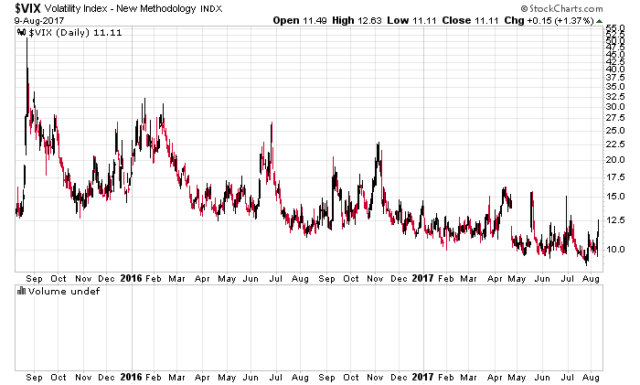
It is pretty ironic how the election of Donald Trump was foreseen by most pundits to be the end of the world and higher volatility times, but so far the opposite has turned out to fruition. Will it continue? Who knows.

I see a lot of people making the mistake of impatience, and also the mistake of assuming that the index ETFs that they are investing into (Canadian Couch Potato, etc.) will leave them safe through masked diversification – works great as long as there are net capital inflows, but what happens if there is a correlated bust among these products? Will retail continue their conviction when they see a 10% drop in prices, or will they grit their teeth and add to their positions?

I continue to wait. It might be a very boring rest of the year with very limited writing. If you think you’re in a similar predicament, I’d love to hear your comments below.
Not finding a lot to invest in

Barring any investment discoveries in the next month, the cash balance I will be reporting in June is going to be a considerably high fraction of the portfolio.

While cash is great, it also earns zero yield.

Compounding this problem is the majority of it is in US currency.

Unfortunately I have done some exhaustive scans of the marketplace and there is little in the way of Canadian fixed income opportunities (specifically in the debenture space) that I have seen that warrants anything than a small single-digit allocation. I would consider these to be medium reward to low-medium risk type opportunities. Things that won’t be home runs, but reasonable base hit opportunities.

Rate-reset preferred shares have also piqued my interest strictly on the basis of discounts to par value and some embedded features of interest rate hike protection, but my radar on future interest rates is quite fuzzy at the moment (my suspicion is that Canadian yields will trade as a function of US treasuries and the US Fed is going to take a bit longer than most people expect to raise rates since they do not want to crash their stock market while Obama is still in the President’s seat).

I have yet to fully delve into the US bond space, but right now the most “yield-y” securities in the fixed income sector are revolving around oil and gas companies.

There are plenty of oil and gas companies in Canada that have insolvent entities with outstanding debt issues, so I am not too interested in the US oil and gas sector since the dynamics are mostly the same, just different geographies.

I’m expecting Albertan producers to feel the pain when the royalty regimes are altered once again by their new NDP government. There will be a point of maximum pessimism and chances are that will present a better opportunity than present.

Even a driller like Transocean (NYSE: RIG) that is basically tearing down its own rigs in storage have debt that matures in 2022 yielding about 7.9%. If I was an institutional fund manager I’d consider the debt as being a reasonable opportunity, but I think it would be an even bigger opportunity once the corporation has lost its investment grade credit rating.

Canadian REIT equity give off good yields relative to almost everything else, but my deep suspicion is that these generally present low reward and low-medium risk type opportunities. Residential REITs (e.g. TSX: CAR.UN) I believe have the most fundamental momentum, but the market is pricing them like it is a done deal which is not appealing to myself from a market opportunity.

The conclusion of this post is that a focus on zero-yield securities is likely to bear more fruit. While I am not going to be sticking 100% of the portfolio in Twitter and LinkedIn, the only space where there will probably be outsized risk-reward opportunities left is in stocks that do not give out dividends. It will also be likely that a lot of these cases will involve some sort of special or distressed situations that cannot easily be picked up on a robotic (computerized) screening.

I would not be saddened to see the stock markets crash this summer, albeit I do not think this will be occurring.