The liquidity of Yellow Pages

The trading of Yellow Pages (TSX: Y) over the past week has been a relatively fascinating display of liquidity – and indeed because the publicly traded float is so tiny and volume so low, that you can review it trade-by-trade and get some insight on what is going on.

This chart does a poor job of illustrating the tick-by-tick price action of the stock.

Supply is being sucked out of the market by ETFs and algos, plus the fact that Yellow is trying to pull supply out of the market through their NCIB (limit: 2,510 shares daily). There is little demand from the short squeeze angle (short interest is about 11k shares). Although the borrow is available (IB shows 1.77 million shares available to be shorted) it is very expensive presently (30% to short). What’s really interesting are the blocks on display:

Monday (all times Pacific time zone):
12:29 Ask 5,100 @ 11.95 (not filled)

Tuesday:
Same block on the ask, trading was thin this day

Wednesday:
The block at 11.95 disappeared, and instead at the beginning of the trading day, Ask 10,000 @ 12.00. There was a bunch of volume at 11.95, and somebody front-runned the large ask by a few pennies with obvious volume.

Thursday:
The big day. Opening was Ask 10,200 @ 12.09, and there was a sizable bid (Bid 2,900 @ 11.95) which crept up in price over the next four hours. At 12:46 the block was hit, preceeded by some volume before that. The largest trade of the week was hitting the ask at 12:46:36 for 12,460 shares (multiple trades).

Friday:
A bidder appeared at 6:32 at 12.19 (1,600 shares) and this rose over the next couple hours to 12.50 (about 3,967 shares traded from the opening $12.00 to $12.50 at 7:47am). Subsequently some supply hit the market at 9:42 at 12.47-12.52, but this was quickly absorbed. From 9:57 to 12:12, there was some liquidity trading at the 12.50-12.60 level (somebody posted an Ask 5,000 @ 12.50 which was eaten in the course of an hour) and subsequently 14,740 shares traded.

At 12:12:44, somebody posted Ask 10,000 @ 12.74, and it took all of ten seconds before somebody hit the ask and picked up the shares (with 501 hidden shares at 12.70, specifically the 1 share trade was probably for the HFT processor to deliver the information before the remainder of the order was filled).

The bidder after this trade continued to increase the bid, and hit some more supply at 12.80 at 12:21:01, and finally continued to 12:59:26 where the closing trade was at 13.01.

The total volume for Friday was 35,222 shares traded, the highest since August 27.

It was very interesting week for Yellow Pages, at least in terms of how the stock traded. If they continue to financially perform as they did in Q2-2020, they should rise further. A particular price point is $19.04/share, which is the conversion price of their debentures (TSX: YPG.DB) and although they have the cash already in the bank to pay off these debentures, if the common shares trade above this, it will be akin to them raising equity financing at this price. I do not think most people would have anticipated this, especially in light of COVID-19. I still have a very significant equity position as I believe this will continue higher.

Cheapest TSX Debenture right now – Surge Energy

Just looking at the list of TSX-traded debentures (100 issues from 63 companies), price-wise, the company trading at the lowest price is Surge Energy (TSX: SGY). Their debentures (a total of $79 million, about half of which matures in the end of December 2022) are trading just a shade above 30 cents on the dollar.

Usually when a company’s debt is trading that low, a recapitalization is looming. Indeed, for Surge, it is a likely scenario, if not an outright CCAA proceeding. Q2-2020 was very rough for all oil producers, with WTIC going negative and all the Covid fallout. For Surge, the last corporate snapshot on July 30, 2020 showed a fairly dire financial picture, specifically the $307 million in senior bank debt. This credit facility goes to a redetermination on December 2020, and is otherwise payable on March 2021.

Although in a ‘normal’ environment, the corporation is cash flow positive (even after the capex), it isn’t going to be nearly enough to address the bank debt, let alone when the convertible debentures are due. The absolute amount of product being produced (17k boe equivalent with 80% crude) is well below what it needs to be to support the amount of financial leverage. Hence, the convertible debentures, being very low on the pecking order, are going to be incredibly disadvantaged if it comes to a recapitalization proposal, and are sure to be wiped clean in a CCAA arrangement. Hence, this is why they are trading in the low 30’s.

There is a winning scenario, and that involves a surge (pun intended) in oil prices. Right now the corporation is hoping they get bailed out by the commodity market before the banks close in for the kill.

I took a small loss in September bailing out what was a very small position in the debentures I took post-COVID. Sometimes debt is cheap for a reason! Or another way – just because it’s cheap doesn’t necessarily mean it’s a good value!

The next companies in line in terms of having the lowest trading prices: Supreme Cannabis (FIRE.DB), Invesque (IVQ.DB.U/.V), and Chorus Aviation (CJR.DB.A), all roughly in the upper 40’s or 50’s, and all for fairly obvious reasons when examining the businesses in question.

Diversification and risk

Textbooks in finance are written about the benefits of diversification and how to achieve your portfolio objectives. If you can find two assets that you estimate have the same expected return, in theory it makes sense to split your portfolio 50/50 among them to reduce the risk to achieve the expected value. Implicit behind this is that the returns achieved by these assets are not correlated. For instance, if your two assets are CNR and CP, if Canada goes bust, your diversification is not going to help. But if your two assets are CP and some boring and stable power generation utility out in India, chances are that the returns from the two assets are likely to be much less correlated. Computer algorithms can sort out all of these historical correlations and give you a pretty good idea of the mathematical risk, just from historical trading data.

Then we get into the business of asset allocation. Traditionally, equities and government bonds are inversely correlated to each other, and it has been a layer of portfolio protection when equities rise, you sell a little bit and buy (relative to before, lower priced) treasuries and vice versa.

However, it all goes haywire when traditional correlations do not manifest themselves.

One example is the usage of gold as a “world is going to hell” hedge and also a hedge against inflationary monetary policy decisions. In panicked market conditions, gold is just as susceptible as other asset classes for being liquidated.

Another example is the market for unsecured debt (e.g. TSX debentures or any other corporate bond that trades publicly in a reasonably liquid manner) – although many of these companies are sure-guarantees to pay out at maturity, the value of their debt trades down in market panic conditions.

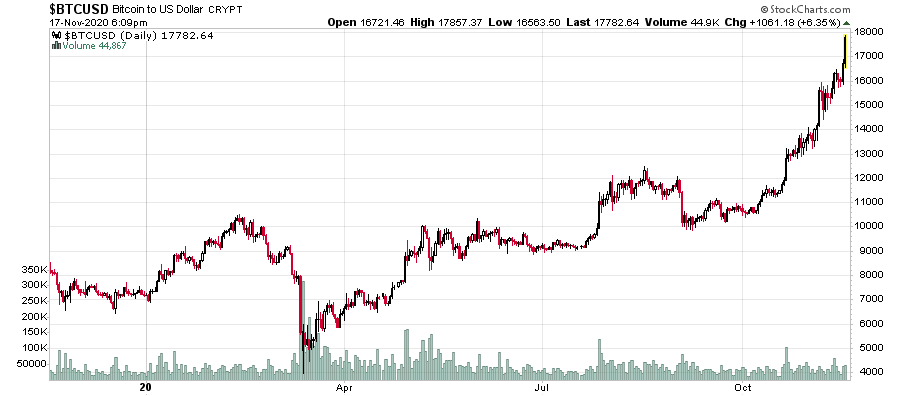
Finally, another example is the usage of Bitcoin. Since there is limited historical data, there is a considerably higher element of human intuition that goes behind what the true risk profile of this asset is.

When traditional correlations break, it forces portfolio managers to either stay the course (assuming it will regress to some sort of ‘mean’), or to adjust the asset allocation to reflect the new reality with the correlations between various assets. In general, my gut feel is that markets are moving ‘faster’ than they were before, which will make institutional managers that much more challenged to adjust their models to reflect market reality.

Hertz is amazing

Take a look at the stock market’s favourite car rental company Hertz (HTZ):

This is what you call a short squeeze.

The catalyst was an announcement they received $1.65 billion in DIP financing.

Considering the unsecured debt is still trading a tad above 40 cents on the dollar, the bond market still doesn’t anticipate the equity receiving anything when the courts approve the Chapter 11 resolution.

This information (the equity fundamentally being worthless) was already priced into the markets. What rational participants don’t anticipate is a huge wave of paradoxically “rational irrational” behaviour consisting of gamblers, coupled with those trying to induce a short squeeze, which is what we are seeing.

A very fascinating display of market dynamics for the textbooks!

Gran Colombia Gold notes

A minor update on (TSX: GCM.NT.U), they will amortize another 8% of their notes effective October 31. (Press release)

They also received a credit rating increase from B to B+ on their senior secured notes. Considering that after the quarterly amortization that they will have US$35.5 million outstanding, coupled with a positive net cash balance, this isn’t surprising. However, Fitch is very correct in identifying that the life of the Segovia mine (which is substantially most of their cash flow) is quite limited and they will need to find additional reserves, and that ore grade levels are depleting. Even if the mine were to shut down tomorrow, the remaining cash balances will be sufficient to pay off the debt (albeit the equity holders will suffer greatly).

They’ll call off the notes on April 30th. In the meantime, holders continue to enjoy a disproportionately large coupon. The notes are trading in a tight bid-ask where it doesn’t make sense to either buy or sell them. I really wish somebody would bid them up into the one hundred plus teens. It hasn’t been the case – lately the bid/ask has been 108/109. So I’ll continue holding until maturity.