Andrew Peller – liquidated by Fairfax

Back on August 31, 2025 I wrote a post about Andrew Peller (TSX: ADW.a and ADW.b) characterizing it as a “low risk, medium reward” situation. Adjusted for dividends, the non-voting stock was trading around $5.10/share.

Fairfax announced yesterday that they made an agreement with the majority voting shareholders (John Peller and the Peller Family Enterprises entity, combined owning about 3/4 of the voting stock of the company) a takeover bid for $8/share cash for ADW.a and $12/share cash for ADW.b, with John Peller graciously receiving a private “rollover” provision with Fairfax, presumably the blunt the impact of any capital gains taxes going forward.

This deal was at a considerable premium to market at the time and is quite probable to be accepted with a 2/3rds vote required by both classes of shareholders and also a majority of Class B shareholders that are not represented by those that get a rollover provision or otherwise exempted by the MI 61-101 rules.

Right now, it is not clear to me whether a significant shareholder (the Peller Family Enterprises Inc. entity owning just under 50% of the Class B shares) is included from the majority vote. I will read the information circular when it comes out. If it is excluded, then the public shareholders (about 25% of the Class B stock) is voting on the deal which creates an interesting dynamic if it occurs.

By all means this trade should be considered a victory, but it leaves me with a couple bittersweet feelings.

The first bittersweet feeling is that the Class A shares are mildly undervalued by Fairfax – albeit there is no obligation for Fairfax to give Class A shareholders any sort of deal at all (they could have just taken control of the entity by purchasing the majority stake from the Pellers), they did short-change the Class A shareholders about 75 cents from the midpoint of the “valuation” alluded to in the press release.

This is no stranger to Fairfax (and other companies) that do this to minority holders of smallcap companies – one of the big risks of smallcap investing is that when you do get a takeover offer, they are sometimes at unfavourable terms. I felt the same way after Cervus was taken over (have to go back to August 2021 for this post).

Andrew Peller is in way better shape today than it was a couple years ago when I started to purchase shares. For the fiscal year ended 2026, they reported a diluted EPS of 61 cents per share – so at the $8/share that Fairfax is paying for non-voting stock, that’s a P/E of 13, not a bad price. Balance-sheet wise the company owns a lot of physical infrastructure, and the marketing/distribution know-how and incumbent contracts consisting of about 10% of the Canadian domestic wine market, but they also own a strip of land in Port Moody, BC, which they will inevitably liquidate and realize a healthy gain from. Factoring in these off-balance sheet assets, Fairfax is getting a fairly good deal, hence some resentment.

There are a couple headwinds, however – about $26 million of the revenues comes in the form of a provincial subsidy (read Note 17 of the financial statements) which considerably overstates the company’s profitability if these subsidies were to be tapered away for whatever political reasons. The other headwind is the nature of the market – in general, alcohol consumption is on the decline.

The second bittersweet feeling is that I have been really struggling to find reinvestment candidates. Andrew Peller was the type of company (similar to Rogers Sugar when it was reasonably priced) that you can just purchase and forget about entirely since the industry itself was so mature and stagnant. My portfolio, which is cash-heavy, is going to become more cash heavy as a result of this takeover. I have been really struggling for reinvestment options that I have considered acceptable.

I have a cliche which is that every good trade you make you wish you had doubled it when getting into the position. Considering the cash-heavy nature of my portfolio since 2023, this is especially true with Andrew Peller. However, by all means I should instead be purchasing a bottle of $10 red wine (perhaps upgrade to the $20 stuff given the one-time nature of this takeover bid) and count my blessings before sobering up and hitting the stock screener for the next opportunity.
Liquidity of precious metals

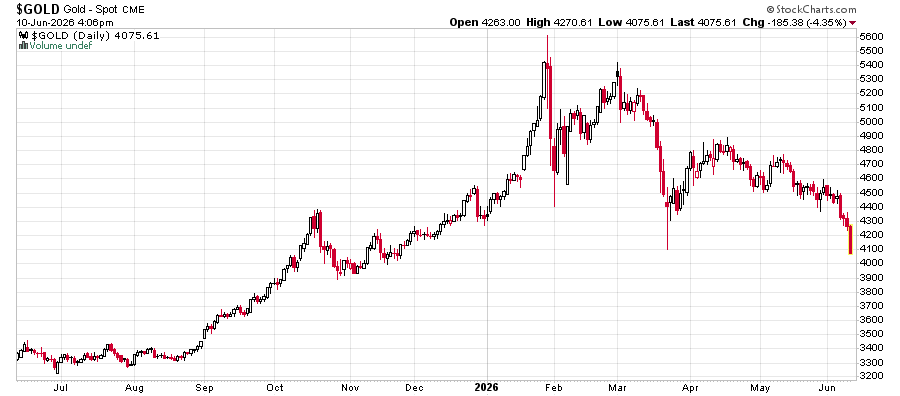
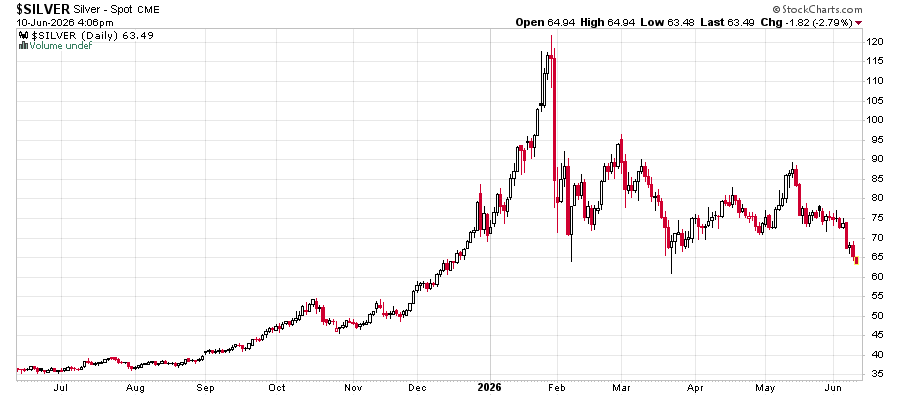
In a world where the headline article is the USA publishing an annualized CPI for May of +4.2%, you would think that precious metals would be the recipient of capital inflows – supposedly a great hedge on inflation – as governments run higher and higher deficits and the supply of money expands to infinity, precious metals will flourish, correct?

Apparently not:

Gold and silver have been trading down, especially since the precious metals price spike last January. Somebody buying Silver at that $120 spike is sitting just under a 50% loss at present.

What do we make of these conflicting narratives?

Prices are set at the margins. It takes one trade for a price to drop from $100 to $10 – if somebody is willing to sell it at 10 dollars and nobody is willing to buy it between $10.01 to $100.

What triggers the sale? The need for liquidity – converting an asset class into cash, and this need is more than the desire of the purchasing party to pay up for it.

The advantage of owning an ounce of gold or silver is that it sits there. It doesn’t depreciate. It will be there forever, irrespective of whatever happens to the entire monetary system. The disadvantage is that it sits there. It doesn’t earn a yield. To convert this asset into something useful, you need to find somebody willing to take it and give you something in return for it that you want – typically cash. If too many people want cash, you’re less likely to receive more for it.

It is very difficult to predict the eddies and currents of when you will see demand for precious metals or seeing people needing liquidity and selling their gold and silver instead of US Treasuries or Bitcoin or shares of NVidia.

“Sell in May and Go Away” is a popular cliche in the markets – perhaps this year it is especially true. I continue to remain very defensively positioned despite the pain of seeing a USA CPI print of 4.2% and the best low-risk short duration ETF I can find on cash equivalents gives out a net of 2.6%. What will break first, the purchasing power of cash or the stock market?

Accord Financial – or why small finance firms are difficult to measure

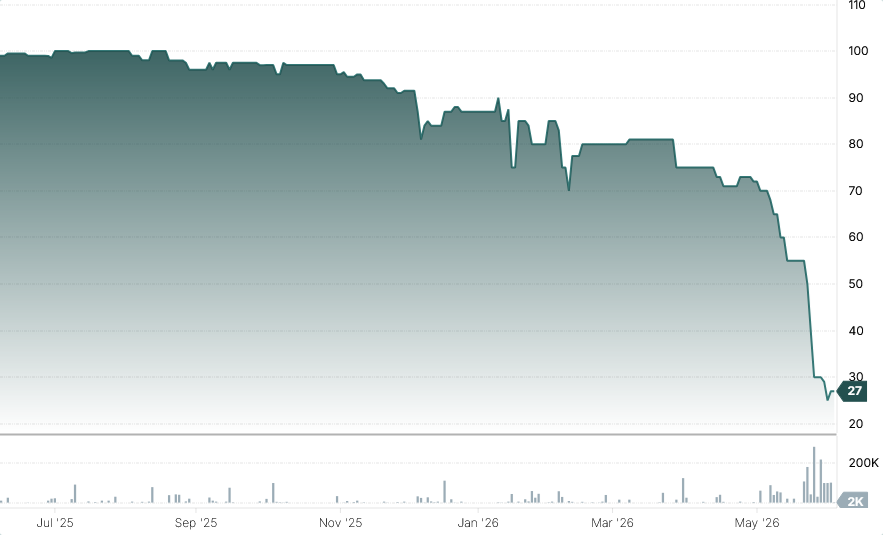
I noticed that the debentures of Accord Financial (TSX: ACD.DB) has fallen off a cliff:

There should have been a hint of what was going on earlier this year when they extended the debenture term and increased the coupon rate (to now 12%) but the firesale of assets has made it quite clear that the subordination of the public debentureholders is not placing them in a very good position to negotiate – let alone getting payment on maturity.

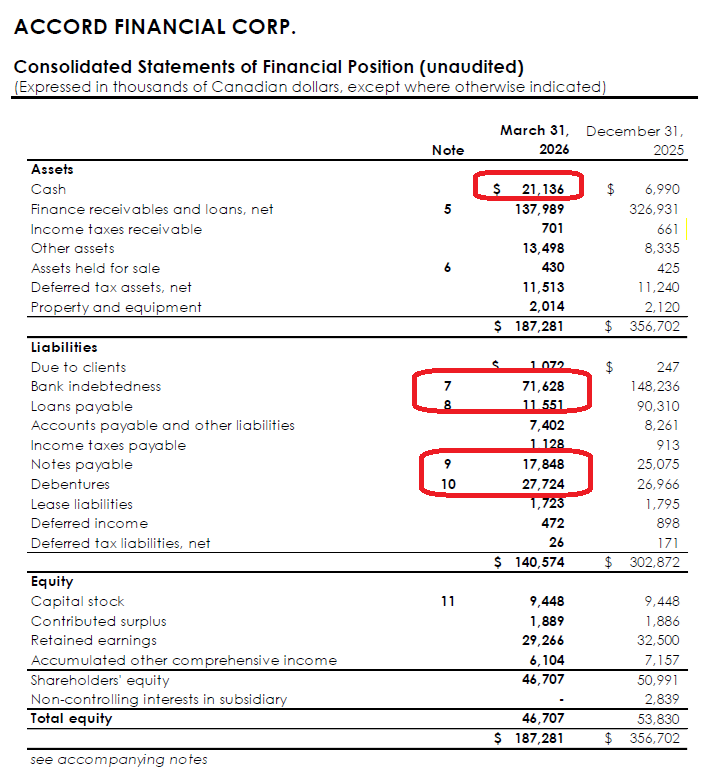
Is it really that much of a train wreck? Let’s quickly examine things. Their March 31, 2026 balance sheet:

We have $21M in cash, and $138M in “finance receivables”.

This is what is needed to pay off notes 7, 8, 9 and 10 (the debt capital used to issue the loans).

Note 8 is a non-recourse loan. Note 7 is the primary credit facility with the bank (extended to June 19, 2026… they’re doing things nearly in monthly increments, never a good sign!). Note 9 is for notes payable, linked with the maturity date of the bank loan from a related party (the related party keeping the corporate entity afloat… for now). Note 10 is the $20.65 million in publicly traded debentures and $5 million in non-listed debentures (same terms). They mature on July 31, 2026.

When doing the math, you have about $159M in financial assets that are going to pay off $127M in loans and debts. That’s nearly $30M leftover, so surely paying off those debentures is going to be no problem, right, right??

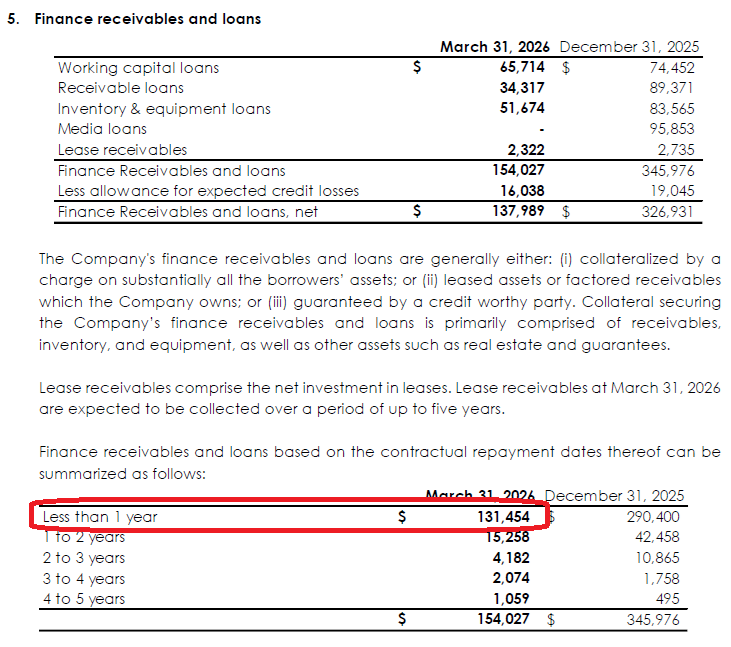
The finance receivables are the lion’s share of assets and they are primarily structured to within 1 year of repayment:

Looks good, right? What’s the issue?

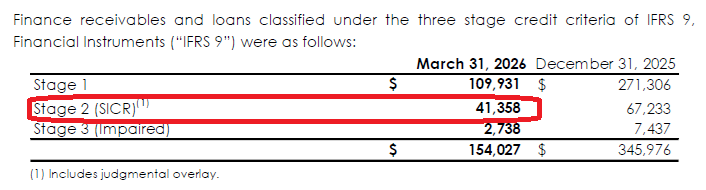
SICR is a “significant increase in credit risk” measurement.

So it turns out that about $41 million in loans are at risk. This makes the threshold for repayment much more narrower. Coupled with the fact that the corporation is loss-generating (specifically the interest expenses and G&A is well higher than the interest income being generated by the loan portfolio), the trading price of the debentures is not surprising.

Finally… the irony wasn’t lost on me when looking at the first page of their quarterly report:

Canadian Preferred share market

I did another quick scan of the Canadian preferred share market.

Yields are very low. Many issues are trading above the $25 par level and ripe for calling (culling?).

The Canadian public market for individual fixed income issuers out there is getting quite thin. The publicly traded debenture market is also exhibiting moribund signs – 60 individual tickers and this is going to go down another six tickers quite soon with the extinguishing of ECN, and the former Slate Office REIT.

I am not inspired by what I am seeing out there.

The impact of rising long-term yields

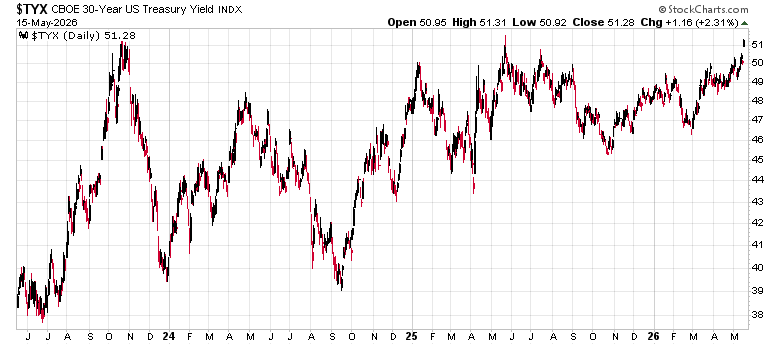
The rise in the 30-year US treasury bond yield post-Iran military action has been ominous:

What blows up when long-term US government bond yields go to 6, 7, 8%?

One answer – the purchasing power of cash.

Here’s the chicken and egg problem and this is what makes markets tricky.

A rise in the long-term risk-free (or let’s just say “so-called” risk-free rate as clearly risk-free is no longer without risk!) will result in the decrease in the capitalized value of future cash flows. This should depress equity valuations.

However, at some point, equities have a component of balance sheet value, which will maintain its value in real terms, but in nominal terms will increase in value over time, all things being equal. This especially applies to firms that have obtained their assets through non-floating rate debt financing.

So we have the yin and the yang of monetary debasement in action – future cash flows are worth less due in current dollars to rising interest rates, while asset values will rise in nominal terms.

Is there a value in holding cash when every day they purchase less in assets?

Possibly – but only when everybody has a rush for cash at the same time. Predicting when or if this happens is difficult.

What causes a rush for cash?

People needing to suddenly (key word – suddenly) make debt repayments or incurring expenses that need to be paid in short order. The perception that the assets in question are garbage and need to be dumped quickly.

When does this happen?

Covid-19 was a good example – nobody is working, everybody needs to raise money for insurance claims. Companies’ earnings will crater due to demand destruction.

9/11 was another example – massive insurance claims from disruptions triggers a need to raise cash immediately.

The 2008 economic crisis – the impending demolition of the financial system – raise cash!

There were obvious catalysts in these cases. What will trigger a need for cash in 2026?