This is another “low risk, medium reward” small cap situation. The risk is tempered with balance sheet assets but also incremental improvement in underlying operations in part due to a significant management transition.
Andrew Peller trades on the TSX as a dual-class stock company (TSX: ADW.a and ADW.b).
The company is a vertically integrated wine conglomerate. They own many producing vineyards in southern British Columbia and southern Ontario. They also own three significant wine production facilities, in Kelowna, BC, Grimsby, Ontario and St. Catherines, Ontario. There are also retail/tourist destinations (the type of places that would host fancy reception parties and the like) in the same geography. Finally, the company owns a significant plot of land in Port Moody, BC which was the subject of municipal rezoning procedures spanning most of a decade but is thankfully done. Unfortunately, since the initial concept was conceived, interest rates have risen and the residential construction market has collapsed in the BC Lower Mainland (similar to the situation in the GTA).
There are headwinds with the main business – the younger demographic is drinking less alcohol than it has historically. Wine sales trends (by volume) suggest that aggregate consumption is flat to slightly negative. There may be opportunities in expanding to alternative markets (e.g. non-alcoholic beverages and the like) but this is going to take development and time. The main value proposition of the company, however, is not through the commodity production of grapes (essentially agricultural production), but rather the distribution network and the accumulation of “mind-share” with its various brands – which is a very expansive collection of names, e.g. Wayne Gretzky Estates and Copper Moon. Branding of wines is very fragmented and it takes nothing other than walking through the shelves of a liquor store to realize the diffuse nature of branding – but if you own multiple brands you get more real estate on the shelf! The company believes it has about a 9% share of the wine market in English Canada, second in the country.
Financially, Covid-19 did not treat the company well, but current results have regressed to the pre-Covid metrics.
Examining the pre-Covid and post-Covid financial metrics, we have a company that posts approximately $400 million in revenues and operating margins of about 11%. Bottom-line net income for the past 12 months total 37 cents a share. The company’s balance sheet has consistently been in a net debt situation, peaking roughly around $200 million during Covid, but presently about $169 million, which is funded by a $275 million available credit facility at 2.5% + CORRA (right now 5.25%). This number is approximately the amount of inventory the company keeps on its books. The assets on the books (including the real property) collateralize the loan. Finally, the company pays out a modest dividend – last couple fiscal years about $10.4 million, which is amply supported when looking at the cash flow statement.
On the downside, Note 17 of the Fiscal 2025 financial statement outlines the amounts of government subsidies they receive from the Wine Sector Support Program and the Ontario Grape Support Program – a non-considerable amount of money that makes gross margins appear far greater than they are in reality. There are political reasons why this stream of money is unlikely to abate, especially in context of the international trade issues with the USA at present.
However, the most significant change that got on my radar was the ownership and changes of management structure.
There are some unusual features worth noting with the dual class stock structure. The Class A shares (35.3M outstanding, trades as ADW.a on the TSX) are non-voting. Class B shares (8.0M outstanding, trades as ADW.b) are voting. Class B shares can be exchanged 1:1 for Class A at any time. The two classes are economically different – Class A shares are entitled to 15% higher dividends than those declared on Class B shares (currently A shares are paid $0.0615/quarter while B shares are paid $0.0535/quarter). However, Class B shares have the preferential right to be subject to a takeover bid without the Class A shares having participation rights. The history of the Class B shares is quite interesting but in present-day, 49.8% is owned by a corporation called Peller Family Enterprises Inc., 24.8% by John Peller, and CDS Clearing (essentially the public portion of the trading float seen on the TSX) holding another 21% of the shares. The remaining 4.4% are held by various other private individuals.
The majority of voting stock used to be held by Joseph Peller through his majority-owned corporation, but has subsequently devolved into the current structure – while the Peller family still collectively owns the voting interest in the corporation, there are different entities in the family having control elements. In particular, Jeff Peller died in 2021 and for estate management reasons, the company had to sell Class A shares in 2022 (definitely did not help the stock price at this time) – SEDI filings suggest this was executed October 2022 at about $5.60/share. Long story short – the Pellers (via the family corp and John) still have about 75% of the voting stake in the company.
A pivotal moment was when, in November 9, 2023, management announced that there would be a transition and the then-CEO, John Peller, would be retiring:
John Peller announced his intention to retire as President and Chief Executive Officer of the Company within the next year. The APL board of directors (the “Board”) is engaged in a process, together with its outside organizational consultants and a leading executive search firm, to find a suitable successor for the CEO position.
For almost 30 years, John Peller has led APL as Chief Executive Officer and been the driving force behind the Company’s growth and success. The Board is seeking to identify and attract a CEO who will respect APL’s core values and will continue the rich traditions that have been ingrained in the Company due to the contributions, efforts and commitment of the Peller family.
In addition, the Company’s independent directors, Perry Miele, Shauneen Bruder, François Vimard and David Mongeau, have announced that they will be retiring effective immediately, to support a proactive refreshment of the Board. The Company intends to add independent directors to the Board within the next few weeks. The identity and details regarding the new Board members will be announced at that time.
We see a public post from Miller Thomson (legal firm) that advised Peller Family Enterprises on this transition. The company has kindly paid $3 million in professional advice to assist with the family corporation.
On February 9, 2024, five directors were announced to the board and the following:
As part of John Peller’s retirement and transition, the Company has agreed to pay $4.5 million in a retirement allowance in addition to his ongoing salary as President and CEO until a successor is appointed. In addition, the Company has also entered into a consulting agreement with John that will take effect upon his retirement to ensure a smooth transition, which provides for a $2.0 million consulting fee for services provided, paid quarterly.
The Company has entered into a transition agreement with Peller Family Enterprises Inc. and the Peller family, which includes provisions relating to the composition of the Board for a 24-month period, as well as standstill and other provisions. Later (see below) it was disclosed that the Company has paid $3.0 million in legal and advisory fees incurred by the shareholders in connection with these agreements.
Finally, on July 9, 2024 it was announced that a couple internal hires would lead the company as CEO and President, and John Peller stepped away as CEO. Later that year (September 17, 2024) announced were some other hirings and firings. However, what got my attention was on November 6, 2024’s quarterly report results, the following sentence was included:
In response to these margin pressures, the Company has executed numerous production efficiency and cost savings programs including the renegotiation of inbound and outbound freight rates and alternate sourcing for glass bottles.
One of the problems with having family-run enterprises is that management can get quite entrenched in old ways and become stagnant. Another problem is that they treat the family business as their own personal spending conduit to the detriment of the non-controlling shareholders. They might surround themselves with staff that are too afraid to rock the boat or suggest changes to long-held methods of doing business that have long since been outdated (perhaps I should take hint at my own words here). By getting new (hopefully competent) eyes to look at business practices, it may lead to better results. Definitely something such as looking for cheaper sources of glass bottles would be low-lying fruit?
On February 12, 2025, John and Angus Peller stepped away from the Board of Directors, completing the transition.
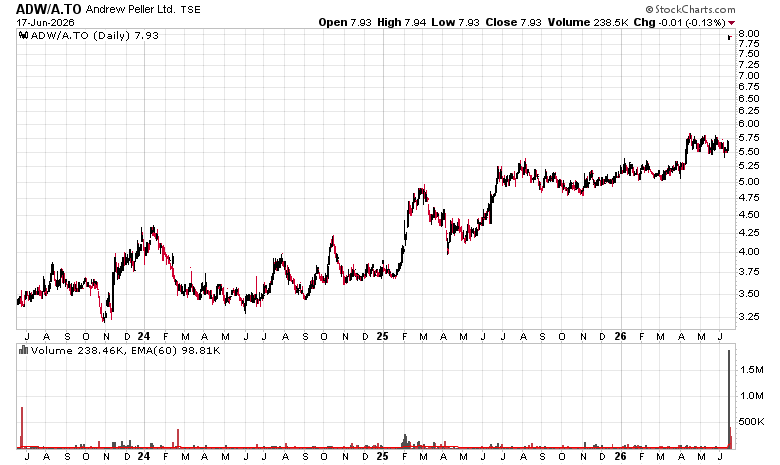
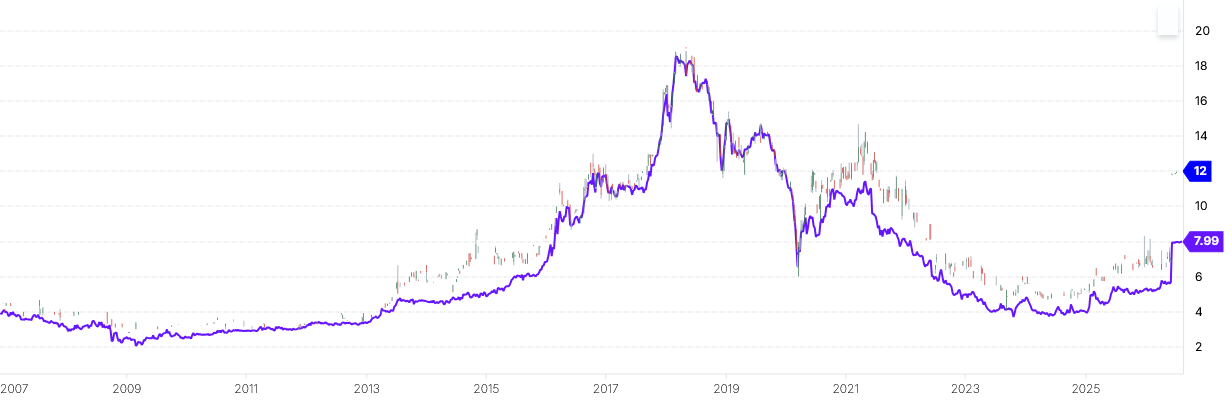
From November 2024 onwards, I made the decision to take a stake in the company, both the voting and non-voting stock. Having really lost my mind on Teck Resource’s reclassification of their super-voting shares (where their voting stock received a 60% premium in their Class B stock and I remember on my trading screen during the depths of the Covid panic looking at the A and B shares and deciding to save a buck and go with the Bs – a mistake that regret), I was very intent on obtaining voting shares of the company. The non-voting stock was easy enough to accumulate, but the voting stock was a real pain in the ass to transact. It is incredibly illiquid with some days featuring zero trades and very high bid-ask spreads. Since November 6, 2024, there have been 94,000 shares trading in this class of stock on the TSX. The premium one pays for the voting stock is typically a dollar over the non-voting stock price, but over the past week this equilibrium has broken – somebody has really wanted to accumulate the B stock and it doesn’t take a lot of dollar volume to inflate the price! I have managed to take a reasonable chunk of the historical trading volume but now that the premium to non-voting is so high, I can reveal this trade which has taken 10 months to perform. I’m no longer in the market for the B shares at present pricing.
My investment thesis here is fairly simple:
1. The company still has the Peller family with control and I am presuming they have an incentive to ensuring that it is being managed with an eye to continuing the dividend stream (providing cash flows to the family) and that their main priority is to capture cash flow – John Peller still controls about 5.1 million shares of Class A stock in addition to the voting stock;
2. The company operates in a stable and very mature industry and should exhibit a small amount of incremental improvement in results;
3. The company is a stealth play on the ownership of agricultural land which should retain value in most economic climates;
4. The non-trivially sized development property in Port Moody which will eventually be disposed of; this continues the theme of new management in Q1-2026 announcing the disposition of “non-core” assets:
During the first quarter of fiscal 2026, as part of its strategy to divest non-core assets, the Company initiated the proceedings to sell land, vineyard, and building assets in Kaleden, British Columbia with a net book value of $977. The sale closed in the second quarter of the fiscal year for proceeds of $1,260.
… it should be noted the BC Assessment value of the Port Moody property is $50,800,000 land value for one parcel (there are other parcels in the vicinity which will add to this value).
5. There is a chance the stock structure will be flattened, Teck-style. From the 2024 November quarterly conference call:
————–
Operator
Your next question comes from [ Dave Boychuk ] shareholder.
Unknown Shareholder
I was at the AGM in September, and this is actually just a clarification question because somebody in the — somebody at that meeting asked the question about the current, I guess,
the current shares of the A and B value
. And I forget which one of you guys answered back something that you were working with somebody or some firm or something. And I just wanted clarification what that was.
Paul Dubkowski
To be honest, I’m actually don’t recall that or mention anything around that. I don’t think that’s something we would speak about at an AGM nor do I have anything to report on that. But I’d be happy to — if there’s something specific, I’d be happy to take a call on it. But no, nothing to report, and I don’t recall speaking about that.
————–
… after the 24 month “stand-still” provision with regards to the board composition is expired, there is a decent chance that there will be some “make whole” arrangement that will invoke a single class of shareholder and compensate the voting shareholders, similar to Teck. This will align with the Peller family receiving cash flows and a still significant control (although far from majority control) of the company. This would likely make the company more attractive for public investment.
6. The financial metrics are relatively cheap when compared to similar participants. The closest comparison is to Corby Spirits and Wines (CSW.A/CSW.B) and although their business is somewhat different, it makes ADW look relatively cheap. Another comparable is Lassonde (LAS.A) but they have been performing shockingly well over the past decade.
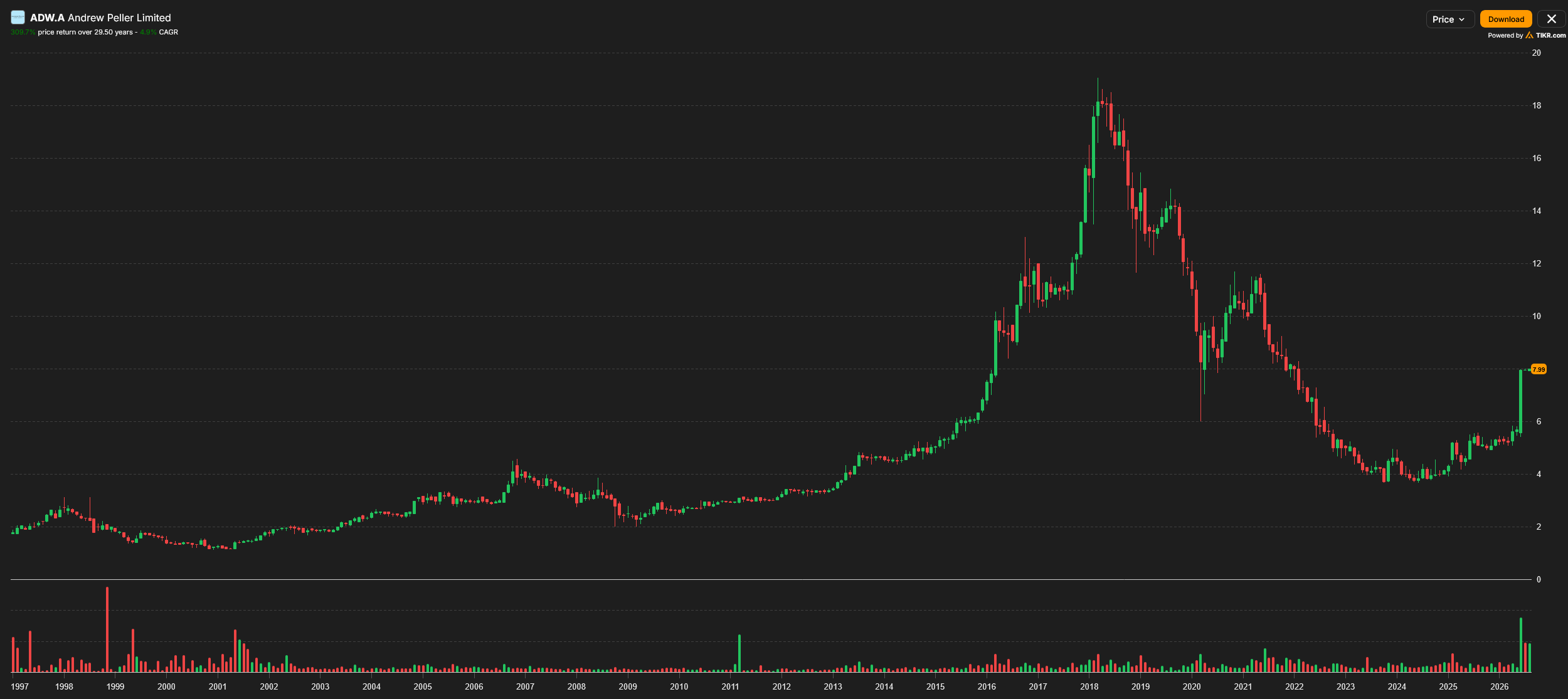
At my purchase price, the downside appears to be quite limited and getting paid 5% to wait seems to be a good proposition. Despite the increase in the share value over the past 10 months, the overall firm appears to be relatively cheap. For the better part of the last decade, the company’s stock traded in the double digits and there is a reasonable possibility over time they will see this again.
Long both ADW.a and ADW.b – and a liquidity disclosure – ADW.b is incredibly difficult to trade efficiently. I’ve learned a lot about trading very illiquid stock and needless to say, I won’t be exiting it anytime soon, even if I wanted to!