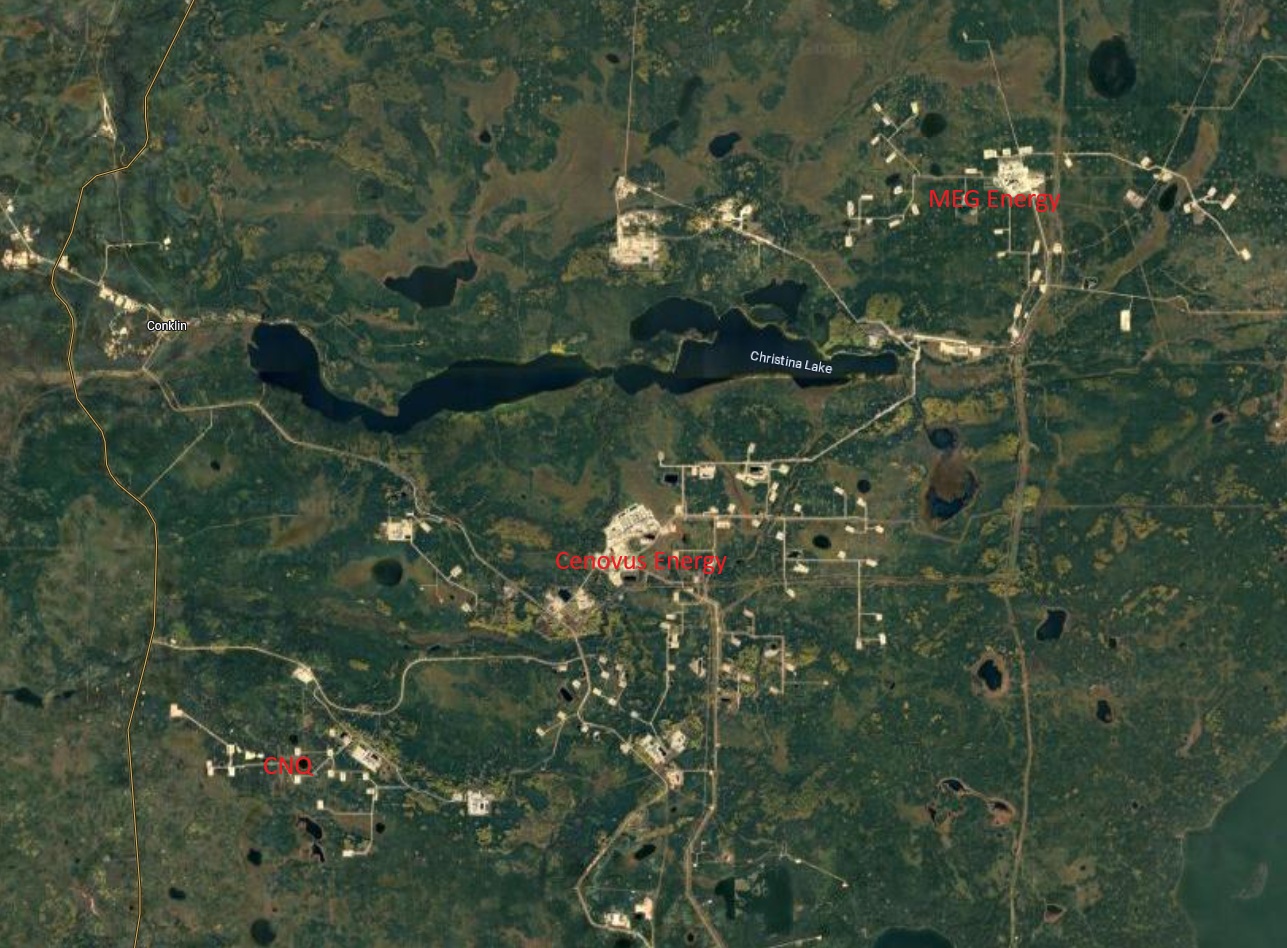
This is simply a compilation of known information. No special insights in this post.
Now that Cenovus is the ‘winner’ of the MEG sweepstakes, what will be the merged entity?
MEG has 255 million shares outstanding. CVE is paying $14.75 cash and 0.62 CVE shares for MEG, or approx. $3.8 billion cash and 158 million shares of CVE.
With dilution from warrants that are highly in the money, CVE will have approximately 1.98 billion shares outstanding after this transaction.
Balance sheet-wise, CVE announced after the sale of their 50% interest in one of their jointly owned refineries netting $1.8 billion, which gave their Q3-ending balance sheet a $3.5 billion net debt pro-forma. CVE purchased $512 million of their own stock in September. After the MEG acquisition, which had about $617 million in net debt at the end of Q2-2025, CVE will have approximately $8.4 billion in net debt pro-forma post-acquisition.
MEG’s production was estimated to be 100,000 boe/d; CVE’s production was estimated to be 800,000 boe/d, hence the combined entity will be approximately 900,000. Combined FCF for 1H-2025 is $1.56 billion, annualized $3.1 billion (noting WTI pricing is considerably lower today than it was in 1H-2025). This assumes no cost synergies when the assets get merged (in reality, there will be considerable synergies to be had with the Christina Lake project being so geographically close, and they will also be able to make proper capital allocation decisions in the whole geography instead of in isolation – MEG was going to blow some money on raising the production and this project is likely to change scope after the acquisition).
At WTI at US$58, I have the FCF of the combined entities at roughly $2.8 billion, but for the purposes of this analysis I will use 1H-2025 numbers.
Analysis: The pro-forma entity currently has an EV of about $55 billion at current market prices; net they are trading at about 18x EV/FCF, which historically has been higher than the typical high single-digit multiples seen in earlier years for most Canadian oil and gas companies. CNQ, notably, is sitting at around 12x EV/FCF on their annualized 1H-2025 numbers – if they creep much lower they might be a reasonable ‘low risk, low reward’ type candidate for incremental capital.
There is likely a considerable amount of value baked into the asset base (which is top-tier low steam-to-oil ratio, i.e. low cost production with most capital already spent) and there is considerable balance sheet value baked into the combined entity. This completes what was attempted nearly a decade ago when Husky Energy tried to take over MEG Energy in 2018. Now it is likely to be completed. The combined entity will be one of the premiere low cost oil sands production companies and should be quite income trust-like in nature, similar to how the old Canadian Oil Sands Trust used to trade (TSX:COS.un if anybody remembers those days – they got bought out by Suncor). The only question is a matter of valuation in this ‘price-taker’ market – WCS differentials are once again creeping higher (about US$13/barrel as I write this).
It is going to be difficult for high-cost producers (shale, and most conventional drillers, and the high steam-to-oil ratio oilsands) companies to make money in the existing environment. One reason why I suspect Strathcona was so desperate to acquire MEG, aside from trying to dump their own stock to MEG shareholders, is because their own assets are marginal (many acquired through prior CCAA or near-CCAA discards such as the old Pengrowth Energy) and will not be doing well in a low price environment – their common stock to me seems frothy. One advantage of the top four dogs in Canadian Energy (CNQ, CVE, SU, TOU) is their ability to make a little money in a low price environment, and making a lot of money in a high price environment. The forward-looking return should be better than the 3.1% that you can currently get for a 10-year Government of Canada bond. If we do get some energy crisis, there is embedded optionality which seems to be underpriced – of course, the painful trade when this occurs is selling the shares when they are trading at 4 times free cash flow.