Arch Coal
Nothing has been derided in media as being as being more environmentally dirty as coal. The mantra is that coal pollutes (mostly mitigated these days with acid scrubbers and other emission systems in coal plants), causes climate change (everything causes climate change), and is the worst of all fossil fuels (it is if you just flat-out burn it, but otherwise is very useful, and critical for steelmaking, which you can’t do with oil or gas). Renewable energy resources (wind, solar) are considered to be sexy and do not contribute to climate change (never mind the fact that you have a huge capital outlay and maintenance expenses that tend to escalate with the age of the power generator).
One big issue about power generation that most media reporters (and seemingly government policymakers) do not focus on is availability versus raw cost per megawatt. Wind has an intermittent profile that needs to be continually balanced with sources that can be turned on and off with the touch of a dial (in this event, that is “peaker” gas turbines, and also hydroelectricity). Solar is somewhat more predictable (cloud cover weather forecasts are somewhat more reliable than wind schedules), but solar delivers its peak power loads in the middle of the day and tapers off at the times when you generally need it. For example, in California, in the winter solstice, solar maxes out between 830am to 230pm, and in the summer solstice, it maxes out between 730am to 630pm. On a typical summer day, demand peaks at 630pm, and tapers off around 930pm.
As a result, excessive reliance on intermittent power sources on a grid can be detrimental to the overall grid. If you throw in a few wind or solar plants, it is not going to cause ripples in the grid too much, but there is a scale issue – you cannot have too much power generation with intermittent sources before it becomes more expensive to provide energy availability rather than raw capacity. Indeed, when various governments around the planet have attempted to convert more ‘conventional’ base load sources (such as coal and nuclear) and convert them into “renewable” energy, the results have been fairly consistent – you pay a lot more for the power, simply because the renewable power isn’t there when you need it.
Despite what Elon Musk might claim, energy storage technologies are not very efficient dealing with large-scale (gigawatt) operations. The battery powering your iPad or cell phone is great for its purpose, but there are serious scale issues when one has to deliver power at a million times higher magnitude. The best technology available is pumped storage, which comes with a 25% energy hit, but it requires specialized geography to implement. Don’t get me wrong, however – there are smaller scale uses for battery storage (especially on isolated grids with excess base power generation), but it isn’t with large scale power grid delivery.
Large-scale hydro the most valuable of power generation sources – you get loads of power, and most importantly, you get to choose when you have the power. In British Columbia, BC Hydro has made millions of dollars exporting power during the 6pm to 10pm peak time, and then shutting the dams for the rest of the time (and buying midnight energy abroad for a couple cents per kilowatt hour).
We come back to coal, which provides a base load of power. It is a very well understood industry that has existed for centuries, and an energy source that still produces just under 40% of the world’s energy. In North America and Europe, coal is being phased out for aforementioned reasons (it’s “bad and dirty”), but it will still continue being a very prominent source of energy generation. In particular, natural gas has displaced coal because of abundant shale gas, but this may, and likely will change in the future when such natural gas resources become exhausted (and thus less competitive in price).
(Update, January 2, 2020: I’d like to make a clarification here. On most large coal power plants, the output generation can be varied in accordance to the typical trend in power demand in a day, but it cannot be dialed up and down at the speed of wind changes or sudden clouds blocking solar panels!)
Coal can be divided into two categories, thermal coal, which is used primarily for power generation, and coking coal, which is used for the manufacturing of steel. While there exists other methods of steelmaking that do not require (or require less) coking coal, they are not economical at large scales. Coking (metallurgical) coal sells for much higher prices than thermal coal. As there is less of it, it is more expensive to mine, but for most companies it is much more profitable.
The USA and Canada are self-sufficient in coal manufacturing. As a result, there is a huge export market available, especially in Asia (China and India) where there are large expectations of growth, primarily economically driven.
In early 2016, due to pricing and leverage of most companies involved, there was a huge washout of publicly traded coal companies, with many recapitalizations.
In Canada, the largest publicly traded coal manufacturing company, by far, is Teck (TSX: TECK.A / TECK.B). They also have significant copper and zinc operations, but the plurality (just under 50%) of their revenues are from coking coal. Much of the coal they generate is produced for export to Asia through the Westshore Terminals (TSX: WTE) complex, which is a very profitable entity controlled by the Jim Pattison group. (I will leave aside political commentary about how the government finds it acceptable to mine coal and export it for Asia where it will be burned off, when they are so negative on the consumption of any fossil fuels – the lobbyists must be doing good work to keep this obvious divergence in stated policy in the shadows). Notably at the beginning of 2016, Teck crashed down to under $5/share but has since recovered as well as most of the coal industry. Teck’s market cap is CAD$12 billion and financially is in reasonable shape (the $4.2 billion in debt they have is a small amount in relation to their entire operation). In the past two years, they have produced a lot of cash flow, but this has gone up and down like a yo-yo with their underlying commodity markets.
In the USA, there are a few more publicly traded coal entities of relevance (which I will define as having a market cap of greater than US$500 million): ARCH (both types), ARLP (thermal), BTU (both), HCC (coke), SXC (coke). Notably, ARCH and BTU went through Chapter 11 recapitalizations in 2016, which alleviated their balance sheets of billions in debt. HCC effectively originated from a recapitalization in 2015 and became public in 2017. ARLP is a MLP that is currently giving off a distribution yield of about 20%. SXC used to be a MLP and converted. By virtue of not going through Chapter 11, they are in the worst financial shape of the various companies listed here.
Notably, after a huge period of pain (culminating in 2015/2016), all of these companies are making money.
What’s even more interesting is that despite making money, these companies are having huge difficulties raising capital. On September 16, 2019, BTU attempted to refinance its 2022 and 2025 notes with a senior secured debt issue (maturing on 2026) and it was unsuccessful. Perhaps bondholders have sour memories of recapitalizations of past yore! In any other industry this would have been a done deal. BTU, as a result, is forced to de-leverage and stockpile cash to protect itself – they were more confident earlier in 2019 when they executed on a stock buyback, but at around $30/share, this decision looks foolish in retrospect (they are now trading at $9/share).
What this all suggests is that there are higher competitive barriers to entry in the coal industry, at least in the domestic side of the North American market. This is somewhat reminding me of the economic dynamics of airlines, where most of the participants have been flushed out and the last players standing are able to absorb a larger degree of economic profits to be had. I am aware that this analogy is by no means perfect.
I will focus on one of these companies, Arch Coal.
They produce thermal coal in primarily in Wyoming, in the Powder River Basin. They produce coke in West Virginia. By revenues, roughly 40% of revenues is metallurgical coal, 40% of revenues comes from Powder River, and the rest of it elsewhere. Out of all the coal, about half is exported, and out of that half, about half of it is to Europe and half to Asia. In 2019, it was announced that the Powder River Basin assets will be combined with BTU’s Powder River assets in a 33.5/66.5% joint venture which should allow for considerable cost savings. The large new capital project of metallurgical coal is Leer South, which will cost about $360-390 million and be operating at the end of 2021. At $120/ton, this is expected to have a 48 month payback – invested capital has the capacity of making fairly large returns.
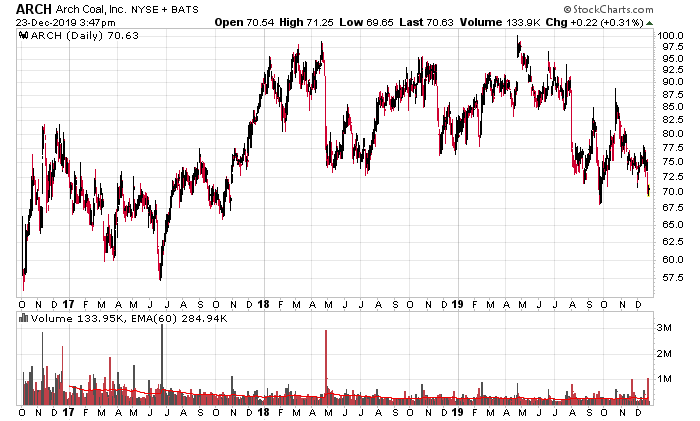
The rest of the businesses operate on maintenance capital expenditures, including the thermal coal business, which all generate a lot of cash. In 2017 and 2018, the company generated about $330 million in operating cash minus capital expenditures, which was mostly ploughed back into share buybacks. After emerging with 25 million shares after Chapter 11, their share count currently is 15 million shares (or 40% of the shares have been repurchased off the market). Thus, looking at the chart is a little deceptive as one has to compensate for the rapid amount of shares that were repurchased since 2017:
Arch Coal - Shares Outstanding and Net Debt
| Date (ending) | Shares O/S (M) | Net debt (Cash) | MarketCap ($M) |
|---|---|---|---|
| Q1-2017 | 25,021 | (213,141) | $1,757 |
| Q2-2017 | 24,310 | (212,072) | $1,849 |
| Q3-2017 | 22,119 | (131,796) | $1,690 |
| Q4-2017 | 21,070 | (103,313) | $1,897 |
| Q1-2018 | 20,663 | (113,840) | $1,670 |
| Q2-2018 | 19,703 | (84,794) | $1,667 |
| Q3-2018 | 18,832 | (93,901) | $1,806 |
| Q4-2018 | 17,831 | (109,751) | $1,571 |
| Q1-2019 | 16,959 | (70,471) | $1,645 |
| Q2-2019 | 16,262 | (86,754) | $1,450 |
| Q3-2019 | 15,095 | (46,778) | $1,191 |
(Market cap at US$70/share at Q3-2019 share levels: $1,057 million).
Putting a long story short, the company trading at its Q1-2017 market capitalization would be worth about $116/share today. On an EV-adjusted basis, $105/share. The gross debt outstanding after Q3-2019 is $305 million, most of which is in a term facility due March 2024 (interest rate Libor plus 275bps). Operating cash flows for the first 9 months of 2019 is $334 million minus $137 million in capital expenditures (net approximately $200 million). This number will likely decrease in the upcoming year as coal prices have softened.
This becomes a bet on a few fronts. One is that the commodity coal retains some sort of pricing power. On a supply basis, this appears to be the case as capital available for the purchase of new mines is limited – new projects are generated from internal cash flows, such as the case of the Leer South project. It does not appear that any thermal coal projects are proceeding forward. On a demand basis, there seems to be a better argument that thermal coal is going the way of the do-do, but I would expect the trajectory to slow down as natural gas inevitably starts to ascend and making that power source less viable, at least in North America. All indications otherwise suggest that coal, especially in East Asia and India, continues to ascend. Although North American producers have shipping constraints to getting product the market, Westshore and Long Beach appear to be viable export points.
Sentiment in the industry is horrible. Everybody believes coal is dying. Few people (unless you know the industry) appreciate the industrial usage of coking coal. University endowments and various funds are feeling public pressure to get rid of anything fossil fuel related or anything relating to climate change out of their portfolios. Since the calendar year is almost over, I would also guess there was a supply dump in December to get these offending companies out of portfolios. Finally, since China is a large buyer of coking coal, the relative instability of trade (and indeed their domestic economy) brings up questions of coking coal demand.
A few years ago ARCH managed to recapitalize its way out of $5 billion in debt, and also managed to retain a significant tax shield ($1,384 million of gross federal net operating losses, $73.3 million of alternative minimum tax credit and $64.5 million of capital loss carryforwards following the bankruptcy). Their cost structure is in the lower quarter of the various players, and should be able to withstand a downturn in commodity pricing.
Even at half the cash generation capacity, they still will be producing a lot of excess cash that they will be dumping into share buybacks – why bother investing in any coal mines when you can just buy your own shares that generate $25/share in operating cash flow for $70? They do give out a 45 cent quarterly dividend, but the net cash for that is insignificant compared to the cash that goes towards buybacks (and indeed is probably designed to get the stock automatically purchased for dividend ETFs).
I bought a few shares at US$70. It is not a large position. I would expect downside in the event of a continued metallurgical coal decline would be around US$50, but upside will be around to US$150-200/share. If the industry starts receiving any hint of love again, multiples will expand from the present 4x to something resembling a more stable and mature industry – perhaps 8x or so. When you add the fact that there were the massive share buybacks, coupled with future earnings power, there’s quite a bit of leverage to be had. It would also not surprise me if a larger mining conglomerate decided to take out the entity. You’re buying a company that has clear capacity to generate about $300 million in cash a year for a billion in enterprise value, and that $300 million figure is if things look worse than they have been in the past 9 months. The thermal coal business will be in decline, but there are precedents in the past for when such businesses are still very profitable (Competition Demystified talks about the leaded gasoline additive market as being an example).
(Some background information on the industry at large – IEA report on Coal, 2019)
Miscellaneous Market Notes
Quite a few things going on.
1) With the rejection of the Canfor offer, the stock went from $15 to $12, but recovered to $13 as I’m writing this. Many investors are probably engaging in the Canadian version of Buffett-following, which is “if Jim Pattison thinks it’s worth buying at $16, surely buying at $12 or $13 isn’t that bad.”
I do agree with general market sentiment that Canfor was lowballed, but the forest industry is cyclical and most definitely we are in the low part of the cycle. When things will emerge again remains to be seen. The good news with Canadian lumber is that it is one of our few economically competitive exports and doesn’t require a pipeline to transport. In addition, environmental groups have shifted their political focus in the last couple decades from antagonizing forestry to fossil fuels, which gives them some breathing room (for now).
In British Columbia, hardly a month goes by without hearing some news about mill shutdowns and the like. The industry is really suffering right now. The renegotiation of NAFTA and expiration of the previous softwood lumber agreement (October 2015) did not help matters at all.
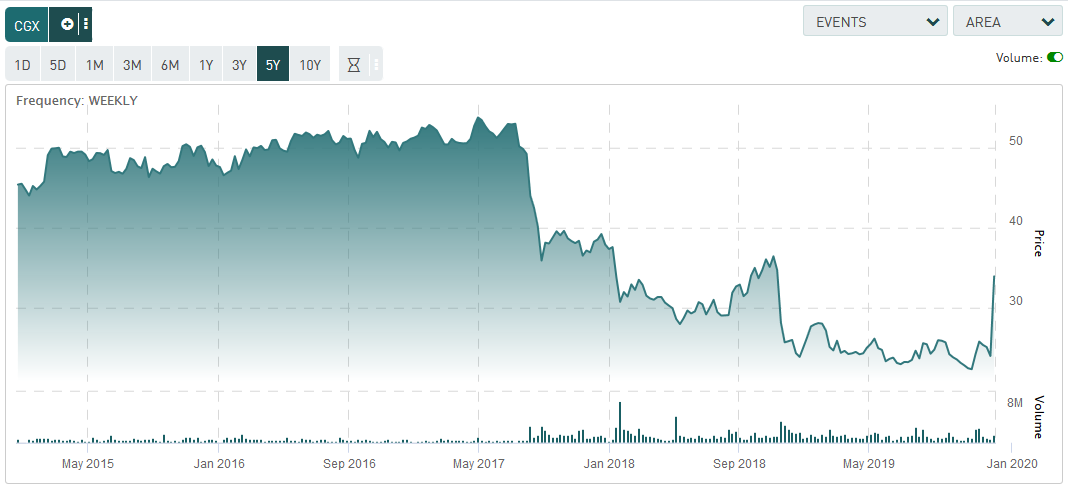
2) Cineplex (TSX: CGX) getting taken out at CAD$34 is a gift to CGX shareholders. A British firm, Cineworld, apparently has too much money and has spared Cineplex owners from taking future losses. As you can tell by the tone of this paragraph, I did not perceive Cineplex’s future business chances as being particularly rosy. The business did have value but not at the price they were trading at. I’ve written about it a few times in the past and will leave a chart here for historical purposes:
3) Another takeout which I thought would go through was HBC (TSX: HBC), which (at $10.30) was withdrawn by the proponents (Baker Group and others, 57%), and a subsequent $11 offer by another significant minority shareholder group (Catalyst, 17.5%) was rejected by the shareholders offering $10.30. This is a gigantic corporate governance mess, but what was interesting was the posting of all the real estate appraisals on their investor relations site. Get some commercial quality information for free!
4) I’ve actually been active taking small stakes in various companies in late November and December. The range of companies is widely varying. For the first time in quite some time, I’ve deployed some capital south of the border.
Two shareholder votes to watch out for this week – Canfor and Pengrowth
Two shareholder votes happening this week which will be of interest:
Vote #1: Canfor
Canfor (TSX: CFP) will vote on Wednesday, December 18, whether they want their minority shareholders (49%) to be taken out by the majority (51%), which is currently owned by entities controlled by Jim Pattison. The proposed takeout price is CAD$16/share, which was higher than its trading range for most of 2019, but lower than last year when things were looking a lot better in the forestry sector. The majority of minority shareholders is required for the vote to pass.
My guess is that this will pass. The only significant shareholder other than Pattison’s entity is through director Barbara Hislop, who controls about 2.5 million shares (out of 125.2 million shares outstanding). The rest of the shareholder base is likely to be institutional in nature and I do not think they will put up much of an opposition. At Friday’s closing price of $15.45, this seems like an easy 3.5% gain in two days of trading for those that are brave to place a bet.
Most other forest companies have gotten killed – WFT, IFP, WEF and especially CFF – picking look slim right now.
I think Pattison’s sense of market timing is excellent with this one – buy low and collect the cash when the times are better again, and they will be. The fact that this isn’t a no-brainer suggests that he’s getting a good price on the acquisition – indeed, if 99% vote to agree to it, he probably paid too much. But if 60% of the minority agree to the deal? That’s a perfect price.
(Update, December 16, 2019: The deal was rejected with 45% of the minority in favour of the deal, with 50% required. Guessing that Pattison wished that he added another 50 cents on this one to seal the deal!)
Vote #2: Pengrowth Energy
Pengrowth Energy (TSX: PGF) will also be voting December 18. The proposed acquisition price is 5 cents a share, mainly because the company has debt maturities outstanding that will likely be defaulted on if the vote goes negative. The only real question mark at this juncture is why Seymour Schulich, who owns 28% of the common shares, all of which have been purchased at significantly higher prices, is going along with this. He purchased a couple million shares as late as July of this year (for approximately 50 cents a piece) and owns 159.4 million shares out of the 560 million outstanding. Is this going to be the mother of all capital losses? Or did he cut a deal with Cona Resources (the acquirer) that will take place after the transaction concludes?
For somebody with patience, I think Cona is getting an excellent deal. With the debt eliminated, Pengrowth is very highly leveraged to ambient oil prices and if there is any revival in the market, the pain that these companies have gone through in the past half decade will be nowhere close to the rewards that will be gained in the future.
One nail before the coffin shuts on Fortress Global Enterprises
The three-year chart of this company is self-explanatory:
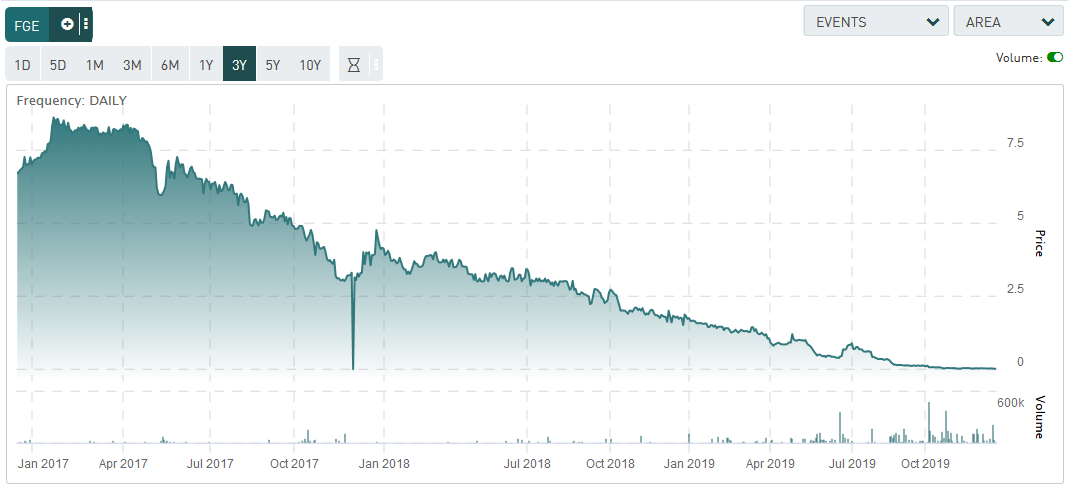
If you ever wanted to own a huge stake in a soon-to-be delisted publicly traded company, now is your opportunity – put in a bid of a penny and see how many of the 14,971,799 shares outstanding you can capture before you have to take a zero!
Earlier this week, Fortress (TSX: FGE) announced:
VANCOUVER, Dec. 10, 2019 /CNW/ – Fortress Global Enterprises Inc. (“Fortress” or the “Company”) (TSX: FGE) (OTCQX: FTPLF) announces that it has failed to receive any indications of interest pursuant to its previously announced strategic and financing initiative (the “Strategic Initiative”) by the required deadline under the financing agreement (the “Financing Agreement”) entered into among the Company’s wholly owned subsidiaries, Fortress Specialty Cellulose Inc. and Fortress Bioenergy Ltd., and their secured lenders or their affiliates (together, the “Lenders”). Failure to meet a material deadline under the Strategic Initiative when required constitutes an event of default pursuant to the terms of the Financing Agreement.
With $208 million in debt outstanding (and this debt being accelerated due to covenant breaches), and the operations being cash negative due to the pulp industry, it does not look good at all.
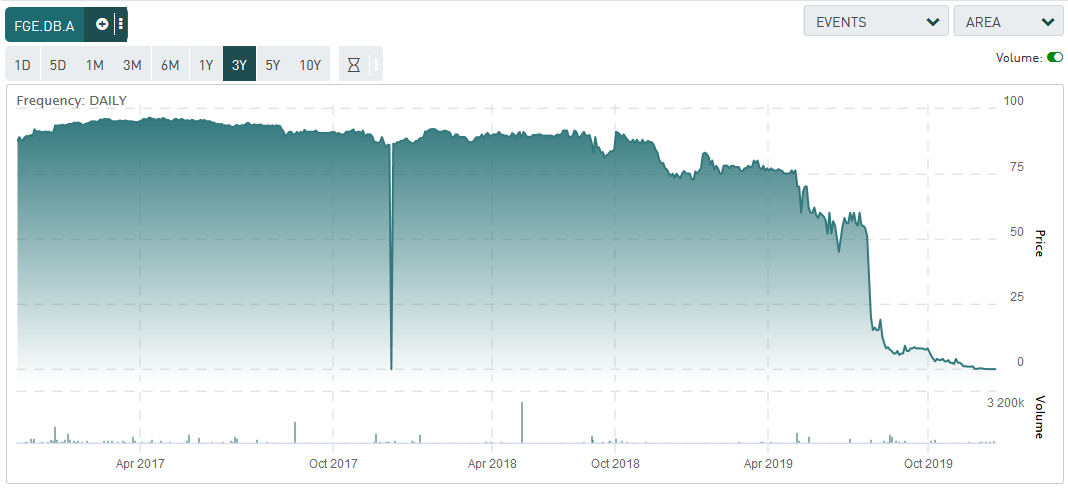
$62 million of the debt consists of convertible debentures (TSX: FGE.DB.A), which are trading at 0.1/$1,000. Amateur investors don’t apparently realize that this amount trades with accrued interest – i.e. with the 9.75% coupon, a purchaser would pay virtually nothing for the convertible debt, but they have to send to the seller nearly 487bps in interest!
In CCAA, the recovery on the debentures are most likely to be zero.
That concludes today’s financial amusement.
(Update, December 15, 2019): Well, that didn’t last long. They went into CCAA on the evening of the 13th.
I’ve posted a chart of the debentures for historical reasons.