This is a review of Atlantic Power’s second quarter, 2019.
My thesis statement on ATP a year ago was “Terrible industry, cheap stock” and little has strayed from that. The industry is still terrible (over-capacity, subsidies for wind/solar have drenched the market, etc.). However, with every passing quarter, Atlantic Power de-levers a bit and makes small financial decisions to the betterment of its shareholders.
For instance, in Q2-2018, they had US$778 million in debt, while in Q2-2019 that is now US$685 million (saving about 4.25% on interest expenses). Preferred share par value is from US$159 million to US$142 million. Shares outstanding went from 111,302,692 to 109,381,678.
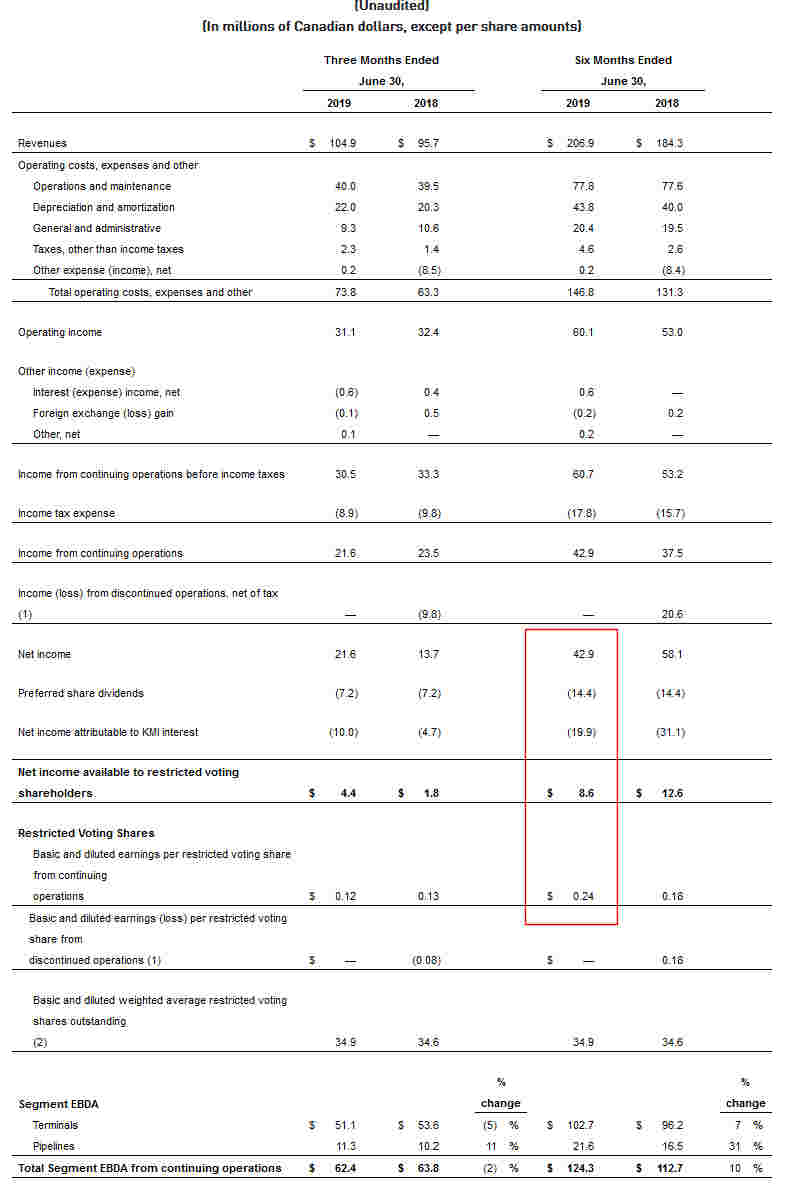
Q2-2019 was better than expected due to weather – Curtis Palmer, a hydroelectric project in New York state, is projected to contribute $8.6 million in extra EBITDA. Negatives include the prolonging of the San Diego decommissioning (and costing a million more than previously guided), and other unexpected maintenance issues. Management guided that Curtis Palmer is 17% below average in the month of July, so clearly a caution that weather can be variable.
Atlantic Power has a very low capital expenditure profile, as maintenance is directly expended off the income statement (the accounting implication here is the “DA” in EBITDA is much more relevant because you are not artificially inflating reported cash flows with high capital expenditures – effectively EBITDA is a proxy for free cash flow). For the first six months of the year, they generated $68 million in operating cash flow.
The storm clouds on the horizon involve the expiration of their power purchase agreements PPAs. Manchief, currently producing $7.7 million in EBITDA in 1H-2019, will expire on May 2022, and afterwards will be sold for $45 million. The market did not receive it very well as it represented nearly a quarter of the company’s power generating capacity (incorrectly extrapolating that the rest of it will be sold at the same rate). The company’s hydroelectric projects are much more likely to claim a higher multiple to EBITDA.
The reduction of capacity and expiration of PPAs are somewhat offset by the purchase of biomass facilities which appear to be purchased at 20%+ EBITDA levels.
As the debt continues to be whittled away at (noting that the company’s tax shield is considerable – $587 million in operating loss carryforwards as of the end of December 2018), eventually the market will realize there is a lot more value to Atlantic Power than what it is presently trading for. If by some miracle the power generation market recovers, there will be even further value to the equity. Looking at a three year stock chart is like watching a heart EKG but fundamentally, the corporation is in much better shape today than it was 3 years ago. Eventually the graph will “hockey stick”, but in the meantime, this is one to purchase and forget.
Conference call notes
Sean Steuart, TD Securities Equity Research – Research Analyst
Few questions. Wondering if you can give some context on deal flow. Are the best opportunities you are seeing limited still to biomass or are there other technologies that, I guess, state your preference for out-of-favor cigar butt-type investments?
James J. Moore, Atlantic Power Corporation – CEO, President & Director
Yes. So biomass, I would say, is the main focus of what we’re looking at now because they’re unglamorous, they’re not popular. A lot of them have had difficult start-ups and difficult operating-wise. Our internal expertise on biomass allows us to kind of roll that out as we try to integrate new plans. So we’re becoming quite a large biomass operator with the acquisitions we’re going from 4 to 8.
I think in the past, we’ve said — look, we were asked this question over the last 4 or 5 years, we’re paying off debt, but we’re going to be very focused on intrinsic value per share. We’re going to be very disciplined. So it took us 5 years before we ended up making some acquisitions.
And then what we did, we moved with some speed and scale. So I think that’s the way we’re always going to approach this. So today in terms of the deal flow, we are looking at biomass plants. We also picked up half of the hydro plant. It’s all about price to value for us, and a sector may be unpopular and then something happens.
Back in 2015, we sold off. I think it was 5 wind plants for what I estimated, my own look at it, around 14x what would be normalized as cash available for distribution. And within 6 months, with the yield cost coming apart, I thought we might be able to buy those at attractive prices. We might be able to buy wind at 15%.
And so we’re going to be very disciplined as evidenced by the fact that over 5 years, we paid down a $1 billion of debt, we cut 60% of our overhead, we didn’t do any external acquisitions for 5 years while we were buying in shares and buying prefs, but when we saw opportunity and when we thought were attractive returns, we jumped on it. It’s getting interesting now. I mean power and commodities, the difficulty with them is they’re commodity-priced and they’re capital-intensive and they’re volatile. But for a value investor, that creates an interesting opportunity set for us. So we come in every day and this — the market tells us what return we can expect if we buy in our own shares or buy prefs what the cash return on that will be.
And then, from time to time, we’ll see something in the external markets and — we didn’t go out and buy 5 plants in the last year because we had cash burning a hole in our pocket. We bought 5 plants because we thought the economics for the various plants we bought were compelling. So we’re continuing to do that, and we are seeing some interesting deal flow, some interesting disruption in the market. There is nothing imminent other than the next 2 biomass plants that are going to close very soon. But that’s the game plan we’ll say on in the next few years.