Weekly annuity or lump-sum payment

There was a story in the news about a woman in Quebec winning a lottery payout and she chose $1,000/week versus a $1,000,000 lump sum payout.

There were some very derisive internet comments against her decision. Intuitively it may seem to be the case – inflation and “bird in the hand” mentality, but when doing the math, it isn’t a terrible choice.

There are two strong variables here – your expected rate of return and your expected longevity. The higher your expected real after-tax rate of return, the more you should take the lump sum. The higher your longevity, the more you should take the annuity.

The woman in the picture looked to be around 60 years of age.

The finance math suggests that if your risk-free rate is 6% and you assume inflation of 3%, and your marginal tax rate on returns is 40%, your break-even is around 20 years.

If you expect equity-like nominal returns at 10%, then the break-even goes to about 28 years.

There are other lifestyle variables involved here, for instance, is a dollar spent today more valuable than an inflation-adjusted dollar spent tomorrow? Does this person have a pressing need for a large lump-sum amount of money today?

Perhaps the best reason I read in the discussion was that if she takes $1,000/week that her friends and family won’t hit her up for money, as this is what happens to almost all big lottery winners.

The lottery annuity is also iron-clad and virtually like a government-guaranteed and after-tax pension.

So I can respect this decision to take the $1,000/week. It can be justified.

General Fusion – How to make money appear from nowhere

I really have to give credit to these guys. Through a SPAC (Spring Valley Acquisition Corp. III, ticker SVAC), General Fusion is effectively going public. The SPAC traded up from US$10 to about US$11.50, give or take, on the announcement. The SPAC shareholders will own about 22% of the remaining entity after all is said and done – 23 million SPAC units are outstanding so the entity is already worth about US$1.2 billion off the get-go.

However, this is not the point of the post. I am writing about them internally cashing in before doing this. It isn’t like one day where you pick up the phone and order that your company get SPAC’ed – there is some lead time involved.

On August 20, 2025 they filed with SEDAR a report of exempt distribution, where from August 6 to 12, 2025 they sold $25.3 million in preferred shares, which will undoubtedly be converted into common shares. I am not sure what the conversion ratio of this transaction is, so let’s just leave it.

On November 28, 2025, less than two months before the announcement, $51.5 million in “Simple Agreements for Future Equity” and warrants with a strike price of $2.8035/share were issued. Unfortunately I do not know what the common share price subscription was effectively at, but one can infer from the warrant strike price that it was likely around CAD$2.50-ish.

So in two months, this is now worth about CAD$16/share, a cool transformation (or should I say creation?) of about $250 million from nothing in two months!

Well done! As much as this thing is going to get hyped up, I will be a spectator. And if their technology actually manages to produce sustainable and cheap fusion, they will be worth trillions in addition to decimating the natural gas market but as a physics major, I remember the in-house joke about fusion power, “Fusion is the energy of the future, and always will be”.

Velan – When getting bought out doesn’t mean going private

Velan (TSX: VLN) had an interesting transaction reported last Wednesday:

Velan Inc. (TSX: VLN) (“Velan” or the “Company”) today announced that its controlling shareholder, Velan Holding Co. Ltd. (“Velan Holding”), the sole holder of the Company’s multiple voting shares, has agreed to sell its 15,566,567 multiple voting shares and one subordinate voting share (representing approximately 72.1% of the Company’s outstanding shares and 92.8% of its aggregate voting rights) to funds managed by Birch Hill Equity Partners Management Inc. (“Birch Hill”), at a price of C$13.10 per share, for aggregate gross proceeds of C$203,922,040.80 to Velan Holding and two other entities associated with shareholders of Velan Holding (the “VH Transaction”). Birch Hill is a leading Canadian investment partner with a 30-year track record of deploying patient capital and operational expertise to scale market leaders for long-term global growth.

Velan, for those that are unfamiliar with the company, are a producer of industrial parts. It has been selling valves for roughly 20-25% gross margins (aside from the Covid times) for time immemorial and is relatively unremarkable other than when the founding family wanted to get out.

The voting shares were privately held by the family and the public (lesser-voting ‘subordinate’ shares) are traded on the TSX.

Subordinate shareholders were clearly anticipating that such a sellout would include the entire company.

Upon the announcement, the stock traded from around $19/share to under $15, likely because any speculation that they would be taken out at a premium faded away, and the final negotiated price was well under what the market was trading at.

Financially the company has had better days – like a decade ago. It is understandable how a $19-20/share valuation would be lofty.

But the overall lesson here is that when it is well known a controlled company is going to go private, the minority shareholders might not necessarily get a good deal, or in this case, any deal at all.

A few miscellaneous notes to begin 2026

Higher prices means lower returns going forward. Overall prices are quite high right now. Therefore, expect lower returns.

The few times that I have been able to identify something of value over the past year, my primary issue has been to not add enough into it. Perhaps I am just over-cautious, or perhaps I am just getting old and do not feel the need to swing for the fences anymore. The most poignant example of this was my tepid entry into Premium Brands (TSX: PBH) early in 2025 in the $75-80 range, which should have been a 10% position but unfortunately was much less. Rationally, it is better to get a small position of something that appreciates rather than nothing, but emotionally it just feels like another lost opportunity plagued with regret!

Here are some thoughts in no particular order:

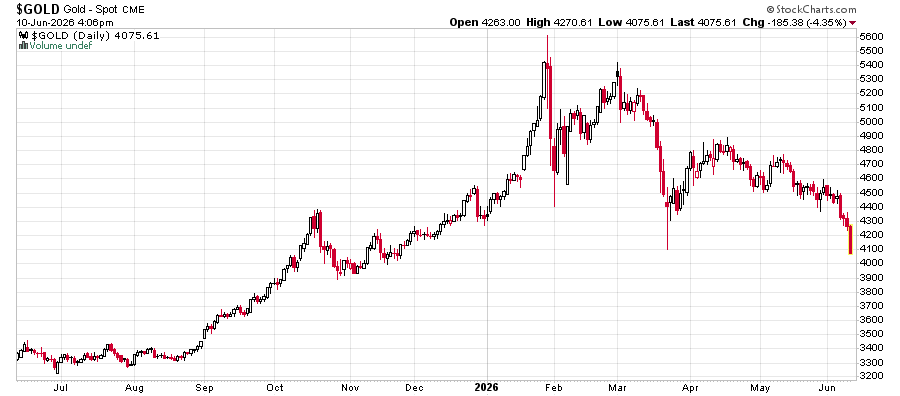
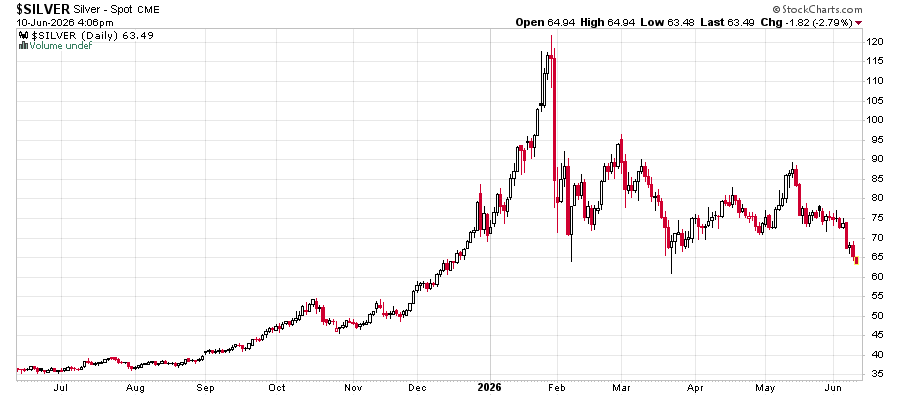
1. (no surprises here) Precious metals have gone wild over the past few months, but especially silver and platinum:

Silver is most frequently mined as a byproduct of gold production and is a relatively ‘common’ element in comparison. However, platinum is a much more rarer metal (rarer than gold). It would suggest that platinum should be more expensive than gold, but currently due to historical factors and the fact that gold is used in higher quantities, especially in jewellery, it is not.

The pricing for precious metals is making me think about several questions –

a. High commodity prices will spur capital expenditures and more production. For physical mining projects, this will take half a decade and there will be a huge lag effect between the investment and when the supply will eventually hit the market – but it will eventually. The AI machine guesses that a ‘greenfield’ gold mine project will have an AISC of US$1,600-$2,200 per ounce and other projects will be less, so there is a gigantic margin to be made on this over the next couple years. When I look at the majors (e.g. Barrick Gold, etc.), it looks like that this story has already played out in the stock market.

b. In the late 1970s after many years of soul-crushing inflation, and short-term interest rates in the double digits, gold became a very popular way to escape. There were accounts of people lining up to buy gold and silver and of course this was the best time to be selling the precious metals and investing in US Treasury bonds. While I don’t see signs of that happening quite yet, there does seem to be some element of precious metal fever reflecting sentiment on the current state of our monetary system.

c. Is physical (or financial) ownership of precious metals displacing cryptocurrency? Is there going to be a “retro” trade? I was particularly intrigued when brokerage platforms (e.g. Wealthsimple) were advertising one-tap purchases of gold, and you can have it transformed into physical metal for a nominal fee. However, what will you do with it? Just put it in a display case and have it stolen like the crown jewels at the Louvre? At least, unlikely cryptocurrency, you can melt it and turn it into a piece of artwork or create some very conductive wire or something.

I am not a fan of holding physical metal. It is a huge security risk. I have one 2 ounce silver coin which I bought many years ago and it acts as a great paperweight on my desk. It doesn’t yield anything other than looking nice.

2. Telus’ “Look! Insiders bought back stock and we did a buyback of 1.5 million shares!” announcement.

Telus came up on my year-end stock screens. I am absolutely sure retail investors will pick them because they have an absurdly high dividend rate, yield is currently 9.3%. I guess when your dividend rate is so high a stock buyback makes sense on paper, but an issue is that the free cash flow going out the window for the past 12 months is higher than the regression to the mean – plus they are still spending billions in capex with no end in sight. While I have no doubt that over time there will be an element to an oligopoly price power to keep them afloat, I would view this public advertising of managing the stock to be a negative signal.

Telus has a ton of debt (about $30 billion net) which also puts them into a dangerous area where their free cash generation to gross debt levels is quite high. While their industry is very stable, it does make them vulnerable to an external shock that would involve withdrawing of credit – these are the times that one waits for to pounce, albeit it happens so infrequently that people get impatient and want to collect a 9% yield instead of waiting for the moment they can purchase shares for 50% cheaper.

The nearest comparable is Bell Canada (TSX: BCE), which is in slightly better financial position than Telus and they already cut their dividend to finance questionable acquisitions and shore up their heavily indebted balance sheet.

A general rule, however, is that if yield is the only thing you are seeking in an investment, you might get dissapointed. Telus sticks out like a sore thumb in this department and it makes me very, very suspicious, especially when seeing this press release from them.

3. Money supply keeps on growing – Bank of Canada – $4.993 trillion in June 2025, $5.090 trillion in October 2025… where does that cash liquidity end up? Some of it in gold, platinum and silver of course, but also the TSX, which was up 32% (total return) in 2025.

Money is reflected by a journal entry – somebody’s credit is somebody else’s debit and the total sum of liabilities plus equity is equal to assets – the larger this number, the larger the nominal returns will be sought after, and the larger the inflation. Hence, we have the Canadian financial sector doing very well in 2025:

The Bank of Canada reducing interest rates from 4.5% to 2.25% just might have something to do with this chart!

4. The compression in real estate, especially in the residential condominium markets in Vancouver and Toronto, is starting to have an effect on rental prices and this is reflected in the price of CAPREIT (TSX: CAR.UN), albeit not today when I am making this post!

There is so much levered finance on real estate that governments and central banks have huge incentives to not letting things get too bad. I suspect things will meander on this front for many years.

5. Lower interest rates create abundant credit conditions, causing a huge chase for yield – preferred shares are now a wasteland (lots of issues trading at/above par), corporate credit spreads are narrow, and Canadian debentures are mostly at par – things in fixed-income land are just terrible if you want to make a high return.

On the Canadian debenture front, I do note that George Aryoman’s adventures into Slate Office REIT (now Ravelin, RPR.UN) doesn’t look like it is going too well – his entity, G2S2, is lending a good chunk of credit and this has been extended out and is now being paid 10%. RPR.DB is a $29M debenture that is outstanding on January 31, 2026 and the debenture series have not been paid interest for quite some time. My comments I made nearly three years ago about this train wreck have aged fairly well, “I quickly came to the realization there is no way for a financial flea such as myself to “win”.”.

6. Software has not done well in 2025. The market starling, Constellation Software (TSX: CSU) has fallen from grace, from $5000/share to $3,200 presently. Its twin cousin, Topicus (TSXV: TOI), also has exhibited a similar price curve. Both of them have been a valuation mystery to me.

However, more common-name companies are also feeling the crunch. Adobe (Nasdaq: ADBE) is trading at 3 year lows, presumably a brand and suite of software that has a following nearly as strong as people’s familiarity with the Windows operating system. As far as large-cap companies go, Adobe seems to be relatively cheap for what it is.

Finally, the drama at Dye and Durham (TSX: DND) or should I say, Dead and Durham? has not resolved itself. We also have companies that have not gone anywhere for seemingly centuries, including Calian Group (TSX: CGY), and OpenText (TSX: OPEN).

7. Energy and lumber are two commodities that have not done well. Despite energy, Canadian oil and gas has picked up a bid – sentiment has made a notable turn there. Lumber, on the other hand, looks to be depressed as the state of the real estate market is suppressing consumption. However, when this turns, there will be a massive spike up in lumber prices as supply constrictions have been significant. Thus, I would pay attention to lumber as a potential “sleeper hit” for 2026. Surely it can’t get worse for them?

Is Dye and Durham going to… die?

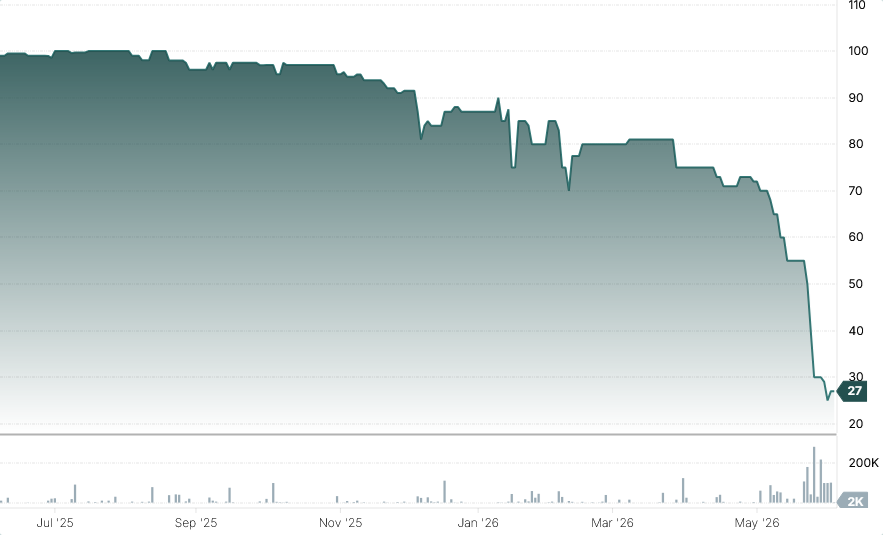
Dye and Durham (TSX: DND) has an interesting story but sadly it may be coming to a close simply because they couldn’t produce financial statements and creditors tend to not like it when the entities they lend money to aren’t in any position to pay back, let alone knowing how much money they are making! As there is a possibility it may be delisted in the near future, I will post its 5-year chart:

During the Covid era the company made many software acquisitions and paid for it with debt financing – amassing about $1.6 billion net from their last reported date, albeit generating $150 million in free cash flow in the past 12 months they have reported. Other than the software they have acquired (amounting to $1.8 billion in goodwill and intangibles) and the material amount of debt, there is nothing else of note on the balance sheet – tangible book value is about negative $1.5 billion.

However, reporting is one of the issues going on – their last financial statement available is from March 31, 2025 (their Q3-2025 as they have a June 30 fiscal year end!).

After they produce the audited financial statements (if they do!), it would not surprise me if there was a massive writedown in the goodwill.

The other issue is that they have been perpetually at war with their shareholders. The drama is simply too much to repeat here, but just giving a scan of the press releases over the past couple years should give a good indication of what is going on.

Notably, despite any lack of financial reporting, one significant shareholder (Plantro) reportedly was going to offer CAD$5.72/share for the entity.

However, just yesterday the TSX finally halted trading on the stock for prolonged non-reporting. Pretty much whichever shareholders are in the stock are locked in until the company either produces audited financial results, or their creditors lower the boom on them.

One interesting data point is that despite the stock not being tradable, their corporate debt is – their 8.625% issue maturing April 2029 (senior secured!) is currently trading at a yield to maturity of just over 12%, about 90.5 cents on the dollar. Given the seniority status of the debt, if DND does go into CCAA, there will likely be some form of recovery by the debtholders (they share the status with the bank creditors, for a total of about USD$905 million plus whatever is on the revolving loan facility).

There is no point for a small fish like myself to get involved with this, but it is interesting to watch. It is also a cautionary tale of companies that expand themselves with debt financing too rapidly.

Thankfully, no positions.