Teekay Offshore’s common units are not going anywhere

Reviewing Teekay Offshore’s financial results (NYSE: TOO), it strikes me as rather obvious that they have missed their initial early 2016 targets when they proposed a partial equitization (issuing common units, preferred units, and some refinancing) of their debt problems. They also borrowed $200 million from the Teekay parent entity (NYSE: TK).

In Q1-2016, they delivered a presentation with this chart:

In subsequent quarters, the company has generally not referred to progressing tracking to this projection, mainly because their debt to cash flow through vessel operations ratio has not met these targets. While the underlying entity is still making money, revenues are eroding through the expiration and renegotiation of various contracts, couple with some operational hiccups (Brazil) that is not helping matters any.

Putting a lot of the analysis away from this article, while in 2017 the future capital expenditure profile is going to be reduced (which would greatly assist with the distributable cash flows), the company doesn’t have a lot of leftover room for matters such as debt repayment and working on improving their leverage ratios in relation to cash generation ability. This leaves them with the option of continuing to dilute or depend on the parent entity for bridge financing. Indeed, one reason why I believe management thinks the company is still open for dilution is due to them employing a continuous equity offering program – they sold nearly 1.9 million units in the quarter at an average of US$5.17/unit. If they don’t think the company is worth US$5.17/unit, why should one pay more than that?

I don’t believe that they are a CCAA-equivalent risk in the current credit market (this is a key condition: “current” credit market), and I also believe that their preferred units will continue to pay distributions for the indefinite future, I don’t believe their common units will be outperforming absent a significant and sustained run-up in the oil commodity price. Note that there is a US$275 million issue of unsecured debt outstanding, maturing on July 30, 2019, which will present an interesting refinancing challenge. Right now those bonds are trading at around a 10% yield to maturity.

I have no positions in TOO (equity or debt), but do hold a position in the Teekay Parent’s debt (thesis here).

Pengrowth Energy Debentures – cash or CCAA

A quick research note. Pengrowth Energy debentures (TSX: PGF.DB.B), something I have written in depth about in the past as being one of the easiest risk/reward ratios in the entire Canadian debt market, has reached the “point of no return” with regards to its redemption. They are to be redeemed on March 31, 2017 for cash (and an extra half year of accrued interest at 6.25% annually). For the company to exercise its option to redeem them for shares (of 95% of TSX VWAP), they needed to give 40 to 60 days of notice from the redemption date.

(Update, February 21, 2017: Pengrowth announced they will be redeeming the debentures on maturity at March 31st. Also on their senior debt covenants, it looks like somebody is trying to steal the company… they might be forced into making an equity offering.)

My math says that the next market opening, February 20, 2017, will be 39 days before March 31st.

Barring some sort of mis-interpretation of the legalese, this means that the company must redeem this debt (CAD$126.6 million) for cash. The alternative is CCAA, which I do not deem is likely considering Seymour Schulich would likely have something to say about that particular option (he controls 109 million shares or 19.9% of the company at present). There is no longer any time to negotiate an extension with debenture holders.

This debenture issue was acquired as a result of the NAL acquisition back in 2012. It was originally CAD$150 million but they company repurchased some at a considerable discount to market earlier this year.

Pengrowth is in the middle of a silent negotiation with their senior creditors as they are in covenant troubles. Their senior creditors will no doubt be unhappy with the fact that some company cash is going towards a junior creditor.

Sadly I have no good candidates for re-investment at this time. Suggestions appreciated.

Genworth MI reports Q4-2016

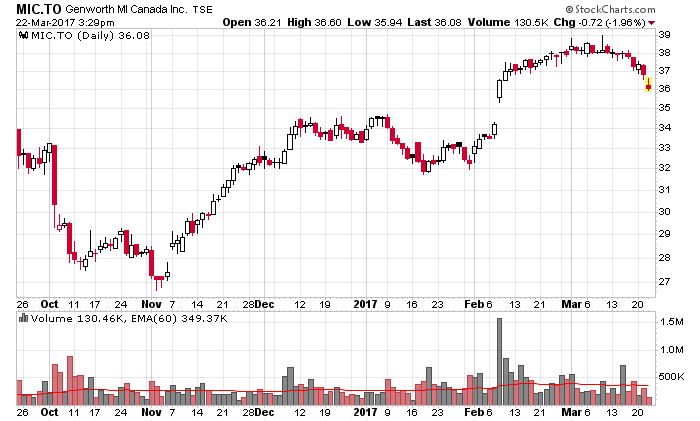
Genworth MI (TSX: MIC) reported their fourth quarter a couple weeks ago. This post is a little late in the game (and irritatingly, a conference call transcript has not been made available and I have had to suffer the indignity of actually listening to the conference call). By virtue of the Canadian housing market not imploding over the quarter, the company likely exceeded market expectations, which registered a 10% price spike since their announcement.

Here are some of my takeaways:

* Loss ratio is exceptionally low, at 18% for the quarter. Management projects 25-35% for 2017 as they identified that Fort McMurray and Quebec were abnormally low in Q4-2016 and that a more normalized loss ratio is to be expected in BC and Ontario (which have been quite dormant in terms of mortgage defaults).

* Book value is up a little bit to $39.28, which is $2.46 more than the previous year. The market value continues to converge to book.

* Premiums written, Q4-2015 to Q4-2016, was down about 20%. Portfolio insurance is down as expected per the rule changes, and transactional insurance is down due to the changes in the mortgage rules. The new capital requirements and new premium changes will kick in at the end of March which will offset reduced volume with price increases.

* Investment portfolio continues to be managed in line with previous quarters, in addition to the losses incurred by the preferred share portfolio seemingly normalizing (and if rates continue to rise, discounted rate-reset shares should fare quite well in that environment).

* Regulatory ceiling for private mortgage insurance was raised from $300 billion to $350 billion, which makes this a non-factor for the next while (a low risk that did not materialize).

* New capital requirements result in a “recalibration” of the minimum capital test ratio. The company is internally targeting 160-165%, and each percentage point is about $25 million in capital. Once they head over 165% then the surplus will likely be distributed via buybacks or dividends – it does not look like anything special is going to happen on this front in 2017 as they will be using retained earnings in order to buffer the capital levels. The new OFSI regulations have grandfathering components with respect to the capital requirements which should mathematically ease in the new capital requirements (especially with the evaluation and testing of the mortgage books acquired 2016 and earlier), but the MCT ratio is not likely to materially climb higher to the point where one can start thinking of extra dividends or buybacks.

* Insiders have exercised options and dumped stock after the earnings release, which is a negative signal.

I will warn readers that I have also lightened my own position in Genworth MI in the days ahead (i.e. after they announced) of the earnings announcement, my first sale since the second half of 2015. The last quarter was undoubtedly a good one for the company. I still have a large position in the stock, but I was reducing my position strictly for reasons that it had gotten too concentrated and I want to reduce my overall portfolio leverage. There is still a lot of runway for Genworth MI to run up to the low 40’s as they have everything going correct for them fundamentally and are generating a lot of cash in a semi-protected business environment. The whole country has been so bearish on Canadian housing that they forget to realize there are considerable pockets of profitability and Genworth MI is one of the spaces where there is money that continues to be made – I am guessing that the short sellers have gotten killed on this one.

Most surprising chart of the month

January has generally been proceeding to plan (i.e. nothing really exciting going on in my neck of the financial woods!). But the real surprise to me to date is the following chart:

The strength of the Canadian currency has been quite impressive in light of what is going on (coupled with a general lack of rise in the fossil fuel commodity market rate). I am generally agnostic about the strength of the Canadian currency (i.e. I rarely have strong feelings about its primary direction), but lately I have been getting pessimistic about it strictly due to various macroeconomic factors (including the fiscal situation, Canadian/US monetary policy, geopolitical, commodity situation, etc.).

Macroeconomics for me is a complete crapshoot so I don’t place too much of a stake on my own predictions in terms of currency. I generally keep a balance between 30-70% USD exposure (the exact amount depends on appreciation/depreciation of CAD/USD components in the portfolio as well).

Market is predicting Genworth Financial’s merger with China Oceanwide will fail

The market is projecting that Genworth’s (NYSE: GNW) US$5.43/share cash merger with China Oceanwide will fail:

The issue revolves around the insurance unit that contains their long-term care insurance liabilities – the theory would be that the Genworth is unlikely to obtain state approvals without taking the full burden of the LTC division.

The salient part of a piece of nearly unreadable verbiage from the finalized merger proxy form is the following:

In addition, it is a condition to the obligations of Asia Pacific and Merger Sub to consummate the merger that certain affiliates of Genworth shall have received regulatory approval (or non-disapproval, in certain instances) from the Delaware Department of Insurance and the Virginia Bureau of Insurance to effect the U.S. Life Restructuring, including the unstacking and the following intercompany reinsurance and recapture transactions between GLAIC and GLIC: (i) a reinsurance transaction pursuant to which GLIC will reinsure certain long-term care insurance business from GLAIC (which we refer to as the “Long Term Care Reinsurance Transaction”); (ii) separate reinsurance transactions pursuant to which GLAIC will reinsure from GLIC (A) certain universal life insurance business and term life insurance business, (B) certain company-owned life insurance business and (C) certain single-premium deferred annuity business, single-premium immediate annuity business, structured settlement annuity business and fixed annuity business (which we refer to as the “Life Restructuring Reinsurance Transactions”); and (iii) a transaction pursuant to which GLIC will recapture from GLAIC certain single-premium deferred annuity business that is currently reinsured by GLAIC from GLIC (which we refer to as the “Recapture Transaction”). GLIC and GLAIC have received approvals for the Long Term Care Reinsurance Transaction from the Delaware Department of Insurance and the Virginia Bureau of Insurance and completed the transaction effective November 1, 2016. Genworth made regulatory filings with respect to the unstacking with the Delaware Department of Insurance on December 21, 2016 and the Virginia Bureau of Insurance on January 3, 2017. Genworth made regulatory filings with respect to the Life Restructuring Reinsurance Transactions and the Recapture Transaction with the Delaware Department of Insurance and the Virginia Bureau of Insurance on December 16, 2016. In addition, the merger agreement provides that Genworth, in consultation with China Oceanwide and applicable insurance regulators, may explore the feasibility of the transfer of GLAIC’s 34.5% ownership interest in GLICNY to GLIC and, if approval from such regulators is received, to pursue such transfer.

If, for whatever reason, you believe these applications will succeed, then there is a very easy method to turn $3.30/share into $5.43/share in less than six months. Won’t tell you what I think, but I’ve been digging.