The MEG Energy Takeover Sweepstakes

Following up on my article “When will Cenovus or CNQ buy out MEG Energy?

Things have evolved since Husky Energy tried to take out MEG Energy at $11/share back in October 2018:
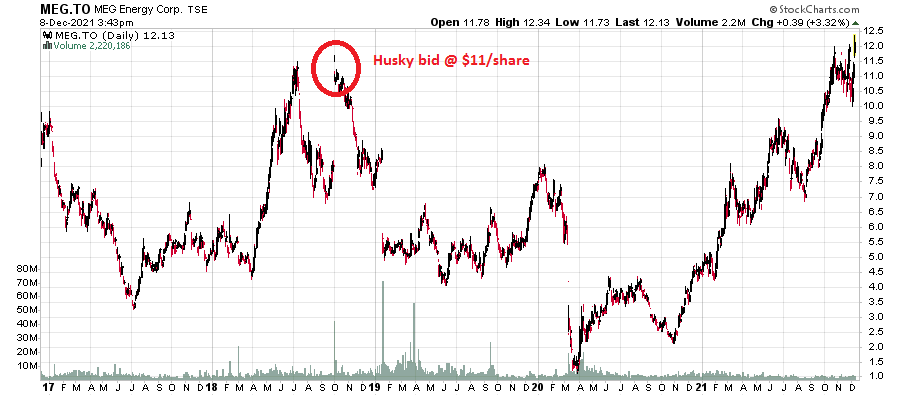
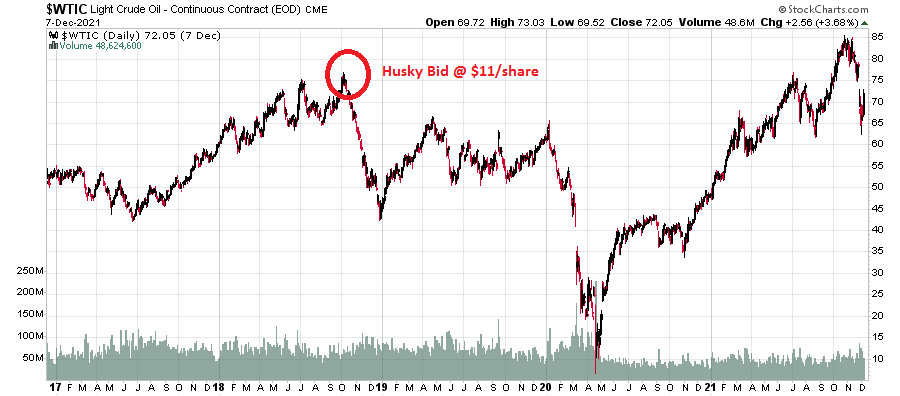
At the time of the Husky offer, WTI oil was at US$75/barrel, MEG had 297 million shares outstanding (today they are at 307 million), and they had $3.2 billion net debt (today they are sitting at under $2.6 billion). Annual production in 2018 was 87.7 kboe/d, while in 2022 it will be around 95-96 kboe/d.

By all accounts MEG is in better shape today than it was 3 years ago. Will it be CVE or CNQ to first offer a stock swap for a 30-40% premium over the current price?

The big hidden asset not readily visible comes from the following two paragraphs on MEG’s financial statements:
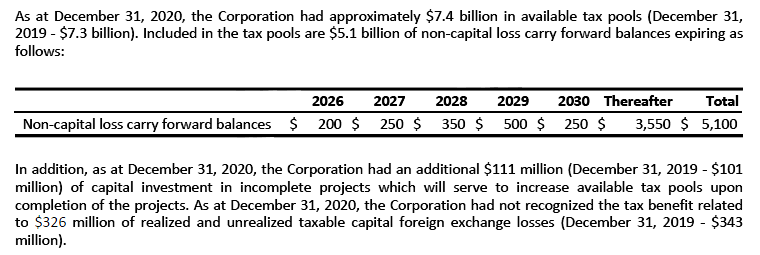
With WTI at US$70/barrel, it will take a very, very long time to dig through these tax pools. Simply put, $5.1 billion in non-capital losses represents an additional $1.2 billion of taxes that can be bought off in an acquisition. With the way things are going, Cenovus will be able to eat through their tax shield mid-decade (they also inherited a tax shield from the Husky acquisition), and CNQ’s tax shield is virtually exhausted at this point (they did acquire some with their announced acquisition of Storm Resources on November 9th, but this will go quickly as Storm had about half a billion in operating loss and exploration credits).

Either way, this tax pool is a ‘hidden’ asset and will bridge the differential between the current market value and a takeover premium. Since valuations in the oil patch are still incredibly depressed (enterprise value to projected free cash flows are still in the upper single digits across the board), a stock swap makes the most sense.

Operationally this is the most likely course of action – without a major capital influx, MEG is constrained to around 100kboe/d of production and things will be pretty much static for them after this point. The only difference at this point is whether Western Canadian Select valuations rise (having Trans-Mountain knocked out for two weeks did not help matters any) and what the final negotiated value will be. The acquiring entity will be able to integrate MEG’s operations to theirs quite readily and shed a bunch of G&A after they pay out the golden parachutes.

Needless to say, I’ve had shares of this at earlier prices.

Corporate earnings for the quarter – Oil and Gas

The next couple weeks will be busy processing quarterly earnings reports.

Oil and gas, however, will be the most interesting. There will be a bonanza of cash flows.

MEG Energy (TSX: MEG) was the first off the bat.

I’ll spare the details and focus on the following line in their PR:

Based on the current commodity price environment, MEG anticipates generating approximately $275 million of free cash flow in the second half of 2021, which will be directed to further debt repayment.

Just below that they talk about one of the worst hedges I can think of, which was to hedge for oil prices in Q2-2020 in a US$39-46 WTIC band. They have about 1/3rd of their production hedged at this level (29k BOE/d) which has lost them a gigantic amount of money. Fortunately it is done after the year is over, but it will be another $125 million of damage (lost potential) at current prices. The hedges cost them nearly half a billion dollars in lost opportunity in the first half of the year.

Adjusting for their hedge disaster, the “true” projected free cash for the second half is closer to $400 million.

Considering the enterprise value of the company is around $5 billion, that’s trading slightly above 6x EV/FCF. This isn’t a case of some US shale driller with a 35% annual decline rate – MEG’s asset is much longer lasting.

MEG currently does not give out a dividend. They are pouring free cash into reducing their debt – they announced they are paying back US$100 million of their existing US$496 million 6.5% senior secured second lien notes (matures 2025). At the rate cash is being generated, they will be able to retire debt this sometime in 2022, and after they will be able to work on the US$1.2 billion 7.125% senior unsecured notes. This tranche matures in 2027.

If oil stays at current pricing, the debt gets removed pretty quickly (in addition to saving money on interest expenses).

Eventually there is a point where it becomes logical to buy back stock, assuming they stay at 6x EV/FCF. It’s a matter of whether management wants the sure 6.5 to 7.125% return, or whether they want to buy back stock at a 16% return on equity.

I speculated that somebody else might be happy to do that for them.

When will Cenovus or CNQ buy out MEG Energy?

MEG Energy (TSX: MEG) is an oil sands producing company with a very good asset – it occupies a prime bitumen producing location at Christina Lake, Alberta. The type of mining is the typical steam-assisted gravity drainage project that, one you put in the required capital expenditures and intellectual prowess, has a relatively low rate of decay. It will produce for decades.

Geographically speaking, the company is out of options. There’s little in the way of synergies as they are surrounded by Cenovus and CNQ’s properties. There isn’t much of a choice beyond optimizing the primary asset they own (which is very valuable) and generate cash. The asset will be producing for decades.

They are properly capitalized – approximately US$2.3 billion in debt securities, with maturities on 2025, 2027 and 2029, in addition to an undrawn credit facility. They made some (retrospectively) stupid hedges on WTI which will cost them a few hundred million in lost opportunity costs in 2021 (approximately a third of their production is hedged at US$46 WTI), but they claim this was to fund the existing year’s capital budget in the event that crude crashed. CEO Derek Evans was formerly the CEO of Pengrowth Energy, and the only reason why Pengrowth lasted as long as it did before it was unceremoniously bought out for 5 cents a share was because they hedged a ton of production before oil prices tanked.

After Line 3 and TMX become operational, egress issues will likely subside and at current prices, they will be generating a significant amount of cash. While they do not give out dividends at present, it probably won’t make much difference in the end equation – they are likely to get consolidated by one of the two in the title of this post.

Notably, MEG rejected a hostile takeover from Husky in 2018 (which was offered at a higher price). From a strategic perspective, Cenovus (which took over Husky at the beginning of this year) would make the most amount of sense – they would own the majority of the bitmuen complex around Christina Lake. They have been busy digesting the Husky merger, but there’s probably ample room for a stock swap. MEG at the end of December 31, 2020 also had a $5.1 billion non-capital loss carryforward, so this would survive a merger and constitute a non-trivial tax asset for an acquirer.

This analysis is by no way a secret – they have been a logical target for ages. We will see.