Yield chasing is back in vogue

(rest assured, I have never been paid to post anything on this site, and this will pleasantly continue)

ETF marketing is clever as always. Did you want a 13% yield? Introducing the Hamilton Canadian Financials Yield Maximizer ETF!

They politely inform you that they are “Canada’s Highest Yielding Financials ETF”, featuring a “13%+ target yield”.

Not just 13%, 13%+.

Who can resist?

They also inform you, in bold font, that “HMAX does not use leverage.”

Is this a dream come true?

Digging into the much dryer prospectus, we get the following:

HMAX will seek to achieve its investment objective by investing in the top ten Canadian financial services stocks by market capitalization (each, a “Financial Services Company”, and collectively, the “Financial Services Companies”).

To mitigate downside risk and generate income, the Portfolio Adviser, in conjunction with the Sub-Advisor, actively manages a covered call strategy that will generally write at or slightly out of the money call options, at its discretion, on up to 100% of the value of HMAX’s portfolio. Notwithstanding the foregoing, HMAX may write covered call options on a lesser percentage of the portfolio, from time to time, at the discretion of the Portfolio Adviser. The Manager has retained Horizons to act as sub-advisor to HMAX solely in respect of the writing of such covered-call options on its portfolio securities. HMAX’s strategy seeks to generate attractive option premiums to provide increased cashflow available for distribution and reinvestment, downside protection, and lower overall volatility of returns.

Here lies in the secret sauce. They invest in highly capitalized Canadian financials, and then try to make up the differential with selling call options. You can actually replicate this fund at home if you wanted to.

Here’s the problem. Essentially the fund is taking the worst of both worlds of split share funds and covered call ETFs.

The call options simply aren’t going to make that much money, especially if the fund starts to scale up in size.

The top holdings of the fund is the Royal Bank, at 23%. The “big five” Canadian banks consist of 71.4% of the fund. If your throw in National, it’s over 3/4 of the fund. Let’s concentrate on Royal.

Royal Bank has a 3.9% dividend. So you need to make up 9.1% over the course of a year to get your quota.

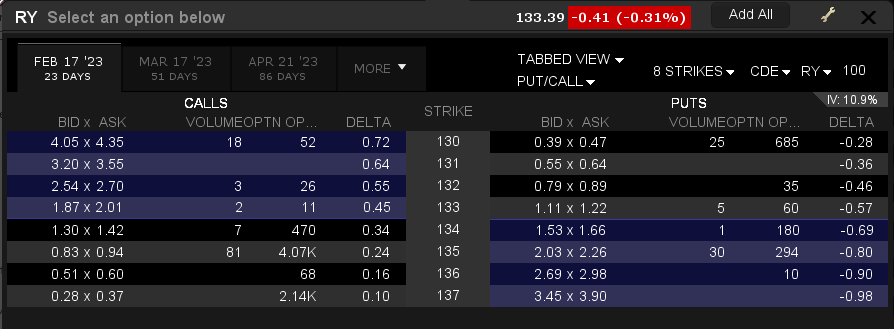
The front-month for Royal Bank options is trading at a Black-Scholes implied volatility of 11%:

So your strategy is to buy stock and sell the next nearest strike at the money, which in the case of RY would be a 1% premium over 23 days (16% annualized!). If you take the next month, you get a 2% premium over 51 days (14% annualized!).

The math goes like this – you repeat this every month and you suddenly earn 3.9% in dividends and an additional 12% yield, you can “easily” get to your 13% quota. Free money!

Forget about capital upside with this strategy – it is a guaranteed “ratchet” that can only click down in price.

Let’s tear this apart a bit.

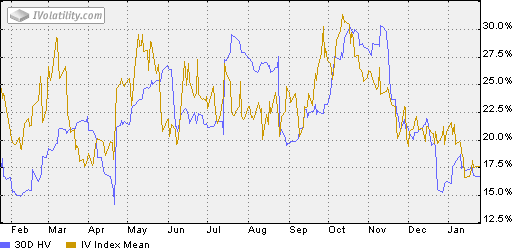
The above chart is the 30-day historical volatility of RY and the implied volatility. The IV index in this chart is normalized to fixed tenors (30, 60, 90, 120, 150, 180 days) using a linear interpolation by the squared root of time, and does not represent the “spot month”‘s implied volatility, which is why the IV index is higher than the front month at the moment.

The point I am trying to make here is that covered calls are being sold cheaper than the likely actual forward volatility of the stock.

Most, if not all, of these covered call strategy funds are, at their core, leaking value through selling call options below intrinsic value because the covered calls are being sold blind to their value. The same style of arguments have been levied against index funds in general in regards to the price insensitivity to the equities in their respect indices. I am sure the initial covered call fund realized a reasonable semblance value, but when you have hundreds of millions or billions of dollars of assets under management employing a strategy into a less than robust Canadian options market that is not going to fundamentally support the liquidity, the response is that the option market makers are going to price the options cheaply.

This is not limited to Hamilton Funds, there is plenty of this going on in the overall marketplace. Volatility can be ‘harvested’ by selling theta on a variety of securities out there. It appears like “free money”, until the market rips up.

Essentially is the other side of the market will be able to “rent” the stocks for relatively cheap rates.

What I project happening is that this fund will discover that making its 13% quota through covered calls will become progressively more difficult to achieve and inevitably distributions will come from return of capital to make up the difference. While the fund will be able to distribute its mandated $0.185 monthly distribution, it will come at the cost of its capital value. It will take a few years for this effect to be apparent.

The easiest way to measure this effect over time is to make a comparable index basket with just strictly the equity (with dividends reinvested) and no derivative trading on the portfolio, and compare the performance between this index and HMAX.

Notwithstanding the 0.65% MER, I predict that the index of straight equity ownership would outperform. This is the inevitable result of employing price insensitive derivative strategies.

However, I have to commend Hamilton for their marketing. I am sure there will be another fund along the way that will promise 15% returns, and 20% returns, and 25% returns until it all busts. This is kind of reminding me of the chase for yield that occurred in the mid 2000’s when you had a huge proliferation of Canadian income trusts going public, which many of them were simply return of capital vehicles.

Mixed signals – thoughts 1/24ths into the year

This is going to be a fairly rambling post, be warned.

After the first week of the year, I extrapolated that by the end of the month that I would be bankrupt. I was then carefully preparing my own bankruptcy filing and then things went 180 degrees from there onto the upside, so I’ve had to shelf my consumer proposal until the next market downturn.

As some of my readers may know, I have been in a state of confusion and have found the cross-currents to be very difficult to swim in. The good news is that despite being jerked around in the currents, the lifejacket I am wearing is very buoyant and to quote our Prime Minister, “the portfolio will take care of itself”.

That said, I am always on the lookout to add value where possible, but the hurdle rate for cash (nearly 5%) is the highest it has been since before the 2008 economic crisis. This brings a different variety of challenge, namely that the speculative winds are blowing in rather odd directions.

Natural Gas

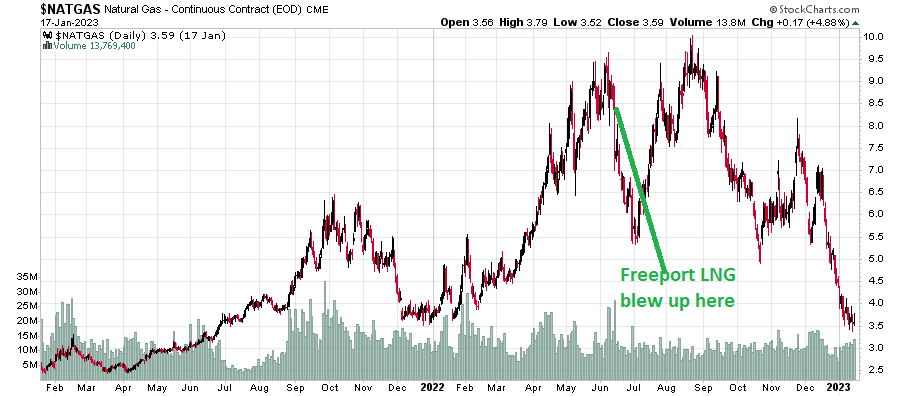
Partly due to a very fortunate warm winter in Europe, the commodity price of natural gas has been completely hammered down:

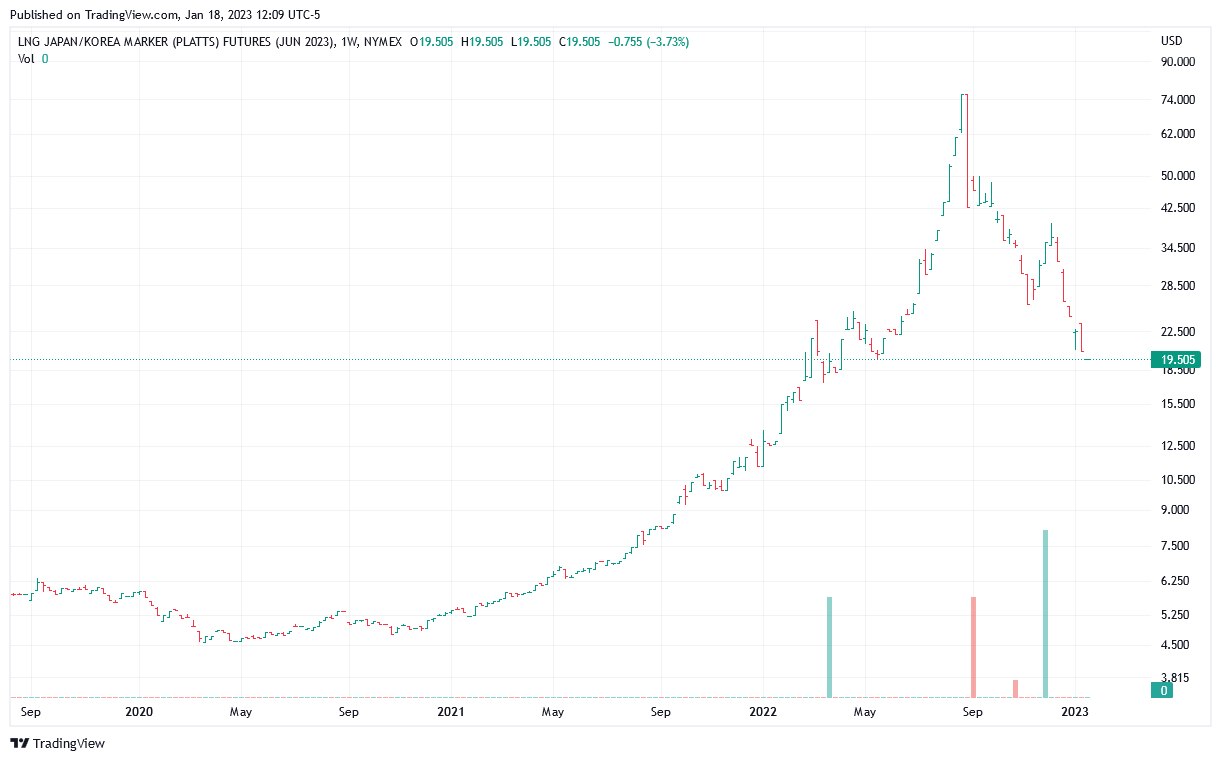
Because of this, LNG delivery prices to Asia (I’ll use the summer 2023 chart, but you can choose whatever delivery date you want) has gone from something huge (up to $76/mmBtu!!) to $19 today:

People that have leveraged long on natural gas have gotten killed. Interestingly enough, the impact on equity prices has not been as terrible as the charts would indicate, but this is because company capitalization rates have increased. The simplest entity that characterizes your typical Canadian (exclusively Alberta) natural gas producer is Birchcliff Energy (TSX: BIR) and they give fairly detailed (and perhaps more importantly, honest) guidance and effectively at this point it is a direct proxy for spot gas with some linkage to Dawn, Henry Hub and AECO. When natural gas was making its highs, the company was trading at around 4x free cash flow to EV. Today, the company will be making less than half of what it would be three months ago, but the EV/FCF ratio has increased from 4 to 9, so the stock has only taken a mild hit (about 20% below the October peak). Even day-to-day trading has exhibited less correlation to spot prices, which I am finding interesting. Are markets slowly pricing in other variables than cash flow (e.g. reserve capacity)?

Bed, Bath and Beyond

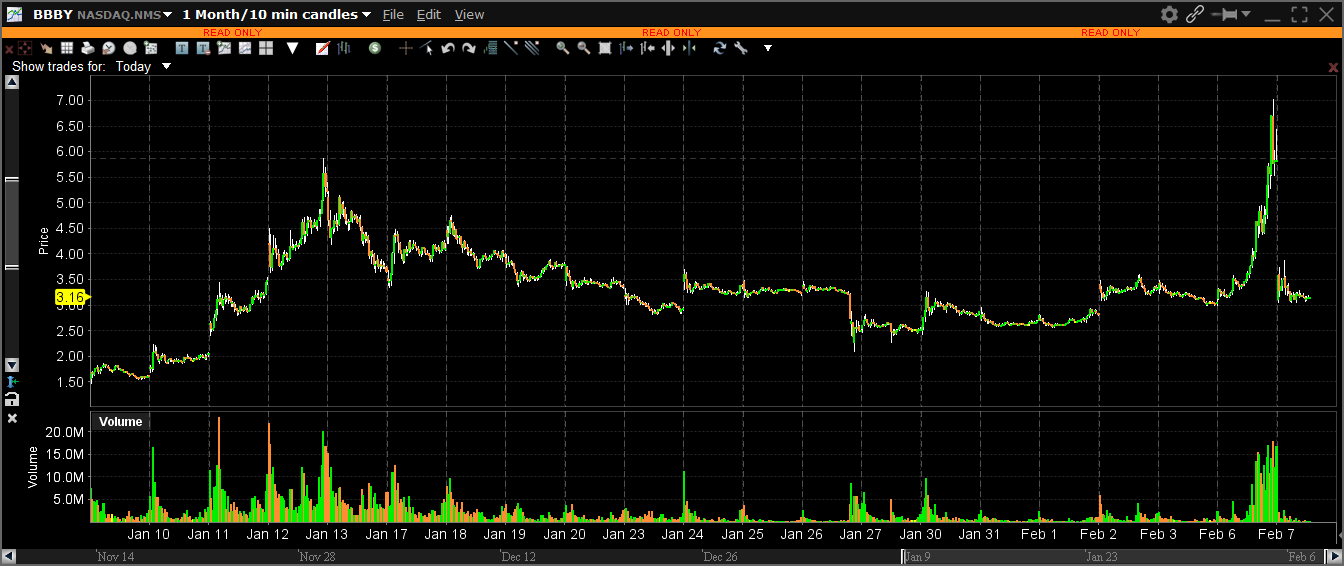
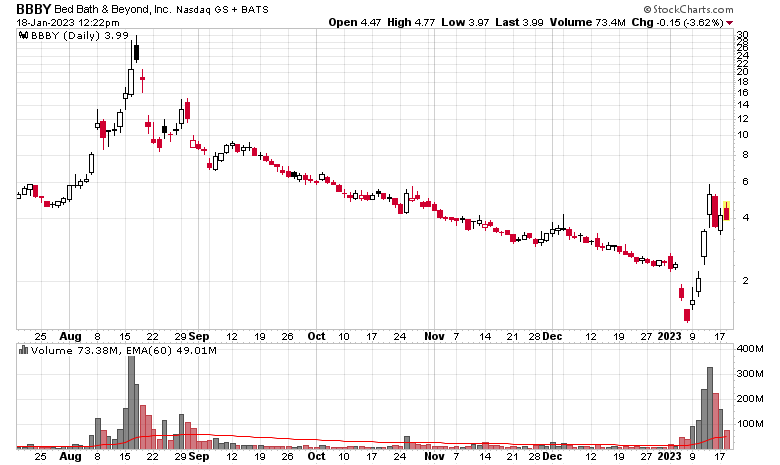
I must say, this has been as fun as Gamestop in the glory era to watch trade:

Shares are not available for short sale, and what kicked off the recent price spike was rumours that the company was shopping around for bankruptcy consultants. Needless to say, the company is in awful financial position. They filed for a late 10-Q on January 5th, and had the following paragraph:

While the Company continues to pursue actions and steps to improve its cash position and mitigate any potential liquidity shortfall, based on recurring losses and negative cash flow from operations for the nine months ended November 26, 2022 as well as current cash and liquidity projections, the Company has concluded that there is substantial doubt about the Company’s ability to continue as a going concern.

This is a “brace for impact” statement.

Let’s get a little more specific – at the end of November, they had $153 million cash in the bank and $1.9 billion in debt (not including lease liabilities, something that would be considered critical for a retail operation!). Add onto that $400 million of cash bleed in the three months ended in November, and suffice to say, this is like a 747 jetliner that is a thousand feet above the ground and heading down at a 60 degree angle. It is not pretty. The publicly traded long-term debt is trading at around 5 cents on the dollar.

However, the equity is going wild.

What is the conclusion that you can make from this?

My obvious take-away: Interest rates still have to rise. There is still plenty of speculative capital sloshing around in the marketplace and until this speculative fervor gets suppressed, money is still loose.

Office REITs and REITs in general

Despite rising interest rates, the REIT sector, and most of all, office REITs appear to be doing very well.

Allied Properties (TSX: AP.UN) was the poster child for depreciation in 2022, but is up 17% YTD as I write this.

Dream Office REIT (TSX: D.UN) is up 13%.

Even residential is doing reasonably well – the bellweather in this space, (TSX: CAR.UN) is up 12%.

Given that many of these REITs have fixed debt exposure that has to be renewed over time at interest rates considerably higher than what the maturing debt is, this price action is surprising, especially when you model out the reduction in available free cash to unit-holders at the higher rate of interest.

I don’t know what to make of this. Is real estate a flight to safety despite rising rates?

Gold and Bitcoin

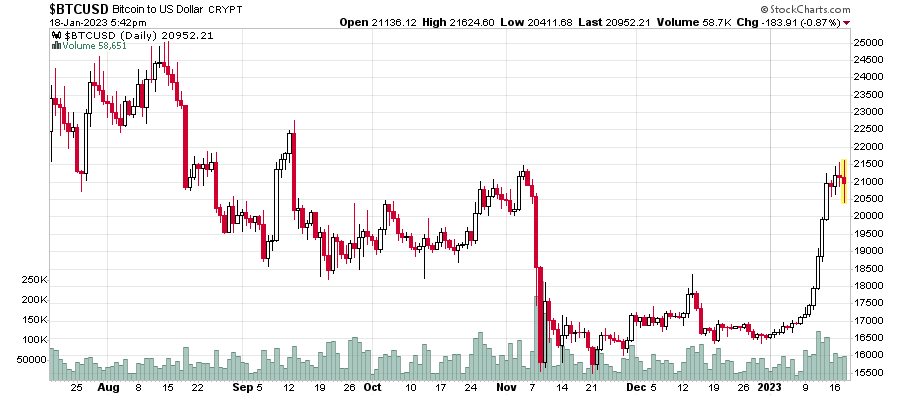
Both have been very strong early this year. Bitcoin, in particular, ripped upwards in January:

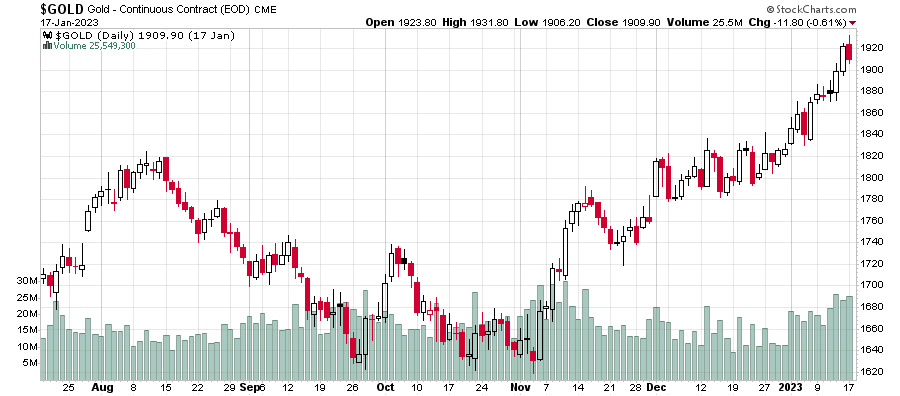
Gold has been on a steady incline since last November as well:

While Bitcoin and Gold do not pay interest, against an inflationary backdrop they have some semblance of a “real” return. Just like REITs, is there a safety element in play? Or is this a play on the general state of monetary policy? Cash is trash, even if it pays 5% interest?

Picking up shares of illiquid stock

My due diligence screens finally picked up a target candidate. Unfortunately, my timing on my “greenlight to buy” occurred just as the stock was jetting up (which I notice is a general trend for the overall markets in January):

It’s obvious that somebody else has some great ideas as well at the same time as me, but I also am wondering whether my own brokerage firm is trying to front-run my own slow trading? Should I just wait for a big ask in the future (not too common) and just hit it?

Demand for tax-advantaged cash returns is high

Horizons found a niche in a corporate-class ETF fund, namely HSAV (TSX: HSAV). Last year (February 3, 2022) because it reached a subscription of $2 billion, the fund had to curtail the creation of new units. This had the effect of raising the NAV of the fund well above the market value. Right now, the market value is approximately CAD$104.80 versus a NAV of $103.82, which means investors are willing to pay an approximate 1% premium or about 2.6 months of interest to get into the fund.

Now the US fund, HSUV.u, made the same decision to close the fund to new unit creation.

The current assets under management (“AUM”) of HSUV.U are approximately US$775 million, which is equivalent to more than $1 billion Canadian dollars. At this AUM threshold, it is the Manager’s view that this suspension will help manage potential tax implications and ensure that HSUV.U can continue to reinvest its distributions, consistent with HSUV.U’s current investment objectives.

As noted in HSUV.U’s prospectus, if the ETF experiences a significant increase in total NAV, the Manager may, in its sole discretion and if determined to be in the best interests of shareholders, decide to suspend subscriptions for new ETF shares if considered necessary or desirable in order to manage potential tax implications and/or to permit HSUV.U to achieve, or continue to achieve, its investment objectives. It is the Manager’s view that the suspension will help manage potential tax implications and ensure that HSUV.U can continue to reinvest distributions.

The advantage of a corporate-class ETF such as this one is that gains accrued within the fund can effectively be liquidated as capital gains, avoiding half the tax that otherwise would be payable upon disposition.

The NAV at the close of today was $102.38, while the closing market price was $102.50. If the parallel to HSAV exists, HSUV.u’s premium to NAV should extend further.

This should also be a sign that in Canada there is a huge demand for high interest cash products – the flight to safety is obvious.

Cash ETFs – Revisited

With the increase in Bank of Canada interest rates:

Cash ETFs:
(TSX: CASH) – gross yield 479bps – MER 13bps – net yield 466bps
(TSX: CSAV) – gross yield 396bps (November 24 distribution * 12, note not adjusted for recent rate increase(s)) – MER 16bps – this should be roughly in-line with the others
(TSX: HSAV) – gross yield 475bps – MER 12bps – net yield 463bps – CAUTION: trading above NAV, do your calculations accordingly
(TSX: PSA) – net yield 459bps

IBKR will give 368bps above CAD$13k.
HISA rates (one example): Home Trust gives 365bps.

Low duration, low risk, liquid:
(TSX: ZST) – 6 month effective duration – YTM 490bps – MER 16bps – net yield 474bps (November 30, 2022 numbers, note roughly 2/3rds investment-grade corporate debt here)
(TSX: XSB) – 2.7yr effective duration – YTM 410bps – MER 10bps – net yield 400bps

Sacrifice liquidity for yield:
GIC Direct is reporting 550bps rates (1 to 5 years).

US Dollar:
(TSX: HISU.U) – Cash ETF – MER 15bps
(TSX: PSU.U) – Cash ETF – MER 15bps
(NYSE: IBTD) – 0.58yr effective duration – YTM 454bps – MER 7bps – net yield 447bps – matures end of 2023
(NYSE: VGSH) – 1.9yr effective duration – YTM 460bps – MER 4bps – net yield 456bps

A few miscellaneous observations

The quarterly earnings cycle is behind us. Here are some quick notes:

1. There is a lot more stress in the exchange-traded debenture market. Many more companies (ones which had dubious histories to start with) are trading well below par value. I’ve also noticed a lack of new issues over the past six months (compared to the previous 12 months) and issues that are approaching imminent maturity are not getting rolled over – clearly unsecured credit in this domain is tightening. There’s a few entities on the list which clearly are on the “anytime expect the CCAA announcement” list.

Despite this increasing stress in the exchange traded debenture space, when carefully examining the list, I do not find anything too compelling at present.

2. Commodity-land is no longer a one-way trade, or perhaps “costs matter”. I look at companies like Pipestone Energy (TSX: PIPE) and how they got hammered 20% after their quarterly release. Also many gold mining companies are having huge struggles with keeping capital costs under control. Even majors like Teck are having over-runs on their developments, but this especially affects junior companies that have significantly less pools of financial resources to work with (e.g. Copper Mountain).

3. This is why smaller capitalization commodity companies are disproportionately risky at this point in the market cycle – we are well beyond the point where throwing money at the entire space will yield returns. As a result, larger, established players are likely the sweet spot on the efficient frontier for capital and I am positioned accordingly. I note that Cenovus (TSX: CVE) appears to have a very well regulated capital return policy, namely that I noticed that they suspended their share buybacks above CAD$25/share. The cash they do not spend on the buyback will get dumped to shareholders in the form of a variable dividend. While they did not explicitly state that CAD$25 is their price threshold, it is very apparent to me their buyback is price-sensitive. This is great capital management as most managements I see, when they perform share buybacks, are price insensitive!

4. Last week on Thursday, the Nasdaq had a huge up-day, going up about 7.3% for the day. The amount of negative sentiment baked into the market over the past couple months has been extreme, and it should be noted that upward volatility in bear markets can be extreme. This is quite common – the process is almost ecological in nature to flush out negative sentiment in the market – stress gets added on to put buyers and short sellers and their conviction is tested. Simply put, when the sentiment supports one side of a trade, it creates a vacuum on the other side and when there is a trigger point, it is like the water coming out of a dam that has burst and last Thursday resembled one of these days. In the short-term it will look like that the markets are recovering and we are entering into some sort of trading range, but always keep in mind that the overall monetary policy environment is not supportive and continues to be like a vice that tightens harder and harder on asset values – and demands a relatively higher return on capital.

I suspect we are nowhere close to being finished to this liquidity purge and hence remain very cautiously positioned. My previous posting about how to survive a high interest rate environment is still salient.