Genworth MI – Q4-2013 review

The earnings release was about what I was expecting. There was a slight increase in the expense profile but this was due to some stock-related compensation expenses (cash flow statement has it at $11.2 million for the year) but this is due to the stock itself increasing in value.

For the year, net premiums written were $511 million, while revenues recognized were $572 million. These two will have to converge eventually. This has been the trend for the past few years now – revenues recognized was $621 million back in 2010. Premiums earned in 2014 should be around the $550 million level.

The $5.4 billion portfolio continues to remain dull (a good thing) with a 3.6% yield, 3.7 year duration.

The loss ratio continues to remain exceptionally low, at 22%. Management continues to focus on Quebec and the Toronto condominium market, which is correct.

The bottom-line operating EPS is $3.60/share. Looking at tangible book value, I get a value of $32.34/share with a diluted share count of 94.9 million shares.

Balance sheet-wise, the company continues to remain over-capitalized with 222% of its required regulatory minimum capital, and well above its 190% internal target. There are regulatory changes which I have outlined earlier that the company is awaiting for before deciding what to do with its excess capital. They bought back shares when the stock was trading lower, but now they are holding onto their cash instead of buying back shares (a smart decision).

The only item of any distinction in the financials is the following paragraph:

On December 20, 2013, the Company, through its indirect subsidiary PMI Canada, entered into a retrocession agreement with Merrill Lynch Reinsurance under which the Company assumed reinsurance risk for up to $30,000 Australian dollars if the losses on claims paid by Genworth Financial Mortgage Insurance Pty Limited, an Australian company (“Genworth Australia”) exceed $700,000 Australian dollars within any one year. The term of the agreement is 3 years. Genworth Australia has the right to terminate the reinsurance agreement after the first year of coverage.

Under the excess of loss reinsurance agreement, the Company is required to collateralize its reinsurance obligations by posting cash collateral equal to the maximum exposure under the agreement in favour of Merrill Lynch Reinsurance. As at December 31, 2013, the Company has posted $30,000 Australian dollars, equivalent to $28,482 Canadian dollars, under the agreement. The collateral is recorded as collateral receivable under reinsurance agreement on the Company’s condensed consolidated interim statement of financial position.

Re-measurement adjustments arising on translation of collateral receivable under the reinsurance agreement and any reinsurance receivable balances from Australian dollars to Canadian dollars are recognized in net investment gains.

This is functionally a bet by management that the Australian real estate market is not going to crater. While I am not thrilled that the company appears to be engaging in gambling outside of the Canadian sphere, I do note that the history of paid claims in Australia appears to be considerably below this:

2013 – AUD$185 million
2012 – AUD$287 million
2011 – AUD$112 million
2010 – AUD$171 million
2009 – AUD$173 million
2008 – AUD$146 million

It would appear that it would take a disaster for Australia’s paid claims to be above the AUD$700 million threshold, but if this was the case, then why did Genworth Australia make this agreement with a sub of Genworth Canada?

Reading between the lines on the conference call, it sounds like management is tinkering around with the idea of deploying their excess capital in reinsurance of mortgage insurers. This doesn’t sound like a bad idea, until it blows up, like it almost did for the parent Genworth (NYSE: GNW) entity.

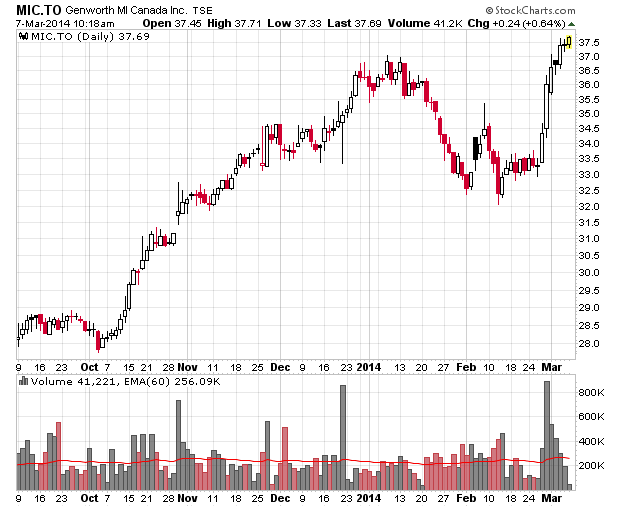
In absence of any better investment alternatives and also in absence of any looming Canadian real estate crisis, Genworth MI is still in my portfolio as a large fraction. It is or more less a proxy for a bond fund at this point and I am comfortable with the relevant risks regarding the Canadian real estate market. I also believe the equity is in the middle of what I consider to be its fair value range. If they execute as they have in 2013, the stock should go up another 10% or so on the basis of increased book value alone.

The critical sensitivity continues to be the state of the Canadian economy. Our country is export-oriented, especially in the commodity sector. As long as this remains active, we are unlikely to see spikes in unemployment that would cause mortgage defaults. Interest rates are also projected to be low and this will not create an additional shock in the market.

Rogers Sugar – Freefall

I used to own shares in Rogers Sugar, back in the days when it was still trading as an income trust. I had a slab of units in the mid 3’s and sold them in the mid 5’s, citing that the upside was probably limited from that point. This was one of the companies that I loaded up on during the economic crisis and it paid off. My selling timing wasn’t ideal as they’ve managed to get up to about $6/share before moderating:

rsi

I’ve been asked whether this company is a buy or not. Normally I don’t entertain these requests, but since I don’t need to do any additional research on this company that I’ve already written about, I’ll comment.

The quick answer is that they are trading within my fair value range. They’ve been well over my fair value range for the bulk of the last couple years. My theory here is that they were perceived as a safe stock with a safe yield, and lumped into every income fund manager’s portfolio as something reliably yieldy but “without risk”. I would say the assessment of income is correct, but the assumption of risk is not, and the market clearly has shown that over the past two weeks of trading.

I’m not sure why they got killed as badly as they have. Their last quarterly report (the catalyst) was not good, but the stock didn’t deserve the 20% bludgeoning they took. There is clearly a lot of other technical factors going on here (stop losses, value investors dumping, margin players dumping, etc.).

Market-wise they are facing a few adverse factors (the crops down south have been better than usual, which will cause over-supply and hence no exports for this year), and also Redpath is seemingly getting good at marketing and beating Rogers – heck, I even notice their product in the local Costco. These margin pressures are not good for the company, but this is the nature of the industry and it has been this way for a long, long time.

They will have to go down further before I’ll consider buying shares.

Also for those wanting to do some fundamental research on the company, just note that reading the GAAP income statement is nearly useless due to the use of derivatives the company engages in to hedge natural gas pricing.

Investing in political unrest – Thailand

Something that hit my political radar a few months ago was that Thailand is going through yet another political crisis. This has a material impact on their equity pricing, as witnessed by the only ETF available to invest in Thai stocks (and that is THD):

thd

There were two thoughts in my mind as this was going on: Will I be able to get an inexpensive Thailand vacation as tourists flee the country, or will I at least be able to earn one by investing in what will likely result in some sort of economic crisis?

The ETF itself is not of a trivial size – it has $500 million in assets under management, trades about $15 million in volume a day, and has about half of its holdings in the top ten consisting of large cap Thai companies such as financials, telecoms, industrials, and so forth. They represent roughly an equity proxy for the country similar to the Dow Jones Industrial Average. The size of the country’s equity market is large and liquid enough that my comments here will not materially contribute to any price movement, so I can write a little more freely on this topic.

It does not require an experienced lens to figure out that there will be continued unrest in the country going into early 2014. There is a highly polarized political situation with the two factions holding considerable public support – in a constitutional monarchy environment where the monarch does exercise power (a subtle version of power, but to a much greater extent than monarchies such as Canada or the United Kingdom), coupled with democratic culture being a means to an end rather than a process of acceptance for defeated rivals, this will create excessive tension. In addition, the Thai military is a significant third “political party” that any governing party needs the implicit consent in order to govern in the country.

The democratic culture in countries that have not evolved with the British parliamentary system is significantly different in execution than in countries that have been influenced by it. In the Western democracy sense, voting (whether in general elections or within legislative chambers) is the final arbitration of public decision-making. In a good number of developing countries, it is akin to how lines painted on the road: for advisory purposes.

Thailand will survive this political crisis as it has done for the past century. It will do so in typical Thai fashion, and there is no shortage of historical articles one can dredge up to get a fairly good idea how this one is going to turn out. Despite the public mess that is occurring, they will solve their own problems. The only question is when and how much collateral damage is done in the process.

I will be keeping THD on the watch list. There are no exchange-traded ADRs of Thai companies that one can directly trade with any liquidity of significance that I can find.

Genworth MI Q4-2013 preview

Genworth MI (TSX: MIC) will report its quarterly and year-end results on February 4th. I am not expecting too much deviation from the previous year’s quarter. From the CREA, sales activity nationally are slightly higher than the levels they were in the previous year. The previous year had seasonal-related issues and this year (either Q4-2013 or Q1-2014) will likely have some seasonal-related issues due to the deep freeze that affected the eastern half of North America.  These weather related events will only shift demand around periods rather than reducing it.

natl_chartA01_hi-res_en

Due to the latest federal regulatory changes (tightening) in mortgage financing kicking in on July 2012 (but constructively pulling some demand from Q4-2012 onwards into Q3-2012), year-to-year underwriting will likely be flattish from Q4-2012 because this will be the first full year-to-year comparison with the new regulations kicking in.

We can see the predominant trends for the company – premiums earned (the revenues earned from the actuarial performance of the mortgages that are being insured) continues to degrade slightly because of the run-down of past premiums written:

The only other item that I will mention is that claims and delinquent mortgages appear to be at an all-time low in Canada, despite all the talk about high consumer debt-to-income ratios.  This will eventually blow up in the faces of those that have accumulated the debt in the first place, but not today.  The lack of mortgage delinquencies will continue to mean that Genworth MI will be a cash generation machine.

There are a few negatives coming along the horizon.  One is that profitability of this magnitude tends to involve competitors, and I see Canada Guaranty is trying to cash in on this market – however, the barriers to entry with respect to regulatory compliance is not trivial and establishing sales networks and funnels will take quite a bit of time.

Another is that the OSFI is continuing to look at the capital framework on the property and casualty insurance industry in Canada.  In 2012, there was a significant change in the government guarantee fund which resulted in surplus funds being released to the company.  This risk is offset somewhat due to some guidelines already being released: for those that have the stomach to read this stuff, you can review the draft guidelines here, effective January 1, 2015.

Another negative are the usual concerns over the Canadian housing market that I won’t bother repeating here.

I do not foresee MIC continuing the share buyback at this price level, nor have I seen any insider purchases from SEDI lately.  The last slab of shares were repurchased in September at $29.23. They increased the dividend in the last quarter (they have been doing it on a yearly basis) and while I do not see them raising it again, depending on the results of the regulatory review, they do have room to declare a special dividend in the future.

Solvency-wise, the only maturity on the horizon they have is $150 million face value at December 15, 2015.  This debt issue has a coupon of 4.59% and in 22 months they can decide whether to refinance or just pay it off.  Management is also in a position to pay off about a $3/share special dividend and likely be within their own internal targets for minimum capital.

To summarize, I am not expecting fireworks out of this quarter, but I do expect consistent performance in line with previous quarters.  The company is far from the bargain basement price it was a year and a half ago, but I do believe it is continuing to trade within what I would consider my fair value range.  In the meantime, they continue to spit out cash.

USEC Inc. – Another company on the discard list

USEC Inc. (NYSE: USU) is going to undergo a pre-packaged recapitalization to refinance a convertible debt offering that is maturing in 2014 that the company has no chance of repaying. Existing equity holders will get 5% of the newly reorganized entity, which constructively means the common shares presently trading represent 1/20th of the current market capitalization.

There is much more to the actual operating business in terms of strategy – uranium refining is not exactly a wide-scale industry and proper analysis requires looking at more geopolitical and government considerations than most investors would probably want to swallow.

After they announced their pending pre-packaged bankruptcy filing, I put this on my research radar. The risk/reward seemed quite good at around $3.50/share, but unfortunately the market caught up in a very efficient manner and while I still believe the entity is somewhat undervalued at its present $6.30/share, the risk/reward metric is not favourable enough to take a position. The proposed recapitalization is still contingent on the approval of a couple strategic partners, but they are receiving a stake in the new entity which they should be accepting.

So I will put this equity in my discards pile – feel free to make what you wish out of this. I’m still rather miffed that low priced companies that I have been researching lately are ruthlessly taken to more efficient prices before I can even complete any reasonable amount of due diligence.