KCG Holdings – Takeover bid from Virtu

The Q1-2017 report is going to be shockingly positive. Genworth MI (TSX: MIC) used to be my largest holding, but I have trimmed the position (mainly for diversification and deleveraging reasons). It still is a decent size of the portfolio, but not as prominent as it used to be.

My largest position after Genworth MI was KCG Holdings (NYSE: KCG).

Yesterday, near the close of trading, they confirmed that they received an unsolicited takeover proposal of US$18.50-20.00 per share from Virtu (Nasdaq: VIRT), another (very credible) high frequency trading firm. KCG did not file with the SEC.

Virtu filed 8-K with the SEC confirming they “made a preliminary, non-binding proposal to acquire KCG”.

Both entities have been quite silent otherwise. There is likely a lot of backroom jockeying going on.

KCG’s stock shot up from about $13.60 a share to $18/share today on over 6 million shares of volume. The company has about 66.4 million shares outstanding, and Jefferies (a wholly owned subsidiary of Leucadia (NYSE: LUK)) owns 15.41 million shares, and insiders own another 3 million shares, leaving a float of about 48 million shares that can be actively traded. 6.65 million shares traded today and suffice to say there is quite a large amount of speculation about what is going to happen.

My take on the matter is the following (in no particular order):

1. Tangible book value of KCG Holdings is $18.71/share as reported in their 10-K filing. A US$18.50 takeover price would allow Virtu to effectively take over KCG for free. This is the primary reason why I wouldn’t think this takeover would go anywhere as-is. My guess is that if Virtu was serious they would have to offer some equity as well, or some sort of premium to book value.

2. Virtu is a logical strategic acquirer to KCG – the synergies are quite obvious to both businesses. There might even be anti-trust issues with this acquisition.

3. Even though the acquisition at the low price range would be “free” for Virtu, it leaves the question of how they would immediately finance it.

4. The Jefferies control block is vital to the situation – if they can be persuaded to sell out, then management will likely have to follow. The question is whether they are motivated to sell out or not – obviously they will at the right price, but US$18.50 is too low.

5. The CEO was granted a huge amount of options at $22.50/share (priced well out-of-the-money at the time of the grant) and probably doesn’t have much of an incentive at this point to selling out the company for cheap.

6. Operationally, KCG is treading water in terms of cash flow, but this is because of unprecedented low market volatility conditions that is practically the worst environment for the firm (and also Virtu). In more normal conditions, one could easily estimate a value of US$25-30/share for the firm which is where I think management is targetting. They’ll probably sell out at 24ish if the bid got there.

7. Who leaked this unsolicited offer? Obviously KCG did – probably trying to drum up any counter-proposals out there as there are some other financial institutions that would be interested in acquiring the business. Perhaps management knows the end-game is nearing and this was a last ditch attempt to prevent a forced merger.

The decision forward is a high-stakes game for a lot of participants!

Disclosure: I own common shares of KCG, call options, and also their senior secured debt. Sometimes you really do hit the lottery in the marketplace.

Difference Capital – Year-End 2016 Report

I wrote about Difference Capital (TSX: DCF) in an earlier post. They reported their 4th quarter results a couple days ago and their financial calculus does not change too much. They have CAD$29.6 million in debentures outstanding, maturing on July 31, 2018. Management and directors own slightly under half the equity, and thus they want to find a dilution-free way to get rid of the debt.

At the end of 2016 they have about CAD$14.4 million in the bank, plus $60.8 million (fair value estimate of management) in investments. One would think that in 2017 and the first half of 2018 some of these investments could be liquidated to cover the debentures. The situation is similar to the previous quarter, except for the fact that they’ve retired about 10% of their debt in the quarter, which is a positive sign.

Due to their investment portfolio not making any money (they have been quite terrible in this respect), they have a considerable tax shield: $186.3 million in realized capital losses, plus $41.9 million in non-capital losses which start to expire in 2026 and beyond. If you assume that they can realize both of these at half of the regular tax rates (I just quickly assumed 13% for the capital losses and 26% for the net operating losses), that’s $17.6 million.

Considering the market cap of the corporation is $26 million, there’s a lot of pessimism baked in. Mind you, there are a lot of corporations out there with less than stellar assets, a ton of tax losses, and tight control over the corporation (TSX: AAB, PNP quickly come to mind) so it is not like these entities are rare commodities. The question minority shareholders have to ask is whether the control group wants to bleed the company through salaries, bonuses and options or whether they are actually genuinely interested in profitably building the corporation (in all three cases, to date, has not been done).

Pengrowth Energy – dodged a bullet

Pengrowth Energy’s debentures (TSX: PGF.DB.B) will be redeemed on March 31, 2017 and the company has also announced it will be redeeming USD$300 million in senior debt (announced February 21, 2017).

I own the convertible debentures and will miss their presence once they mature. I’m probably one of the few people that invested in the company and actually made money.

They also announced their year-end results on February 28, 2017. The operations of the company are fairly simple to understand – they are losing a relatively small amount of cash in the existing oil price environment, which they assume is at WTIC US$55/barrel and a 0.74 CAD/USD rate. Management has made some good decision-making on their oil hedges, but they have now closed them (for cold hard cash) and are completely at the whim of the oil commodity markets.

If you take their 2017 guidance to heart, you will end up with $195 million in “funds flow through operations”, a non-GAAP metric that is a proxy for operating cash flow excluding the impact of financing expenses and remediation. The GAAP statements are a mess to read because of derivative accounting (for oil price hedges), exchange rate adjustments, and require some mental massaging to be read properly.

All things considered, the corporation is not in terrible shape.

This is, however, except for the debt maturities coming up which need refinancing.

The company did have a $1 billion credit facility at the end of 2016. It was untapped, probably because the credit facility has a covenant similar to the senior debt. I believe the original intention of management was to use the credit facility to pay off the senior debt as it became due.

The corporation pre-announced in Q2-2016 that if oil prices continued their relatively low level, that they would be potentially in breach of their covenants. What was new in the Q4 announcement was that they alleviated their senior debt (before working capital) to book capitalization ratio covenant, at the expense of amending the debt agreement to redeem senior debt in the event of asset sales and also to reduce the ceiling of their credit facility to $750 million.

There are three other covenants remaining that an investor needs to pay attention to. The most material of them is the senior debt before working capital to adjusted EBITDA ratio, which ended at 3.1 in 2016, but needs to be below 3.5.

Pengrowth, to its credit, walked investors through their covenant calculations (page 10 of their MD&A). Doing some pro-forma (after debt repayment in the end of March) analysis, we have about $1,250 million in debt for covenant purposes, which means adjusted EBITDA needs to be above roughly $360 million for them to clear the mark. They did $581.6 million adjusted EBITDA in fiscal 2016, which gives them a relatively healthy margin of error – even though guidance is taking their production down about 10% for the year despite $120 million in projected capital expenditures.

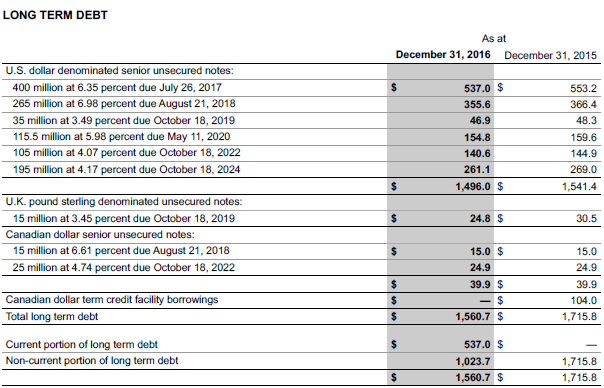
So as long as oil prices don’t crash, they’ll probably use the credit facility to pay off the remaining US$100 million in debt due in July 26, 2017. The next major maturity is CAD$15 million + US$265 million on August 21, 2018, and if nothing changes between now and then, they will use the credit facility to pay that off. At that point, they will have about CAD$500 million utilized in their facility, plus the (presumably negative) amount of cash flow they burn through operations in the next couple years.

If oil does slip, there is a point where they will get into covenant trouble.

They did note in the MD&A:

After the above debt repayments, Pengrowth anticipates it will remain in compliance with its covenants through the end of 2018. In order to comply with certain financial covenants in its senior unsecured notes and term credit facilities through 2017 and 2018, Pengrowth has run a scenario, that accesses the capital markets before the end of 2017, and includes an improvement in realizations for oil and natural gas.

They will probably tap the asset market to give them a higher degree of comfort. This is what Penn West did when they gave up their Saskatchewan operations to stabilize their balance sheet.

In retrospect, I think the company erred in not using shares to repay the convertible debentures – they probably should have bit the bullet and increased their margin of safety by cheaply equitizing the convertible debt. Now, management is basically gambling that oil will be going up in the next couple of years and are basically playing a waiting game.

Who’s short on Genworth MI?

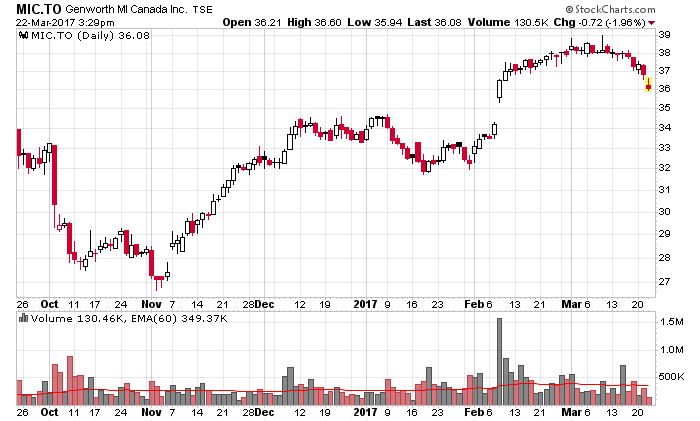
Genworth MI has 57.2% of its shares outstanding held by Genworth Financial (NYSE: GNW). This leaves approximately 39.3 million shares outstanding in the public float. Q4-2016 in the following annotated chart refers to the quarterly earnings report at the end of February 7, 2017:

On January 31, 2017 there was a reported short position of 2,844,353 shares and on February 15, 2017 that position increased to 3,188,297. This is a 343,944 share increase in short interest since their earnings report (which means that somebody is taking on a position to profit from their presumed downfall).

Borrow rates on MIC are relatively modest, at around 2.75%.

That said, when the price increases and short interest rises it will raise volatility – is the entity with deeper pockets the one that is accumulating shares and driving up the price, or are they the ones that are selling shares and applying downward pressure on the price? It is impossible to say without the benefit of retrospect, but if either party exhausts its funds or changes the pace that they are accumulating or distributing, it will result in higher price volatility. Imagine if those 3.2 million shares that are shorted decide that it is time to cover their position. Could there be a short squeeze? Share volume has been higher than normal lately which suggests that there is interest in both sides of this price battle to see who breaks first. Right now, clearly the winning side is the one accumulating shares and slowly raising the bid – I noticed the same price trend post-Presidential election, where the algorithm was simply “accumulate shares at whatever rate that it is sold to you and raise the bid by a nickel each trading hour until you hit some sell pressure”.

Technical analysis these days is simply about guessing the competing algorithms at work and who has the most money behind them – almost no institutions use non-algorithmic trading anymore as such manual trading leaks information like a sieve which increases frictional costs (you’ll get front-runned).

Teekay Offshore’s common units are not going anywhere

Reviewing Teekay Offshore’s financial results (NYSE: TOO), it strikes me as rather obvious that they have missed their initial early 2016 targets when they proposed a partial equitization (issuing common units, preferred units, and some refinancing) of their debt problems. They also borrowed $200 million from the Teekay parent entity (NYSE: TK).

In Q1-2016, they delivered a presentation with this chart:

In subsequent quarters, the company has generally not referred to progressing tracking to this projection, mainly because their debt to cash flow through vessel operations ratio has not met these targets. While the underlying entity is still making money, revenues are eroding through the expiration and renegotiation of various contracts, couple with some operational hiccups (Brazil) that is not helping matters any.

Putting a lot of the analysis away from this article, while in 2017 the future capital expenditure profile is going to be reduced (which would greatly assist with the distributable cash flows), the company doesn’t have a lot of leftover room for matters such as debt repayment and working on improving their leverage ratios in relation to cash generation ability. This leaves them with the option of continuing to dilute or depend on the parent entity for bridge financing. Indeed, one reason why I believe management thinks the company is still open for dilution is due to them employing a continuous equity offering program – they sold nearly 1.9 million units in the quarter at an average of US$5.17/unit. If they don’t think the company is worth US$5.17/unit, why should one pay more than that?

I don’t believe that they are a CCAA-equivalent risk in the current credit market (this is a key condition: “current” credit market), and I also believe that their preferred units will continue to pay distributions for the indefinite future, I don’t believe their common units will be outperforming absent a significant and sustained run-up in the oil commodity price. Note that there is a US$275 million issue of unsecured debt outstanding, maturing on July 30, 2019, which will present an interesting refinancing challenge. Right now those bonds are trading at around a 10% yield to maturity.

I have no positions in TOO (equity or debt), but do hold a position in the Teekay Parent’s debt (thesis here).