Canadian Housing Finance stocks, April 13

On April 13, three notable companies associated with Canadian housing pricing fell considerably: HCG, EQB and MIC.

There were a bunch of other companies that had issues, but it looks like that the trio above were fairly pronounced in the day’s list of losers:

April 13, 2017 TSX Percentage Losers

CompanySymbolVolumeClose% Change
Nthn Dynasty Minerals LtdNDM4,841,0272.17-10.3
Intl Road Dynamics IncIRD203,2032.81-10.2
China Gold Intl Res CorpCGG1,269,5942.43-9.3
Home Capital Group IncHCG972,60621.70-8.6
Aphria IncAPH6,005,7937.21-8.3
Equitable Group IncEQB287,51263.41-8.3
Fennec Phrmctcls IncFRX12,5375.50-8.0
Silvercorp Metals IncSVM1,516,9934.94-8.0
Alacer Gold CorpASR1,881,2092.52-7.7
Street Capital Group IncSCB28,4891.40-6.7
Taseko Mines LtdTKO794,6751.52-6.2
Trilogy Energy CorpTET182,4814.95-6.1
Genworth MI Canada IncMIC221,17434.63-6.0
Top 10 Split TrustTXT.UN9,8634.08-6.0
Guyana Goldfields IncGUY916,0127.41-5.4
Golden Star Resources LtdGSC548,2681.09-5.2
Continental Gold IncCNL852,8253.91-5.1
Arizona Mining IncAZ501,4501.96-4.9
Great Panther Silver LtdGPR387,1652.00-4.8
Argonaut Gold IncAR1,036,6442.43-4.7

I’ve been trying to find what caused this spontaneous meltdown in equity prices.

My 2nd best explanation is that Bank of Canada Governor Stephen Poloz is putting a torpedo to the Toronto housing market by making explicit statements about the 30% year-to-year rise in valuations and about how there is no explanation for it. Specifically, he stated “There’s no fundamental story that we could tell to justify that kind of inflation rate in housing prices, and so it’s that gap between what fundamentals could manage to explain and what’s actually happening which suggests that there is a growing role for speculation“, which is a mild way of saying that people are basically trading houses in Toronto like they did with Tulip Bulbs in the Netherlands in 1636.

He also politely stated that if you believe that housing prices are going up 20% year-to-year, it doesn’t matter whether he raises interest rates by a quarter or half point, and he could even raise them 5% and it wouldn’t make a difference (although it would be rather fun to see him try and see all the mathematical financial models predicated on stability go out the window in one massive flash crash).

However, my primary reason why I think the three stocks crashed is a simple announcement:

==========================

Media Advisory
From Department of Finance Canada

April 13, 2017
Minister of Finance Bill Morneau will hold a meeting with Ontario Finance Minister Charles Sousa and Toronto Mayor John Tory to discuss the housing market in the Greater Toronto Area.

A media availability will follow the meeting at approximately 3:30 p.m.

Date and Time
2:30 p.m. (local time)
Tuesday, April 18

Location
Artscape Wychwood Barns
601 Christie Street
Toronto, Ontario

==========================

Being somewhat experienced with the nature of government communications, there is no way you can get a federal and provincial Liberal with a Conservative mayor doing a joint announcement on something without it leaking to the marketplace.

The only question here is how deep they’re going to stick their silver-tipped oak stake into the heart of the Toronto real estate vampire.

Home Capital Group – The cliche about smoke and fire applies

Home Capital Group (TSX: HCG) fired its CEO today.

The manner that it did suggests that there was a considerable disconnection between the information the Board of Directors was receiving and what management actually knew about the situation (or over-boasted about its damage-control abilities).

My guess is that the final straw was the dealings concerning the Ontario Securities Commission alluded to in the March 14th press release.

Home Capital Group is notorious in my mind for having a very high cost to borrow shares for shorting – it is the biggest proxy used by most people to bet against the fortunes of the Canadian real estate market – right now it would cost you about 22% to borrow to short. Those short sellers will probably be most happy to cover some of their holdings tomorrow (or depending on their risk horizon, add to their shorts!).

Pengrowth executes an asset sale

Pengrowth Energy (TSX: PGF) managed to execute an asset sale on its conventional production property north of Edmonton, the Swan Hills assets for CAD$180 million.

The debt profile at December 31, 2016 looked like this:

Right now the CAD/USD ratio is 0.75.

At the end of December 31, 2016 they also had CAD$287 million cash in the bank, plus another CAD$250 million for the 4% gross royalty sale on their Lindbergh asset.

They will be redeeming CAD$126.5 million in convertible debentures on March 31, 2017. They also have redeemed US$300 million of their 2017 debt maturity, and will redeem the rest after this transaction concludes at the end of May.

The company announced that after this sale, they have a pro-forma net debt of CAD$970 million.

My math suggests that after the 2017 redemption, they would have CAD$57 million cash left, assuming their operations consume zero cash (not a correct assumption!).

Payment of the debt will result in an interest expense decrease of $42 million per year.

They still need to have CAD$368 million on-hand on August 2018 in order to pay off their next debt maturity. It is possible they will run into covenant issues given that oil hasn’t moved around the US$50/barrel mark – their existing senior debt to adjusted EBITDA ratio would be the most material of it. They have about CAD$1.02 billion outstanding and their EBITDA needs to be above CAD$290 million in order to clear this hurdle.

Although the EBITDA value for covenant purposes was CAD$582 million, this is a skewed figure due to the employment of hedging. People not versed in accounting procedures for commodity hedging will have a tough time figuring out the mess, but I will just point out that management closed out their hedges in 2016 (which had been a VERY profitable transaction to them that otherwise would have guaranteed CCAA had they not had the foresight to doing so when times were much better).

KCG Holdings – Takeover bid from Virtu

The Q1-2017 report is going to be shockingly positive. Genworth MI (TSX: MIC) used to be my largest holding, but I have trimmed the position (mainly for diversification and deleveraging reasons). It still is a decent size of the portfolio, but not as prominent as it used to be.

My largest position after Genworth MI was KCG Holdings (NYSE: KCG).

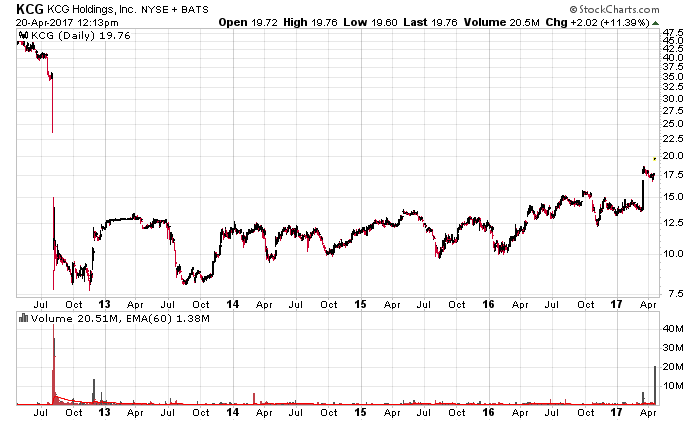
Yesterday, near the close of trading, they confirmed that they received an unsolicited takeover proposal of US$18.50-20.00 per share from Virtu (Nasdaq: VIRT), another (very credible) high frequency trading firm. KCG did not file with the SEC.

Virtu filed 8-K with the SEC confirming they “made a preliminary, non-binding proposal to acquire KCG”.

Both entities have been quite silent otherwise. There is likely a lot of backroom jockeying going on.

KCG’s stock shot up from about $13.60 a share to $18/share today on over 6 million shares of volume. The company has about 66.4 million shares outstanding, and Jefferies (a wholly owned subsidiary of Leucadia (NYSE: LUK)) owns 15.41 million shares, and insiders own another 3 million shares, leaving a float of about 48 million shares that can be actively traded. 6.65 million shares traded today and suffice to say there is quite a large amount of speculation about what is going to happen.

My take on the matter is the following (in no particular order):

1. Tangible book value of KCG Holdings is $18.71/share as reported in their 10-K filing. A US$18.50 takeover price would allow Virtu to effectively take over KCG for free. This is the primary reason why I wouldn’t think this takeover would go anywhere as-is. My guess is that if Virtu was serious they would have to offer some equity as well, or some sort of premium to book value.

2. Virtu is a logical strategic acquirer to KCG – the synergies are quite obvious to both businesses. There might even be anti-trust issues with this acquisition.

3. Even though the acquisition at the low price range would be “free” for Virtu, it leaves the question of how they would immediately finance it.

4. The Jefferies control block is vital to the situation – if they can be persuaded to sell out, then management will likely have to follow. The question is whether they are motivated to sell out or not – obviously they will at the right price, but US$18.50 is too low.

5. The CEO was granted a huge amount of options at $22.50/share (priced well out-of-the-money at the time of the grant) and probably doesn’t have much of an incentive at this point to selling out the company for cheap.

6. Operationally, KCG is treading water in terms of cash flow, but this is because of unprecedented low market volatility conditions that is practically the worst environment for the firm (and also Virtu). In more normal conditions, one could easily estimate a value of US$25-30/share for the firm which is where I think management is targetting. They’ll probably sell out at 24ish if the bid got there.

7. Who leaked this unsolicited offer? Obviously KCG did – probably trying to drum up any counter-proposals out there as there are some other financial institutions that would be interested in acquiring the business. Perhaps management knows the end-game is nearing and this was a last ditch attempt to prevent a forced merger.

The decision forward is a high-stakes game for a lot of participants!

Disclosure: I own common shares of KCG, call options, and also their senior secured debt. Sometimes you really do hit the lottery in the marketplace.