Colony Capital – in the discards pile

Over the past couple weeks, I did some research on Colony Capital (NYSE: CLNY) as it appeared to hit a few of my target spots for investment criteria.

Unfortunately, due to having a minority or bare majority investment in a ton of joint ventures and a myriad of various recourse and non-recourse loans, the consolidated financial statements are completely useless for the purpose of financial analysis, which takes quite a bit of digging to get the proper numbers.

I’ve put this stock into my “have a reasonable idea of the valuation, but the underlying is beyond my core competence” category. In terms of valuation it seems relatively cheap (and dividend investors also have a good reason to throw some money in it), but I’m not pulling the trigger on it.

So this ends up in the discards pile – one of you out there might wish to take a second sober look at it.

Exited my Genworth MI position

The trading in Genworth MI (TSX: MIC) feels like it is in the middle of unwinding a short sale position in Genworth MI. Short investors (2,276,672 shares as of July 13, 2018) are obviously losing money. The quarterly reports have usually been positive news events for the company as they report record low loss ratios and insanely high profit margins. Everything is as rosy as it can get – high profit margins, low unemployment, low default rates, and people paying their mortgages. The stock is trading above tangible book value for the first time, ever.

Sounds like a good time to sell.

I’ve sold the last of my position today. The last block of shares went off at $46.06. This has been my longest held position, initiated in 2012, and partially sold and partially added on at opportunistic prices. For a considerable length of time between 2012 to 2016, it was my largest position.

I will still continue tracking the stock as my accumulated research (I have written more about Genworth MI than any other person on the entire internet) will come in handy if the price range descends into a more opportunistic range.

There’s probably a bit of upside remaining in the stock (in a good case could go to $50), especially if the short sentiment decides to cover up in a hurry. But I’m not one to play these types of guessing games and getting out at a 5% premium to book is sufficient for my investment purposes.

The cash will be parked – I still don’t see much compelling opportunity out there.

TC Pipelines (Trans-Canada Pipelines) MLP and FERC Ruling

Today was a very interesting day for TC Pipelines MLP (NYSE: TCP) which is the USA MLP arm of TransCanada Corporation (TSX: TRP).

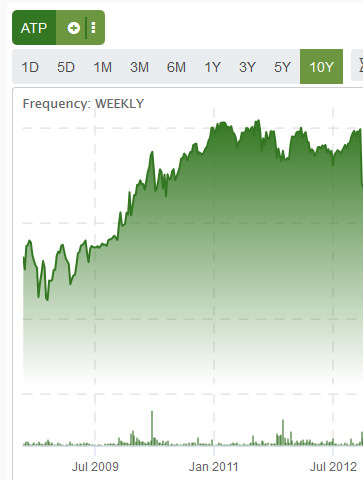
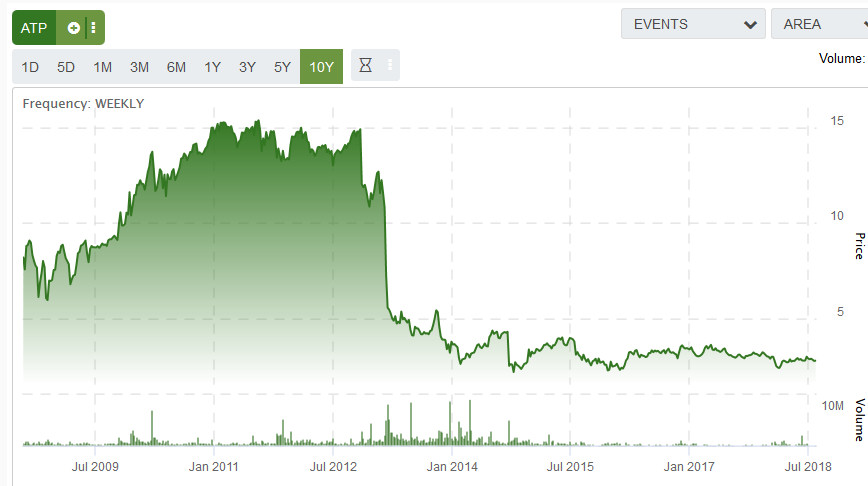
They were heavily impacted by a March 2018 FERC ruling concerning the calculation of regulatory revenue rates for oil and gas pipelines – essentially they were not allowed to incorporate the income tax expense of their unitholders into their rate calculations. Not surprisingly, the stock crashed in March (along with most other MLPs) and when TCP announced the subsequent consequence in their next quarterly report (May) they crashed even further. It is fairly evident by the stock chart when these moments occurred:

Today, the FERC partially backpedaled on this change announced in March for natural gas pipelines only (nothing mentioned on oil pipelines). According to my read of the commissioner’s details, they came to the conclusion that the underlying natural gas pipeline legislation had technical issues which did not allow them to enforce the previous order. Putting a long story short, they came to the conclusion that this change would be considered retroactive rule-making and hence they did not have the authority to implement the change. They provided a mechanism where gas pipelines could voluntarily consent to changes in exchange for the commission to not review their rates within a certain time period, but I doubt MLPs will exercise this if such changes are adverse.

This is effectively a reversal of the decision unless if Congress decides to intervene in the matter. Considering the perpetual dysfunctional mess in Congress and them not touching the underlying legislation to correct this matter, this is a huge victory for natural gas MLPs.

Finally, the rationale for TCP MLP dropping from $50 to $25 in the first place has completely evaporated – although interest rates have increased somewhat (causing some headwinds in the MLP price due to simple spreads over the risk-free rate), one can make an argument that the price should be restored close to previous levels. In other words, there is an argument to be made that the price should go even higher.

The FERC ruling does not appear to affect crude oil pipelines (this is a very loaded sentence).

The disclosure I will make is that I own call options in TCP, which bypasses messy taxation issues of foreigners owning USA MLPs.

========================================
Addenda:
Very quick valuation notes, TC Pipelines (NYSE: TCP)

Units outstanding: 71.3 million
General Partner: (TSX: TRP), owning approx. 23% of the entity
Distributable cash flows, 2015/16/17: $290/313/310

GP/Incentive Distribution Rights: 2% below $0.81/quarter, 15% to $0.88/quarter, 25% above $0.88/quarter

Top-line Revenues/Equity earnings (2017): US$446 million.

Debt: $2.3 billion, staggered across various term facilities/bonds. Refinancing available, will pay slightly more interest in rising-rate environment when rolling over debt. YTM on May 2027 unsecureds: 4.7%

Paper napkin valuation: $310 million / 71.3 million units, $4.35/unit, $35@12%, $42@10%. Does this warrant a 700bps or 500bps spread over debt? Historically was trading around $45-$50 (MLP sector was ‘more sexy’, perceived as ‘ultimately safe’, etc.)

Previous distributions were $1.00/quarter, but post-FERC, reduced to $0.65/quarter, citing debt ratios and anticipated reduction of revenues.

Bombardier Yield Curve

It has been awhile since I’ve posted the progression of the Bombardier debt yield curve, but clearly things have stabilized at the investment grade quality level:

The corporation itself has also raised half a billion (US$) in an equity offering, and has warrants outstanding to purchase shares of its class B stock which are now well within the money. This will be another CAD$500 million that will go to their treasury when it is exercised. Solvency-wise, the company looks like it is once again on stable footing now that the liabilities associated with the C-Series jet has been dumped off to Airbus.

I will likely discontinue my Divestor coverage of Bombardier after this post. The story is over. A few years ago, people were selling down their preferred shares to ridiculously high yields (22%) on the premise that they were not going to be able to stay solvent while they financed their C-Series jet. This was a classic time to capitalize on the cascade of emotional negative sentiment towards the corporation. I even got a media mention for this.

I’m still holding onto my Bombardier preferred shares, although strictly from a valuation perspective, I would not be buying them at the existing price. However, due to the unrealized capital gain and the fact that I have nothing else better to invest my cash with, I will be holding my holdings indefinitely.

Safe cash parking in USD

I’ve spoken about US dollar cash parking in the past (back in 2011!). Since then the offerings have not changed tremendously – the standard option is VGSH which gives you 2-year duration exposure to US interest rates. Whenever interest rate hikes abate, this ETF should do reasonably well – unless if there is a massive inflationary spike.

Interactive Brokers gives out 1.2% on US cash balances. This is not a terrible option if you don’t want to engage in transactions to eek out another 80 basis points or so of “nearly risk-free” money. However, other brokers generally don’t give out interest income on their idle cash balances and thus it makes it worthwhile to shop for short-term options if you have high cash balances while you wait for better investment options (as you can tell, I’m in that situation currently).

VGSH has been a perennial standby, but the duration risk over the past couple years really shows itself in the charts:

Interestingly over the past two weeks the 2-year US treasury dropped in yield from about 2.58% to 2.32% and hence this was enough to take the ETF up about 0.6% which is very unusual volatility historically. VGSH right now has a YTM of 2.5% and an MER of 0.07%, which still makes it very cheap for short-term exposure to 2-year AA-rated debt.

Still, one annoyance is that if you were unlucky to hit the rising interest rate lottery and be one of those September 2017 investors in VGSH, it can be annoying especially when you know you’re still in a tightening interest rate environment. Since 2011, there is an alternative ETF class that seems to offer a solution: target-date maturity ETFs.

In particular, BSCI will terminate at the end of December and contains investment-grade corporate ETFs that will mature throughout 2018. After June, the ETF will accumulate cash (by maturities) and invest the proceeds in T-Bills until the final termination at the end of the year. The yield to maturity on this fund is 2.17% and MER is 0.1%, so this is not a bad way to skim a couple percentage points while waiting. The ETF is also exceptionally liquid (spreads are a penny wide in size).

The main competitor to this is IBDH, and it is slated to mature on December 15, 2018. It is mostly the same product as BSCI except that it is already in its cash accumulation phase (47.5% in a short-term treasury fund). This will give 2.1% minus 0.1% in MERs. Liquidity is also typically a penny on the exchanges.

Barring a massive financial crash of cataclysmic proportions (e.g. something bigger than 9/11 – I’m thinking around the scale of multiple nuclear detonations in major US cities where we would have bigger problems than how to liquidate our investments from the radioactive ashes), these ETFs are modestly safer than VGSH by virtue of their lower duration. They seem to be a good vehicle to park cash in a rising interest rate environment.