Mad Retail Muppet – on Aimia debt

Daniel Austin has transitioned to a new site, the Mad Retail Muppet. On his first post in his forays with Aimia’s corporate debt, I am happy to bring his site to your attention.

I’m sure the 10 or 20 human visitors here will find excellent reading on his site.

I’ll add some value by saying:

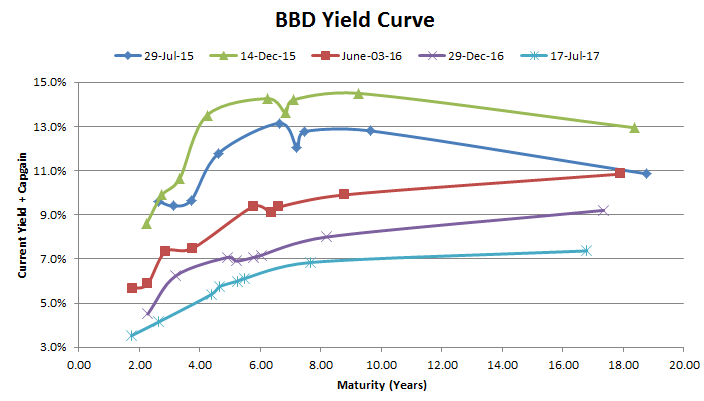
* Aimia’s 2018 debt matures on January 22, 2018 and will likely mature. Their 2019 debt matures on May 17, 2019 and has a 5.6% coupon. They’re not actively traded via IB, but via Questrade they are currently being asked for at 84 cents (or YTM of 15.3% – noting these are the regular bonds and not the strip bonds). Retail bond pricing typically incorporates a VERY healthy price spread over what should be the existing market price (i.e. an institutional investor would likely get at least a couple cents better pricing, thus a higher YTM).

* The YTM of this debt issue should give you an idea of what I think about the preferred shares, which are trading at a yield of roughly 11% at present (AIM.PR.A/B).

* Taking a $456 capital loss (pre-tax!) on this debt transaction is a very low tuition cost. It’s even less than the cost of a typical 3-credit course at my old university!

* Daniel’s deferred revenue/cost analysis is spot-on: if Aeroplan members go on a Home Capital Group-style bank run on their Aeroplan accounts, Aimia is hard-pressed to pay – such is the perils of investing in a company with a negative tangible equity of some $3.1 billion! This alone is a major reason why I would not touch anything in this corporation’s capital structure.

* It’s obvious Aimia has another choice they will execute on in the future – watering down their rewards pricing. Legally speaking, if they were to double the price of all rewards, what recourse does the consumer have?

Let’s check the terms and conditions

In particular, you acknowledge and accept as a condition of continued membership that:

1. Aeroplan Miles have no monetary value whatsoever and cannot under any circumstances form the basis of a monetary claim against Aeroplan.

5. Aeroplan assumes no liability to members whatsoever by reason of the termination of, or amendment to, the Aeroplan Program, in whole or in part, the addition or deletion of reward partners (including Air Canada), limitations on the availability of flights or seats, changes made by Aeroplan Partners to their terms and conditions, or any change made in accordance with sections 6 to 8 below.

Looks like the program (similar to Air Miles) is an unregulated confidence game – the only recourse Aimia has to watering down their product (or Air Miles) is the loss of consumer confidence. Not much of a remedy.

As a side note, I’m anxiously awaiting my $100 gas gift card in the mail.

Thoughts on Teekay Offshore have not changed

Teekay Offshore (NYSE: TOO) reported their Q1-2017 results last night and they were lacklustre. In particular, the introduction of a litigation dispute with their largest customer, Petrobras, in respect of the operation of an offshore rig is not helping matters for them.

Last quarter I wrote about how Teekay Offshore units are “not going anywhere“, and that was an understatement considering this stock graph in the interm:

The next pillar to fall is their common unit dividend. Teekay traditionally declares dividends at the beginning of the calendar quarter and pays them out mid-quarter. I would expect there would be a 50/50 chance that they will suspend common dividends at the end of June or early July, and this would probably have a negative impact on their unit price. There is also an outside chance that they would decide to suspend their preferred unit dividends at the same time until they have shored up their financial resources.

The reason for this would be that they have not stabilized their financial position. With approximately 149.7 million units outstanding, the cash outflow of $16.5 million/quarter is something they really need to be putting into their outstanding debt. Preferred units receive around $11 million/quarter in cash in distributions and in a couple years, another series of preferred shares will switch from payment-in-units to payment-in-cash distributions (another $10.5 million/year).

Saving $27 million a quarter in distributions has to be attractive for a management that needs to repay $589 million in 2017 (this information is from their 20-F filing for their 2016 annual report). Cash flows through vessel operations will bridge some of this, but they are still missing some capital to make it through. They are also uncomfortably close to a debt covenant that they maintain total liquidity of at least 5% of their total debt (which is about $150 million in liquidity).

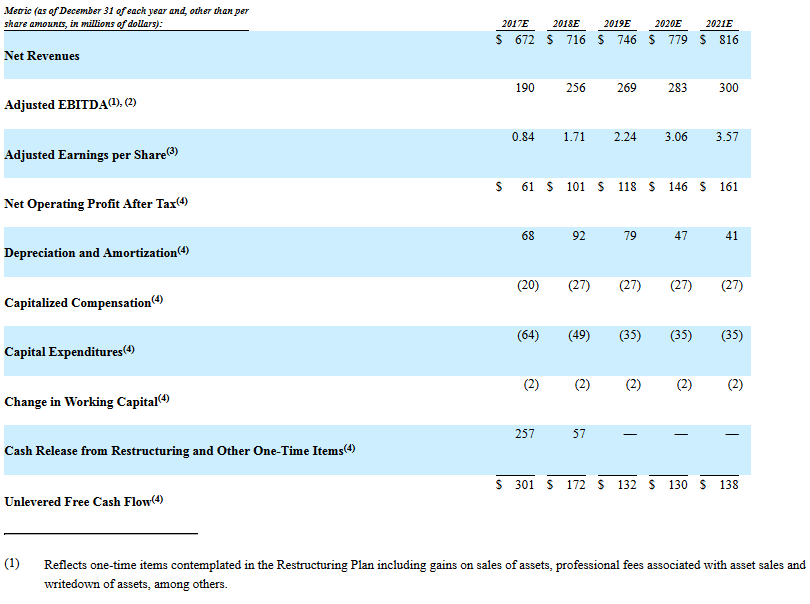
If you remember this chart from an earlier presentation when they got investors to chip in another $200 million in equity (April 2016):

CFVO (Cash flows through vessel operations) in Q1-2017 was $141.3 million, while net debt is ($3.12 billion gross minus $0.29 billion cash = $2.83 billion) – doing the math, we have ($2,830 / 4*$141.3) = 5.00 Net Debt/CFVO ratio!

This is way off the original 4.5x target as projected by management and this is getting into very dangerous territory where management has to take other measures to get the balance sheet back into a reasonable condition.

The only silver lining I can think of is that net debt has dropped $13 million for the quarter, but this is such a minor fraction of the overall net debt that it is relatively inconsequential.

Thus, I will predict that short of another form of recapitalization (or extremely dilutive equity offering), management will likely cut distributions from Teekay Offshore.

On a side note, I have gotten used to the “personality” of their quarterly reports and presentations as they release them and they are quite skillful at illuminating the information that they want you to be seeing and not paying any attention to the worms and termites that are crawling under the rocks. These nuggets of information are usually buried in the subsequent (weeks later) 6-K filings they report to the SEC. Also they are quite good at not reconciling their current situation with past expectations as you can see in the above post of their CFVO/Debt chart.

Stormy seas

When politics is attributed as the reason why the broad market drops by 2% in a day, you know there is more to come (the reason is most certainly not politics).

Brace yourselves – I’ve been continuing to liquidate things and are well positioned for a market crash.

(Update, June 4, 2017: S&P 500 is up 4% since I wrote this, in a huge upward trajectory! Shows you what I know about short-term market timing!)

Avoided another time bomb – Aimia

Aimia (specifically their preferred shares) were suggested to me a year ago as a reasonable risk/reward and a relatively high yield.

I declined. Today is the reason that I saw would likely happen.

Air Canada will be ending their business with them in 2020.

Everything in their capital structure is trading massively down – common shares are down over 50%, and preferred shares are down about 30%.

Good market timers could have bought when the margin calls were starting to flood in at around 10:00am Eastern time. The preferred shares at one point in time were down even more than the common shares.

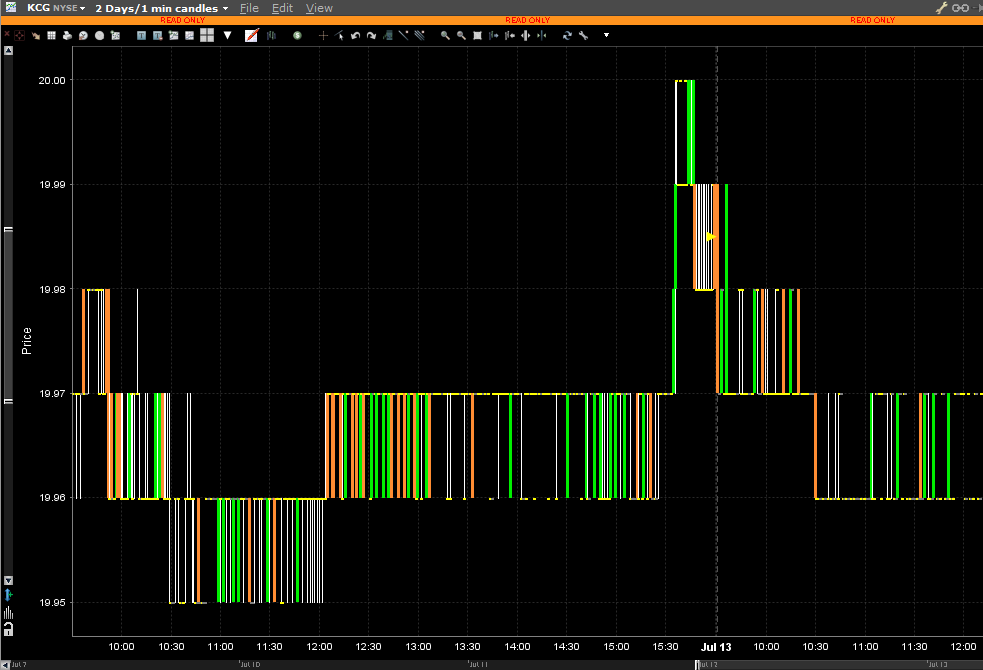
(Update, I have included the chart of AIM.PR.A for illustration below)

I have no idea what the business prospects of Aimia is (although this news about Air Canada is VERY negative) and thus I will still not touch them.

I will, however, be a little more diligent at liquidating the meager amount of Aeroplan points I still have remaining – companies like Aimia can decrease deferred revenue liabilities by simply increasing the cost of “rewards” that their customers have already pre-paid for (can you tell what I don’t like about their business?).

Yellow Media – are they done?

Yellow Media (TSX: Y, and thankfully no positions in equity or debt) reported today what can only be described as a near-disaster of a quarter.

The elephant in the room is what will be (after May 31, 2017) $295 million of 9.25% senior secured notes which mature on November 30, 2018. About 95% of this debt is owned by Canso Investment Counsel Ltd., who also owns 23% of the company’s equity.

In other words, the corporation’s future, short of a surprise turnaround in financial results, completely depend on what Canso’s intentions are. Presently they are able to extract a 9.25% coupon out of the corporation via the senior secured debt and I very much think they would be reluctant to relinquish what is a first-in-line cash stream.

There is a $107 million issue of 8% unsecured debentures trading on the TSX (TSX: YPG.DB) which is also about 30% owned by Canso (maturing on November 2022). The power of this class of securityholder is much more tenuous than it was before Yellow’s recapitalization (in other words – at 98 cents on the dollar it is trading too high given the risk profile). The conversion rate is at CAD$19.04/share which is has little value at the existing equity price of CAD$5.80/share.

The financial situation at Yellow has deteriorated and although they project $50-55 million in free cash flow for 2017, their revenues are continuing to decay and this trend is likely to continue as they morph into a digital consulting firm.

Since their market cap (after today’s 25% decline) is $160 million, it might appear the stock is cheap from a market cap to free cash flow basis. But this is a total illusion for two reasons. One is that the enterprise value of $562 million makes it expensive in light of the decaying free cash flow. The second and more powerful factor is Canso’s control motivation. The return opportunity for shareholders is going to be quite stunted, absent of some surprise takeover bid (doubtful, but this is up to Canso) simply because Canso has too much power and ability to extract capital in what is a financially unfavourable position to Yellow.

This is going to hurt the minority equity holders.

The business story is simple and everybody knows it – Yellow Pages used to be the business Google of the offline world. It is no longer.

No positions, not interested in any unless if somebody wants to sell me that senior secured debt, but sadly Canso owns most of it.