Teekay / Teekay Offshore / Brookfield financing

Brookfield Business Partners (TSX: BBU.UN) announced a $750 million investment (Brookfield’s release) (Teekay’s release) in Teekay Offshore (NYSE: TOO).

I’ve written extensively about Teekay Offshore and thought they would cut their distributions to zero and likely cutting their preferred unit distributions because of impending financing issues. This prediction turned out to be mostly incorrect – they are cutting their common unit distribution to 1 penny per quarter (down from 11 cents), and maintaining their preferred distributions.

In general, my expectations for the outcome for this pending recapitalization transaction have been worse than what materialized.

Not surprisingly, Offshore’s preferred units are trading considerably higher in the markets – up about 28%.

Teekay (parent) unsecured debt traded up to 98.5 cents on the dollar today – I am happy regarding this transaction – it is likely to mature at par (January 2020) or earlier via a call option. Offshore debt holders have even more reason to be happy – theirs are up from 82 cents to 97 cents, with a 7% yield to maturity. (On a side note, I notice somebody was asleep at the switch at 5:00am today – there was a $100k bond trade for 90.8 cents on TK unsecured, which was a steal for the buy-side – NEVER leave those GTC orders out in the open unless if you’re willing to scan the news before the market opens!).

Summary thoughts (apologies in advance for this not being in a more professional manner, I am not writing from my usual location):

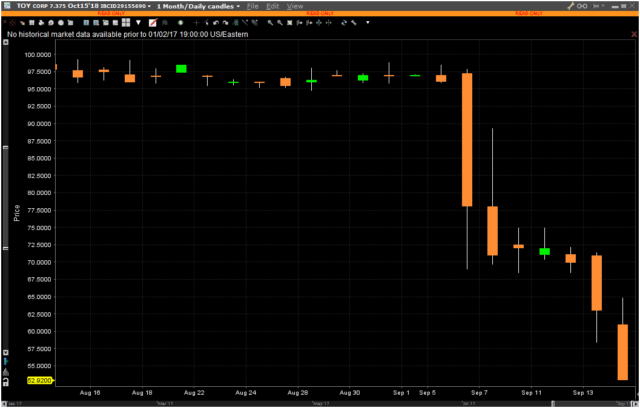
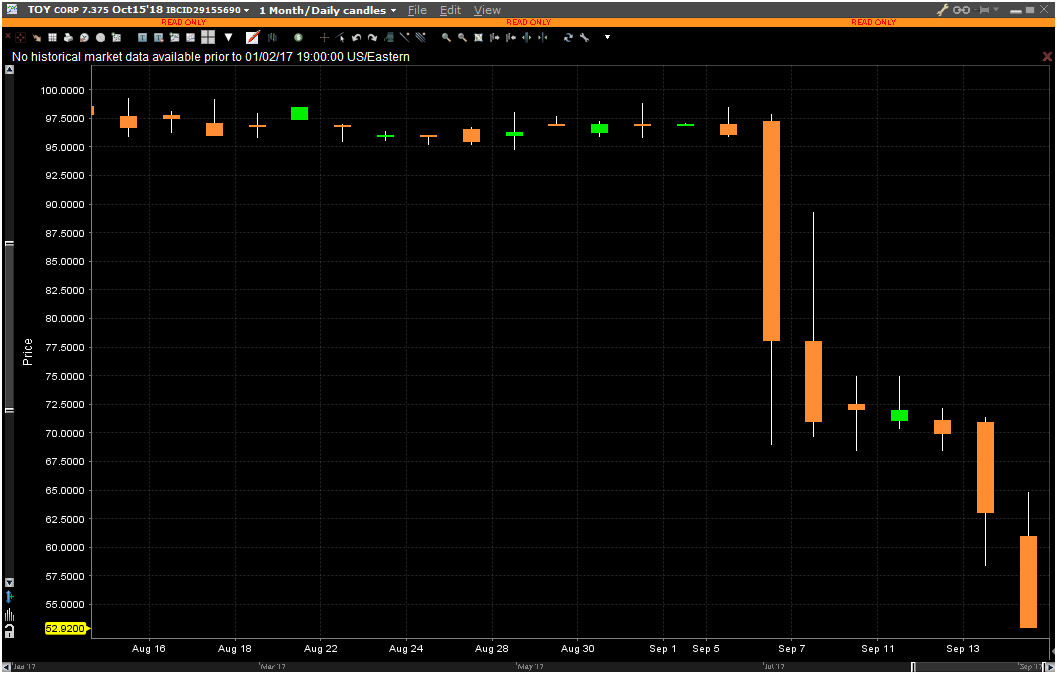
The first chart is from their today’s presentation, while the second chart was from an early 2016 presentation. Compare the two:

1. With this equity injection, Offshore buys itself a couple years of time (which is what they desperately needed) – however, their debt leverage goes from “very high” to “above average” – slide 9 is considerably above what they were anticipating in their 2016 slide when they initially recognized the pending financial crisis. Pay attention to the Y-Axis of those charts!
2. Teekay dumps its $200 million loan to Brookfield for $140 million cash and 11 million warrants in Offshore;
3. It’s not entirely clear what the terms of these warrants are, or how Brookfield picks up 51% control of the GP (they get 49% of it right now);
4. Offshore’s financial metrics (cash flows through vessel operations) should start to improve, but I suspect there will be upcoming challenges as long as the oil price environment is not supportive (thinking counterparty risk, potential future contract renewals, pricing pressure, etc. – examining Diamond Offshore, TransOcean, etc., although not strictly in the same market as TOO, leads one to believe that the present environment is also not favorable to maintenance offshore oil production expenditures);
5. Teekay also liquidated their preferred unit holding in Offshore, and this is functionally a sell-off to Brookfield.
6. The creation of a “ShuttleCo” subsidiary of Offshore will create some more financial complexity in the operation – they probably want to spin this out for valuation and/or leverage purposes (as this division apparently is doing reasonably well).
7. Offshore’s operational challenges and risks are still not going away with this equity injection, but Teekay has more or less divested as much as they could from them.
8. Teekay also get relieved of guarantees from Offshore, which will improve its financial position dramatically in the event of insolvency (this is huge for Teekay unsecured debt holders). Teekay is functionally at this point a play on their LNG daughter entity, while having some minority economic participation in offshore.
9. Teekay’s cash flows through Offshore will obviously be curtailed significantly, they have their own vessel operations which are cash neutral, so they will be solely reliant on either equity distributions of Offshore (if they decide to fully liquidate) or LNG’s distributions.

If I was an investor in the preferred shares or debt of Offshore, I’d be taking gains right now and going elsewhere.

I remain long TK unsecured debt and do not have any intentions to sell – I took a full position back in them last year. I’m not keen on any of the equity.

Worst-performing portfolio components

The biggest hits my portfolio has taken this year has been with the appreciation of the Canadian dollar and the cash-parking vehicle of VSB.TO. Sadly (not including monthly distributions, which is about 5 cents a month) they’re down about 40 cents over the past couple months, due to the short-term rate curve rising considerably.

I take solace knowing that the increased Canadian dollar gives me larger purchasing power parity and the increase in interest rates in theory should make credit-sensitive assets cheaper to purchase.

KCG, it was good knowing you (Eulogy)

The merger closed yesterday and I received proceeds from the equity and debt today.

The equity I had purchases between $9-11/share. My first stake in the company was back in Q4-2012!

From my debt purchase at 90.5 at the end of June 2016 to 13 months later, resulted in a capital gain of 13.1% plus the 7.6% current yield, made for a 20.7% CAGR investment on a senior secured debt, first in line, on a cash flow positive entity. I’ll miss you.

The perils of indexing

Horizon Kinetics has been writing about the flaws of passive index investing, and their latest quarterly report hits the nail on the head.

It reminds me of when Nortel was at one point 40% of the TSX60 index.

A solid investment screen begins with discarding the top 3 quartiles of the S&P 500 or Nasdaq 100 – or anything ascending. Due to the passive mechanism of re-balancing, stocks that gain capitalization have a momentum effect because of their higher weighting.

Genworth MI – Q1-2017 and Q2-2017 preview

(Update, July 20, 2017: FYI, Genworth MI reports the next quarter on August 1, 2017)

While Home Capital was going through their issues, I had neglected to report on Genworth MI’s Q1-2017 report.

It was a quarter for the company that was about as good as it gets – their reported loss ratio was significantly lower than expected (15%) and well below expectations. The number of delinquent loans creeped up slightly (2,070 to 2,082) but the loss ratio was the highlight for the quarter. Most of the increase in delinquencies occurred in Nova Scotia and Manitoba.

Portfolio insurance written was also higher than I would have expected ($38 million), but this was due to the completion of paperwork received at the end of Q4-2016. I would not expect this to continue in future quarters.

The geographical split of insurance has not changed that much – Ontario continues to be 48% of the business, while BC/AB is 31% and QC is 13%. Half of the transactional insurance business continues to be at the 5% down-payment level.

Book value continues to creep up, now to $40.42/share. Minimum capital test ratio is 162%, slightly above management’s 157% holding level, and as long as this number is between 160%-165%, management is not going to take any capital actions (i.e. special dividends or share buybacks), although I will note some insiders did purchase shares earlier in the quarter.

The market reaction to the quarterly report was initially very good, but I suspect short sellers decided it was a good time to continue putting pressure on the stock. It got all the way down to $30.50 before spiking up to $38 and now has moderated to $34.70/share, which is a 14% discount to book.

Looking ahead to Q2’s report, my expectations are a more moderate outlook – the loss ratio should creep up to 25% again, and management should be noting that Ontario’s actions to curb foreign property speculation have had an impact on the local residential market. In relation to mortgage insurance, however, if people continue paying their mortgages (they are employed), ultimately real estate pricing does not matter. I think a lot of market participants have failed to make that distinction.

The other question is the impact of increasing interest rates – this will certainly have an impact on the short-term investment portfolio of MIC – including small unrealized capital losses on short-term debt. This will more than likely be offset by gains in their preferred share portfolio, which totalled $456 million on March 31, 2017.

Price-wise, the company is currently too cheap to sell and too expensive to buy. I’ll continue collecting my dividends.