A few miscellaneous notes to begin 2026

Higher prices means lower returns going forward. Overall prices are quite high right now. Therefore, expect lower returns.

The few times that I have been able to identify something of value over the past year, my primary issue has been to not add enough into it. Perhaps I am just over-cautious, or perhaps I am just getting old and do not feel the need to swing for the fences anymore. The most poignant example of this was my tepid entry into Premium Brands (TSX: PBH) early in 2025 in the $75-80 range, which should have been a 10% position but unfortunately was much less. Rationally, it is better to get a small position of something that appreciates rather than nothing, but emotionally it just feels like another lost opportunity plagued with regret!

Here are some thoughts in no particular order:

1. (no surprises here) Precious metals have gone wild over the past few months, but especially silver and platinum:

Silver is most frequently mined as a byproduct of gold production and is a relatively ‘common’ element in comparison. However, platinum is a much more rarer metal (rarer than gold). It would suggest that platinum should be more expensive than gold, but currently due to historical factors and the fact that gold is used in higher quantities, especially in jewellery, it is not.

The pricing for precious metals is making me think about several questions –

a. High commodity prices will spur capital expenditures and more production. For physical mining projects, this will take half a decade and there will be a huge lag effect between the investment and when the supply will eventually hit the market – but it will eventually. The AI machine guesses that a ‘greenfield’ gold mine project will have an AISC of US$1,600-$2,200 per ounce and other projects will be less, so there is a gigantic margin to be made on this over the next couple years. When I look at the majors (e.g. Barrick Gold, etc.), it looks like that this story has already played out in the stock market.

b. In the late 1970s after many years of soul-crushing inflation, and short-term interest rates in the double digits, gold became a very popular way to escape. There were accounts of people lining up to buy gold and silver and of course this was the best time to be selling the precious metals and investing in US Treasury bonds. While I don’t see signs of that happening quite yet, there does seem to be some element of precious metal fever reflecting sentiment on the current state of our monetary system.

c. Is physical (or financial) ownership of precious metals displacing cryptocurrency? Is there going to be a “retro” trade? I was particularly intrigued when brokerage platforms (e.g. Wealthsimple) were advertising one-tap purchases of gold, and you can have it transformed into physical metal for a nominal fee. However, what will you do with it? Just put it in a display case and have it stolen like the crown jewels at the Louvre? At least, unlikely cryptocurrency, you can melt it and turn it into a piece of artwork or create some very conductive wire or something.

I am not a fan of holding physical metal. It is a huge security risk. I have one 2 ounce silver coin which I bought many years ago and it acts as a great paperweight on my desk. It doesn’t yield anything other than looking nice.

2. Telus’ “Look! Insiders bought back stock and we did a buyback of 1.5 million shares!” announcement.

Telus came up on my year-end stock screens. I am absolutely sure retail investors will pick them because they have an absurdly high dividend rate, yield is currently 9.3%. I guess when your dividend rate is so high a stock buyback makes sense on paper, but an issue is that the free cash flow going out the window for the past 12 months is higher than the regression to the mean – plus they are still spending billions in capex with no end in sight. While I have no doubt that over time there will be an element to an oligopoly price power to keep them afloat, I would view this public advertising of managing the stock to be a negative signal.

Telus has a ton of debt (about $30 billion net) which also puts them into a dangerous area where their free cash generation to gross debt levels is quite high. While their industry is very stable, it does make them vulnerable to an external shock that would involve withdrawing of credit – these are the times that one waits for to pounce, albeit it happens so infrequently that people get impatient and want to collect a 9% yield instead of waiting for the moment they can purchase shares for 50% cheaper.

The nearest comparable is Bell Canada (TSX: BCE), which is in slightly better financial position than Telus and they already cut their dividend to finance questionable acquisitions and shore up their heavily indebted balance sheet.

A general rule, however, is that if yield is the only thing you are seeking in an investment, you might get dissapointed. Telus sticks out like a sore thumb in this department and it makes me very, very suspicious, especially when seeing this press release from them.

3. Money supply keeps on growing – Bank of Canada – $4.993 trillion in June 2025, $5.090 trillion in October 2025… where does that cash liquidity end up? Some of it in gold, platinum and silver of course, but also the TSX, which was up 32% (total return) in 2025.

Money is reflected by a journal entry – somebody’s credit is somebody else’s debit and the total sum of liabilities plus equity is equal to assets – the larger this number, the larger the nominal returns will be sought after, and the larger the inflation. Hence, we have the Canadian financial sector doing very well in 2025:

The Bank of Canada reducing interest rates from 4.5% to 2.25% just might have something to do with this chart!

4. The compression in real estate, especially in the residential condominium markets in Vancouver and Toronto, is starting to have an effect on rental prices and this is reflected in the price of CAPREIT (TSX: CAR.UN), albeit not today when I am making this post!

There is so much levered finance on real estate that governments and central banks have huge incentives to not letting things get too bad. I suspect things will meander on this front for many years.

5. Lower interest rates create abundant credit conditions, causing a huge chase for yield – preferred shares are now a wasteland (lots of issues trading at/above par), corporate credit spreads are narrow, and Canadian debentures are mostly at par – things in fixed-income land are just terrible if you want to make a high return.

On the Canadian debenture front, I do note that George Aryoman’s adventures into Slate Office REIT (now Ravelin, RPR.UN) doesn’t look like it is going too well – his entity, G2S2, is lending a good chunk of credit and this has been extended out and is now being paid 10%. RPR.DB is a $29M debenture that is outstanding on January 31, 2026 and the debenture series have not been paid interest for quite some time. My comments I made nearly three years ago about this train wreck have aged fairly well, “I quickly came to the realization there is no way for a financial flea such as myself to “win”.”.

6. Software has not done well in 2025. The market starling, Constellation Software (TSX: CSU) has fallen from grace, from $5000/share to $3,200 presently. Its twin cousin, Topicus (TSXV: TOI), also has exhibited a similar price curve. Both of them have been a valuation mystery to me.

However, more common-name companies are also feeling the crunch. Adobe (Nasdaq: ADBE) is trading at 3 year lows, presumably a brand and suite of software that has a following nearly as strong as people’s familiarity with the Windows operating system. As far as large-cap companies go, Adobe seems to be relatively cheap for what it is.

Finally, the drama at Dye and Durham (TSX: DND) or should I say, Dead and Durham? has not resolved itself. We also have companies that have not gone anywhere for seemingly centuries, including Calian Group (TSX: CGY), and OpenText (TSX: OPEN).

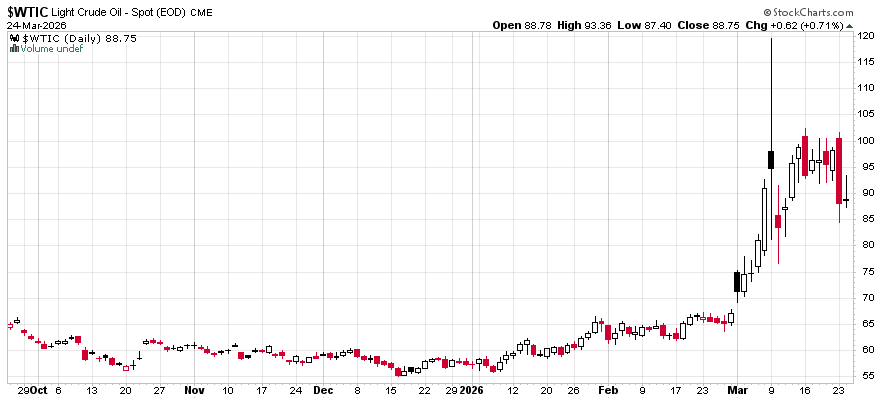
7. Energy and lumber are two commodities that have not done well. Despite energy, Canadian oil and gas has picked up a bid – sentiment has made a notable turn there. Lumber, on the other hand, looks to be depressed as the state of the real estate market is suppressing consumption. However, when this turns, there will be a massive spike up in lumber prices as supply constrictions have been significant. Thus, I would pay attention to lumber as a potential “sleeper hit” for 2026. Surely it can’t get worse for them?

Is Dye and Durham going to… die?

Dye and Durham (TSX: DND) has an interesting story but sadly it may be coming to a close simply because they couldn’t produce financial statements and creditors tend to not like it when the entities they lend money to aren’t in any position to pay back, let alone knowing how much money they are making! As there is a possibility it may be delisted in the near future, I will post its 5-year chart:

During the Covid era the company made many software acquisitions and paid for it with debt financing – amassing about $1.6 billion net from their last reported date, albeit generating $150 million in free cash flow in the past 12 months they have reported. Other than the software they have acquired (amounting to $1.8 billion in goodwill and intangibles) and the material amount of debt, there is nothing else of note on the balance sheet – tangible book value is about negative $1.5 billion.

However, reporting is one of the issues going on – their last financial statement available is from March 31, 2025 (their Q3-2025 as they have a June 30 fiscal year end!).

After they produce the audited financial statements (if they do!), it would not surprise me if there was a massive writedown in the goodwill.

The other issue is that they have been perpetually at war with their shareholders. The drama is simply too much to repeat here, but just giving a scan of the press releases over the past couple years should give a good indication of what is going on.

Notably, despite any lack of financial reporting, one significant shareholder (Plantro) reportedly was going to offer CAD$5.72/share for the entity.

However, just yesterday the TSX finally halted trading on the stock for prolonged non-reporting. Pretty much whichever shareholders are in the stock are locked in until the company either produces audited financial results, or their creditors lower the boom on them.

One interesting data point is that despite the stock not being tradable, their corporate debt is – their 8.625% issue maturing April 2029 (senior secured!) is currently trading at a yield to maturity of just over 12%, about 90.5 cents on the dollar. Given the seniority status of the debt, if DND does go into CCAA, there will likely be some form of recovery by the debtholders (they share the status with the bank creditors, for a total of about USD$905 million plus whatever is on the revolving loan facility).

There is no point for a small fish like myself to get involved with this, but it is interesting to watch. It is also a cautionary tale of companies that expand themselves with debt financing too rapidly.

Thankfully, no positions.

Teck / Anglo American – it’s almost done

Teck announced today that Industry Canada approved the merger between Teck and Anglo American. This cleared one of the most significant regulatory hurdles to the merger and basically clears the way for the merger to proceed sometime in 2026.

The last trading price of Anglo American and Teck was at a -17.7% merger arbitrage spread at the 1.3301 share conversion factor. This will most likely converge to a single digit number and close to zero as the hurdles clear.

It pretty much will be a matter of valuation at this point. The 437 page management information circular gives some hints on how to approach this, but given how both companies have various write-downs on income, the net income pro-forma is not useful for analytical purposes.

The combined entity will have approximately 1.94 billion shares outstanding, diluted.

The balance sheet, after Anglo shareholders receive their one-shot dividend to strip Teck’s cash, will have a negative net cash position of about US$18 billion.

At US$38.14 per Anglo share, this gives them a market cap of US$74 billion or an EV of about US$92 billion.

Looking at Anglo, we have an entity with US$6.4 billion in operating cash flow in the trailing 12 months. If you include Capex, the free cash flow is about US$1.4 billion. The commodity environment going forward should be a bit more favourable than those numbers.

We have Teck, with LTM operating cash flow of US$1.1 billion and Capex of US$1.3 billion as they try to figure out how to run QB2 efficiently.

It doesn’t take a CFA to figure out that the promise of this combined entity will rely on increased commodity prices, an element of balance sheet value (i.e. the reserves they are dredging out of the ground) and moderating capital expenditures (yeah right!).

These mega-mergers always take a ton of time to figure out as there will inevitably be huge cultural clashes, not to mention figuring out how to fix QB2 and realize “synergies” in that mining operation.

Teck was one of my Covid trades and they have gone through a lot since then – selling Fort Hills (an oil sands project that Suncor is now taking great advantage of), selling their metallurgical coal operations in Elk Valley (to Glencore), and now selling the the rest of it. They are going out at nearly all-time highs and so will I with the rest of this trade. I have zero interest owning the merged entity.

More consolidation

This has been quite a year for mergers.

Teck (TSX: TECK.b) is on the way (although definitely not confirmed) to being acquired by Anglo American (possibly to be Anglo Teck). There is a 16% merger arbitrage spread still going on, reflecting the regulatory uncertainty – but I do think this will be passed.

I have written ad nauesum (for years) about MEG being taken over, and Cenovus (TSX: CVE) was finally the suitor. Husky Energy (which itself was taken over by Cenovus) originally took a shot at MEG more than half a decade back. There were other oil patch consolidations I will not write about here which went through consolidation mergers.

Telus International (TSX: TIXT) was majority owned by Telus and Telus was able to re-absorb it into the main entity.

I recently wrote about Laurentian Bank effectively selling itself off to a couple institutions, one of which was National Bank (NA).

On the heels of this, a couple days ago Equitable Group (TSX: EQB) announced that they were acquiring Loblaws’ (TSX: L) PC Bank business and Loblaws is taking a minority stake in Equitable.

Finally, Canfor (TSX: CFP) announced it is proposing to take over the 45% interest in Canfor Pulp (TSX: CFX) that they did not own, for a 20% premium to market, and an option to take cash or shares of Canfor – looking at the balance sheet and the state of the pulp market (which is seemingly deader than 8-track audio), their minority shareholders are quite likely to proceed with this consolidation. Canfor itself tried to take itself private in 2020 and failed by a few percentage points on the shareholder vote – is this far behind?

What is causing all of this? Natural economic forces, but also that credit is cheap and plentiful if you have it – Canadian Natural Resources, for example, just issued $1.65 billion in 3, 5 and 10 year debt at a spread of about 85bps, 100bps and 130bps to GoC equivalents, respectively – dirt cheap!

I see the preferred share market is quite low-yielding – the spreads between yields to corporate debt has narrowed significantly over the past couple years and many of the issuers have their shares trading well above par value (e.g. most of the PPL.PR.x complex, FFH, BIP, etc.) – they are being called out at their 5-year rate resets.

High prices means low yields, and in order to get higher returns, one has to venture further up the risk spectrum. It’s getting quite competitive out there.

Laurentian Bank – more consolidation and general comments

Laurentian Bank (TSX: LB) finally found its solution to its years-long strategic review and found a way to carve itself out to various suitors, leading to a CAD$40/share cash buyout offer. The three year history of the stock graph pretty much tells the story – with the prior outsider CEO in 2023 getting fired for not being able to sell the company, and new management being successful:

I was contemplating taking a relatively mid-sized position in LB around $25-ish early this year but simply didn’t. Even worse yet, I had a tiny position (a fraction of a percent) in late 2024 but cleared it out in early 2025 to just simplify my portfolio and reduce the number of names that sucked up my attention. It’s one more illustration (more like a financial slap in the face) of how 2025, despite the major indexes posting somewhere around a +20% year, has been quite sub-par for my own personal decision-making, which is shaping up to be my worst relative performance since 2014.

Going back to LB, this pretty much eliminates the “pure banks” out there, albeit LB was a very small fish in a large ocean and also Quebec-centric. We have the following banks remaining on the TSX with a market capitalization of over a billion dollars, and needless to say, they are names that you’d all recognize, in order from largest to smallest market capitalization as of 31-Oct-2025, and I will also post the approximate YTD performance (NOTE: CAGR over the past 0.9 years) and market cap as of the writing of this post:

RY (+28%, 304B)
TD (+60%!!!, 200B)
BMO (+31%, 126B)
BNS (+32%, 121B)
CM (+36%, 112B)
NA (+30%, 66B)
LB (+45%, 2B)

There’s pretty slim pickings when it comes to publicly traded Canadian Schedule 1 banks out there. They have all done pretty well this year. The only notable valuation nook was when CM was trading around book value earlier this year. Indeed, banking world-wide has done very well as interest rates have dropped – many of the European Banks have posted triple-digit percentage returns (e.g. DB is up +115%, etc.).

With Canadian Western Bank (CWB) being picked up by National Bank a little while back, this leaves the “sub-bank” companies, such as Equitable (EQB) and the like being potentially picked off – notably Equitable is one of the few that are down year-to-date, presumptively due to its exposure to less than ideal real estate financing assets. This is also likely why he largest residential REIT trading in Canada (CAR.un) is also down YTD.

If I were to describe my investment tone at the moment, it is quite restless. High valuations do not make for high returns, and with credit seemingly plentiful and corporate debt yields relatively tight to risk-free rates, it has been a struggle to find value. Indeed, holding a grenade like Ag Growth (AFN) has not been a particularly thrilling experience although thankfully I lightened out of that one in 2023 when things were a bit more optimistic there.

I do intend to continue my Late Night Finance episodes, but only when I have something meaningful to contribute. In our make-belief world of generative AI, it is difficult to compete – I do not know whether I am adding more to the slop or whether what I am contributing is signal. Based off of my performance as of the past couple years – it seems to be noise.

The good news – past successes or failures do not have to equate to future successes or failures – each decision can be considered afresh.