The short squeeze of the year (to date) – Gamestop

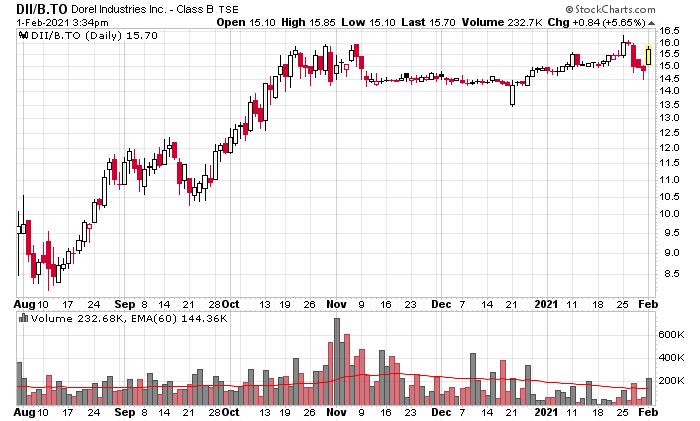
GameStop has had very high short interest as a percentage of its float, and it was obviously the recipient of a short squeeze over the past two days that saw its stock price double:

Share volume yesterday was 144 million, which is over double the approximate 70 million shares outstanding. In other words, every day trader on the planet was flipping shares like pancakes. Today, about halfway through the market open, 53 million shares have been traded.

For the brave, the cost to borrow has also increased:

As readers here know, I do not speculate on these high volume issues – there are plenty of other intelligent (and not so intelligent) actors that are putting their two cents (or perhaps US$41) into the matter. But from a trading mechanics perspective, this one is an incredibly fascinating story considering that as far as I can tell, the underlying business is this decade’s version of Radioshack for gamers.

Waiting for the last dance

This article by now 82-year old investing giant Jeremy Grantham nails it. Well worth the read.

As for the canaries in the coal mine, a good one to follow would be in my back yard – Ballard Power (TSX: BLDP), a perennial cash burner that is currently cashing in on the Hydrogen rush. Notably since 2004 they have not made any cash through operations, and have not made any net income aside from 2008 when they had a one-time gain (my memory faintly recalls a one-time sale of tax loss credits!). Doesn’t mean they won’t be making money in the future, especially from federal government subsidies for our bold hydrogen energy economy!

A hint for Ballard executives (after you’ve cashed in stock options): Do a secondary offering.

Rising long-term interest rates

From the Bank of Canada (the 10-year and 5-year government bond yield):

From the end of 2020 (0.67%) to yesterday (0.84%) the 10-year bond yield has risen.

This could just be from the “white noise” of trading. A fixed equity/debt split would surely have resulted in equity selling and fixed income purchasing which to date has not occurred, prices would appear to have done the opposite. US 10-year treasuries are also up about 15bps or so from the beginning of the year.

The impact of rising long-term interest rates have a ripple effect through the market. If the trend continues, you’ll see a dampening effect across the investment spectrum. Right now it is not a lot, but if yields continue to rise another 20bps or so (totally arbitrary guess), more people will start noticing and you’ll start to see momentum effects occur, which would likely be concentrated with price contractions of yield-based instruments (which would have the immediate impact of increasing their yields, but interest rate increases would result in the expense of their ability to borrow money at low rates). Soros’ theory on reflectivity reflexivity really applies here!

The zero rate bound

What is the difference between 0.25% and 0.1%? A 60% drop in the short term interest rates!

Apparently that is the logic of the Bank of Canada mulling a decrease in the target rate, which is currently at 0.25%.

In November, the Reserve Bank of Australia cut its policy rate by 15 basis points to 0.1%, while the Bank of England did the same last March.

While this may not seem like a lot, the mathematics of division when you get close to zero gets really fun. If your limitation is interest expense, then reducing the interest rate by 60% means you can borrow 2.5x more money!

This is a luxury that nations with their own sovereign currencies can perform. In Canada, despite the federal debt ballooning over $1 trillion this fiscal year, public debt charges peaked in 1995-1996 at nearly $50 billion. For the 2020-2021 COVID-19 fiscal year, that interest bite is expected to be about $19.5 billion (table A2.4)!

The low interest rate environment ends when the demand for currency starts to abate and one trigger to this is the onset of inflation.

Dear Questrade, fix your system

What does it say about a brokerage platform when they cannot enter the proper multiplier for securities in their system?

Chemtrade example:

CHE.DB.E.TO:

This is correct – a sample order of 1000 par value at 80 cents = $800 plus commission. Hurray!

Chemtrade example:

CHE.DB.F.TO:

This is incorrect – a sample order of 1000 par value at 100 cents = $100,000 plus commission.

Needless to say CHE.DB.F.TO can’t be traded on their system because for whatever reason they put a 100x margin multiplier on the new issue. Putting in a “10” quantity at a price between the bid-ask spread did not register on the quotation, so this is clearly a margin clearing check failure.

I’ve chatted with their support and also sent a couple emails, but have not received any satisfactory reply. They don’t seem to have any idea what is wrong.

It makes you wonder if they can’t get this right, what else will go wrong? What if this was an actual time-critical situation and saw that I could get in at a cheap price?