DREAM Unlimited and Birchcliff Preferred Shares – cash-like with higher yield

I’ve written in the past about DREAM Unlimited 7% preferred shares (TSX: DRM.PR.A) and the situation still applies today. They, along with Birchcliff 7% preferred shares (TSX: BIR.PR.C) are the only holder-retractable preferred shares trading on the entire Canadian stock market.

They are both trading slightly over par value.

In the case of Birchcliff, the preferred shares only become retractable on June 30, 2020. As such, the implied yield to retraction is around 6.14% (assuming CAD$25.50/share and not factoring in the accrued dividend). You would receive eligible dividends over the next three years and a capital loss upon retraction. The underlying corporation, while somewhat leveraged, is quite well positioned if you assume the North American natural gas market is not going to evaporate. There is also some upside catalyst to the business fundamentals (not to the preferred shares!) if North America finally gets a liquefied natural gas plant on the Pacific Coast, but this is not likely to happen since price spreads have narrowed significantly over the past couple years.

Liquidity on Birchcliff preferred shares is not the greatest – but if you float an ask at the ambient price level you will likely get hit a few hundred shares at a time.

In the case of DREAM, the premium is not extreme when factoring in the amount of accrued dividend (at the closing price of $7.29/share, implies a 6.88% yield with a risk of an immediate capital loss if the company decides to redeem at $7.16/share). It has been quite some time since they have traded at a discount to par, and this is likely due to scarcity of shares – shares outstanding have decreased from 4.87 million at the end of 2015 to 4.01 million at the end of 2016, and this trend is likely to continue. Holders are probably waiting for the inevitable call by the company to redeem the preferred shares. But until this happens, holders receive an eligible dividend of 7% on their preferred shares.

Likewise with Birchcliff, liquidity with DREAM preferred shares is not good. However, there is usually daily activity on the shares and the spreads are typically within pennies. In a financial panic, however, that liquidity might fade and in a quick trading situation you might get a price a percent or two below par value.

There is conversion risk – the company can choose to redeem the preferred shares in DREAM equity, to a minimum of $2/share or 95% of the market price (which is the standard 20 business day VWAP, 4 days before the conversion provision, as defined in section 4.09 on page 68 of this horrible document). With the common shares trading at $6.60 and the business fundamental not being terrible, the risk seems to be quite low that preferred shareholders will leave this situation with anything less than par value.

I have some idle cash parked in both instruments. I consider them a tax-advantaged cash-like instrument and do like the fact that they are margin-able at IB (Birchcliff at 50% and DREAM at 33%!). This is much better than putting the money in a Home Capital Group GIC (earn 2% fully-taxable interest income AND have the privilege of losing principal when they go insolvent)!

Does anybody out there know of any similar situations that relate to US-denominated preferred share securities that are “cash-like” in nature?

KCG cost of capital calculation

I will warn this is a very dry post.

The merger arbitrage spread with KCG has narrowed considerably.

When the $20 cash merger was announced the shares were trading at $19.75. There is little chance of the deal falling through or there being a superior offer.

Today KCG is trading at $19.88. The estimated close of the merger was reported to be “3rd quarter 2017”. The assumption is the mid-range, or August 15, 2017.

So there are 3.5 months until the deal closes.

12 cents appreciation is 0.6% over 3.5 months, which over the course of 3.5 months implies a 2.1% annualized rate, not compounding. This also excludes trading costs.

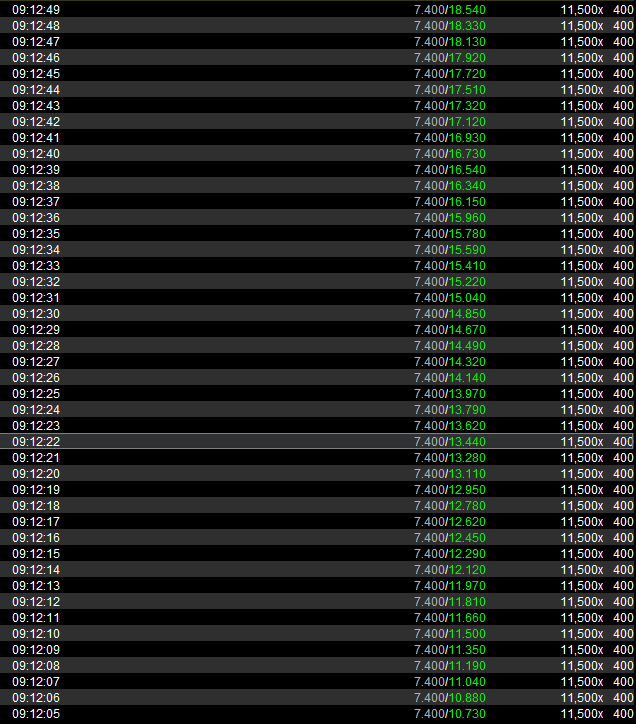
Because I had a small cash deficit in my USD account and a surplus in CAD, I’ve sold some shares at $19.88 to make up the shortfall. I placed it at the ask to minimize trading costs, which turned out to be 29 cents per 100 shares.

What’s interesting is my trade got hammered away, 100 shares at a time, approximately 2-4 seconds apart per trade. Interesting algorithms at play here.

I also believe Virtu (Nasdaq: VIRT) will have a more difficult time with the integration of KCG than they originally anticipate. The company cultures are significantly different and while the merger makes sense on paper, in practice it is going to be quite different. KCG was also dealing with a non-trivial data migration program on their own, from New Jersey to New York City and these sorts of technical details require highly skilled individuals to pull off without causing trading blow-ups. It might take them a year to get things stabilized after the merger is finished. KCG had huge growing pains of its own after it was reverse-takeovered by GetCo.

Home Capital / Equitable Group discussion

Home Capital (TSX: HCG) collapsed 60% on news that they are in the process (not obtained!) a secured credit facility for a 10% interest rate, and a 2.5% standby rate for the unused portion. They also announced that customer deposits have collapsed in recent days.

Needless to say, this is a huge amount of interest to be charged and the market’s reaction is fairly indicative of this being a very, very negative event for the company.

(Update, April 29, 2017 – This is a little late, but the company confirmed the secured credit facility on April 27, which including the $100 million commitment fee, means an effective rate of interest of 15% for a $2 billion borrow, or a 22.5% rate for a $1 billion borrow. The ex-chair on television said it was secured 2:1 by mortgage loans and is front-in line. Yikes!)

Equitable Group (TSX: EQB) also has collateral damage, down approximately 17%. Are they next?

No positions.

Home Capital Group, Equitable Group

Home Capital (TSX: HCG) and Equitable (TSX: EQB) have been hammered today as a result of fallout of the Ontario Securities Commission allegations that certain Home Capital Group executives have contravened the various regulations. They continue to perform damage control, today announcing their CFO (who was under the OSC investigation) will be stepping down and other various board changes.

Borrowing rates for Home Capital spiked to 26% today. Equitable, which normally has been an inexpensive borrow, had its cost to borrow rise to 2.75%.

Implied volatilities on options for HCG is also very expensive at present, around 110% for near-dated options and around 90% for a couple months out. EQB does not have options trading on their shares.

There has been an avalanche of media coverage (both in print and social media) about Home Capital and their woes. They have been pushed down to about 25% less than tangible book value.

This spill-over has not occurred to Genworth MI (TSX: MIC) at present.

The closing sale for Davis and Henderson

I’ve written a little bit about D+H Corporation (TSX: DH) in the past. On March 13, 2017 they received an all-cash buyout offer for CAD$25.50 from an international firm and there is no reason to believe this will fail.

In my opinion, DH shareholders are getting a good deal since there are plenty of storm clouds on the horizon for the company.

However, there is a lesson for me in this story even though the last time I owned shares was in 2010.

Back in October 2016 when they released their disaster of a quarterly earnings report, their stock subsequently traded as low as CAD$14.06, although realistically if you had started accumulating after their earnings disaster you would have received an average price of around CAD$15/share. I also predicted the company would slash its dividend in half (which it nearly did, from 32 cents to 12 cents a quarter) and thought the stock would get hit even further as I projected a spiral of selling by panicked investors.

This did not happen. Instead, when they announced their dividend slashing, the stock quickly went up to $16 and never looked back. The company announced a strategic review to sell out the firm on December 7, 2016 which sent the stock up to $21/share and you can see the rest of the story in the stock graph.

So in the span of six months between an earnings disaster and the buyout offer, the company’s stock price has appreciated by a factor of 70%.

In retrospect, the October quarterly report and subsequent dive in stock price (from $28.70 to $16.20) should have been an equity purchasing event, not an event to continue throwing eggs and rotten tomatoes at the corporate body.

It makes me wonder about my valuation methods and why I got this one incorrect.

I wasn’t in a very good position to invest back in October 2016 (I was mildly leveraged at the time), but even if I was in more of a cash situation I probably wouldn’t have dipped my toes until around CAD$12/share where I would have seen an acceptable risk/reward ratio.

I have performed equity and debt research on hundreds of companies. Some companies I keep current on even though I have not taken a position on them. Some companies I just look at once and don’t look at them again until years later when there is some reason for them to show up on my radar again. There are also some like D+H that I have invested in a long time ago and check in from time to time. Whenever companies like these appear again, there is always the knowledge that I have done my due diligence over a larger period of the company’s history compared to those that are freshly looking at the company. In the case of D+H, it will be sad to see this accumulated research knowledge go away, but that is life as an investor in publicly traded securities.