Back on August 31, 2025 I wrote a post about Andrew Peller (TSX: ADW.a and ADW.b) characterizing it as a “low risk, medium reward” situation. Adjusted for dividends, the non-voting stock was trading around $5.10/share.
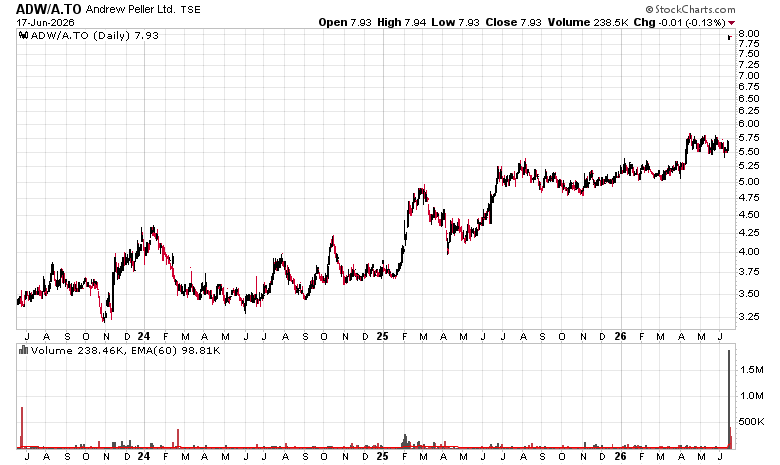
Fairfax announced yesterday that they made an agreement with the majority voting shareholders (John Peller and the Peller Family Enterprises entity, combined owning about 3/4 of the voting stock of the company) a takeover bid for $8/share cash for ADW.a and $12/share cash for ADW.b, with John Peller graciously receiving a private “rollover” provision with Fairfax, presumably to blunt the impact of any capital gains taxes going forward.
This deal was at a considerable premium to market at the time and is quite probable to be accepted with a 2/3rds vote required by both classes of shareholders and also a majority of Class B shareholders that are not represented by those that get a rollover provision or otherwise exempted by the MI 61-101 rules.
Right now, it is not clear to me whether a significant shareholder (the Peller Family Enterprises Inc. entity owning just under 50% of the Class B shares) is excluded from the majority vote. I will read the information circular when it comes out. If it is excluded, then the public shareholders (about 25% of the Class B stock) is voting on the deal which creates an interesting dynamic if it occurs.
By all means this trade should be considered a victory, but it leaves me with a couple bittersweet feelings.
The first bittersweet feeling is that the Class A shares are mildly undervalued by Fairfax – albeit there is no obligation for Fairfax to give Class A shareholders any sort of deal at all (they could have just taken control of the entity by purchasing the majority stake from the Pellers), they did short-change the Class A shareholders about 75 cents from the midpoint of the “valuation” alluded to in the press release.
This is no stranger to Fairfax (and other companies) that do this to minority holders of smallcap companies – one of the big risks of smallcap investing is that when you do get a takeover offer, they are sometimes at unfavourable terms. I felt the same way after Cervus was taken over (have to go back to August 2021 for this post).
Andrew Peller is in way better shape today than it was a couple years ago when I started to purchase shares. For the fiscal year ended 2026, they reported a diluted EPS of 61 cents per share – so at the $8/share that Fairfax is paying for non-voting stock, that’s a P/E of 13, not a bad price. Balance-sheet wise the company owns a lot of physical infrastructure, and the marketing/distribution know-how and incumbent contracts consisting of about 10% of the Canadian domestic wine market, but they also own a strip of land in Port Moody, BC, which they will inevitably liquidate and realize a healthy gain from (book value is about $6 million, market value of land is assessed at $50 million). Factoring in these off-balance sheet assets, Fairfax is getting a fairly good deal, hence some resentment.
There are a couple headwinds, however – about $26 million of the revenues comes in the form of a federal/provincial subsidy (read Note 17 of the financial statements – not a revenue accounting-wise but an offset to costs, but either way, it is 100% pure ‘margin’), and coupled with the VQA revenues of about $17 million, all of which considerably overstates the company’s profitability if these subsidies were to be tapered away for whatever political reasons. The other headwind is the nature of the market – in general, alcohol consumption is on the decline.
The second bittersweet feeling is that I have been really struggling to find reinvestment candidates. Andrew Peller was the type of company (similar to Rogers Sugar when it was reasonably priced) that you can just purchase and forget about entirely since the industry itself was so mature and stagnant. My portfolio, which is cash-heavy, is going to become more cash heavy as a result of this takeover. I have been really struggling for reinvestment options that I have considered acceptable.
I have a cliche which is that every good trade you make you wish you had doubled it when getting into the position. Considering the cash-heavy nature of my portfolio since 2023, this is especially true with Andrew Peller. However, by all means I should instead be purchasing a bottle of $10 red wine (perhaps upgrade to the $20 stuff given the one-time nature of this takeover bid) and count my blessings before sobering up and hitting the stock screener for the next opportunity.