This article is entirely political, so for those of my readers who care about finance and not politics, please disregard everything below.
Prediction is an activity that is subject to a lot of error. Most pundits issue predictions and there is usually little social consequence for getting them wrong, so they make as many as possible and then stick to the ones they got right as a sign of their prognostication abilities. So I’ll thump my chest and say that I saw Trump getting elected despite the fact that he was a 3-1 odds against of winning (if you were to put money on it).
So far my political predictions in my year-end 2016 report have been quite poor – I predicted incorrectly most of the federal budget actions and I completely failed to predict Kevin O’Leary’s surrender in the Conservative leadership contest (I initially predicted he would take it in the first ballot, but this was under the presumption that his French wasn’t as bad as the media made it sound to be – but it indeed was!).
It is quite clear to me right now that my original prediction (at the end of 2016) of the BC NDP winning 20 seats or less in the upcoming election is going to be incorrect. Just how incorrect is going to depend on the volatility of who shows up to vote tomorrow.
Overall notes
The NDP’s campaign has performed better than my expectations. It hasn’t been perfect, but my original expectations were them campaigning on matters relating to social justice which would have appealed to some narrow niches within their party but not appealed to any wide swash of the electorate in order for them to win. Instead, I saw this:

These sorts of “bread and butter” issues are ones that can relate to people that otherwise would not be voting or worse yet, voting against you.
In particular, what got my attention was the initial battle on the issue of the toll bridges. The BC Liberals promised to cap tolls to $500/year as a measure of ‘affordability’, while the NDP a few hours later promised to eliminate them entirely.
While this in itself might not sound like anything special, it was a sign that (whether accidentally or purposefully) the NDP knew what they were doing politically – they knee-capped the BC Liberals on this topic and got them to shut up about transportation entirely across the region, which normally should have been a strength of the BC Liberals. This was the first data point that suggested to me that the NDP were running a good campaign.
As the federal Liberals demonstrated, a good portion of the voting public do not prioritize the status of the fiscal balance until it begins to hit them directly in their pocketbooks. The BC Liberals are smart enough to know that fiscal conservatism is not a strong political selling point when times are good and they wisely chose to focus on other matters.
Unfortunately for the NDP, they failed to keep a laser-like focus on the affordability section of their platform after approximately the two week mark in the four week campaign – they got distracted and somehow they seemed to lose focus while they attempted to also battle the left side of their flank (the Green party). They did not, however, commit any huge errors this campaign like they did in 2013 (the infamous reversal of policy position on the Kinder Morgan pipeline by Adrian Dix being the key example).
The BC Liberals, for the most part, ran a very predictable and I might say cautious and boring campaign. Being in government for 16 years to date, it is difficult for them to make any sort of “change” argument. That said, they have significant messaging strengths in the BC interior geography (natural resource development and jobs) and they still appeal generally to the older electorate (property-owners and those generally with money).
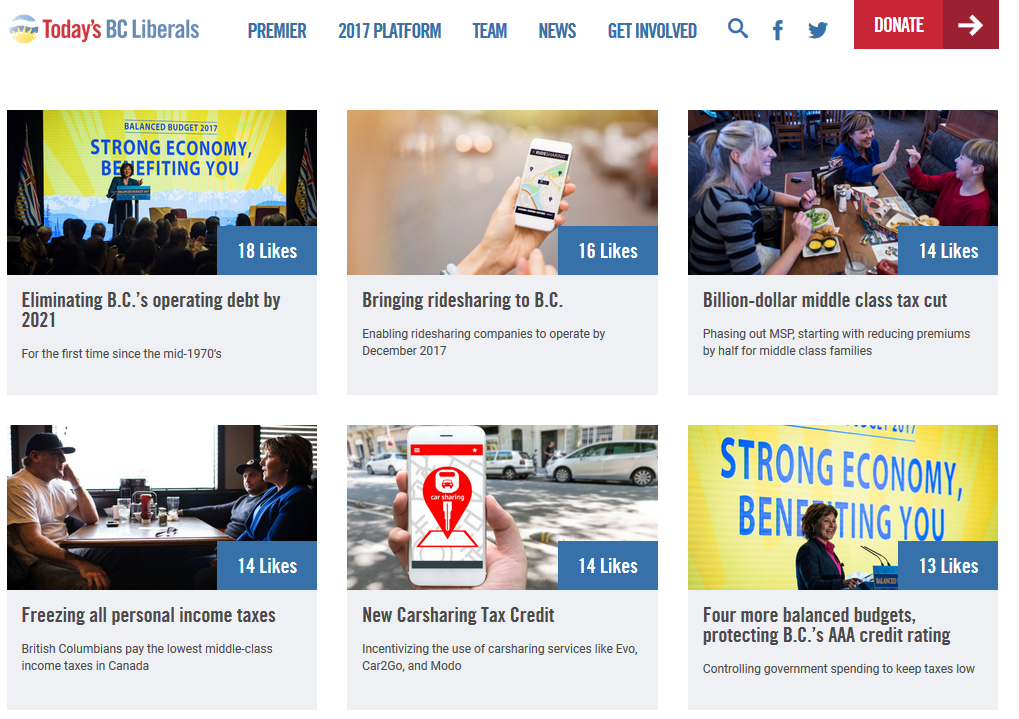
Their messaging beyond the track record, however, is a bit muddy. For instance, on their website, we have the following mish-mash of platform points:
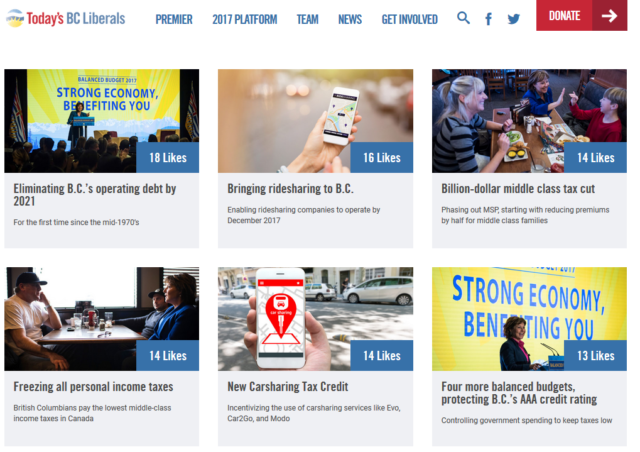
I realize that only opposition researchers and media will be scouring political parties’ webpages for information, but this gives a general sense of what the BC Liberals are trying to focus on (short of the odd obsession over ride-sharing, which is probably the only bone thrown to millennial voters).
The Greens’ strategic objectives were obvious from the very beginning of the campaign and their goal is to expand out in Vancouver Island to elect 4 MLAs (this will qualify them for official party status and entitle them to various privileges that they otherwise don’t have in their current situation). Their other objective is to be the balance of power in a minority government situation, but that part is out of their control – it depends on the BC Liberals and NDP very narrowly balancing each other’s seat count.
The Greens’ primary marketing point is that they’re not the other two parties. It’ll be enough to get them another seat, but not much more. A lot of their candidates across the province are paper candidates – for instance, they have somebody running in a Richmond riding that actually lives in Castlegar. Without having credible candidates on the ground, their vote share will bleed to the NDP.
Projecting voter turnout is the key task in this election prediction. Who is motivated to vote, who will they vote for, and for what reasons?
Polling
In 2013, polling agencies had the NDP up approximately 45-37 and the actual result of the election was the BC Liberals winning 44-40. This was a huge “miss” in terms of polling agencies failing to predict the outcome of the election. It is also instructive that final election numbers has a huge amount of inherent volatility that make the “margin of error” a theoretical and not a practical figure.
In 2017, the big difference is that the polling agencies are showing a tight contest provincially – both major parties are around the 40% mark, with the Greens sitting around 15-20%.
The message is not whether these polls are correct, but the message that unlike 2013, the race in 2017 is significantly closer, which tends to increase voter turnout.
In reality, I’d venture (this being a gut instinct feel) that the +/- factor in polls is around 5%, and would suspect the BC Liberals and NDP are indeed gravitating towards 40% each.
BC Interior (24 seats)
I believe the BC Liberals have a significant edge in their messaging and policies concerning the BC Interior. The population is also more aged, has higher homeownership levels and is the bread-and-butter of the BC Liberal party support from the Social Credit days. The old influences of union workers are fading away which works against the NDP, especially as NDP platforms have become more focused on urban issues. Thus, I only see the NDP winning swing ridings such as Skeena and Columbia River-Revelstoke. Ridings such as Cariboo North, Kamloops-North Thompson, Boundary-Similkameen, Fraser-Nicola (Harry Lali’s nomination victory was a disaster here for the NDP) will go BC Liberal. The biggest question mark I have is Columbia River-Revelstoke – if the NDP lose this riding they will have zero chance of forming government.
You can also see evidence of the relative importance of the interior ridings in some BC Liberal campaign spin:
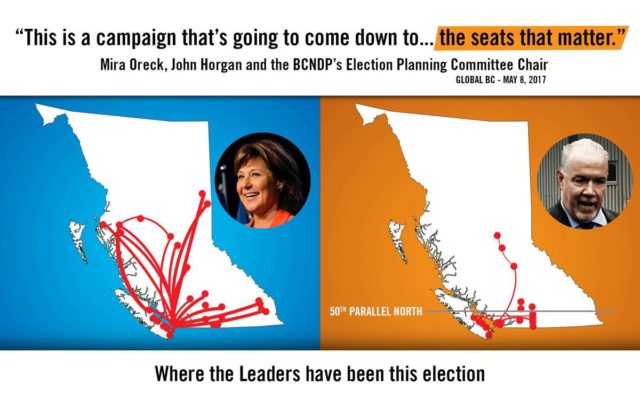
This is probably a rare piece of political advertising that appears to be truthful.
There are 24 ridings (out of 87) in the interior, and 18 will go BC Liberal and 6 will go NDP.
Vancouver Island (15 seats)
On Vancouver Island, the main contest is between the Green Party and the NDP in certain southern Vancouver Island ridings. The Greens will win Oak Bay-Gordon Head, and Saanich North. Cowichan Valley has been the other riding that has generally been considered a swing riding between the NDP and Greens, and I believe this will go NDP, along with the rest of the island short of Parksville-Qualicum (which will be the sold riding remaining BC Liberal on the island). Courtenay-Comox stands a good chance of swinging back to the NDP and I will note this is contrary to most public predictions.
There are 15 ridings in Vancouver Island, and 12 will go NDP, 2 Green and 1 BC Liberal.
City of Vancouver (11 seats)
In the City of Vancouver, the prevailing issue is affordability and while this means homeowners vs. renters, the geography of past elections only allow a swing in a single electoral district – Vancouver-Fraserview, which should probably go NDP. The rest will remain the same. There is an outside chance of Vancouver-Langara going NDP, but the components of the electorate will not be enough to swing the seat to the NDP.
There are 11 ridings in the City of Vancouver, and the NDP will win 8 and the BC Liberals will win 3.
Fraser Valley (9 seats)
The geography here includes Pitt Meadows, Maple Ridge, Mission, Kent, and Langley to Hope. I do not think there will be any surprises south of the Fraser River. North of the Fraser, the two selections I have that run contrary to consensus is that the NDP will win both Maple Ridge-Pitt Meadows and Maple Ridge-Mission, although I do not give these predictions with huge conviction.
There are 9 ridings in the Fraser Valley, and the BC Liberals will win 7 and the NDP will win 2.
Metro Vancouver minus Vancouver (28 seats)
The specific question is who wins Burnaby North, Coquitlam-Burke Mountain, Port Moody-Coquitlam, North Vancouver-Lonsdale, Delta North, Surrey-Fleetwood and Surrey-Guilford.
The geography of these areas suggest that the electorate of these sub-urban ridings will have the influence to decide who gets to be in government. There are competing variables in play – transportation was a big one (most of these ridings are heavily influenced by the Port Mann Bridge toll and motorists that want to vote for shorter commutes, whether by car or TransLink), affordability (renters vs. owners), and perceptions of economic competency (jobs, jobs, and jobs). It is difficult to juggle these influences on the overall electorate. Political parties have likely done their statistical research to attract their target demographics on these topics.
In the 2015 federal election, we saw firm evidence that voter turnout from people between the age 18-34 turned out when previously they would not before. Judging from my experiences in that election, predominantly these voters went (federal) Liberal as there was a desire for change.
Survey data (e.g. Reddit, polling and so forth) would suggest that the average younger individual will be voting NDP or Green. And in the event that they are in a riding where the Green party is not a realistic contender, they will probably vote NDP if they do indeed vote.
Question: Will this same millennial voting wave take over provincially? This is the key to the election and one where I have no insight on until looking at things retrospectively. I do not have a good intuitive grasp whether Christy Clark or John Horgan have actually been able to galvanize the average millennial voter.
Polling with regional splits indicates the NDP has a significant advantage in the Metro Vancouver area, but I take these sub-regional splits with a grain of salt for various reasons. All it indicates to me is that the race is competitive.
Factoring in everything, I am going to venture that the NDP will take 15 of the 28 sub-urban seats, while the BC Liberals will take the other 13.
Conclusion
NDP – 43 (41%)
BC Liberals – 42 (42%)
Green – 2 (15%)
Others – 0 (2%)
This is a low conviction prediction. I’m probably wrong. The numbers don’t really add up for me (which is the first sign that my election modelling is not right). The BC Liberals have a higher popular vote because their interior and Fraser Valley victories are going to be what might be a bunch of narrow victories in the Lower Mainland for the NDP. Also despite this prediction, I view the odds of a minority government to be very slim.
We’ll see tomorrow what happens.