Trading credit principal for quality – TFSA update

As readers here may remember, my TFSA investment (which I am trying to compound as quickly as possible) was in First Uranium debentures (TSX: FIU.DB), unsecured senior debt, coupon 4.25%, maturing June 2012.

This has been one of my lesser performing investments, due to a horrible entry point (the company announced some adverse news shortly after my investment), which I had an opportunity to see the writing on the wall and liquidate (which I could have received a very acceptable price), but unfortunately my worst decision in the year was to not.

Anyhow, my TFSA is currently sitting about $600 below the end of December 2009 mark (netting out the $5,000 deposit), which is not too good since my other (fixed income) investment candidates at the time would have resulted in an actual increase on investment, which is the whole point of the TFSA. If I was planning on losing money, I would have prefered to do it in the RRSP or in the non-registered account so I could deduct the loss. C’est la vie – that’s how things work sometimes. The question is now, how to get back on track?

The first thing to look at is whether the underlying securities are still worth keeping based on new information that has been received in the interim. First Uranium went through a recapitalization which saw common shareholders be diluted in the form of a convertible notes offering (senior, secured by all assets minus what Gold Wheaton is entitled to, maturing March 31, 2013, convertible at $1.30/share, 7% coupon, TSX:FIU.NT) and a 14 million share settlement to Gold Wheaton (TSX: GLW) since FIU did not finish constructing a mine module in time. The company itself remains active in the gold mining industry (despite the company’s name, Uranium is a small part of the business), having two mines operating – Mine Waste Solutions (which is operating well and is profitable) and Ezulwini (which has been a basket case operationally and has been losing money). After firing most of the board and management, it appears there are hints that the company is coming back to financial life again, especially with gold prices at the high prices they are at today.

The company’s financials, once they stop spending big cash on capital expenditures, should be cash generating and healthily profitable even if you believe they will moderately underperform the economic projections in the technical reports. So it becomes a matter of whether the market believes the management can deliver operationally, and whether the management is credible. Given the history of the company, they are not and the common stock and debentures trade as if this is the case.

Thus, this is a high risk, high reward scenario. I have only gone superficially into one of the risks in this post, but there are other risks that I have mentally dissected.

While I do not think this investment is a slam dunk, when you adjust it for risk/return, there is a compelling investment thesis on the debt of First Uranium, and possibly the equity, which appears to be somewhat undervalued. There is a huge amount of default risk for the equity holders, and some risk for the unsecured debenture holders, and limited risk for the secured note holders.

The TFSA transaction that I recently performed was to sell half the debentures ($12k face) at 70 cents on the dollar, and then use the proceeds to purchase $10k face of notes, which I subsequently purchased at 88.5 cents on the dollar.

Why would I trade lower priced unsecured notes, maturing earlier (and a better annual compounded yield at existing trading prices) for more expensive, secure notes with a later maturity and less yield? The quick answer is that I am trading yield for quality.

The longer answer is that I am reasonably confident that the secured note holders would be able to receive the full principal amount in a bankruptcy liquidation of First Uranium. There is $150M outstanding and the company is likely to fetch more than this from Mine Waste Solutions alone. The upside for the noteholders (beyond a payout at maturity) is the $1.30 strike price, 2.5 year call option embedded in the notes, which provides a mild amount of equity participation without actually having to own the equity. The equity is currently about 67% out of the money as of this writing.

If FIU does get its act together, it is likely that the equity will increase higher than 67%. However, the equity is far too risky in the TFSA – it is better suited to a non-registered account where you can at least book capital losses if it tanks.

Finally, there is the scenario of what happens to the unsecured debenture holders when their maturity hits (June 2012) – the company will either likely make an offer to extend the maturity or give the debenture holders a sweeter deal (higher coupon and lower conversion rate) while the company tries to make its mining operations profitable. I do not think the unsecured debenture holders will force the company into bankruptcy simply because of their rank – they have relatively less negotiating power.

I will emphasize that equity in First Uranium is a highly risky investment, and the debentures are a risky investment, but the notes appear to be less risky, and are priced to represent the lower risk.

The notes are also better positioned in the TFSA (since you will likely see your money back), while debentures are better positioned in the RRSP (income is tax-deferred, but you can still benefit if you have a loss of prinicpal), and equity is positioned in the non-registered account.

Pay attention to the 30-year treasury bond

With all the talk of the US Federal Reserve performing another round of quantitative easing (which amounts to repurchasing medium and long-dated government debt securities in an attempt to lower long term interest rates and frustrate people into purchasing anything else where they can get a decent yield on cash), the markets have started to get a bit antsy on the macroeconomic front.

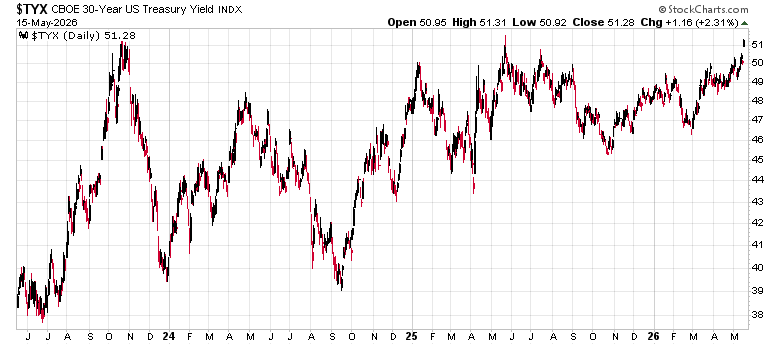
Since the strength of the US dollar is a huge global variable, whenever the US Federal Reserve does something, the rest of the world, including domestic US investors, will notice. And indeed, the world has reacted by tanking the currency. More interestingly, however, is the rise in treasury yields (lower treasury prices):

In theory when you have the full force of the US Federal Reserve behind a position (in this case, purchasing government bonds), you try to get out of the way. This time, the market’s reaction appears to be one of indigestion – an exit from bonds. This is very interesting and if the trend continues, will have huge ramifications on investor’s calculations as to what exactly constitutes a “risk free rate”.

It is increasingly clear that US government debt is not as “risk free” as people may think, and this risk should be appropriately adjusted in financial calculations.

The easiest way for an investor to directly take a stake in this (other than buying or shorting treasury futures, which is a relatively trivial transaction to perform) is to buy or sell units in NYSE: TLT, which is an ETF that contains long-dated treasury instruments of 20 years and above. TLT is down about 8% from two months ago, when US Treasury bonds were trading at a local minimum of 3.5%. During the pits of the economic crisis, the US Treasury bond traded as high as 2.5% as investors dove for the safest haven.

A question in the financial markets should now be – exactly how safe is the “safest haven”? If the answer is anything other than US government debt, this would explain the currency exodus.

As a comparison, Canadian long term benchmark yields have generally gravitated down from August – reaching a high of 3.72% in August, and currently trading at 3.45%, and a low of 3.33% seen in late September. Clearly, the crisis hitting the US bond market is not hitting the Canadian bond market, at present.

My perception is that if this is the beginning of a “run” on US long term debt, there will be huge financial ripples in the US marketplace – for example, what do you do when you see a corporate long-term bond trading at a yield of 7%, when the 30-year US government debt is trading at the same yield? We are not there yet, but rising US government bond yields will crush the corporate debt market window that is currently open.

Watch out, because I suspect things are getting exciting again.

Clearwater Seafoods buys 3 months of time

I wrote earlier about Clearwater Seafoods Income Fund and their solvency issues. They had two maturities due – a small one in late September, and a much larger one on December 2010.

I have been an interested spectator to see how this resolves. I am not interested in purchasing either their equity or debt.

The first announcement in this refinancing game was on September 28, 2010, when Clearwater came to an arrangement with the September debt holders.

Of the CAD$11.9M debt that was due, three of the debtholders consisting of a majority ($8.8M or 74%) of the amount agreed to extend the debt to December 15, 2010, with the penalty of raising the coupon from 6.7% to 10.5% and the accumulated interest to date.

The rest of the minority holders (26% or $3.1 million) will be paid off the interest and debt principal.

So the company managed to pay off $3.1 million of debt, and deferred $8.8 million for less than three months.

The big maturity coming up (December 31, 2010) is a $45 million issue, which trades as CLR.DB on the TSX, with the last quoted value of 88 cents on the dollar. The relatively large price suggests the market anticipates that there will be a refinancing at relatively attractive terms for the underlying company. If Clearwater manages to get around this debt hurdle, there are successive hurdles to be cleared in 2012, 2013 and 2014.

Lack of fixed income candidates

I’ve been scanning the entire list of exchange-traded debt and asset-backed securities, and the number of securities that are trading at a substantial discount to par you can count with the fingers of one hand.

On the US side, you have subsidiaries of Ambac, AIG, and SLM Corp.

On the Canadian side, you have Clearwater Seafoods, First Uranium, Holloway Lodging REIT, Lanesbourough REIT, Newport Partners, Priszm, Royal Host and Sterling Shoes.

All of these companies have significant issues, so an investment in the debt of any of these issuers involve a substantial amount of risk, including their ability to refinance. Right now is the most debt-friendly time to finance, so one wonders what would happen in the event of a slowdown in the debt issuance market.

Questrade offering bonds

I notice that Questrade is offering bonds to their clients. More interestingly, they have a comprehensive list of securities available with tentative pricing. This method of offering is a good step, although they probably will need to automate the transactions.

They claim to be offering it “commission-free”, but the commission is embedded in the bid-ask spread. For example, a Government of Canada bond maturing on December 1, 2011 (a year and a couple months away) is quoted at bid 1.28%, ask 1.26%. This is not bad when you consider that 1-year T-Bills have a yield of 1.23%.

One of the big differences between retail investing and institutional investing is that if you have $100 million lying around, you just can’t dump it all into Ally or some retail savings bank and get your 2%; with large quantities of cash, you have to pile them into government securities in order to get a risk-free return – in this case, locking away $100 million you can get about 1.23%, at least using end-of-September quotations. If you want 2% or higher, you have to go all the way out to December 2015 for Government of Canada debt (2.04% on the ask); if you are willing to settle for a province, Quebec has June 2014 issues for 2.06%.

A retail investor does have the option of putting money risk-free into retail facilities, and thus this makes investing in government bonds quite useless since typically GIC rates (of up to 5 years of maturity) will be higher than prevailing government bond rates.

Corporate debt is another story – you can find higher yields there, but will have to take the appropriate amount of risk, and/or be willing to take debt with very long terms to achieve the desired yield. Most of the interesting issues are also exchange-traded, which alleviates the hassle of dealing with somebody over the telephone.

Finally, Interactive Brokers has a system that enables automated transactions on bonds, but it strongly depends on the corporate issue whether you will have any liquidity available.

Fairfax Fixed Income offering

Via James Hymas, Fairfax Financial is issuing $250M in preferred shares, with a 5% yield, and 2.85% above 5-year government bond rates thereafter, and the (holder’s) option to convert to preferreds yielding a floating rate of 2.85% above 3-month government treasury bill rates every five years.

5-year government rates were 2.16% on September 24, and the 3-month note rates were at 0.90%.

Cheap, cheap financing. As issuers start to pound away on the fixed income side (due to heavy demand), it makes you wonder when the party will end. My strong impression is that companies should be extending maturities and securing their debt financing since rates right now are about as good as they will get due to such voracious demand for fixed income securities.

A top to fixed income securities?

I don’t like calling tops and bottoms – it is nearly impossible to get the exact time correct, but it is possible to get close. The way you take advantage is by scaling in your orders and waiting for the executions.

Trends in the marketplace go on further than anybody usually expects. Fixed income securities (especially bonds) appear to be quite pricey at the moment. Also, I have been noticing a lot more sentiment on the retail side toward dividend-bearing equities, and doing a cursory scan on that side of the marketplace leads me to believe that performing screens on non-income bearing securities would bear more fruit at the moment.

Portfolio movement has been mainly selling securities and raising cash, due to lack of research time. In particular, there is quite a bit of US currency available for deployment, and it is has been nearly a year and a half since I have invested in US equities.

Yield is now down, but I am very liquid.

Competition on the mortgage front

I notice that a certain local credit union is advertising a 5-year fixed mortgage rate at 3.45%, which is a very low rate considering it is about 125bps above government benchmark bond rates. Since the overnight rate is now 1%, they will not be making much margin on the transaction. This also implies they have confidence in the price stability of the local real estate market, and being in the Greater Vancouver area, makes you wonder whether this is a valid assumption.

Something that is not easily discovered is their loan criteria – for example, if getting such a rate required a 40% down payment, then the rate might be warranted since the bank would have recourse and recovery in the event of a mortgage default.

Looking at the variable rate market, the best rate I can find is 0.85% below prime (prime is currently 3.00%), but if other institutions are over-capitalized, this discount to prime will continue to increase as they compete for loans. It makes you wonder whether consumer demand for debt has slowed down.

If you put a gun to my head and forced me to choose a mortgage that would result in the lowest interest paid over a 5 year term, I would still go for the variable rate. However, that said, 5-year mortgage rates cannot go much lower than 3.45% – maybe down to 3%, but that’s about it before you really question the sanity of financial institutions offering loans at that rate.

There is some risk of short term rates rising even further in 2011 and 2012, but it doesn’t seem like such movement would be extreme if it did occur. For financial modeling purposes, the market is saying that the 2011 increase will be 0.43%. There are scenarios where this rate could skyrocket, and also scenarios where the short term rate goes back to 0.25% again (where sitting on a prime minus 0.85% mortgage is really inexpensive!).

Relative debt pricing – Yield and Quality

Noticed that AON Corporation (NYSE: AON), which is a financially stable and large insurance broker, issued some debt to fund a $1.5 billion dollar takeover of another corporation:

Of these notes, $600 million will mature on September 30, 2015 and bear interest at a fixed annual rate of 3.50 percent; $600 million will mature on September 30, 2020 and bear interest at a fixed annual rate of 5.00 percent; and $300 million will mature on September 30, 2040 and bear interest at a fixed annual rate of 6.25 percent. The offering is expected to close on September 10, 2010.

They have a convenient 5-year, 10-year and 30-year maturity, which compared to the US treasury bond is a spread of 2.05%, 2.35% and 2.52%, respectively compared to the closing quotes in September 8, 2010. AON is receiving very cheap debt financing, and the bonds were rated BBB+, although one can see by a quick look at AON’s financial statements that despite the takeover (which is roughly a $5 billion purchase, half cash, half stock that dilutes shareholders by about 20%) they should still be generating sufficient cash to pay off the debt.

So let’s pretend you are owning some 30-year corporate debt in a less solvent entity (e.g. QWest) and have a yield to maturity of 7.5% on a similar bond. Do you trade 1.25% of yield in exchange for higher credit quality? Or do you think the macro environment (e.g. the risk-free rate) will turn hostile to long bond yields and both assets will depreciate? Very difficult to say.

Bonds are trading high

When markets move in a direction, the trend typically goes longer than most people otherwise anticipate. The Vancouver Real Estate market is a great example, or I could just be completely wrong and not realize there is some fundamental underpinnings that I am unaware of.

I believe this lasting momentum is the case for the bond market – today, I continue to unload at a pace of a trickle some of my slightly-better-than-junk debt (long-dated maturities) because the quotations just keep going higher.

Fortunately, some of it is sheltered in a registered account so I can defer the tax hit for a future time, but some of it is in the non-registered account. There is a tax timing problem in that I ideally would want to carry forward gains into the 2011 tax year, but it is better to take the bird in hand, rather than waiting 4 months. The taxes have to be paid eventually, but I’d rather want to pay them in April 2012 than April 2011.

Chances are in four months the bond party will still be going strong (especially when people dump their annual RSP contributions into the hottest bond fund they can find), but as a bond investor, I am getting very concerned as to the macro movement toward fixed income products and accordingly am continuing to leak my positions to the market as quotations go higher.

My cash balance continues to rise in the portfolio. It is at a higher level (in absolute but not percent terms) than at the end of 2008!