30-year treasury bonds

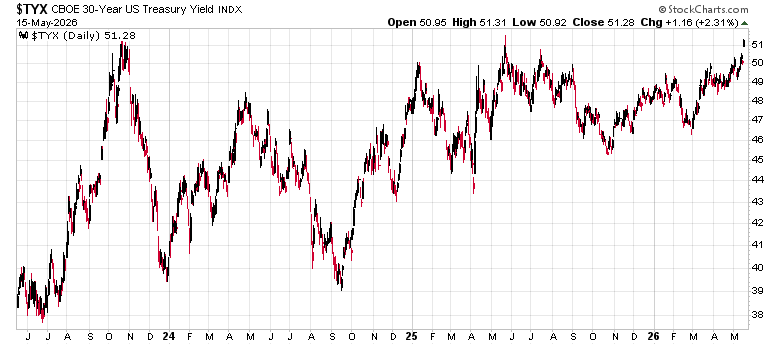
I am so tempted to short 30-year bonds right now. I might soon.

There are a few ways to represent this position:

1. Short bond futures (CME) – this is the world’s most liquid proxy to treasury bonds (other than dealing with the underlying product directly!). It has the advantages of liquidity and dealing strictly with the capital and not income component of the bond.

2. Purchase/short a liquid ETF that deals with long-term treasuries. There are a few to choose from:

- iShares 20-year+ government bond fund (TLT) – MER is 0.15%; average term of bond is 27.8 years – fund is highly liquid and shortable;
- Proshares Ultra/short (2x) 20-year+ (UBT/TBT) – MER is 0.95%; linked to TLT performance above as basis index. UBT is not very liquid, while TBT is very liquid.

ETFs have the advantage of being tradable in smaller amounts than futures (Future contracts are for $100,000 face value of product, which currently trade around 142% of par for the June contract). Futures typically have a spread advantage ($31.25 per $142,000 notional value), but liquid ETFs such as TLT have typically had penny spreads, resulting in comparable slippage. As previously mentioned the futures have an advantage with stripping the income-related aspects of the bond, and also tax advantages (both in the USA and Canada).

Still watching

The S&P 500 continues to make a local high, and commodities except for natural gas appear to be on the rise again.

My examinations continue to be on zero or low-dividend, non-resource, non-financial companies. I don’t have much to report at present.

Playing with numbers – What you can buy with $469 billion

Apple’s market capitalization is $469 billion. Let’s see what you can buy with $469 billion?

Microsoft’s market cap is $257 billion, and Intel is $136 billion. Throw in Dell for some chump change ($32 billion) and you still have $44 billion left to blow on beer and popcorn.

Alternatively if you wanted to go for a more “online model”, you could pick up Google for $199 billion, and throw in Ebay for $43 billion, Yahoo for $20 billion, LinkedIn ($8.5 billion), Amazon for $87 billion and still have $112 billion left to pick up things like Facebook (presently the IPO is not priced yet).

I’m not saying that Apple is a buy or a sell at existing prices, just that its market gigantic market capitalization means it will be facing the law of large numbers, mainly it becomes more and more difficult to increase your size on a constant percentage basis when you get bigger.

Another investment candidate

There are some interesting companies available that do not give out dividends.

I’ve started to build a position in a company that is another leader in its niche, in the $500-$1B market cap range, enterprise value roughly equivalent to its revenues. It is seemingly a bit expensive, trading at about 25 times projected 2012 earnings, but it is in a sector where it will obviously be a growth industry and likely they will be able to increase such earnings over the long run.

The most dangerous investment right now appears to be locking your money up at 2% for 10 years in government bonds. Even cash seems to be better than this.

Yellow Media Q4 projections

I made a pretty good estimation of Yellow Media’s Q3 projections, my range was EBITDA of $160.4M to $175.8M with them achieving an actual of $166.0M.

Modelling Q4, there are two significant factors worth considering. One has to adjust an amount due to the impact of the LesPAC disposition. There may be an impairment expense dealing with the CanPages fallout that will take effect in Q1-2012. A parenthetical note that has to do with the “I” in EBITDA; one has to make a subtle adjustment to the amount of cash interest the corporation is paying – it will be about $7M less due to debt repayments.

In Q3-2011, the corporation did $166.0M EBITDA; in Q4-2010, the corporation did $192.7M, but Trader Corporation needs to be removed from the equation, thus this is adjusted down to $161.3M. This number itself is artificially low because the company expensed the majority of its income trust to corporation expenses in this quarter. With Trader Corporation, the number is $225.2M, and adjusting Trader out of this was $193.8M as a baseline.

Leaving out my distillation which can compete with alchemy, leaves the following projection, which uses a 14% decay and plus or minus 4% for error bounds:

Higher than expectations: $174.4M or above;
Lower than expectations: $158.9M or below.

I also anticipate the company will announce it will convert the Preferred Shares Series 1 into equity, but this should not surprise the market. A potential surprise, and one I cannot predict, is whether the company will suspend preferred share dividends completely – my model shows that in 2013 the company will face a cash crunch if it cannot renew its credit facility as the Medium Term Notes become due. This does not assume any further asset sales.

There becomes a bit of psychology involved. Payment of preferred share dividends will cost about $29M for 2012, and this is assuming Series 1 and 2 convert into equity at the earliest date. If dividends are suspended, the company will save cash flow but this will not be sufficient to pay off the 2013 Medium Term Notes with existing operational cash flow. If the dividends are not suspended then the company will still not make the 2013 MTN payments unless if they can raise cash through an extension of their credit facility or an asset sale.

However, the market perception might be better later in 2012 than it is currently. It is also more likely that it is more likely there would be some sort of recovery if the company paid preferred share dividends than if it did not.

My guess is that the company will continue paying preferred share dividends for this quarter, but I am not completely sure. I do believe the preferred shareholders will become more vulnerable later in the year when Yellow Media tries to renegotiate the credit facility – if their operations are not to snuff, the bank(s) that are willing to lend to Yellow will likely have as a covenant that preferred shareholders cannot be paid unless if Yellow Media is below certain debt coverage ratios.

I also believe management will bring up the idea of doing a reverse stock split, as the dilution after the conversion of Preferred series 1 and 2 will likely keep the stock price below the psychological barrier of one dollar for some time.

This continues to be a high risk, very high potential reward situation if the company gets it right and stems the decay in revenues. However, it will be a long and drawn out battle as it struggles to raise cash to slay its debt albatross. If you assume the company will not go into creditor protection, the unsecured convertible debentures (TSX: YLO.DB.A) has great value, but again, they are trading at 21 cents to the dollar for a reason – you never know if/when they are going to do a pre-packaged CCAA deal, at least if you are not an insider. Since the unsecured convertible debentures are subordinated to the other components of the debt structure, they will likely be offered a pittance compared to the Medium Term Note holders in such a deal, which explains why they are trading at about half of the Medium Term Notes of comparable coupon and duration.

Petrobank cleaning the slate

Petrobank (TSX: PBG) announced today that they were selling their primary property asset, the May River project for $225 million. After paying off their $60 million bank debt, this will leave their corporate with approximately $165 million to figure out what to do in the meantime. Their other primary asset includes their 59% ownership stake in Petrobakken (TSX: PBN) which readers of this site will also know has its own issues, although it has solved its imminent financial problems by floating a $900M, 8.625% coupon bond issue with an 8 year maturity date.

Readers might suspect that I’d rather want to put my money in that bond than the equity.

This is about a clean a slate that Petrobank will have before it decides how to invest the proceeds in other projects. The May River project was not as successful as management anticipated and they likely hit the best bid they could solicit. The low-rate interest environment does create a lot of froth, and they were probably wise to take the money while they could.

Lululemon valuation

I notice that John Hempton of Bronte Capital is scratching his head with Lululemon’s (Nasdaq: LULU) valuation.

I’ve been scratching my head since they had a $2.8 billion market cap, and now they are trading at $9.2 billion.

They are headquartered in Vancouver, British Columbia, Canada, which is right in my backyard.

The after-tax profit margin (19%, trailing 12 months) is just incredible for a clothing company. It is right up there with handbag producer Coach (NYSE: COH), although in the latter’s case they have a somewhat more reasonable valuation.

In both cases, understanding women’s sense of fashion is the key investing variable. What’s the next meme after yoga pants?

First stock purchase in some time

For the first time in about half a year, I’ve purchased a straight stock (not preferred or ex-income trust) for my portfolio. Current position is 1% but I am targeting a 5-7% position, so I am currently in accumulation mode. I’d be a little miffed if it moved up to my fair value tomorrow, which is about double-to-triple the current stock price.

Some metrics include roughly a $50M enterprise value (i.e. market cap minus cash plus debt), revenues of a quarter billion, negative profitability in the past 12 months and a brand name moat that some, but not most should recognize. In terms of expenses, over 60% goes to sales and marketing expenses. No dividends.

The “over 60% goes to sales and marketing expenses” should give the reader a hint that I am not talking about a company that is related to commodities!

The general thesis is that while revenues have appeared to be flattening, this company is generally regarded as the best of breed in its product category, and they should be able to reduce expenses to restore profitability.

If the world economy goes into a 2008-style meltdown, there is some downside protection in the stock, mainly embedded in the huge cash position it has relative to its market cap.

Using my not-patented risk-reward measure, I would say this is a low risk, medium reward type situation.

Rogers Sugar

The last little bit of my longest-term holding, Rogers Sugar (TSX: RSI) I have unloaded today. The company is very well run, but substantially all of its free cash flow is sent out the window in dividends – at a yield of roughly 6-6.1%, historically this is expensive and by virtue of being in the sugar refining industry, isn’t exactly in a position to dramatically expand revenues and earnings.

Investors are paying bond-like premiums for equity-like returns. At the rate that yield-chasing is going, investors might even bid up the company to 5.5% or even 5%, but I won’t have any part of it. The golden moment was when in early 2009 it was trading at $3/unit and I did load up during this time since the stable 15% pre-tax returns made much more sense in terms of valuation. The only problem was that most other equities at that time were also exhibiting high risk-reward potential!