Reviewing predictions made in January 2017

I’ve been slowly assembling my year-end report. One segment of the report is my predictions for the year, which is issued at the beginning of the calendar year. They are mainly for fun and not for serious investment purposes. Some years my crystal ball is clear and in some other years it is very opaque. This year, the crystal ball was not only opaque, it had huge cracks!

For reference, the predictions were made in my 2016 Year-End Report. I will grade them as follows:

If absolutely everything works in 2017, the gains should be in the low teens. It is more probable that it will be a mid-single digit percentage year for me. My research pipeline is relatively thin at the moment (not a good sign for gains). Keeping my past 11 year record of 17% right now is a pipe dream.

Failed. Barring a catastrophe in the remaining 8 trading days of the year, the year-end percentage gain figure is going to be well north of the +17% previous 11-year CAGR.

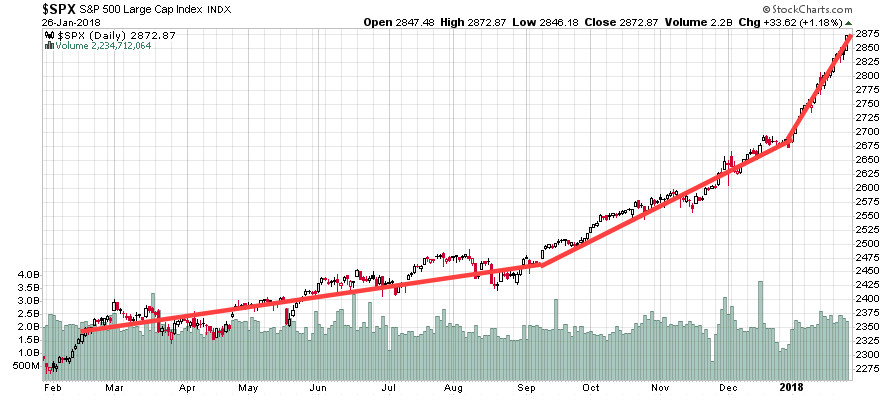
1. The 1st half of the year will contain the high water mark for the S&P 500, Nasdaq and TSX. (The TSX’s high water mark was on the last trading day of the year!).

Failed. As I write this, December 18, 2017 is the high water market for the year for all of the indicies! (the prediction was looking good until September).

2. The Bank of Canada will not raise the short-term interest rate (0.5%), UNLESS if the 10-year bond yield rises above 2.5% (right now it is 1.72%).

Failed. The 10-year never got above 2.2% and rates rose twice to 1.0%.

3. The Canadian dollar will depreciate below 70 cents USD at some point during the year.

Failed. It got to just below 73 cents but that’s it.

4a. Kevin O’Leary becomes the next leader of the Conservative Party of Canada, first-ballot victory with around 60% of the vote.
4b. He will speak better Français better than the media expects (think about Facebook’s Zuckerberg speaking Mandarin).

Failed, and failed! Even if he stuck around, he would have received nowhere close to a majority of the vote on the first ballot.

5. The 2017 Budgetary proposals as written above (I’ll consider this prediction successful if at least 4/7 occur).

Failed. 1/7 correct.

6. Spot WTIC pricing will spend the majority of its time around the USD$50-65 price band.

Somewhat failed. The chart dipped well below 50 for a good chunk of the middle of the year. (Update: A commentor below, Live from London, said this is not the case)

7. If China experiences something akin to Japan’s early 1990-type economic malaise, there will be significant ripple-down effects on Vancouver real-estate (let’s define this as a Teranet average of less than 220).

Not graded. The conditional “if” statement never occurred.

8. The US federal reserve will raise interest rates once to 1%, but will relax the interest re-investment policy on their balance sheet assets during the year and retain a tightening bias.

Mostly failed. They raised rates three times. While they certainly altered their re-investment policies on their balance sheet items, they continue to retain a tightening bias and it is predicted there will be 3 additional rate increases in 2018.

9. “Canada Recession” will register a Google Trends search index rating of higher than 10 sometime in 2017. This is basically a prediction that by year-end that it should be fairly evident that we are close or going into recession.

Failed. The measurement parameter was ambiguous on this but it would have been in relation to the five-year chart (as it is a relative index and not an absolute index). It got up to 3.

10. Minister of Democratic Reform Maryam Monsef will get shuffled out of her portfolio (in addition to others from theirs) during 2017. There will be some “face-saving” measure applied for the justification (e.g. she suffered an injury, or something to explain it other than her performance).

Mostly correct. I think the widely recognized excuse was incompetence on the democratic reform file.

11. In the May 2017 BC election, the BC NDP win 20 seats or less (down from the 35 they currently hold). I note polling now has them neck-and-neck with the governing BC Liberals.

Failed. However, to my credit, during the campaign period I completely flipped my prediction and got it mostly correct in this post. Take this advice from a political student: campaigns matter.

12. There will be at least one volatility spike (VIX index) that will take it above 30 as a result of some geopolitical (not economic) event.

Really failed. This one was a mile away, with a peak of 17.

13. (Added January 2, 2017) Canopy Growth Corp (TSX: CGC) trades below CAD$9.14/share (2016 year-end closing price) at 2017 year-end (background info).

Really failed. Good thing I wasn’t shorting this, as it is CAD$2021/share today! Don’t know what investors are smoking when they’re buying this, but what do I know? (Update December 28, 2017: One week later, WEED is north of CAD$30!)

Summary:
Correct – 1
Failed – 13

Sometimes when you make predictions, they all turn out to be wrong. Indeed, the only correct prediction I thought was a lay-up.

Fortunately, I do not invest my capital on the basis of these predictive whims, so my yearly performance doesn’t reflect the dismal record displayed above!

Small notes on random equity research

I’ve been looking at some existing holdings and companies that I do not own, specifically what has been doing well and not doing well year-to-date. Some miscellaneous thoughts that are not so illuminating:

1. Natural gas has been getting killed lately. I’ve been looking at Birchcliff Energy (TSX: BIR) (I own the preferred shares but not the common shares), and they are going to face significant revenue compression in relation to past financial statements because AECO natural gas pricing is really, really, really low. We’re seeing continued pain in equity pricing (also looking at Peyto and others) and no signs of this getting better – demand isn’t rising that fast (especially since the dreams of the product being exported across the Pacific is completely dead), and supply is plentiful.

2. Any company with the word “blockchain” in the press release, no matter how junky, is getting a market reaction upwards as it is obvious there is algorithmic trading designed to pick up such releases, hit the “buy” button and sell an hour after.

3. Pulse Seismic (TSX: PSD) is a very interesting business with incredibly lumpy revenues. Their balance sheet is misleading in that they amortize their accumulated data, so the remaining asset is not really present in its monetarily realizable format. I am not interested in them with their existing valuation but from an analytical perspective an interesting business. They made a relatively large sale to a customer and they gave a lot of cash away to shareholders both in the form of a special dividend and a significant share buyback.

4. Other energy service companies have also been hammered. There’s a few that look interesting, although it is clear they are all still suffering from large amounts of overcapacity – it appears revenue margins are still quite low.

Macro: US Federal Reserve Balance Sheet

I rarely make investment decisions as a result of macroeconomic analysis. I find that it is too easy to confuse correlation and causation, and also it is too easy to miss data that one should be considering as part of an analysis – i.e. it is the things that you don’t know that kill any way to glean superior insight.

I still try my best to piece together certain pieces of information to strengthen my belief on where the market currents are headed – even if something gives you a half percentage point edge on a coin toss, while you might not notice it if you flip a coin a few times, over a period of time it will give you a statistical edge. Better having it than not!

The Federal Reserve yesterday raised interest rates another quarter point. Given the reaction in the fed funds futures, this was entirely expected, but the details are in the implementation note. In this note, I draw attention to the two paragraphs:

The Committee directs the Desk to continue rolling over at auction the amount of principal payments from the Federal Reserve’s holdings of Treasury securities maturing during December that exceeds $6 billion, and to continue reinvesting in agency mortgage-backed securities the amount of principal payments from the Federal Reserve’s holdings of agency debt and agency mortgage-backed securities received during December that exceeds $4 billion.

Effective in January, the Committee directs the Desk to roll over at auction the amount of principal payments from the Federal Reserve’s holdings of Treasury securities maturing during each calendar month that exceeds $12 billion, and to reinvest in agency mortgage-backed securities the amount of principal payments from the Federal Reserve’s holdings of agency debt and agency mortgage-backed securities received during each calendar month that exceeds $8 billion.

Normalization started in October 2017 with the $6/$4 billion in maturities. The new information is the step-up in January 2018.

We look at the Federal Reserve’s actions since 2007 and observe during the economic crisis they have pumped a gigantic amount of money into the economy (mostly held up in banks, but still available nonetheless):

(On the top graph you can see a tiny, tiny dip in the holdings on the right hand side – this is the start of the “normalization”).

(If you wish to play with the data yourself, just go to https://fred.stlouisfed.org/categories/32218 and have fun).

As of today we have 2.454 trillion dollars of US treasuries held and 1.767 trillion dollars of mortgage-backed securities. The mortgage-backed securities are an artifact of buying off garbage assets from banks that were afraid that securitizations of such debt would fail – the federal reserve essentially back-stopped this marketplace until it normalized (and given real estate valuations, it has mostly succeeded in doing this, and more).

The point here is that there is $4.221 trillion in cash floating around, mostly in the vaults of banks, but this money has been creeping its way into the asset markets, causing considerable inflation of asset prices (but not inflation of consumer prices, which is why the reported CPI is still so low).

The Federal Reserve has been reinvesting proceeds of these securities until now – they will be maturing off another 0.010 trillion in December and 0.020 trillion in January. For the next two months that will amount to 0.71% of the Federal Reserve’s balance sheet. If they keep the January 2018 pace for the rest of the year, it will amount to about 5% of their balance sheet drawn off.

The question that I am asking is when this will have an impact on asset prices. Cash is still cheap to obtain, but clearly it is going to get more and more expensive as the year continues.

For comparative purposes, the Bank of Canada is relatively boring – they hold roughly a hundred billion in government debt. Most of the financial action in Canada is with the “big banks”. The only on-balance sheet action the Bank of Canada took with respect to real estate-related financial activity was the $35 billion they accumulated in securities purchased for resale in 2008, and the majority of off-balance sheet actions were in the form of guarantees during the financial crisis.

My suspicion is that the Canadian dollar will weaken, but correspondingly US equities as an aggregate will have their gains capped. There will of course continue to be opportunities, but the headwinds are starting to build up.

Marijuana stocks – if there was any question of over-valuation

(December 18, 2017: Article featured on the Globe & Mail: TSX short sales: What bearish investors are betting against)

This post applies to the recent December 5, 2017 press release by the British Columbia government regarding how they plan on implementing marijuana regulations in the province.

Saving you from reading the actual release, they plan on having a sole wholesaler (the BC Liquor Distribution branch) and a private/public retail distribution mechanism.

This is very similar to how liquor in other major provinces are distributed – the government gets to keep the lion’s share of the profit on the wholesale side.

In British Columbia, liquor retailers can purchase product from the government monopoly wholesaler at a 16% profit margin for licensed retail stores. These stores will have to then sell enough volume in order to pay for the usual business expenses (leasing a physical location, maintaining inventory, staffing, etc.).

Using the liquor analogy, profits from the retail end of things will be minimal. The best example is Liquor Stores NA (TSX: LIQ) which, despite booking 25% gross margins on their product, when things are good, earn a 3% operating profit margin (not before financing costs, but this is after depreciation expenses).

People following this company will shout out that they are undergoing a significant restructuring, but the central theme still sticks – it is a very low margin industry when your only supplier is government-controlled and has every incentive to maximizing its own profit and not yours.

This is a miserable business climate to be in.

Another, much smaller, example is Rocky Mountain Liquor (TSX: RUM). They operate retail entirely out of Alberta. Cherry-picking their best results in the last year, they are earning a 2% operating profit margin (and this is BEFORE financing and depreciation expenses).

Is marijuana going to be any different than liquor?

I would float the claim that retail marijuana profitability will be even worse than liquor because people can easily grow their own product sufficient for their own consumption. Federal legislation actively encourages people to grow their own marijuana plants at home (4 plants that you can now grow larger than the original 100cm proposed in the initial draft of Bill C-45).

This leaves the question of wholesale – there will need to be suppliers of this. I will also make the claim this will be a race to the bottom, with the exception that the “grow it at home” market will erode profits to the point that wholesale will nowhere near justify the 3.6 billion market capitalization seen from Canopy Growth (TSX: WEED) today – even assuming they captured the entire Canadian marijuana market.

The hype is marijuana producers will be able to achieve tobacco company margins – Rothmans was the last publicly traded Canadian tobacco company and they achieved roughly 50% operating margins (before financing and depreciation). It won’t be happening this way again – this margin will be siphoned by the government from the very beginning.