Genworth MI Q4-2013 preview

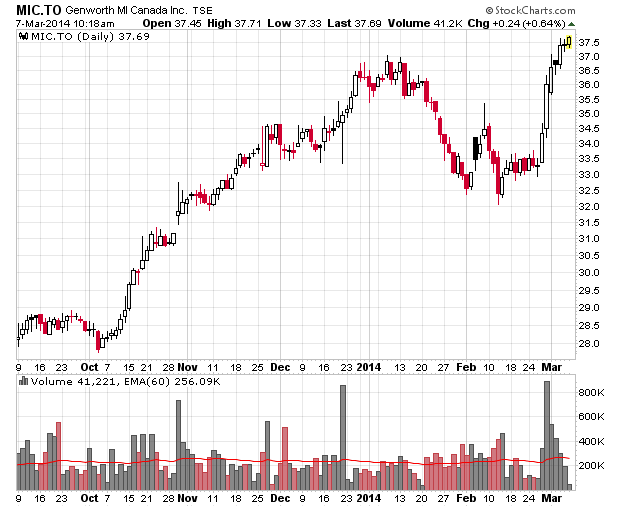
Genworth MI (TSX: MIC) will report its quarterly and year-end results on February 4th. I am not expecting too much deviation from the previous year’s quarter. From the CREA, sales activity nationally are slightly higher than the levels they were in the previous year. The previous year had seasonal-related issues and this year (either Q4-2013 or Q1-2014) will likely have some seasonal-related issues due to the deep freeze that affected the eastern half of North America.  These weather related events will only shift demand around periods rather than reducing it.

natl_chartA01_hi-res_en

Due to the latest federal regulatory changes (tightening) in mortgage financing kicking in on July 2012 (but constructively pulling some demand from Q4-2012 onwards into Q3-2012), year-to-year underwriting will likely be flattish from Q4-2012 because this will be the first full year-to-year comparison with the new regulations kicking in.

We can see the predominant trends for the company – premiums earned (the revenues earned from the actuarial performance of the mortgages that are being insured) continues to degrade slightly because of the run-down of past premiums written:

The only other item that I will mention is that claims and delinquent mortgages appear to be at an all-time low in Canada, despite all the talk about high consumer debt-to-income ratios.  This will eventually blow up in the faces of those that have accumulated the debt in the first place, but not today.  The lack of mortgage delinquencies will continue to mean that Genworth MI will be a cash generation machine.

There are a few negatives coming along the horizon.  One is that profitability of this magnitude tends to involve competitors, and I see Canada Guaranty is trying to cash in on this market – however, the barriers to entry with respect to regulatory compliance is not trivial and establishing sales networks and funnels will take quite a bit of time.

Another is that the OSFI is continuing to look at the capital framework on the property and casualty insurance industry in Canada.  In 2012, there was a significant change in the government guarantee fund which resulted in surplus funds being released to the company.  This risk is offset somewhat due to some guidelines already being released: for those that have the stomach to read this stuff, you can review the draft guidelines here, effective January 1, 2015.

Another negative are the usual concerns over the Canadian housing market that I won’t bother repeating here.

I do not foresee MIC continuing the share buyback at this price level, nor have I seen any insider purchases from SEDI lately.  The last slab of shares were repurchased in September at $29.23. They increased the dividend in the last quarter (they have been doing it on a yearly basis) and while I do not see them raising it again, depending on the results of the regulatory review, they do have room to declare a special dividend in the future.

Solvency-wise, the only maturity on the horizon they have is $150 million face value at December 15, 2015.  This debt issue has a coupon of 4.59% and in 22 months they can decide whether to refinance or just pay it off.  Management is also in a position to pay off about a $3/share special dividend and likely be within their own internal targets for minimum capital.

To summarize, I am not expecting fireworks out of this quarter, but I do expect consistent performance in line with previous quarters.  The company is far from the bargain basement price it was a year and a half ago, but I do believe it is continuing to trade within what I would consider my fair value range.  In the meantime, they continue to spit out cash.

Market is beginning to panic?

The S&P 500 is down two days in a row, significantly, and everybody is panicking.

Volatility is up from 12% to 16% and the whole world is about to collapse.

vix

The fact that we are 3% from the all-time highs has nothing to do with this sentiment. Stock markets are supposed to go up forever, all in a straight line, right?

spx

Less sarcastically, my general feeling out there is that almost anybody investing from about August 2011 has not felt the experience of real loss. As a result, I think the market sentiment is going to be quite skittish – people with gains will want to lock them in quicker than normal, especially now that the 2013 tax year is over. Just a guess.

I continue to have 1/3rd cash and am being patient.

The decline of the Canadian dollar

There have been drawn out periods where I have done literally nothing and 2014 has had that kind of start for me. Writing about how I am twiddling my thumbs is very unexciting, so I will talk about something which has caught my radar: The Canadian dollar.

cdw

Just like any patriotic Canadian, cross-border shopping (and just generally enjoying recreation in fantastic and not-too-contaminated by mass population areas like the Oregon Coast) is something that is easily accessible due to the relative strength of the Canadian dollar.

As you can see from the chart above, our purchasing power has just eroded by about 10% over the past year, which is mildly disturbing and makes inexpensive vacation prospects slightly more expensive. When something makes my recreational agenda more expensive, I take notice.

Not helping was today’s announcement by the Bank of Canada, declaring that inflation is “further below” their 2% target, which creates more pressure that interest rates are not going to be rising anytime soon, ergo the currency drops to the USA, which is starting to see signs of their short term rate increasing:

2014-01-22-2015-fedfunds

The thoughts swimming in my head is whether the drop in the Canadian currency is a predictive indicator of what is going to happen to the Canadian economy and equities as a whole (adjusting for the impact that they are now cheaper to purchase with US funds!)?

We will see. My market exposure is relatively low and I have not been inspired by anything I have seen out of the marketplace. It might be some time before I write again given this “do nothing” stance.

When to give up investing in individual stocks and bonds

Michael James has a fairly good article on why he chose to stop investing in individual securities and instead just go with low-cost index funds (or ETFs).

Putting a long story short, he put in a lot of time into researching the stock market between 2000 and 2008 and failed to outperform his baseline index and then a couple years later made the decision to just give up and index.

Pretty smart, I would say.

When I look at my own performance where I have an 8-year baseline of data, 3 of those 8 years I have underperformed the major indicies. One of those years I definitely attributed to mental stupidity on my part and is a genuine outlier year of profound incompetence (2011). Overall, I am still performing about 12% over the S&P 500, but this could just entirely be luck. Very difficult to say as I do not believe 8 years is a sufficient baseline.

If I was performing at or close to the index average, I would easily say that giving up would be a good option.

The other component of individual equity and bond investing is that it requires a lot of time and mental concentration to be able to pluck value out of the marketplace (and more importantly, to know when to pluck it out!). An index investor just needs to decide what low-cost baskets to put his/her money into (e.g. an all-equity allocation would be 20% TSX, 20% S&P 500, 20% S&P 400, 20% S&P 600, 20% International) and just sit back. Of course, there is a science to this as well that requires a certain amount of research, but the idea is to just set the autopilot switch on and forget about it while focusing on other parts of life.

When will Bitcoins peak? Part 2

My first article went through some scenarios of when Bitcoins will peak in price. I gave a very broad order-of-magnitude prediction of “not higher than US$10,000/Bitcoin”, but I’m now going to revise this to a peak price closer to present trading prices (roughly US$900/coin) than the upper threshold (US$10,000).

The reason is quite simple: Apparently some Ukranian firm has managed to obtain a majority of the computational power of the network. Blockchain dominance was one of the reasons why I thought this scheme would collapse.

A deviant entity will want to lay low in the shadows and be patient while others continue to pour money in the scheme, but the cartel’s inevitable goal is to vacuum as much capital out of the system as possible. There is no point in announcing to the world you are taking over the whole monetary system, but rather to wait in stealth and just wait for people that are generally unaware of this political dynamic to put their hard currency into it.

It is akin to playing in a marketplace with a central banker, which functionally takes the “independent” nature of Bitcoin out of the equation – if the Ukranian entity wants to pull the plug on the network by denying your transactions, they can.

Why bother when you have a real-world currency market to dabble around with? At least you can pay income taxes in the host currency, while in Bitcoins, you have nothing.

A binary phrasing of this is: Do you want your central bank to be controlled by a Ukranian corporation, or an arm of your national government?