One of the entrails of the Brookfield Property Partners is the merging with and guarantee of the preferred share obligations of Brookfield Office Properties. They trade on the TSX as BPO.PR.x and you can view the salient terms and conditions of the various securities on Brookfield’s surprisingly well-organized website.
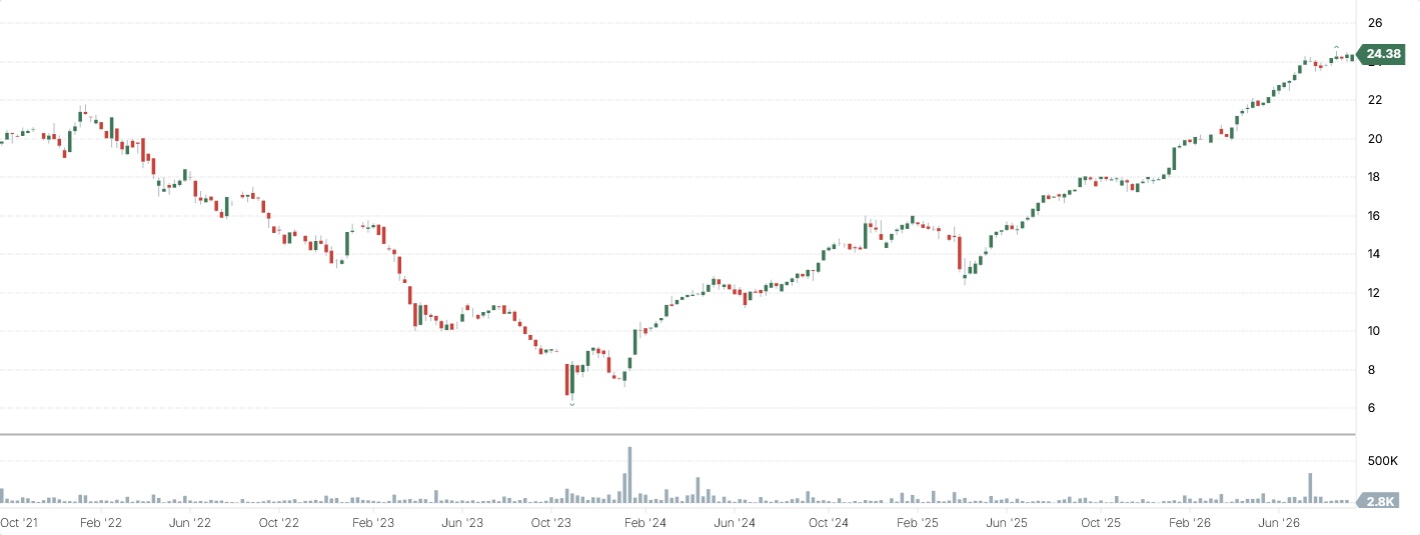
At the end of 2023 these were dumped by the market as the office property market had cratered due to Covid-19 lease expirations and also due to tax-loss selling. There is not much of an organic demand-side for these shares as there are no structural preferences for non-Canadian residents (Canadian residents receive an advantage of an eligible dividend payment in non-registered accounts). Also, the Brookfield Office Properties entity itself is only part of the Brookfield Property Partners entity (technically the LP) which itself is a subsidiary of Brookfield Corporation. When reading the 6-K and 20-F filings, it is an incredibly complex structure and I do not pretend to understand it comprehensively other than that there is a significant equity buffer for unitholders and the dividends are likely to be paid for years ahead, barring some calamity in the regions they operate in.
Specifically, the BPO.PR.R issue was at a 4.3% coupon, and its rate reset is 3.48% every five years, October 1, 2026 being the upcoming reset date. The last time it did a rate reset, five-year government bond yields were at near record lows.
I bought my shares at $7.60, which translated into a 14.1% yield. Now the shares have reset their yield to 6.829%, which is a 22.5% yield on cost. Yield on cost is a completely meaningless financial metric but in the era where you will be lucky to get (a fully taxable) 2.5% on a high interest savings account, this trade can be chalked up in the “win” category.
It creates quite an interesting dilemma on when these securities should be sold. Given the cash-heavy position in the portfolio, it would make no sense to liquidate this. The only instances where it would make sense is that if I had some inkling that the dividend was no longer going to be paid, if I suddenly found a use for the portfolio’s idle cash, or if I was betting on a significant rise in interest rates (I could attempt to convert the preferred shares into floating rate shares which is effectively a bet that the average 3-month treasury bond yield over the next five years will be about 1% higher than it is presently – I do not think this is a good bet). In the meantime, I clip these very boring coupons.
The shares are a small fraction of my overall portfolio. I do have thoughts if I would have taken a 20% position back then in these preferred shares (as I was still about 40% cash at the time in question). It would have been quite the tax-preferred income stream.
Especially after my Teekay Offshore experiences, I am very aware Brookfield is by no means a benevolent corporation. Like anything in the capital marketplace, I am not treating this as a permanent income stream.