The beginning of the end of the commodity rush?

I’ve been slowly trying to get back into the rhythm of the marketplace and then hopefully I will be able to continue researching some opportunities. Nothing looks promising so far, and this quarter has been turning out to be a very low transaction period.

It seems like when Osama Bin Laden got shot, that it also took out the wind of the commodity market. High-risers, especially silver, got pummeled this week:
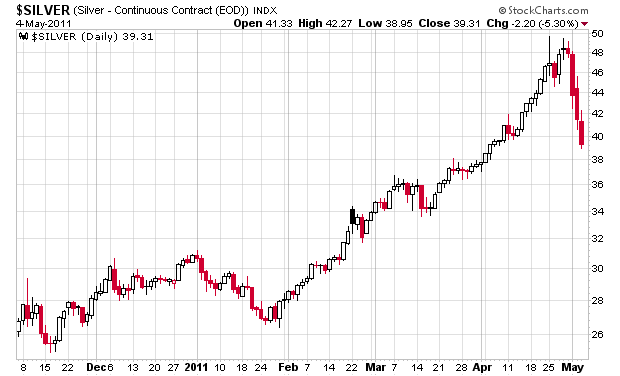
Who wants to be the person admitting that they bought Silver at $50 an ounce?

Anecdotally, I was walking down the street a week ago and remember these two people walking out of a currency exchange store, and they were clearly holding silver coins as they exited the place. Maybe I should have taken this as some sort of contrarian signal and short the commodity, but I was too busy with other matters to do so.

Also, it is my opinion that the indexes appear like they will be treading water and not exhibiting the run-up that they were doing between September 2010 and February 2011.
The easy trade is the dangerous trade

The easy trade these days appears to be in crude oil, and to a lesser degree, commodities.

My trading gut instinct says that the crude market may be a tad overextended at the moment, presumably due to geopolitical instability.

Modern historians should note that Iran and Iraq went through a decade-long war, yet the Persian Gulf still managed to export billions of dollars of crude.

The big shoe to drop is the answer to the question of “What happens in Saudi Arabia?” since they control a significant source of supply globally. That said, it is highly likely that the oil will still flow since whoever is left to control government will still want the cash cow – what will be significantly more disruptive is that the incumbent administration knows it will be kicked out, but has plenty of notice of its pending demise. In this scenario, they will likely use the “scorched earth” option, similar to what Saddam Hussein did in Kuwait prior to the first Iraq invasion.

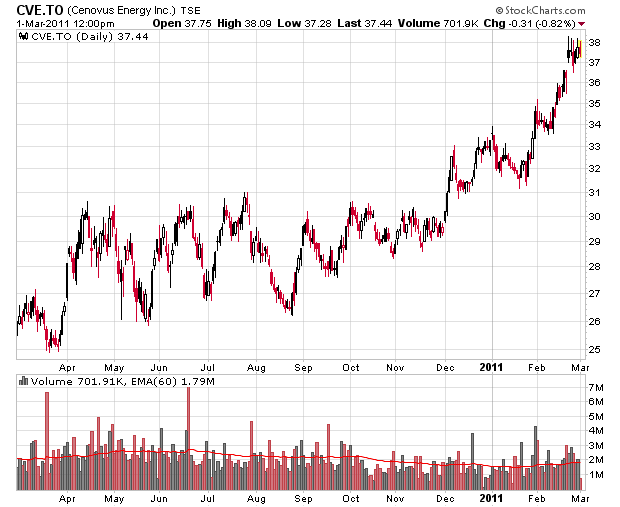
Readers will likely note that their holdings in Canadian oil sands related companies have received a significant amount of appreciation over the past 6 months – partly related due to the market conditions and improving economy. Here is a chart of Cenovus (TSX: CVE), but you can pretty much fill this in with the usual suspects (Suncor, Canadian Natural, etc.):

The last spike up over the past month is a function of higher crude prices and geopolitical instability – I’d estimate of the $6 that it has gone up from $32 to $38, half of that is due to crude, and half of it is implied instability.

That said, it seems like an easy trade to pile in at the moment, so be very cautious – when others think alike, your risk/reward ratio becomes more adverse.

Difference between West Texas Intermediate and Brent Sea Crude

This article from the US Department of Energy is educational with respect to the price differential between Brent Sea crude oil and West Texas Intermediate.

It is clear that logistical issues with exporting Canadian oil sands crude will continue, especially if the Enbridge pipeline from Alberta to the Pacific Coast does not proceed. Oil sands production is steadily increasing so the supply pressure will continue to be apparent.

Although crude oil is being mined out, it is subject to cyclical patterns of supply-demand cycles. It should be noted that the last crude spike (in the middle of 2008) was so excessive that in conjunction with the economic crisis, pushed crude down 75% at its trough – producers still must produce supply but if demand lessens they must receive a lower price for the product.

In terms of cost accounting, there are situations where mining product is profitable from a marginal cost perspective, but when you fully burden in capital and other fixed costs, the project as a net becomes unprofitable – we are seeing this somewhat in the natural gas industry presently. Eventually the money-losing producers quit producing and/or demand will increase and you will see a price spike since bringing capacity online is not a speedy process.

Geopolitical concerns – Oil prices

The headlines making the news right now are focused around political unrest in the North Africa region – first Egypt, now Libya.

This has strategic implications with respect to crude oil pricing – Brent Sea crude has traded significantly higher than West Texas Intermediate, which would suggest that North American markets are somewhat more insulated from what is going on across the Atlantic Ocean.

In terms of market implications, it remains to be seen whether this geopolitical unrest is going to flare up into something bigger (and thus interfering with trade more than it has) or whether it will be a blip that will pass by – and the major indexes continue their seven-month uptrend without any significant correction.

Note that I will be taking a little break and will not be posting for the rest of the week.

The difference between ocean and land freight transportation

Apparently ocean freight rates for various commodities are tumbling simply because of the supply of vessels available to transport such goods.

I know very little about the ocean freight industry other than that internationally based companies, such as Dryships (Nasdaq: DRYS) have exhibited considerable volatility as the market has boomed and now crashed.

The big difference between ocean shipping and land shipping is that inexpensive freight transit can only be performed by railways, while oceans are only limited by the number of ships you can manufacture and port facilities. Trucking is not commercially competitive with rail freight (except for delivery to the “last mile”) and as energy prices continue to rise, rail will continue to be very relevant in the future.

The two large Canadian companies in this space are CN Rail (TSX: CNR) and CP Rail (TSX: CP), both of which are trading at healthy, but not ridiculously overpriced valuations.