Progress Energy takeover stopped – strategic implications

The stoppage of the Progress Energy (TSX: PRQ) takeover (news article) is something significant – Canada is starting to become serious about protecting its energy resources.

Something has strategically shifted in terms of resources companies, and this will have implications domestically for investors of energy companies. The foreign takeover premiums that are embedded within various energy companies will drop and this will also likely have an effect on decreasing the demand on Canadian currency. This also has implications for the Nexen takeover – it is likely that Nexen will probably have to divest its share in Syncrude since China already has 9% of Syncrude and Nexen currently owns 7% of Syncrude.

Politically speaking, this is going to be a case of short term pain for long-term gain. I would guess that the concept is that the Canadian government believes that global trade might be impacted in the future, especially with respect to energy, and maintaining high levels of domestic energy reserves seems to be prudent. So if companies are going to get access to Canadian energy, it will have to be through domestic Canadian operations.

I’m guessing this is also a signal that taking a minority stake is the best route for foreign access to domestic energy reserves.

However, if you have shares in PRQ or NXY, the lesson here is simple: should have sold out instead of waiting for the merger to formally proceed.

Genworth Financial / Genworth MI Canada S&P note

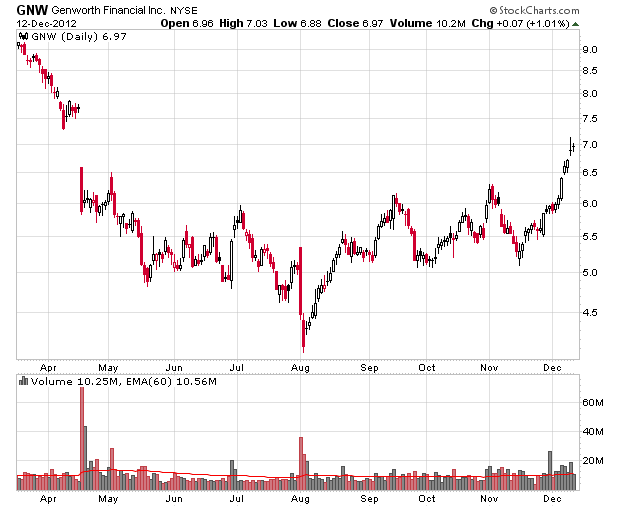
A credit rating note on Genworth Financial (NYSE: GNW) and impact on Genworth MI Canada (TSX: MIC):

Oct 11 - Standard & Poor's Ratings Services said today that its 'AA-'
financial strength rating and 'A-' issuer credit rating on Genworth Financial
Mortgage Insurance Co. Canada and Genworth MI Canada Inc., respectively
(collectively referred to as Genworth Canada), and the stable outlook on these
ratings are unaffected by the recent downgrade of their ultimate parent and
majority shareholder, Genworth Financial Inc. (GNW) to BBB-/Negative/A-3
from BBB/Negative/A-2. The ratings on the Genworth U.S. life insurance companies
were also affected by these actions (for details see "Genworth Financial Inc.
Downgraded To 'BBB-'; Outlook Negative", published Oct 11, 2012, on
RatingsDirect on the Global Credit Portal). 

Although Genworth Canada is part of the GNW group, we consider there to be 
negligible links between the creditworthiness of GNW and Genworth Canada. We 
consider Genworth Canada to be non-strategically important to GNW. 
Accordingly, we attribute no support to the stand-alone credit rating on 
Genworth Canada from GNW. We are cognizant of the influence GNW has on its 
Canadian operations as a majority shareholder but, in our view, Genworth 
Canada has some protection against financial deterioration at the group level, 
aided by prudential supervision by the Office of the Superintendent of 
Financial Institutions, presence of independent directors on the boards of 
both the Canadian operating company and publicly listed holding company, and 
senior management/boards' recognition of the necessity of a financially strong 
entity in order to operate in the Canadian market, considering that the main 
competitor and largest player, Canada Mortgage and Housing Corp. 
(AAA/Stable/A-1+), is a highly rated federal government-owned entity. In the 
normal course of business, we expect Genworth Canada to return capital 
including payout of dividends. However, if the level of return of excess 
capital, in our view, hinders the company's very strong capitalization, the 
ratings could come under pressure.

The “non-strategic” nature of Genworth’s 57% investment in MIC would make it ripe for some sort of takeover bid if Genworth was going to fetch a reasonable price for MIC.

The Dell and PC hardware value trap

I noticed recently that Dell (Nasdaq: DELL) slipped below $10/share. They’re now at $9.5/share or roughly a market capitalization of 16 billion (if you net out the cash and debt, the enterprise value is about $12 billion). This is on $3 billion income for the trailing 12 months, so something is completely out of whack – the market is either nuts, or they’re betting that Dell’s net income is going to drop significantly in the future. The latter is more likely to be the case.

I still don’t see anything worth investing in unless if you have a good sense of salvage or residual cash flow analysis. Dell is facing a compounding problem of being in a low margin industry that is not only shrinking, but is facing longer lifespan cycles and technological shifting.

In other words, they don’t have a proprietary tablet to be selling for ultra-large margins like some other fruity-named company.

Intel (Nasdaq: INTC) has an escape route – their processors can be used elsewhere and can command market pricing. They’ll take collateral damage, but will do relatively better. However, since the consumer end is still a significant portion of their market, I will also continue to lump them in the value trap category. Their anti-trust shield, AMD (NYSE: AMD), should also struggle. Considering that embedded chip makers such as ARM (Nasdaq: ARMH) are stronger competition to Intel, it makes you wonder if AMD is at all relevant any more and will get taken out by Intel finally.

This is similar to the fate that graphic chip designers were all finally consolidated into Nvidia (Nasdaq: NVDA) – which in itself might get munched by Intel. Its as good a time as any for consolidation in this entire PC sector.

Finally, it is always easy to point out share buybacks are a mistake when your stock is richly priced, but in Dell’s case, they have cumulatively spent $32.1 billion of cash on repurchasing 1.2 billion shares of stock – an average price of $26.79 per share. If from day zero they banked this cash and simply traded at a market cap of their net cash value (not even the higher book value), they would be trading at $11.93/share today. If they traded at the premium above book value as they are trading today, they would be at $15.26/share. Quite a bit of value destruction went on with those share buybacks.

More Genworth MI propoganda

Another reason why Genworth MI Canada (TSX: MIC) is a cash machine is because delinquency rates have significantly decreased since the 2008-2009 financial crisis:

Also, a stress test scenario where unemployment goes from 8% to 11% and property values go down 15% (which seems to be a low number – higher decreases in property prices would increase severity):

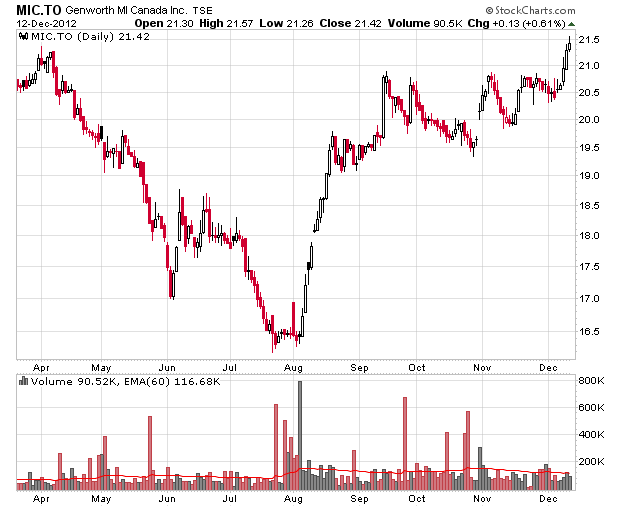
Unless if there is a huge crash in the commodity market, I don’t see this happening. The crash might occur, but not when you have massively loose monetary policy like we do today. The only reason why the stock got as low as it did (bottoming out at $16.72) is betting on a massive real estate bust. Now those expectations are moderating somewhat.

Genworth MI Canada volatility

The past five days of trading of Genworth MI Canada (TSX: MIC):

The last day’s volatility (remember: volatility means down and up) is relatively unusual for the company. In the 722 trading days preceding this one, the largest volatility was a 7.4% increase in price on November 4, 2011. The largest volatility down was 5.2% down on October 17, 2011. Both of those days were on higher volume than today’s average. Today’s performance (5.61%) was its fifth most volatile day in its trading history.

The market is coming to my idea of fair value much sooner than I was originally thinking. It would be even nicer if Genworth sold it off for $30/share, but I digress.