Last second agreement with Pinetree Capital

I thought Pinetree Capital was going into CCAA, but clearly there was enough arm-wrestling behind closed doors to come to the following agreement (which should hopefully be posted in SEDAR fairly quickly):

In connection with the execution of the Forbearance Agreement, each of Messrs. Roger Rai, Sheldon Inwentash and Marshall Auerback will resign from the board of directors of the company. As well, Mr. Inwentash will resign as Chairman and CEO of the company. Richard Patricio, the company’s Vice-President, Corporate and Legal Affairs will assume the responsibilities of Interim CEO.

Management is gone, plus three (of seven) directors, all of which can be considered to be heavy insiders in the company. Needless to say, considering past performance, this can only be a plus.

The CFO and corporate counsel is still on board, presumably to keep continuity in the overall operation.

I had speculated in my earlier post that the reason why Pinetree did not come to any agreement with debentureholders was because they demanded that management be removed, and it looks like management blinked. The reason for this is perhaps because they did not want to be associated with an entity going into creditor protection. This has to get disclosed in any subsequent documents (such as annual information forms) if management is associated with any publicly traded entities.

the Supporting Debentureholders will have the right to nominate up to three directors to the company’s board of directors; two of whom will constitute an investment oversight committee to be established by the company;

The current board (including the three directors that will be leaving) is of seven people; while this is minority representation, one can presume that they will bring in actual investment expertise to ensure that the interests of the debtholders are respected in future decisions. In particular, the hiring of a new CEO will be the most important decision the reconstituted board will make.

the company will grant security over its assets in favour of all holders of the Debentures;

This will ensure that debenture holders will receive proceeds of any sale of the company, including the value of the deferred tax assets. It will also restrict the company from borrowing more money unless if subsequent lenders understand they are subordinated.

the company will utilize at least $20 million to reduce the aggregate principal amount of the outstanding Debentures by July 31, 2015, and will be subject to a debt-to-assets ratio of 50% (in lieu of 33%) for the three-month period of July through September;

$20 million will be utilized and whatever discount there is to market value will result in a higher par value retired by the corporation. At the current quotation of 70 cents, this would retire about $28 million in par value, or about half the current issue.

the Indenture will be amended to remove restrictions on the company’s redemption rights, subject to the approval of the Toronto Stock Exchange; and

I am not entirely sure what this alludes to, but we will see whenever the agreement is posted on SEDAR.

the trustee and the Debenture holders will refrain from exercising any rights or remedies that they may have against the company under the Indenture or otherwise, as a result of the current default and any subsequent default in respect of the Covenant occurring up to October 31, 2015.

This is functionally a 9 month grace period. The maturity of the debentures is May 2016.

You will have the debtholders working to ensure an efficient liquidation of assets coupled with the possibility that they might end up with a significant equity stake if there is a redemption to equity on the May 2016 maturity. The October 31, 2015 restriction is designed to ensure that debtholders have effective control of the company if Pinetree’s debt-to-asset ratio is not less than 33% by October 31, 2015.

Some remaining questions:

1. Will Pinetree be able to liquidate its holdings efficiently? Reported NAV was 46 cents in November 30, 2014.
2. Final year-end statements must be received and filed publicly by March 31, 2015. At a minimum, it will probably look like their $13 million in deferred tax assets will be vanishing and a valuation allowance put into place. The level 2 and level 3 assets will have to be carefully examined to see if they are worth anything (this was $55 million of the reported $161 million in assets at the Q3-2014 statement).

Finally, the asset remaining on the books that is not going to be seen on the statements will be the half-billion dollar capital loss tax shield. This will get sold, the question is for how much and to who. You would think that the debtholders, compromised mainly of financial firm people, will have a way of getting this into one of their own closed end funds for utilization – funds that generate capital gains to offset such losses.

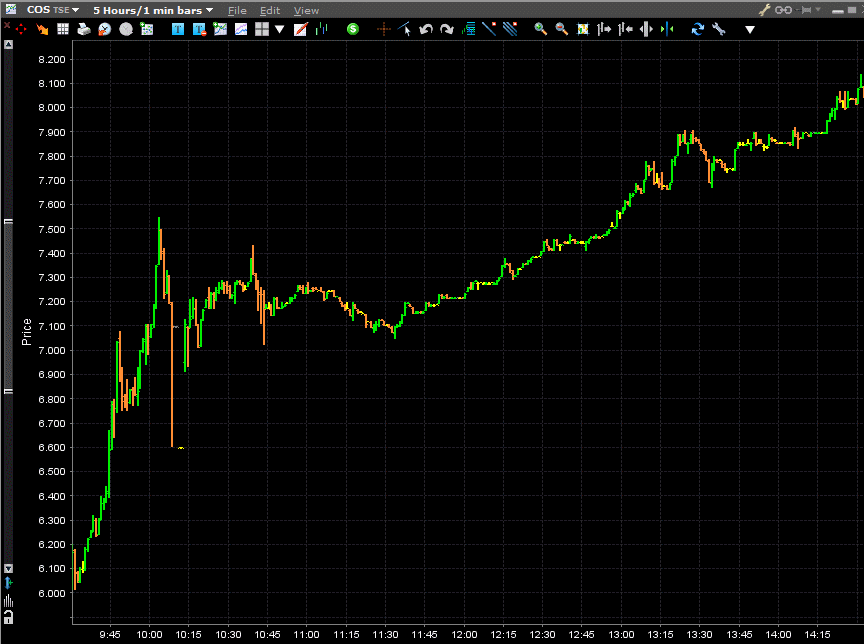
Currently the equity is getting trashed (at 7 cents per share, down from 11 cents when it was halted), while the debentures are roughly level. My initial suspicion would be that with the removal of management, you would have an increase in valuation, but I guess I was wrong there too.

That’s about it for Pinetree Capital

History: Pinetree Capital previous postings (link here).

January 23, 2015 was the date that Pinetree Capital (TSX: PNP) had to cure a covenant breach of its debt-to-assets ratio (being 33% or less). Unfortunately for them, they failed to obtain a waiver or apparently cure the default.

Before the ordinary time of opening, IIROC put a trading halt with news pending. There hasn’t been any news published so it would lead one to believe that management has failed to cure the breach.

Section 8.1 of the indenture states:

ARTICLE 8
DEFAULT
8.1 Events of Default

(x) in each and every such event listed above, the Trustee may, in its discretion, and shall, upon receipt of a request in writing signed by the holders of not less than 25% in aggregate principal amount of the Debentures then outstanding, subject to the provisions of Section 8.3, by notice in writing to the Company declare the principal of and interest on all Debentures then outstanding and all other monies outstanding hereunder to be due and payable and the same shall thereupon forthwith become immediately due and payable to the Trustee.

One can presume that given the rather speedy notice that was given to the company of the default that the trustee is going to get notified of this breach fairly quickly and on the first business day, January 26, 2015, the principal and interest will become due immediately. Since there is an event of default occurring, the company cannot trigger the common share conversion feature.

My guess at this point is that the trading halt will continue until Pinetree officially declares itself unable to pay its debenture and goes into CCAA. Then TSX rules will suspend trading and eventually delist the company. The subsequent proceeding will involve the bankruptcy trustee being instructed by its creditors (the bulk of which are the debenture holders of which the major players will form a committee) to liquidate and put an end to the terminally ill patient.

My other observation is that Pinetree Capital management should have received the hint back in 2013 that they needed to reduce debt by purchasing debentures off the open market while they were given a 9-month grace period by its debtholders. They instead went recklessly purchasing other penny stock securities and ultimately got what they deserved.

My other guess is that behind the scenes the debtholders told management the only condition they will accept for a waiver is a complete overhaul of the board of directors and management. Clearly management did not agree, nor is it in management’s best interest to re-capitalize their company with fresh equity (i.e. cash) since this cash would most likely end up in debtholders’ hands.

I originally thought management had better self-preservation instincts, but apparently even this was too much for them to handle.

Skimming their last quarterly report (September 30, 2014), we have the following entry:

For the nine months ended September 30, 2014, the Company generated net realized losses on disposal of investments of $334,412, as compared to $14,921 for the nine months ended September 30, 2013. The net realized losses in the current period was a result of the disposition of approximately 68% of the Company’s investment portfolio.

Realize these numbers are in the thousands, so just in the first nine months alone they managed to go through 1/3rd of a billion in realized losses (a lot of which I am sure have been on their books for ages). They also have another $118 million in unrealized losses their portfolio, which will inevitably get liquidated for less than fair value as stated on their financial statements.

My idea for Pinetree’s inevitable exit strategy was that they would sell their corporation off to some hedge fund actually capable of making money. The acquiring fund could use Pinetree’s accrued capital losses as a massive tax shield. There are quite complex rules concerning CCAA (if things get there) and utilization of operating and capital losses that I will not get into this post about, but suffice to say, my original idea for their exit strategy has not materialized.

Somebody give me management’s $1 million a year salary job and I’ll do better, I promise. Heck, I’ll do it for a 10th of that with a bit of an equity incentive.

First few causalities of US$50 oil – and who’s next?

Industry Canada maintains a list of companies going into creditor protection (CCAA).

Other than Target Canada (which is for wholly different reasons than the oil market!), GASFRAC (TSX: GFS) has the dubious distinction of going into CCAA first. Their insolvency can be described as operating losses (helps to have a permanent CEO running the company to execute a turnaround!), combined with lack of liquidity (their operating line of credit was nearly exhausted in their Q3 report).

gfs.to

They had a debenture issue which was still trading at a relatively high level (36.5 cents on the dollar) when they finally pulled the plug.

gfs.db.to

The debentures were supposed to mature on February 2017, and had a 7% coupon and were convertible at $10.50.

The debentures are not that badly far behind in the capital structure – the credit facility is $28.6 million and the debentures are a $40 million issue. Debenture holders may get a few pennies from the firesale.

Another recent CCAA filing is Southern Pacific Resource Corp (TSX: STP). They are a pure oil and gas producer and markets were predicting the demise many months ago:

stp.db.to

This was an issue maturing June 2016, 6% coupon and if you purchased it at its 52-week low of 0.1 cents on the dollar and the bond matured, it would eclipse making a leveraged bet on the CHF/EUR pair before the Swiss bank announced it was removing its Euro peg.

Other companies I’m waiting for to hit the CCAA bucket include:
– Arcan Resources (TSX: ARN);
– Argent Energy (TSX: AET);
– Armtec Infrastructure (TSX: ARF) – this patient is being kept alive and bled slowly to death by Brookfield, so the actual time of death may be prolonged;
– Connacher Oil and Gas (TSX: CLL)
– Exall Energy (TSX: EE) – On or around February 13, 2015!
– Ivanhoe Energy (TSX: IE)
… and others.

There is significant opportunity here to pick up players (none of which have been named yet anywhere on this site) which appear to be going down but should be able to weather the storm. When companies with December 31 year-ends have to report audited financial statements by March 31, bank covenants are likely to be breached and the negotiations between now and then will be very unpleasant for all involved.

Even big players like Penn West (TSX: PWT) are publicly talking about covenants.

Speaking of covenants, Pinetree Capital (TSX: PNP) has today (January 23, 2015) to cure a debt-to-assets covenant or face default. If they can’t, then they’ll be forced into insolvency by debtholders on January 26, 2015. This would end one of the saddest, yet fascinating, episodes of capital management.

Genworth MI year end earnings preview

This is part of a long-continuing series covering Genworth MI (TSX: MIC). I will give the changes that I see salient over the past few months.

The past two months of price action has seen an approximate 20% decline in common share price:

mic

This is likely due to market perception of increased default rates in mortgages, especially in the Alberta and Saskatchewan markets (the two provinces in Canada with the most negative bias to lower oil prices). At the Q3-2014 report, Alberta has 17% of the insurance in force, while Saskatchewan is 3%. Both provinces have very low delinquency rates (0.09% and 0.12%, respectively).

This will undoubtedly climb up as property will flood the market in the wake of layoffs and capital expense reduction of the oil majors.

The frequency of mortgage defaults is strongly affected by unemployment rates, while the severity of defaults is determined by property valuations. I would expect management would touch upon the impact of Alberta and also the impact of a potential recession in Canada and how it would affect mortgage defaults. As I have mentioned in the past, Genworth’s loss ratios are at all-time lows and this is an abnormal condition.

The other item of note is that management has repurchased $32 million in shares (799,345 shares) between mid-November to early December, at an average of $40.04/share. This was probably the worst example of market timing I have seen in quite some time and was a transaction above book value. In other words, this will be a negative value transaction to shareholders.

Normally management has been a little more cautious with shareholder capital (demonstrated by their willingness to give a sizable special dividend of excess capital in the previous quarter), but this decision is relatively questionable.

Company management had a shift which I deemed relatively minor – the CEO is resigning and becoming the executive chairman of the board; while the COO is now becoming the CEO. This continuity in management would suggest no major strategic changes in the pipeline.

Tangible book value, pro-forma to the buyback, will be around $34.50/share at Q3-2014. This also includes other accumulated comprehensive income and also deferred policy acquisition costs (which is effectively an intangible asset that represents cash paid to acquire business).

At Q3-2014, they did have exposure to $32 million in energy equities and $253 million in energy fixed income investments out of a $5.6 billion portfolio. It will be interesting to see if they got hit during the quarter on energy.

On a positive note, their fixed income portfolio will very likely accrue an increase in fair value as interest rates have continued to drop over the quarter. Indeed, with the Bank of Canada’s interest rate drop, they will be experiencing even higher gains in Q1-2015.

This will pose reinvestment risk, however. Most insurance companies (and pensions) are really struggling to find high quality investments that give out yield. In the low interest rate environment, this will suppress portfolio yields and will result in more expensive policies.

A slowdown in the Canadian real estate market would have an adverse effect on premium generation. That said, with last year’s price increase by CMHC, and little in the way of market competition, I would view the company as generating more premiums than recognizing at present. For the first 3 quarters in 2014, the company took in $461 in premiums and recognized $422 million in revenues. The decline in revenue recognition should reverse in 2015 and beyond.

In balance, considering the risks in the Canadian real estate market, Genworth MI’s position, and current market valuation, I believe Genworth MI at CAD$32/share is slightly undervalued. While it is not at a low enough price for me to add shares, it is something I am comfortable holding at existing price levels. I do not see Canada’s real estate market imploding, although it is certainly going to be rough going for those that have bought million dollar homes in Alberta and finding they have been laid off in the oil patch.

Disclosure: I have been long on MIC.TO since July 2012. I sold a good chunk of my holdings in 2014 but still hold a reasonable amount today.

End of the line for Pinetree Capital?

I’ve written about Pinetree Capital in the past (TSX: PNP) (previous articles), but it appears that management is cutting it really close with a debt-to-assets covenant on their convertible debentures. The indenture document, as amended (amendment 1, amendment 2), broadly stipulates that the debt-to-asset ratio cannot exceed 33%. If the company cannot cure this condition within 30 days of being called on it by the trustee, bondholders can declare the company in default and demand immediate payment (which would clearly result in Pinetree going into creditor protection).

The relevant clauses are quoted as follows:

7.10 (c) Until the earlier of May 31, 2016 and the date when no Initial Debentures remain outstanding, neither the Company nor any of its Subsidiaries shall incur any Designated Indebtedness or issue any Debentures if, after giving effect thereto, the aggregate amount of all Designated Indebtedness and Debentures would exceed 33% of the aggregate value of the total consolidated assets of the Company and its Subsidiaries as at the end of the immediately preceding month, as reflected on the unaudited consolidated balance sheet of the Company as at the end of such month.

(d) Until the earlier of May 31, 2016 and the date when no Initial Debentures remain outstanding, the Company shall not, as of the 15th day of each month, permit the aggregate amount of its Designated Indebtedness and Debentures to exceed 33% of the aggregate value of the total consolidated assets of the Company and its Subsidiaries as at the end of the immediately preceding month, as reflected on the unaudited consolidated balance sheet of the Company as at the end of such month.

According to a November 24, 2014 press release, Pinetree has until January 23, 2015 to cure the existing default condition as their debt-to-assets ratio was 38.8% as of October 31, 2014, based off of a net asset value of 47 cents per share (disclosed November 11, 2014).

On December 2, 2014, Pinetree also breached a debt incurrence covenant by accumulating $3.3 million of margin debt subsequent to the debt-to-assets ratio breach occurring, but this was subsequently cured on December 12, 2014 when presumably they sold securities to cover this amount.

Scouring SEDI, Pinetree Capital disposed of the following securities from November 24, 2014 onwards, of which they are required to disclose in the event of them being 10% or greater owners, or an insider of Pinetree is also an insider of the following issuer:
Canadian Orebodies Inc.
Caracara Silver Inc.
Gold Canyon Resources Inc.
Macarthur Minerals Limited
Manitex Capital Inc.
Mega Uranium Ltd.
Sanatana Resources Inc.

The dispositions of these securities alone do not account for $3.3 million, so there are other companies in the portfolio where Pinetree is not a 10% owner that must have accounted for other cash raised.

There is a major complication at this stage with Pinetree Capital and their ability to obtain a waiver or cure the default.

On November 26, 2014, they filed a notice with SEDAR that an extraordinary meeting will be called on January 22, 2015 for debentureholders on record as of December 18, 2014. The relevant regulations concerning notification to securityholders is through NI 54-101, Communication With Beneficial Owners of Securities of a Reporting Issuer; Section 2.12 (which applies to securityholders in this particular circumstance) states that proxy materials need to be sent 3 business days before the 21st day of the scheduled date of the meeting. The deadline for this was December 24, 2014, which means there can be no brokered agreement with debentureholders as there is no time left for the January 23, 2015 default date.

This leaves them with the following options:

1. Purchase debentures, approximately $11 million face value at 80 cents of par value, which will bring them relatively close to the 33% level. The complication with this is that there is little liquidity in the marketplace, coupled with a lack of time, and the inability to execute on a dutch auction in such a short period of time. They would need to find a private seller of debentures and make a private purchase from them off-market. This is not a trivial amount of debt to be repurchased in a short period of time.

2. Issue equity – given that their stock price is in the toilet, it would be highly dilutive. At a share price of 13 cents, they would need to dilute the existing firm about 40% in order to raise enough in assets to get below the 33% debt-to-assets mark. Pinetree would have to apply to exempt themselves from TSX rules and have this classified as a distressed situation that does not need shareholder approval in order to proceed.

3. If by whatever miracle their assets appreciated by December 31, 2014 to the point where the debt-to-assets ratio went below 33%, they bought themselves at least another three months, depending on what happens to the assets.

Note that simply selling securities in their portfolio would not help their situation – even if they received fair market value for their securities (which is unlikely given the illiquid nature), the debt-to-assets ratio would still remain the same. In order for the ratio to change, their asset value needs to increase significantly, or they need to repurchase debt.

There have been no reported debt repurchases by Pinetree, nor any other insider activity other than insider management issuing options to themselves consisting of approximately 1.76% of the outstanding shares of the company, with a strike price of 16 cents per share and a 2019 expiration date.

How this is going to play out over the next couple of weeks is going to be very, very interesting. There is also a distinct possibility that the company will opt for going into creditor protection via the CCAA (Companies’ Creditors Arrangement Act) and restructure their debentures through that route. This would presumably be a sub-optimal route for management, however, since they would most likely lose control of the company; it would be in the debentureholders’ best interests to see a timely liquidation of a company that presumably still has a positive net asset value of 46 cents per share, as reported on December 15, 2014 – it would be a good educated guess that they could derive $54.8 million in remaining par value with the $148 million in reported assets on the books.

And finally, yes, I will disclose that I own some debentures in this train wreck. This one is not for the faint of heart, nor for those that will have issues with liquidity in the future (there will be none if they go through the creditor protection route, rather there will be a payout by the trustee at some distant point in the future).