Coal exports – Westshore Terminals

Westshore Terminals Investment Corporation (TSX: WTE) is a holding corporation that owns all the limited partnership units of Westshore Terminals LP. The LP is controlled through a partnership agreement by Westshore Terminals Ltd., and functionally speaking control is held by Westar Management Ltd (not to be confused with another company, Westar Energy, which is unrelated).

The whole reason for the verbose description is that although it may appear at first glance that shareholders of Westshore Terminals have control over its operations, in reality this is a situation where shareholders are in the minority and external actors control the firm. One must always be mindful of the motivations of the controlling entity and whether there is significant alignment with shareholders.

Skimming the documents, I am not entirely sure who controls Westar or the General Partner, Westshore Terminals Ltd., but would assume the present directors of Westshore Terminals Investment Corporation have a say in the parent controlling entities.

Jim Pattison (a very prominent BC businessman that usually keeps his ventures privately held) owns 18.6% of the company as of May 2015. Since then his entity (Great Pacific Capital Corp.) has acquired another 4.1% of the company, according to SEDI disclosures, roughly at an average of $25/share. An early warning report on October 30, 2015 confirmed 22.5% ownership.

The whole Canadian investment world can see this public investment and thus one has to ask what Pattison’s firm is thinking.

Westshore’s entire business is about exporting coal, primarily to Korea, Japan and China/Taiwan.  The coal is majority sourced (58% in 2014) through mines owned by Teck (TSX: TCK.B).

wte-1

Financially, the corporation has been very profitable over the past couple fiscal years – earning about $130 million in profit over 2013 and 2014, and $101 million for the first 9 months of 2015. As the corporation has 73.9 million shares outstanding and is trading at $17.50/share, some simple math will indicate that they are trading at a P/E below 10 according to their historical profitability.

The nature of their coal exports can be divided into the following categories:

wte-2

And here is where we have the problem – steel commodity in China has cratered. There’s various types of indicies and types of steel that you can measure (rolled steel, rebar, etc.) but all indications show that demand is dropping:

wte-3

Adding to the woes of the coal industry is the fact that there is a gigantic supply glut of thermal coal due to western nations suddenly deciding they wish to phase out coal power generation. Taking a look at charts of Peabody Energy (NYSE: PEA), and Arch Coal (NYSE: ACI) should pretty much tell this story. Take a snapshot of their charts before they go into Chapter 11! Or if you don’t wish to waste your money on their equity, Peabody’s senior unsecured debt is trading in the teens – a fairly good sign of imminent capital restructuring.

Teck’s stock has also gotten killed over the past 5 years – an investor’s shares has gone from about CAD$60/share to CAD$5/share today, plus Teck’s corporate debt has cratered – e.g. their senior debt maturing in January 2021 (4.5% coupon) has the following ugly chart:

wte-4

Despite Teck being rated Ba1 (Moody’s) or BB+ (Fitch), their debt is clearly trading in the junk status and one has to start wondering about counterparty risk when your medium-term debt is trading at such high yields (and the nearest liquid issue, January 2017, is trading at a yield to maturity of about 10% presently).

Financially, it just doesn’t look good for coal producers (most of them are deeply encumbered by debt), but does these financial issues reflect the actual economics of Weststar Terminals’ industry which is the shipment of coal?

Weststar does not have any debt on its balance sheet – its primary liability is the $91 million unfunded portion of its pension plan at the end of September 2015. It is primarily functioning as a flow-through operation for its shareholders and to this effect, it has reduced dividends from 33 cents to 25 cents quarterly as it anticipates increasing capital expenses and also anticipating a decrease in coal shipped, according to an October 28, 2015 corporate update.

So we have a perfect storm brewing in the coal world – decreased demand for steel, decreased demand for power generation, and thus lower shipments and lower revenues, spread on a relatively large fixed cost base – suggesting decreased profitability in the future.

This also doesn’t factor in the increasing scrutiny of coal shipments in BC from a political perspective. While the existing provincial government is clearly supportive, there is election risk for the upcoming 2017 election in terms of economic impact.

Westshore does have several advantages that cannot be easily obtained with competition. There are three terminals in BC that are in the same business – Ridley is up north in Prince Rupert, but they are limited in capacity (although well strategically positioned to take coal from mines in the BC northern interior). In the greater Vancouver area, there is Neptune and Westshore – Westshore has a significantly larger capacity, but Neptune is still under its capacity. Neptune is 46% owned by Teck as well, which will put it in conflict with Westshore.

The market has clearly seen all of these negatives and has subsequently “adjusted” the equity value of WTE very dramatically – about 50% over the past 6 months. The question as an investor would be:

1. Financially, what would the “trough” look like for Westshore? Does the underlying entity still generate cash?
2a. Will coal recover from what are decidedly anti-coal government legislative regimes (USA EPA, Germany, Alberta, and now possibly Canada?)
2b. If so, what would the timing be where enough supply has been stripped from the system, and perhaps a recovery in demand?
3. Competitively speaking, how much shipping capacity will the other two terminals in BC represent?

The answer to 2b will presumably rely upon the economic fortunes of Korea, China and Japan, all of which have their own internal issues to deal.

I will leave this post now as an exercise for the reader. No positions as of this writing.

Bombardier paper napkin valuation

Based on the slides on their investor day, looking at their 2020 financial roadmap, if the corporation is seriously able to reach $25 billion in revenues and 7-8% in EBIT, the quick calculation is the following:

$25 billion revenues
* 0.075 EBIT margin
= $1.875 billion EBIT
Less: $750 million interest expense (Assume $10 billion debt at 7.5%);
= $1.125 billion EBT
Less: $298 million (15% Federal + 11.5% QC = 26.5% taxes)
= $827 million net income

At this point they would likely have around 2.3 billion shares outstanding, so this would equate to about 36 cents a share. Just picking a P/E out of the cloud (15) and multiplying gives a $5.40 share estimate, or about 4.2x above existing market value, or about 33% CAGR if we use the full five years starting today.

Of course, for this to happen, a lot of execution risk (technical, marketing) has to be resolved, but management did a fairly good job solving the immediate financing risk – investors and customers no longer have to care whether the company is going belly-up or not (they are not).

I stress this is a total paper napkin exercise. Actual valuations under a more rigorous process can vary by a factor of 10!

Pinetree Capital – another debenture redemption

Previous articles on Pinetree Capital can be found with this link.

Today, they announced a redemption of $3 million in their senior secured debentures out of a total of $9.716 million outstanding. Interest accrued will be another 1.07% on principal. The redemption will be effective January 8, 2016.

The only wrinkle in this announcement is that $1 million of the $3 million principal will be redeemed in equity of Pintree Capital (TSX: PNP) and based on 95% of the weighted average price of trading from December 2 to December 31. So debentureholders will have 10.3% of their debt redeemed in equity of Pinetree Capital.

Based on Pinetree Capital’s equity, they have 201.9 million shares outstanding and are currently trading at 5 cents per share. If trading is around the 5 cent level, Pinetree will be issuing 21.05 million shares, representing a dilution of approximately 9.4% to existing shareholders. If the common shares start trading lower as a result of this announcement, each incremental decrease in trading will result in more dilution to shareholders – a mildly toxic convertible situation. For example, if the weighted average price is 4 cents a share, Pinetree will issue 26.3 million shares with 11.5% dilution. At 3 cents, the issuance is 35.1 million shares (14.8% dilution).

My guess at present is that the common shares will trade around 4 cents as a result of this announcement, but after the issuance of shares there will likely be a supply dump.

What was peculiar is the following quote in the news release:

The issuance of common shares in partial payment of the redemption amount is subject to the satisfaction of certain conditions contained in the indenture governing the Debentures, including the approval of the Toronto Stock Exchange, failing which the total redemption amount will be paid in cash.

I have guessed the motive of the company to do this redemption was to reduce interest expenses, but if they are opting to not deploy cash in exchange for (nearly worthless at this point) equity, then it is constructively like doing a secondary offering in the marketplace at a very low share price.

The other motive for this partial redemption might be management bracing for impact when they take an impairment expense on their Level 3 assets when they do the year-end audit. The deadline for the year-end annual report is the end of March 2016. They still have to abide by a debt-to-assets covenant of 33%. They are at 28% as of the Q3-2015 report. If there is a mild asset impairment then they will breach their covenant. There might be a temporary breach of the covenant (between the December 31, 2015 reporting period to January 8, 2016) which will be cured by this redemption, but investors will not know about this breach until the issuance of the annual report itself as they no longer report monthly NAV.

Pinetree also received a serious setback when Aptose Biosciences (TSX: APS) suspended a clinical trial, taking its stock price down 50% on November 20, 2015. This probably destroyed another $2.5 million in Level 1 assets (of which $14 million was remaining on September 30, 2015!).

In terms of estimating the shareholder value, the primary variable at this point is whether the board of directors has any plans on executing on a recapitalization-takeover of the company, utilizing its massive capital losses for an acquiring entity. I’m guessing this would be worth about 8-10 cents a share, but first they need to get rid of their remaining debt.

Bombardier Bailout, part 2

Today’s big news is that Bombardier is selling 30% of its transportation division to the Quebec Pension Plan (CDPQ) for $1.5 billion.

The quick analysis is the following:

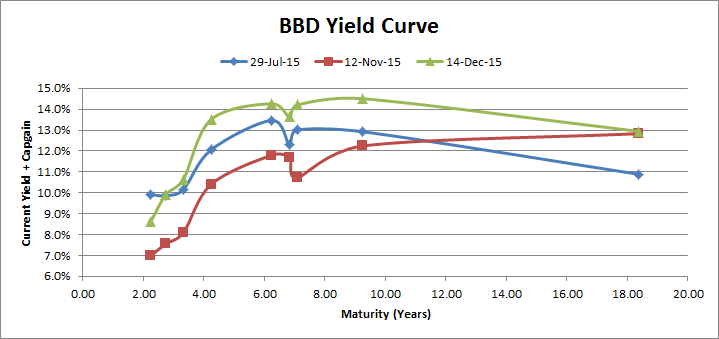
1. BBD will have received a cash injection of US$2.5 billion as a result of selling 49% of its C-Series aircraft interest and 30% of its transportation division; this will alleviate any short-term solvency concerns (from the September 30, 2015 balance sheet, they will have over CAD$5 billion liquidity to deal with). This capital is obtained with zero interest cost and some potential dilution of shareholders if the common share price ever gets above the US$1.66 exercise point (which one would hope it does in the recovery scenario!). Near-term bond yields (2018 maturities) are trading at 6.8%, while mid-range debt (2022 maturity range) is between 10-11%. The market is still skeptical of the financial recovery of the corporation.
2. BBD issues another 106 million warrants at an exercise price of US$1.66 on their subordinate voting shares. This is in addition to the 200 million they issued with the previously announce US$1 billion investment from the Quebec government.
3. BBD is required to maintain a cash balance of US$1.25 billion otherwise control on the board will start to erode.
4. This will save BBD from the hassle of doing an IPO (i.e. going through a regulatory quiet period, doing an institutional investor road-show, etc.), but noting that the CDPQ will have rights to trigger an IPO after 5 years of investment. CDPQ will also have significant minority shareholder rights.
5. If the Government of Canada wishes to tag along with some sort of contingent financing offer or backstop, BBD is in a considerably better position to negotiate as they will have sufficient financial reserves to do so.

I view this generally as a positive for the corporation, although they will still need to execute on getting the C-Series jet out the door and be able to generate sales. However, they seemed to have tackled the immediate perception issue of financial trouble, and have shown the financial world that the Quebec government will do whatever it takes to ensure Bombardier’s survival. If the Government of Canada chips in some cash, it will be icing on the cake.

My assessment of the preferred shares is still the same – they will likely pay dividends for the foreseeable future. At CAD$6/share, BBD.PR.B gives off a 11.25% yield, while BBD.PR.C is sitting at around 16%, with the risk that they’ll be force-converted to 12.5 shares of BBD.B – something I doubt management will do, but financially speaking it would make sense to issue 118 million shares to save CAD$14.7 million/year cash flow – with the way they are treating their equity holders, they might as well eliminate this headache off the books. This is the most likely reason why there is such a yield spread between the preferred share series.

The endgame for Pinetree Capital

Long-time readers will know of my investment in Pinetree Capital Debentures (TSX: PNP.DB) and the various amounts of volumes written on this company in the past, probably more than anywhere else on the internet and if I may modestly say so, in higher quality.

The debentures caught my eyes when the underlying company blew their debt-to-assets covenants and while having questionable asset quality, they still had enough blood that could be squeezed from the stone which would flow through to the bondholders.

So far this has been the case – purchasing my 70 cent stones has yielded one dollar blood droplets, plus a generous annual coupon of 10%. In addition, security is granted on all assets of the company, so even if things went wrong, there was a first-in-line claim to picking what was left of the carcass.

By virtue of going from $54 million in debt to about $10 million presently, I’ve had over 80% of my initial position redeemed in cold, hard cash. There’s a bit of residual that I continue to hold. I had an order set to liquidate the position above par, but I am content on riding it until maturity (or CCAA proceedings, whatever the case may be!).

This brings me to my latest post on the company, which is subsequent to their third quarter release. The information contained in the news release is relatively useless for analysis purposes, but their financial statements on SEDAR are much more relevant and I will quote some of the material.

First of all, they were in breach of their covenants and failed to cure them and were under forbearance with a committee of debtholders. This has now passed and the company’s debt-to-assets ratio is once again under 33% (it is approximately 28% as of the end of October). As a result, the debtholders no longer have any direct control of the company’s operations.

What will follow is a simple mathematical exercise in terms of the cash requirements of the company vs. their capacity to actually pay it.

The company still has about $9.8 million in secured debt to pay off, which matures on May 31, 2016. They have an approximate $0.5 million coupon to pay off on November 30 and assuming no further maturities, another $0.5 million in May 2016.

They are sub-leasing their offices and paid somebody $1.55 million so they could get rid of their lease. $1 million is to be paid in Q4-2015, and the remainder on February 1, 2016. They pay about $0.6 million/year for their lease so they gave somebody a 2.5 year inducement on a lease contract that expires on December 2023. They vacate their office effective February 1, 2016. It is not known where they will be moving to, but one can reasonably expect that Pinetree Capital can be run out of a lawyer’s office in the near future instead of a 9,928 square foot behemoth employing less than 10 people.

The company’s burn rate otherwise is $0.8 million/quarter, so operationally they will spend about another $2 million, plus likely professional fees if they are going to do anything financially sophisticated (like liquidating their tax losses!).

So their total cash requirements to May 2016 is likely to be around the $14 to $15 million range – $10.8 million for debenture principal and interest payments, and the rest of it the usual G&A and professional expenses that all publicly traded companies must incur.

In terms of their ability to pay, they had $2.3 million cash on the balance sheet at September 30, 2015. We know they redeemed $5 million in debentures (plus $0.2 million interest) in October, so this functionally put them at a negative $2.9 million balance.

Level 1 assets included $14.2 million in equities – likely consisting of PTK, APS and AAO equities. They do have a minor amount of PRK and LAT, but disposal of these equities will prove to be difficult given the lack of liquidity.

Let’s pretend they liquidated enough Level 1 assets to pay the $2.9 million residual (or they were actually successful in liquidating some of their Level 3 assets, which would be a minor accomplishment). This leaves them with $11.3 million in Level 1 assets remaining to bridge a $14-15 million expense requirement over the next 7 months.

In other words, even if they were to get perfect liquidity on their Level 1 assets the next half year, they still are going to be short on cash.

The remaining assets are Level 3 assets, which total $24 million. However, most of these assets are private investments and hints of what these are can be dredged through previous press releases. SViral was a $5 million investment that nothing could be heard of over the past year in terms of that company’s operations (indeed if any exist at all).

Keek was a slightly more transparent case as it is publicly traded. Pinetree had invested $3 million in their secured notes and they cut a deal to sell them for an undisclosed amount of money. Did Pinetree receive 100 cents on the dollar? Or did they take a slab of equity that they can’t possibly choke through the marketplace?

Due to management not disclosing any information at all about Pinetree’s investment portfolio, one can only guess what else is in there. However, as the year-end audit comes closer, the auditors will have to determine whether management performed a proper test for asset impairment (IAS 36 for those in the accounting world reading this – I am an accountant, after all!) – i.e. is the book value as stated on Pinetree’s books actually what the fair value of those assets are? I would find it very difficult to believe that a $5 million equity investment in SViral is still worth $5 million presently.

My gut instinct says the real value of this Level 3 portfolio is worth about 25% of what management says it is, but without any real disclosure of the components, who knows?

One thing I do know, however, is that management has a huge incentive to ensuring that reported value is kept as high as possible, because they don’t want their assets to fall to the point where the debt-to-assets covenant (33%) gets breached again! My calculations show if they had to impair $6 million of their $24 million in Level 3 assets (without any offsetting gains in their remaining Level 1 asset investment portfolio), they’d once again breach the debenture covenant and have to go through the charade of curing the default.

There are a couple other options for Pinetree and both of these have been discussed before.

One is that in their indenture agreement they are allowed to redeem up to 1/3rd of the debentures in the form of Pinetree equity. The equity redemption of the remaining debentures would dilute existing shareholders by a significant fraction at current market prices (6 cents per share).

Another solution is a monetization of the capital losses the company has incurred to date in a financial transaction. Pinetree has had the dubious distinction of losing half a billion dollars in its investments over the past few years and these tax losses can theoretically be monetized by some sort of recapitalization transaction. Using a theoretical capital gains tax rate of 13% and a willing partner buying the tax credits at 40 cents on the dollar would suggest there’s about $20-25 million left to be harvested here after legal expenses. This is really the only reason why I’m holding onto the secured debt.

Either way, management is still going to be financially creative to get their debt albatross off their backs. It still does not look good in any manner for the equity holders and the debtholders will actually face some risk in terms of getting paid their due in cold, hard cash.

Disclosure: Still holding onto some of those debentures!