Genworth MI (TSX: MIC) reported their 2nd quarter earnings results.
The results are reasonably positive for investors and a shade higher than what the market expectation would be.
Diluted book value per share goes to $38.23, up a dollar from the previous quarter (higher than net income minus dividends due to portfolio fluctuations).
Premiums written were $249 million, up significantly from $205 million in the Q2-2015, but this number was artificially higher due to the closing of the July 1, 2016 regulatory window for the issuance of portfolio insurance (i.e. future portfolio insurance issuances are likely to be significantly lower). Portfolio insurance written has been averaging about $24 million for the previous four quarters, but this quarter was $78 million. Transactional insurance (the type of insurance most people associate with mortgage insurance) was down 7% to $170 million.
Portfolio insurance has been quite profitable as the constituents of the loans are low loan-to-value ratio material – although the premiums received by the company are relatively low to the loans insured, these premiums are basically free money exchanged to entities so those other entities can free up the capital to make other loans. The government announced they were going to put a halt to this activity in the 2013 Budget as entities (e.g. HCG, EQB, etc.) were basically using government guarantees to increase their ability to perform higher amounts of mortgage lending. Now the lenders will have to take higher risk, which would potentially dampen the credit market for residential housing.
Other items of note include the following (quotations are from their MD&A):
The Company has reviewed the proposed methodology for calculating SCRIs and observed that Calgary, Edmonton, Toronto, Vancouver and Victoria would breach their respective prescribed SCRI thresholds at the end of the first quarter of 2016. These metropolitan areas represent approximately 35% to 40% of transactional new insurance written in the first six months of 2016.
Calgary, Edmonton and Vancouver would have been in breach of the prescribed SCRI thresholds since 2010 or earlier and are currently more than 15% above the respective SCRI threshold. The anticipated changes from the proposed new capital framework, including the proposed supplementary capital requirement may impact the regulatory capital requirements for the Company however the final impact will not be known until OSFI publishes the supplementary capital requirements. The Company expects that transactional and portfolio insurance premium rates may have to be increased for affected metropolitan areas as a result of the implementation of the new capital framework in 2017.
If the regulatory framework continues to tighten (i.e. more capital required for “hotter” markets), this would result in increased mortgage insurance rates and hence higher premiums written for future transactions – or perhaps premium surcharges for “hot” metropolitan areas. Not surprisingly, Vancouver is the epicentre of this.
During the quarter the Company entered into a $100 million senior unsecured revolving credit facility, which matures on May 20, 2019.
This was very mysterious. Genworth is solvent, their nearest debt maturity is not until June 15, 2020 ($275 million) and they have plenty of capital that they are using as a buffer until federal regulations are finalized. So why go through the bother to open up a credit facility? Odd.
(Update, August 3, 2016: Remarks were made in the conference call:
CFO: “It’s not earmarked at this time for any specific activity. It’s more in light of build-in financial flexibility to ensure that we’re nimble and whether this is core business opportunities in the MI business, for example, you saw the levels of bulk insurance as we did last quarter. If in the future other opportunities were to present themselves in our core business, and it require incremental capital, we certainly have long-term plans to fund that capital. We may use the facility for short-term need but it’s clearly not intended for a long-term portion of our capital structure.”)
The loss range for 2016 has been revised to 25% to 35%.
The company’s initial projections for losses were 25-40% for the year, but the upward range of this was lowered to 35%. For the first two quarters of the year the loss ratio averaged 22%. This is obviously a good sign for investors.
In order to help improve housing affordability, on July 25, 2016 the B.C. government introduced a four-pronged plan that includes an additional land transfer tax on foreign buyers. As of August 2nd, foreign individuals and corporations will be subject to an additional 15% land transfer tax on the purchase of residential property in Metro Vancouver. The company does not expect these changes to have a material impact on its business, as foreign borrowers are typically not eligible for high loan-to-value mortgage insurance.
I will parenthetically add that foreign buyers typically do not take out mortgages for properties either – these are cash payments as the real estate title is the vessel for storing cash offshore. Foreign investors would not have a requirement for mortgage insurance.
Also, delinquency rates have lowered from quarter-to-quarter. While Alberta and Saskatchewan have higher delinquencies, they have lowered significantly in Quebec. I would also estimate that the severity of the real estate market decrease in Alberta was less pronounced than projected.
Not everything is rosy, however. There are a couple other storm clouds worth noting:
1. The company has lost a considerable amount of money on its preferred shares. They have $49 million in unrealized losses as of the end of June on their preferred shares, which is down from $51 million at the end of March, but this is very sloppy pickings by their asset managers.
2. Private mortgage insurers are approaching a $300 billion cap:
The maximum outstanding insured exposure for all private insured mortgages permitted by the PRMHIA is $300 billion. The Company estimates, that as of March 31, 2016, the outstanding principal amount of insured mortgages under PRMHIA was $197 billion for Genworth-insured mortgages and $241 billion for all privately insured mortgages. While the federal government has increased the cap to ensure that the private sector can continue to compete with CMHC in the past as the total of the outstanding principal mortgage amounts has approached the legislative cap, there is no guarantee that this will continue. The Company estimates that the private sector will remain below the cap for the remainder of 2016 and the first half of 2017 based on the current market share of the private mortgage insurers and the forecasted size of the mortgage originations market.
The inability to capture more of the mortgage insurance market beyond $300 billion, needless to say, would be a negative – the company would have to run off the book and only acquire insurance at the rate that it expires. I am also not sure how Genworth would coordinate with the other private insurance company (Canada Guaranty) to collectively stay under the $300 billion mark. This is a line item that would need to be addressed in legislation, specifically the 2017 Budget, and I would not view the current government to be supportive of private industry in mortgage insurance markets.
Finally, I will observe that the company is unlikely to buy back shares or declare special dividends until such a point that the regulatory framework for capital holdings is solidified.
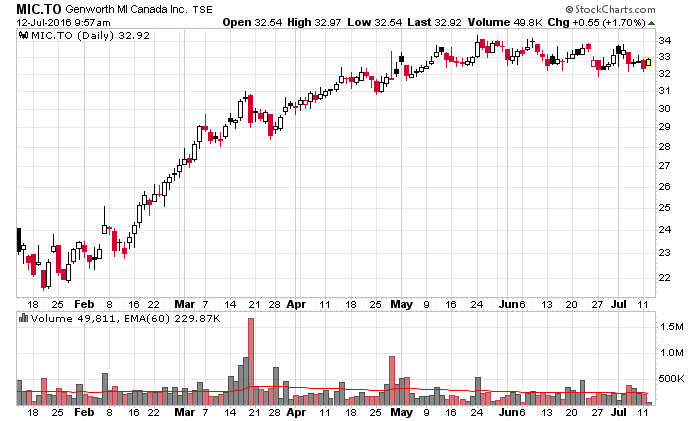
Overall, my conclusion still remains unchanged that Genworth MI appears to be somewhat undervalued at present (trading at 89% of book value, with a strong balance sheet and low loss ratios). The market is clearly pricing them lowly due to the increasing speculation of over-valuation of real estate pricing in Canada, in addition to the balance sheet issues faced by their parent company. Genworth MI appears to be very aware of the Canadian real estate issues at hand. As I have been long-since speculating, given the issues that are going on in the parent company (Genworth Financial), Genworth MI is a likely candidate to be taken over if Genworth Financial finds the correct (and willing) purchaser. The take-out price would most certainly be higher than the current market price.