Genworth Financial / Long-Term Care Insurance

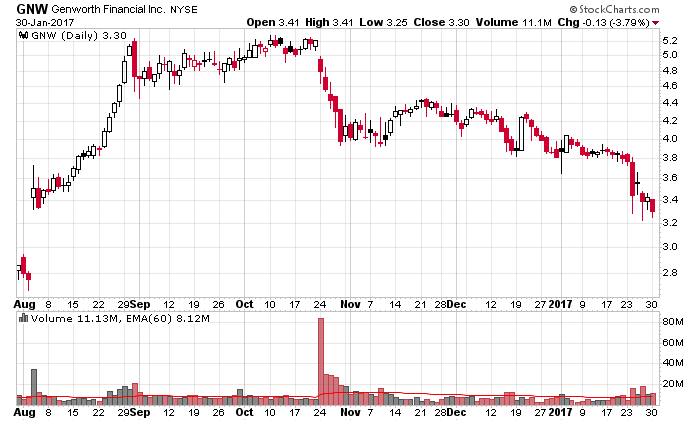
For those of you that are interested in why Genworth Financial (NYSE: GNW) is willing to be bought out at US$5.43/share when their book value is far, far higher should take notice of this following Wall Street Journal article about the woes of another long-term care insurance provider that went belly-up.

Putting a long story short, there is an accounting mismatch – the liabilities on the book are less than what the actual liabilities will be.

There has been a lot of incorrect analysis (especially on Seeking Alpha) on the actual value of the holding company. In general when one sees sloppy analysis that is regarded as consensus, there is a necessary, but not sufficient condition for an investment decision in the contrary.

D+H Corporation slashes dividend

I looked at D+H Corporation’s (TSX: DH) last disaster of a quarter and predicted the following:

My guess is that the dividend is going to get slashed in half.

So, today, they announced their 32 cent dividend is going down to 12 cents. The stock is up today because the company says they are going to do a share buyback with half the amount that they wouldn’t have paid out in dividends, but given their leverage situation, I’d be skeptical.

KCG Holdings – Significant share buyback

KCG Holdings (NYSE: KCG) I’ve identified as a fairly good risk-reward candidate last month.

Yesterday they announced they came to an agreement with one of their major shareholders (whom were part of the recapitalization/reverse takeover of the predecessor firm after their major trading glitch on August 1, 2012) and have swapped 8.9 million shares of BATS for 18.7 million shares of KCG stock and 8.1 million at-the-money (roughly) warrants.

After this transaction, KCG still has 2.3 million shares of BATS – they did liquidate about 2 million shares on the open market over the past month.

This transaction has a positive double-whammy for book value – not only are the BATS shares accounted for at less than market value (which means the transaction will cause an accounting gain), but the KCG shares are being bought back for well under book value. Even when accounting for the not insignificant tax bill that will result (about a hundred million!), the final book value of KCG would be around $18.79/share after the transactions.

KCG will have about 67.5 million shares outstanding and 5.1 million warrants outstanding (strike prices of $11.70, $13.16, and $14.63, with each about 1/3rds of the warrants). These are likely to be exercised and shares sold in time – each of these warrants expire in July 2017, 2018 and 2019, respectively.

The corporation is trading slightly more than 20% underneath tangible book value. They have historically made money, especially in volatile conditions. The word “volatile” is also used to describe the new President-Elect. Needless to say, this has potential.

The other note is that CEO Daniel Coleman owns 1,487,907 common shares, or about 2.2% of the company, which is not a trivial amount of capital. He also owns 161,132 warrants, and 1.7 million stock options at a strike price of $11.65/share (making the effective ownership about 4.8% assuming the exercise of warrants and options), plus stock appreciation awards at $22.50/share, due to expire in July 2018. There is some serious incentive for him to get the stock price higher.

Canopy Growth Corporation

Canopy Growth (TSX: CGC), specializing in the production of marijuana, has gone parabolic.

cgc

Today, 12.9 million shares traded (about 10% of the company) around a level that valued the entire entity at around CAD$1.5 billion.

Fundamentally, looking at their last quarterly report, they have sold $15 million of marijuana in the last 6 months.

If you (exponentially) extrapolate their revenue growth curve, they will be selling over $1 billion in marijuana in five years.

Somehow, I don’t think this will happen.

I am predicting two things:

1. Management is going to do a massive secondary offering. They did two of them earlier in 2016 (raising an 8-digit sum of money), but they will scramble to raise an even bigger amount of money which would pay for a lot of marketing. I’m guessing they’re going to aim for over a hundred million. I’d do the same if I were in their shoes, in addition to personally selling shares at the earliest possible opportunity.
2. Eventually, within the next six months, a lot of people are going to lose money on this stock.

Right now, if you are short, I can imagine the pain. Maybe those short on the stock should get a prescription of medical marijuana to ease the pain.

No positions, no intention to take any, but looking at this stock with amusement.

Genworth MI reports Q3-2016

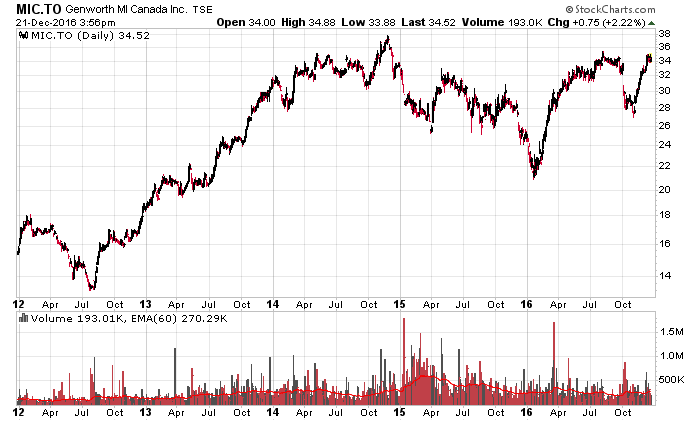
Genworth MI (TSX: MIC) reported their Q3-2016 report. This was a very “steady as she goes” type report fundamentally, with little hidden surprises. Some highlights:

* Stated book value per share is $39.01 (means the company is trading 29% below book value, which is a huge discount – I will also point out there is about $2.48/share of goodwill, intangibles and the deferred policy acquisition costs, so the most absolute conservative valuation of tangible book value is roughly $36.50/share diluted).

* Loss ratio goes to 25%, up from 20% in the previous quarter mainly due to oil-producing (Alberta, Sask) delinquencies and defaults. Delinquency rate is still at 0.10%.

* Investment portfolio is up another $200 million in invested assets (3.2% average yield).

* Transactional written insurance premiums down 15% from quarter of previous year; portfolio insurance up 7%, which was somewhat surprising given the rule changes after Q2-2016 (quarter-to-quarter comparisons here are not that useful due to seasonality).

* Minimum capital test under soon-to-be-replaced OSFI rules went up to 236% from 233% in previous quarter.

* Dividend raised from 42 to 44 cents (I was expecting a 3 cent raise, but this is probably to ensure they keep raising capital levels for the new rule changes – market may not like this although in strict financial theory they’d do best to scrap the dividend and repurchase shares at current prices).

* Credit score increases of client averaging 752 from 744, gross debt service level is 24% (would lead one to suspect that absent of catastrophe, clients would continue to pay mortgages above all else)

* They seemed to figure out how to stop losing money on buying Canadian preferred shares. They really should just outsource this to James Hymas, who I am sure will be able to provide superior risk/reward on these investments.

The big question is the looming impact of regulatory changes, an issue previously discussed on this site. Some snippets:

* On the issue of OSFI capital calculation changes, the “new” target is 150% (from 220%), and in the new framework, they are at 155-158%, the previous June 30, 2016 quarter had it at 153-156%.

* Impact of BC announcement of 15% property transfer tax on foreign buyers in Vancouver area:

As of August 2, 2016, foreign individuals and corporations will be subject to an additional 15% land transfer tax on the purchase of residential property in Metro Vancouver. The Company does not expect these changes to have a material impact on its business, as foreign borrowers are typically not eligible for high loan-to-value mortgage insurance.

* Impact of the mortgage changes and applicability of transactional and portfolio insurance on various mortgage properties:

After the Company’s review of the mortgage insurance eligibility rule changes announced October 3, 2016, it expects that the transactional market size and its transactional new insurance written in 2017 may decline by approximately 15% to 25% reflecting expected changes to borrower home buying patterns, including the purchase of lower priced properties and higher downpayments.

As the result of clarifications provided by the Department of Finance after the October 3, 2016 public announcement, the Company now expects that portfolio new insurance written in 2017 may decline by approximately 25% to 35% as compared to the normalized run rate after the July 1, 2016 regulatory changes for portfolio insurance. The new mortgage rules prohibit insuring low loan-to-value refinances and most investor mortgages originated by lenders on or after October 17, 2016.

Notes: I had anticipated transactional insurance would drop by 1/6th (so this is within the 15-25% estimate), and I thought portfolio insurance would get completely shot up (which is going to be the case).

Basic calculations would suggest that if transaction insurance gets dropped 20%, the annual run-rate is about CAD$521/year, plus whatever insurance premium increases that will happen in 2017 as a result of heightened capital requirements. I had originally given some conjecture that this number would be CAD$570 in the end – which is still a pretty good number even if the combined ratio goes up to 60% or so – you’re looking at a very, very, very profitable entity.

Portfolio insurance will taper down and contribute about $60 million/year in written premiums.

Going forward, Genworth MI should produce about $570-580 million/year in written premiums, without increases in mortgage insurance premiums.

Cash-wise, at a 50% combined ratio (30% loss and 20% expense) and a 26% tax rate, shareholders are looking at $210-215M/year or about $2.32/share in operating net income. A $6.2 billion investment portfolio at 3.2% blended yield gives $1.60/share, taxed at 26%. Combined, the entity would still pull in cash at $3.92/share – considering the $27.86 share price currently, this is trading at a P/E of 7, at a book value of 30% below par… needless to say, an attractive valuation.

I generally do not care about the top-line revenue number as this just represents an amortization formula of the unearned premium reserve. However, analysts and uninformed members of the public do tend to care about this since revenues translate into bottom-line results, and this number will continue to rise over the next year above the $162 million they booked this year. The only thing that will change this is a change in claim experience and time – for any given insurance policy, more of it gets booked in the earlier stages of the policy than the later ones. The increasing revenue number will result in higher amounts of higher reported net income, and higher EPS.

Questions for conference call:
– Impact of Genworth Financial’s acquisition on Genworth MI – what restrictions would there be on equity repurchases – and asking about the out-right sale of the MIC subsidiary (which, at current values, has to be put on the table);
– Ability/willingness for Genworth MI to repurchase shares at extremely discounted book value per share prices;
– Regulatory impact of private mortgage insurance $300 billion cap (currently at $275 billion for all private entities, MIC at $221 billion);
– What the MCT internal target will be with the new OSFI capital regime.

Final thoughts: Right now, repurchasing shares of Genworth MI is such a no-brainer shareholder-enhancing decision. I hope management can snap on it. The common shares are trading on the basis of Canadian real estate fear and not in any regard to the underlying financial reality which show an entity that is generating a massive amount of cash.