Taking my foot off the market accelerator

When reading the news, keep in mind that it is trying to program your brain what to think about. Frequently it tries to program your mind how to think. Social media is a filter and amplifier of both of these effects.

In all of these instances, they do not give you any cues about what is not being discussed. As a result, the potential for availability bias is extreme if one does not have reasonably decent critical thinking skills.

I’ve written before about what it takes to outperform in the markets, and one variable is knowing where your thinking is standing in relation to the competition. Since a good amount of the competition is programmed by media what to think, there is a value in paying attention to the programming, but with keeping your full mental shields on.

Right now, apparently Covid-19 is no longer the scourge of the earth. Businesses are re-opening, a good chunk of the public is in silent defiance of social distancing, and life appears to be slowly getting back to normal, short of the annoying lineups you see to get into Costco.

A safe time to invest back in the markets again? Seemingly yes, but the process of transitioning from a very risky (Covid-19 is going to kill us all) to risky (riots in the name of racism is going to kill us all) to not so risky (normalization of the pre-Covid life) has more or less been priced into the market – the S&P 500 is sitting at about 8% less than the pre-Covid peak.

Short of these headlines (riots, normalization), what is not being discussed? I’ll leave this as an exercise to the reader. Being able to assemble ideas to answer the “not” question is valuable in that it allows you to take a good guess at what might be in future headlines (presumably after you’ve gone long on whatever it is that you’ve thought of).

After things re-open, there is a certain ‘novelty’ factor which will result in an initial boost, but reality will be setting in pretty soon – the Canada Emergency Response Benefit payments will end (the US parallel is the $600/week unemployment benefit enhancement), and then decisions will become tough. This will come with increased risk, which portends to choppy waters ahead.

I’m not saying we’re going to crash back down again, but I am saying that the ‘easy’ gains (at least if you recognized that March 23rd was indeed the bottom) have been made here and things going forward will be much more difficult than the past month. The past month you could throw you money into nearly anything and make profits, while going forward, the market is going to be much more discriminating. In particular, I’d be especially hesitant to be long on stocks that Robinhood investors are bullish on. With record amounts of retail account openings, it gives me caution (although the wisdom of the masses may be correct in that they want to be converting their cash into assets that aren’t going to depreciate rapidly like all world currencies are doing).

Bombardier

Aerospace-related entities today received a bit of a boost up on credit, especially Air Canada (TSX: AC) (they were able to get off a reasonable offering consisting of equity and 4%, 5-year convertible debt, both of which are now significantly doing better).

However, my focus is on Bombardier – their debt has been in the trash heap since Covid-19 and it is finally beginning to normalize – their 2022 issue spiked up 12 cents on the dollar today and the rest of their yield curve is flattening. While they are hardly out of the woods (they have a huge disposition of their Transportation division to finalize), it is looking seemingly apparent this is coming to fruition, which leaves their private jet division.

I believe the remaining private aviation industry will do better post-Covid-19 than most people anticipate.

They will also receive large business subsidies from the Canadian and Quebec governments. Bombardier is oddly reliable in this respect. I mean, just five years ago, I was doing the same thing.

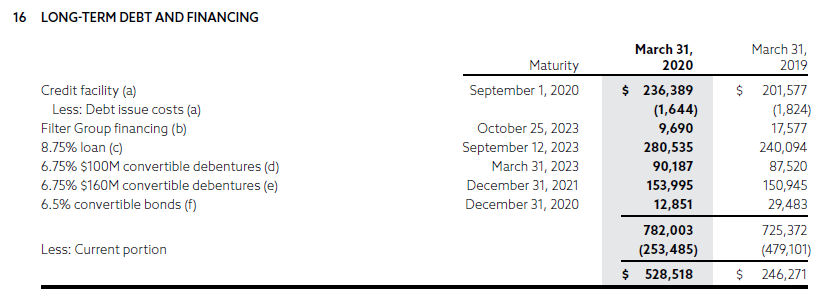
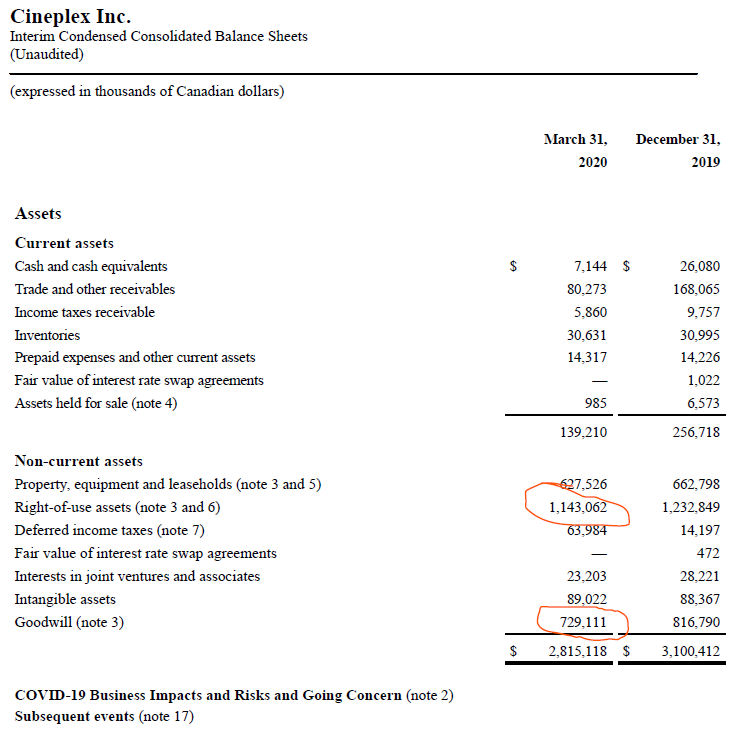
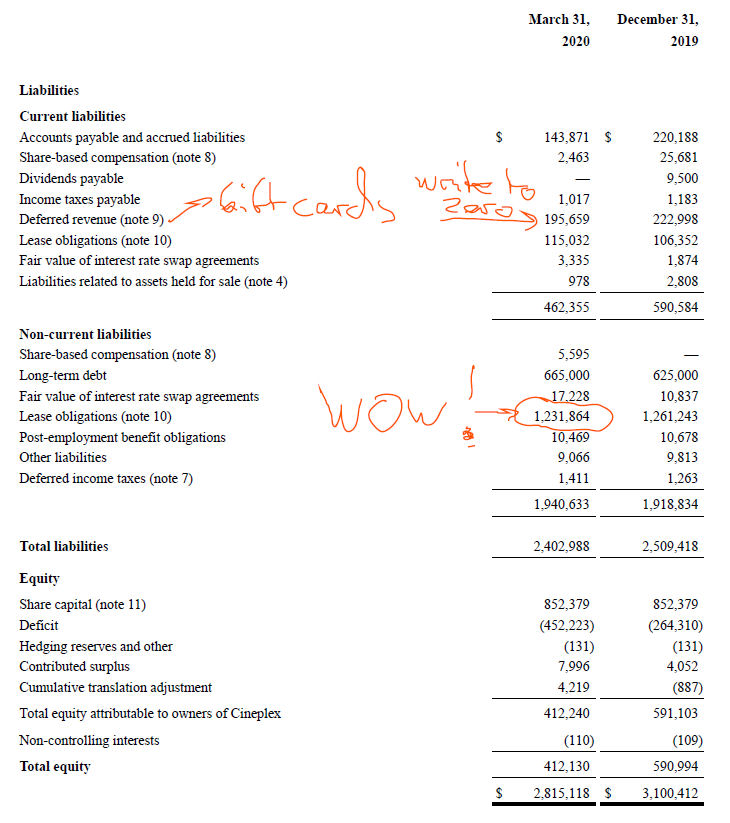
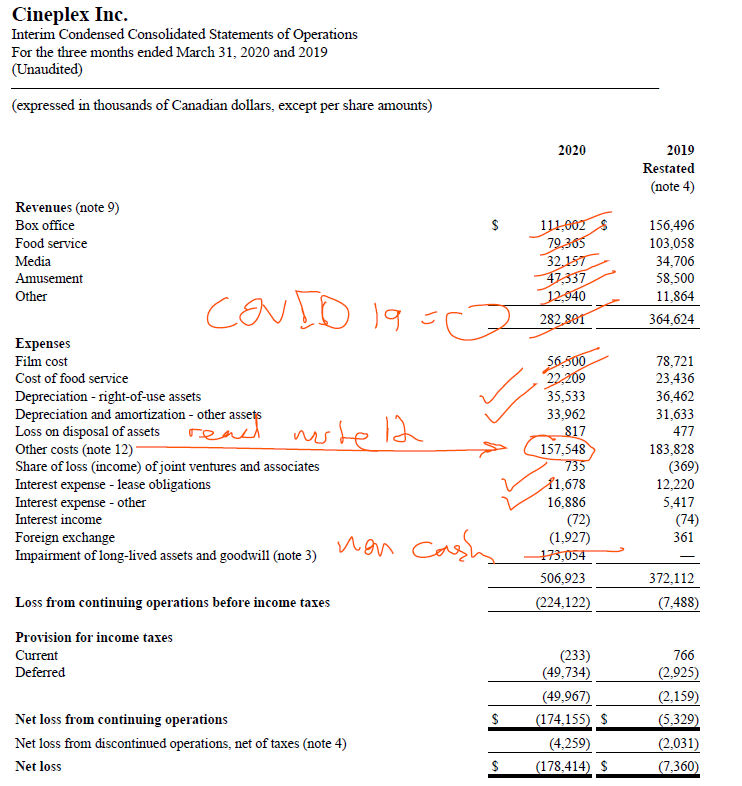
The Alstom acquisition of Bombardier Transportation is the key trigger to the company’s solvency and all indications appear (unlike Cineplex and Air Transat!) that it will continue.

May 2020 – wild times

Today wraps up another month in the markets.

This quarterly report is going to shape up to be one of the most interesting since the 2008-2009 economic crisis. May was a very active trading month. Indeed, something very rare is that my usually very concentrated portfolio has been flattened like the COVID-19 curve – today I count 18 separate issuers that I own either equity or debt positions in (some more concentrated than others). There is an additional three separate positions in various futures contracts. There are more balls being juggled up in the air than ever in the history of my portfolio.

I was caught very badly with the onset of Covid-19, but just because you lose a bunch of money on the way down doesn’t mean you have to earn it back in the same manner. Things are going to be a bit more tricky in the next month – predicting correctly the nature of the post-Covid normalization is where the bulk of the money will be made.

An investor wins in the Covid-19 era by avoiding where there is less likely to be demand. Although I’m sure a few of my picks are going to be duds, the nature of what happened (culminating March 23, 2020) will result in winners that will, by the virtue of mathematics, become more concentrated, while the laggards will naturally reduce in proportion to the overall portfolio.

But overall, there is still an obvious tailwind for the market. This is taking the market sailboat that we are all on in a forward and upward direction. The wind is going to slow its gusting (i.e. central banks will soon start to normalize monetary policy), but just because the wind slows down doesn’t mean the ship stops sailing forward. There’s momentum and plenty of participants that want to convert their zero-yielding cash into assets at ever increasing prices. The winners and losers of Covid-19 are well known by this point, and institutions have their sales data to place their near-insider bets on various retail agencies. Headlines now are concerned about racism and police brutality, geopolitical and electoral politics, another sign of normalization.

Finally, here is an un-testable prediction – on Saturday at 12:22pm Pacific Time, you can watch Elon Musk’s SpaceX launch a couple astronauts into space. While this might not seem like anything special, if this launch is successful, the S&P will rise faster than the rocket that took them up into space. I’ve always thought that SpaceX and not Tesla, SolarCity, Boring or Paypal is the gem of Elon Musk, which would explain why it’s not publicly traded.

Corvel Corp

Here is another quick post.

I took a substantial position in the past month in Corvel Corp (Nasdaq: CRVL). Now that it’s rocketed up, I can write about it. Corvel’s domain is primarily in the software processing of workers’ compensation, insurance and related claims processing. They are vertically integrated to the extent that they provide the software and management systems.

I have been tracking this company for nearly 20 years, and owned and sold it over a decade ago, but I’ve been keeping an eye on it ever since (which assists the due diligence effort since there is such a long institutional history in my own mind). I finally had my opportunity.

It is a very unusually managed company. The pioneering manager (Gordon Clemons) still owns 9.4% of the company and sells bits and pieces now and then. He came on board 1988. The pioneering shareholder, Jeffrey Michael, owns 37% of the company through a holding company, and this was from 1990. They have since passed the baton to the next round of management, which does provide some succession risk (what happens to those shares?). Both Clemons and Michael have kept very low profile, along with current management. Almost nobody has heard of this company despite them doing over half a billion in revenues a year. They inhabit a niche that has very high barriers to entry. Their capital allocation strategy has also been relatively unusual – the underlying business makes a lot of free cash flow (after R&D) and all of that capital (up to the end of 2019, approximately $514 million) has gone into the repurchase of shares. They do not employ debt – indeed, not only did they not use their credit facility but they got rid of it in September 2019.

Their capital allocation strategy is uncommon. They maintain a cash float, and reinvest the rest of the proceeds in their own stock. As long as you assume the company will continue making money at the rate they are doing, these buybacks are extremely value-added over time. This makes past stock charts less comparable to present day situations. As of December 31, 2019, they have bought back nearly 2/3rds of their shares outstanding, at an average of US$14.25/share.

CRVL’s sensitivity to Covid-19 was primarily related to raw employment figures – their revenues are ultimately derived from employment and insurance factors. Their fiscal year end is in March and they released the annual results, which were in-line. The April to June quarter will show a slowdown, but after that, things should normalize.

While revenues will take a minor hit during COVID-19, as employment normalizes (in whatever form), Corvel will achieve its track record in annuity-like income and will be priced at a higher multiple than it was during COVID-19, which needless to say was lower than its ambient norm.

The company maintains a significant competitive advantage. Their pricing power will not erode too much as a result of the economic turmoil.

Needless to say, this is one trade I wish I made larger. My investment style is far too cautious at times.

Royal Canadian Mint ETR premiums

In Canada you can directly invest in gold by buying (TSX: MNT), which currently represents 0.0105808 Troy ounces per unit (this goes down slowly to reflect the 0.35% MER).

Normally the trading price of this product is close to the net asset value, but presently there is a huge premium involved.

This second as this is being written, the NAV is $24.81 while the market value is $26.99.

This is an 8.8% premium above NAV, which is very expensive and more so than it has typically been, especially during and after the CoronaCrisis.

You can redeem for physical with 10,000 ETRs, which would be good for 105.808 troy ounces, or nearly 3.3 kilograms.

The redemption fee for this (assuming you receive 3 kilobars, and the remainder in gold maple leaf coins) is about US$2,500, plus shipping and insurance. This is roughly 1.3% of the whole purchase price.

One would intuitively think that the NAV premium would be restricted somewhat to the cost of delivery.

Because you can’t just deliver physical gold to MNT, the only method to equalize this arbitrage is for the Royal Mint to sell units of MNT to the public at a premium to NAV (skimming the difference).