The very strange dawn of robotic marketing

This post is more of an experiment than anything from reading James Hymas’ May 25, 2016 post. A successful result will be me being sent a spam email by a robot. This is probably one of the most rarest times where receiving spam is a positive result!

On May 19, 2016, IGM Financial invested $50 million in Personal Capital, which is a robo-investing corporation.

Just so there is some information content in this post, there is clearly a scale where passive investing will deliver inferior absolute returns in relation to active managers. Although I have not done the detailed analysis (in terms of obtaining reasonable data in terms of capital flows and such), I would suspect we have already reached this point. Too much capital that is attracted to the main equities (TSX 60 and the like) will likely result in under-valuations in less liquid portions of the market – especially when there are market corrections and robotic investors decide to liquidate “roboticly” – i.e. without regard to price.

A very quiet May and some self-reflection

It has been a relatively calm month of May for me – I know the cliche of sell in May and go away has resonated in my mind, but my positioning is still quite defensive (very heavily weighted in preferred shares and corporate debt). One advantage of such a defensive portfolio structure is that it is relatively insulated to equity volatility.

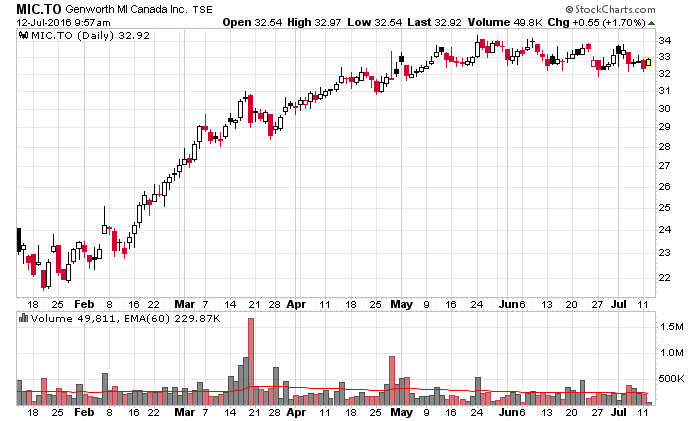
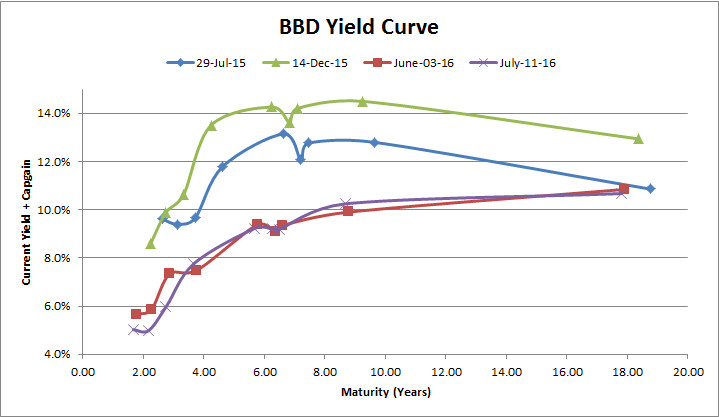
The past three months have seen quite a significant performance gain and when there are gains this large I always ask myself whether it is sustainable. When I look at the fixed income components of my portfolio, I see higher room for appreciation from current levels as markets continue to normalize. For whatever reason, Canadian markets were heavily sold off in early February, especially in the fixed income space, and we are still continuing to see a normalization of these valuations.

There were a few missed opportunities on the way. I will throw out a bone for the audience and mention I was willing to pounce on Rogers Sugar (TSX: RSI) when it was going to trade below $3.75/share, but clearly that did not happen (sadly, its low point was $3.84/share) and it has rocketed upwards nearly 50% to $5.71 presently on the pretense that Canadians are going to have a sweeter tooth for sugar rather than corn sweeteners in the upcoming months (which is true – their last quarterly financial statements show an uptick in business and this should continue for another year or so and the market has priced this in completely).

My overall thesis at this point is that the aggregate markets will be choppy – there will not be crashes or mega-rallies, but there will be lots of smaller gyrations up and down to encourage the financial press that the world will be ending or the next boom is starting. When looking at general volatility, the markets usually find something to panic about twice a year and we had a large panic last February. The upcoming panic would likely deal with the fallout concerning the presidential election.

If net returns from equity are going to be muted, it would suggest that the best choices still continues to be in fixed income. The opportunities at present are not giving nearly as much of a bang for the buck in terms of risk/reward, but there are still reasonable selections available in the market. A good example of this would be Pengrowth Energy debentures (TSX: PGF.DB.B) which is trading between 94 to 95 cents of par value. Barring crude oil crashing down to US$30/barrel again, it is very likely to mature at par on March 31, 2017. You’ll pick up a 6% capital gain over 10 months and also pick up some interest at a 6.25% coupon rate. Worst case scenario is they elect a share conversion, but with Seymour Schulich picking up a good-sized minority stake in the company, I very much doubt it. (Disclosure: I bought a bunch of them a couple months ago at lower prices).

In the meantime, I am once again twiddling my thumbs in this market.

Reviewing one of my year-end predictions

For my December 31, 2015 new year’s predictions, I said the following:

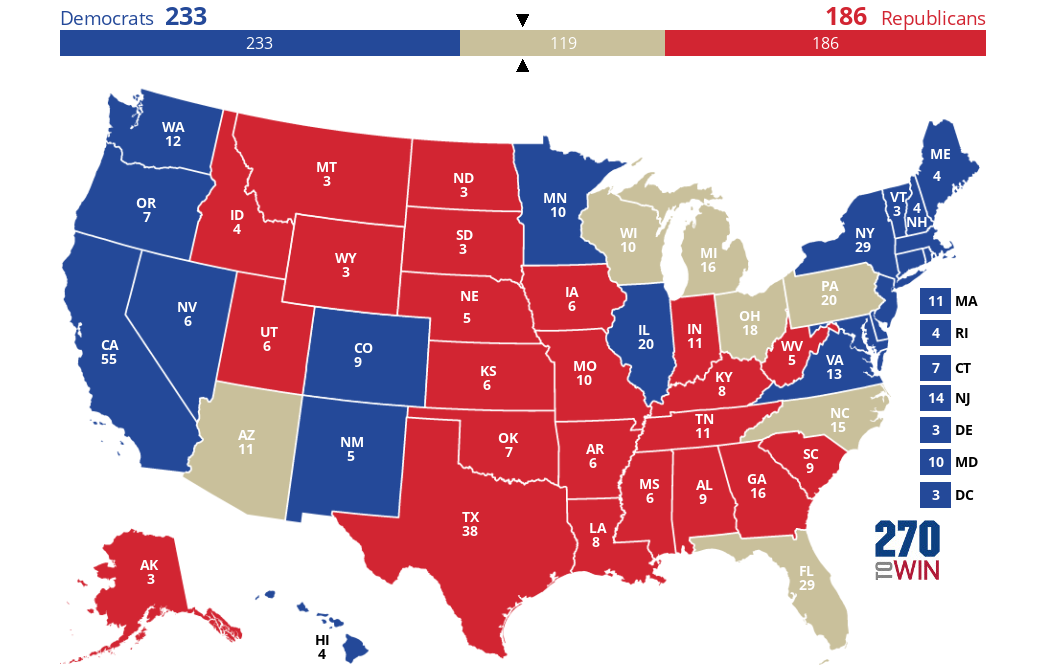
* Next US President: Donald Trump will be elected as the next president of the United States, by a considerable margin. This prediction is not an endorsement of him, but it is a reflection of my political analysis and my take on what is happening in the United States at present.

I’ve been telling people since September 2015 that Donald Trump would not only win the nomination, but the presidency of the United States. The general election result is not even going to be close – Trump will get at least 350 electoral votes.

Best places to park short-term, nearly-risk free Canadian cash

As a result of the Bank of Canada’s decision to hold the overnight interest rate target at 0.5%, options for Canadian dollar cash balances are bleak.

Cash can always be held at zero yield and would be immediately available for deployment.

There are also financial institutions that will allow you to lock your money in for a 1-year GIC and earn around a 1.25% risk-free return. However, the sacrifice in liquidity in the event that you would want to deploy such capital is unacceptable from an investment perspective. One can also purchase a cashable GIC (typically redeemable within 30 days after purchase) that earns slightly less yield – my local BC credit union offers such a product with a 0.85% yield.

I was curious as to the best exchange-traded products that would offer some yield at the lowest risk.

There are basically two options. They are (TSX: XSB) and (TSX: VSB). Both are short-term government bond funds. VSB is significantly cheaper on management expenses (0.11% vs. 0.28% for XSB), and both portfolios offer similar durations (roughly 2.8 years), and VSB has slightly better credit quality (55% weight to AAA instead of 50% for XSB). VSB should eventually have a better net yield after expenses (roughly 1.1%) due to the smaller MER. While the 1.1% net return is small, it is better than zero and is nearly risk free – there is anti-correlation between general market movement and the likely price movement of this fund – the capital gain on VSB should rise if there was some sort of crisis due to the heavy government bond exposure of the fund.

Another alternative which is deceptively cash-like but will not serve any purpose if you wish to save money for some sort of financial crisis is the high-quality corporate bond fund also offered by Vanguard (TSX: VSC). Although VSC will offer you another 80 basis points of yield, it has the disadvantage of likely having a liquidity premium in the event there was some adverse financial event – i.e. your cash-out price will likely be materially less than NAV.

All three ETFs trade at modest premiums to NAV.

Bombardier update

It is virtually a given now that Bombardier will announce that Delta Airlines has ordered a bunch of C-series jets. The announcement will probably be Thursday as there is no reason for them to move back the earnings announcement unless if they want to have a huge feel-good party for their annual general meeting on April 29th.

However, in terms of pricing of securities, “buy the rumour, sell the news” is the cliche to follow here. Most (if not all, or even an over-reach) of this news has been baked into current market pricing, which means that investors will now have to focus on the finer details, such as: how much of a price concession did Bombardier make in order to ink the sale on the contract?

These price concessions inevitably will affect profitability of the overall entity, and while it is nice to sell jets at a near break-even profit margin, the corporation needs to eventually make money.

However, Bombardier has solved one of their massive problems which was a chicken-and-egg type matter: they now have an American purchaser of their jets, which is a lot better than how things were portrayed for them half a year ago. More importantly, they are current in a position to raise capital again from the public marketplace.

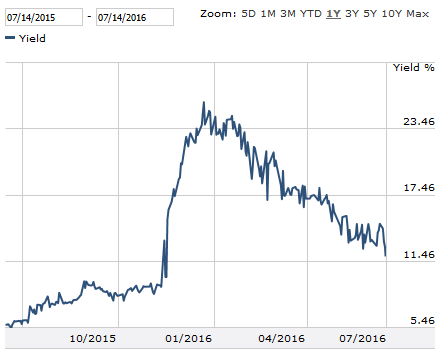
I will point out in a reduced profit scenario that the security of income from the preferred shares (or even the bonds) looks more favourable from a risk-reward perspective than the common shares. Back in February, investments were selling preferred shares (the 6.25% Series 4) at 18% yields, but today it is at a much more respectable 10%. I’d expect this to get around 7-8% before this is done.

My investment scenario is pretty much resolving to my initial projections – just have to continue to be patient and then the decision is going to be whether I sell and crystallize the gain, or just be content to collect coupons and sit on a large unrealized capital gain.

(Update, April 28, 2016): As expected, Bombardier has announced that Delta has purchased 75 C-Series jets with an option to pick up another 50. This is a huge win for the corporation, but again, the question remains: how much money will they actually be able to make when they produce these things? Let’s hope they’re able to actually get the production lines going and crank them out without issues, unlike their Toronto street cars…

I’ve glossed over their Q1-2016 financial statements, and as expected, they still show an entity that is bleeding cash, albeit they have a lot of liquidity available – US$4.4 billion in cash and equivalents when you include Quebec’s $1 billion investment. They’ve got US$1.4 billion due in 2018 on their March 2018 debt (coupon 7.5%) but this is trading at around a 6.5% YTM at the moment so they can refinance it.

The company expects the C-series program will consume $2 billion further cash for the next five years, of which the province of Quebec has generously chipped in a billion. After that they expect things to be cash flow positive. Who knows if this will happen!

(Update, April 29, 2016) The market has “sold the news” as I expected. I generally believe the common shares will have a significant drag compared to the historical charts due to dilution, but the preferred shares and debt should normalize to “reasonable” yield levels simply due to their standing being in front of line on the pecking order. This is assisted with the Beaudoin family’s very rational self-interest in maintaining their control stake with the Class A common shares which will translate into outwards cash flows being paid as scheduled. If the Government of Canada decides to chip in a billion dollars, it is icing on the cake, but it is not required as Bombardier will be busy for at least the next four years producing C-series jets. Assuming they can actually execute on the production and the jets live up to their reported (superior to competition) specifications, they should be good to at least pay off debts and preferred share dividends.

Each additional order of C-Series jets will be making profitable margin contributions and as these orders continue to come in, the common shares, preferred shares and debt will ratchet up, accordingly. I still believe they are under-valued but not nearly as much as they were late last year when everybody was in doom and gloom mode! The preferred shares are the sweet spot in terms of risk-reward.