Smallcap time: Vital Farms (VITL)

In my quest to dredge out smallcap companies, I stumbled upon Vital Farms (VITL on the Nasdaq). This was a pretty interesting case study. I’ll keep the analysis to short sentences.

Vital Farms’ niche in the business world is selling premium-branded eggs. You can imagine the marketing with pictures of farmers, and free-roaming chickens, and talking about ethical sourcing and so on. Predictably, they have supply contracts with the likes of Whole Foods. They were going into the premium-branded butter market as well but they have recently discontinued this business (indeed, dairy is a significantly different business than egg farming).

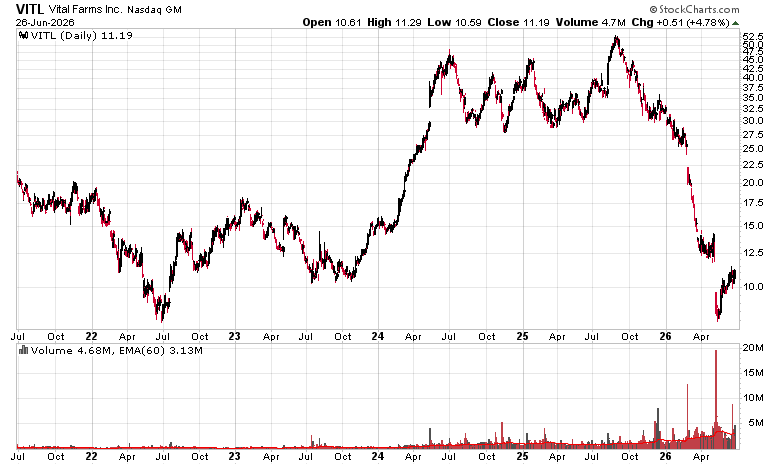
Vital went public in the start of the Covid crisis 2020 and the stock regressed until about 2023 before rocketing up again in 2024.

The reason why they rose so quickly was due to margin tailwinds concerning cost inputs (grain feeds and the like), and a perception that their total addressable market would expand further. A typical extrapolation to the max story.

Net margins after taxes for calendar year 2024 and 2025 were just under 9%, which for a commodity industry is impressive. Headline diluted EPS in 2024 and 2025 was $1.18 and $1.44, respectively, and the stock had a growth valuation accordingly – well beyond that typically afforded of most consumer staple producers.

By the end of 2025 there were some significant storm clouds approaching. One was that the company had embarked on a significant capital expenditure program which would suck up most of the money it raised from its IPO. This project (an egg processing plant in Indiana) was announced in the middle of 2024, started in the middle of 2025, and based on the economics back in 2024 – needless to say, those economics have changed.

In 2025 we had the avian flu, egg supplies in the USA had plummeted and prices started to skyrocket for eggs. The backlash of this we are starting to see with excess capacity. Blowing a hundred million on capex to expand into something that is over-supplied was not a decision that aged well.

Fast forward to 2026 and basically the bottom fell out of the company after the February 2026 reporting of annual results. A quarter later, they had reported their first loss, decreased revenues, decreased gross margins, and essentially had relegated themselves to all the characteristics of what is fundamentally a commodity business.

A social media report from a rival competitor (in January 2026) that showed that their premium eggs were not that different than typical store-brand eggs did not help their cause.

The kicker is that in Q1-2026, VITL had spent $20 million repurchasing their stock at a price which is now trading 45% under what they paid for it, and in the most recent quarter conference call, stated that they are aware with the completion of their capital projects that they will have to tap into a line of credit because they blew so much cash.

It was pretty evident from conference call transcripts that management had been drinking the coolaid (or perhaps a better analogy would be eating too much of their own egg yolks) of the perceived historical strength of their business.

While I am looking at more agricultural-oriented companies, this one isn’t going to fit the bill for me. The “regression to the mean” investment scenario should discount what happened to them in the 2024-2025 calendar period, although if you believe those days will come back, perhaps this stock might be right for you. For me, I will be looking elsewhere (including the type of eggs that I purchase at Costco!).

An economic model of buying put options for free

Article about how a third-party ticket vending company fails to honour its agreements to sell tickets to a World Cup game to its customers: (StubHub cancels thousands of World Cup tickets, leaving fans furious and heartbroken)

He paid $11,380 Cdn months ago for a pair of premium seats to watch Canada play Qatar in a World Cup match in Vancouver last Thursday. They were to be a Christmas gift for family members.

“They said, ‘Everything’s fine. Your tickets are 100 per cent guaranteed. We will get back to you in two to three hours.’ That never happened.”

StubHub cancelled his order while he was stuck outside the stadium. There was no explanation, no replacement and no refund, he said.

Let’s assume the article at face value and assume its representations are true.

From a financial perspective it sounds like the business model is StubHub buying put options on tickets for free, with the full benefit of capital usage of exercising said option for free.

For example, in the above transaction, StubHub received $11,380 for 2 tickets “months ago”. As they were a Christmas Gift, assume this was done in December 2025.

StubHub thus received an interest-free loan for at least six months, coupled with a put option for the tickets – essentially they had a six month window of opportunity to purchase “premium seat” tickets for less than $11,380 and pocket the differential.

If they could not do this, then they can just say “Oops” and cancel the transaction the day of the event. Presumably this person will receive the $11,380 they originally paid.

So StubHub, financially, is realizing a value of the six month put option they purchased for free on the ticket transaction. What is the implied volatility of a world cup ticket? An interesting modelling exercise, no doubt.

Doing a paper napkin calculation, a put option expiring six months out with an implied volatility of 40%, roughly yields 10.4% of strike price.

Say StubHub’s cost of capital is 8% – when adding the option value and the free usage of capital for half a year means they netted about $1,640 for the pair of tickets without any risk whatsoever. If the tickets on the open market went “into the money”, the realized profits would be locked in, instead of theoretical. Not a bad business model, noting the other winner here is going to be Visa or Mastercard for the interchange fees.

Late Night Finance – Episode 31

Date: Monday June 22, 2026
Time: 7:30pm, Pacific Time
Duration: As long as my brain is working
Where: Zoom (Registration)
** PLEASE SEE CAMERA REQUIREMENTS BELOW **

Frequently Asked Questions:

Q: What are you doing?
A: This will be somewhat different than my prior Late Night Finance sessions. I will conduct a brief portfolio review, and then I will begin a Canadian small-cap research session. This will be truly unrehearsed and I will go end-to-end from screening and then drilling into various stocks. It may be a bust, there might be some golden needles in the haystack – I truly don’t know. Likely result will be putting a few more onto the watchlist. I may wade into US smallcap and international smallcap (be warned – international is not my forte!).

To be clear, this will not be a session where I dump data into Claude and just read the output to you guys. This is bona-fide human research. It will be painfully slow. Think of this as “Twitch” except way less visually stimulating. (There is a website I wanted to use rather than Twitch for this analogy which I am sure you can think of).

Q: What do you mean by smallcap?
A: Roughly C$50M market cap and above.

Q: How do I register?
A: Zoom link is here. I’ll need your city/province or state and country, and if you have any questions in advance just add it to the “Questions and Comments” part of the form. You’ll instantly receive the login to the Zoom channel.

Q: Are you trying to spam me, try to sell me garbage, etc. if I register?
A: If you register for this, I will not harvest your email or send you any solicitations. Also I am not using this to pump and dump any securities to you, although I will certainly offer opinions on what I see. Perhaps you will want to front-run me.

Q: Why do I have to register? I just want to be anonymous.
A: I’m curious who you are as well.

Q: If I register and don’t show up, will you be mad at me?
A: No.

Q: Will you (Sacha) be on video (i.e. this isn’t just an audio-only stream)?
A: The majority will be on “screen share” mode with Browser / PDFs as I explain what’s going on in my mind as I present.

Q: Will I need to be on video?
A: ** PAY ATTENTION TO THIS ** You are required to be on camera, dress code is pajamas and upwards. Even if you are busy web surfing, I still want to see you. Quite frankly, I find it depressing to chat to a bunch of black boxes. If you are a black box for more than 5 minutes in the session I will kick you out of the meeting (don’t take offense, you can rejoin later).

Q: Can I be a silent participant?
A: Yes, although be warned – I will try to engage with you.

Q: Is there an archive of the video I can watch later if I can’t make it?
A: No. To be perfectly clear this is not recorded.

Q: Will there be a summary of the video?
A: No.

Q: Will there be some other video presentation in the future?
A: Most likely, yes.

Andrew Peller – liquidated by Fairfax

Back on August 31, 2025 I wrote a post about Andrew Peller (TSX: ADW.a and ADW.b) characterizing it as a “low risk, medium reward” situation. Adjusted for dividends, the non-voting stock was trading around $5.10/share.

Fairfax announced yesterday that they made an agreement with the majority voting shareholders (John Peller and the Peller Family Enterprises entity, combined owning about 3/4 of the voting stock of the company) a takeover bid for $8/share cash for ADW.a and $12/share cash for ADW.b, with John Peller graciously receiving a private “rollover” provision with Fairfax, presumably to blunt the impact of any capital gains taxes going forward.

This deal was at a considerable premium to market at the time and is quite probable to be accepted with a 2/3rds vote required by both classes of shareholders and also a majority of Class B shareholders that are not represented by those that get a rollover provision or otherwise exempted by the MI 61-101 rules.

Right now, it is not clear to me whether a significant shareholder (the Peller Family Enterprises Inc. entity owning just under 50% of the Class B shares) is excluded from the majority vote. I will read the information circular when it comes out. If it is excluded, then the public shareholders (about 25% of the Class B stock) is voting on the deal which creates an interesting dynamic if it occurs.

By all means this trade should be considered a victory, but it leaves me with a couple bittersweet feelings.

The first bittersweet feeling is that the Class A shares are mildly undervalued by Fairfax – albeit there is no obligation for Fairfax to give Class A shareholders any sort of deal at all (they could have just taken control of the entity by purchasing the majority stake from the Pellers), they did short-change the Class A shareholders about 75 cents from the midpoint of the “valuation” alluded to in the press release.

This is no stranger to Fairfax (and other companies) that do this to minority holders of smallcap companies – one of the big risks of smallcap investing is that when you do get a takeover offer, they are sometimes at unfavourable terms. I felt the same way after Cervus was taken over (have to go back to August 2021 for this post).

Andrew Peller is in way better shape today than it was a couple years ago when I started to purchase shares. For the fiscal year ended 2026, they reported a diluted EPS of 61 cents per share – so at the $8/share that Fairfax is paying for non-voting stock, that’s a P/E of 13, not a bad price. Balance-sheet wise the company owns a lot of physical infrastructure, and the marketing/distribution know-how and incumbent contracts consisting of about 10% of the Canadian domestic wine market, but they also own a strip of land in Port Moody, BC, which they will inevitably liquidate and realize a healthy gain from (book value is about $6 million, market value of land is assessed at $50 million). Factoring in these off-balance sheet assets, Fairfax is getting a fairly good deal, hence some resentment.

There are a couple headwinds, however – about $26 million of the revenues comes in the form of a federal/provincial subsidy (read Note 17 of the financial statements – not a revenue accounting-wise but an offset to costs, but either way, it is 100% pure ‘margin’), and coupled with the VQA revenues of about $17 million, all of which considerably overstates the company’s profitability if these subsidies were to be tapered away for whatever political reasons. The other headwind is the nature of the market – in general, alcohol consumption is on the decline.

The second bittersweet feeling is that I have been really struggling to find reinvestment candidates. Andrew Peller was the type of company (similar to Rogers Sugar when it was reasonably priced) that you can just purchase and forget about entirely since the industry itself was so mature and stagnant. My portfolio, which is cash-heavy, is going to become more cash heavy as a result of this takeover. I have been really struggling for reinvestment options that I have considered acceptable.

I have a cliche which is that every good trade you make you wish you had doubled it when getting into the position. Considering the cash-heavy nature of my portfolio since 2023, this is especially true with Andrew Peller. However, by all means I should instead be purchasing a bottle of $10 red wine (perhaps upgrade to the $20 stuff given the one-time nature of this takeover bid) and count my blessings before sobering up and hitting the stock screener for the next opportunity.

Liquidity of precious metals

In a world where the headline article is the USA publishing an annualized CPI for May of +4.2%, you would think that precious metals would be the recipient of capital inflows – supposedly a great hedge on inflation – as governments run higher and higher deficits and the supply of money expands to infinity, precious metals will flourish, correct?

Apparently not:

Gold and silver have been trading down, especially since the precious metals price spike last January. Somebody buying Silver at that $120 spike is sitting just under a 50% loss at present.

What do we make of these conflicting narratives?

Prices are set at the margins. It takes one trade for a price to drop from $100 to $10 – if somebody is willing to sell it at 10 dollars and nobody is willing to buy it between $10.01 to $100.

What triggers the sale? The need for liquidity – converting an asset class into cash, and this need is more than the desire of the purchasing party to pay up for it.

The advantage of owning an ounce of gold or silver is that it sits there. It doesn’t depreciate. It will be there forever, irrespective of whatever happens to the entire monetary system. The disadvantage is that it sits there. It doesn’t earn a yield. To convert this asset into something useful, you need to find somebody willing to take it and give you something in return for it that you want – typically cash. If too many people want cash, you’re less likely to receive more for it.

It is very difficult to predict the eddies and currents of when you will see demand for precious metals or seeing people needing liquidity and selling their gold and silver instead of US Treasuries or Bitcoin or shares of NVidia.

“Sell in May and Go Away” is a popular cliche in the markets – perhaps this year it is especially true. I continue to remain very defensively positioned despite the pain of seeing a USA CPI print of 4.2% and the best low-risk short duration ETF I can find on cash equivalents gives out a net of 2.6%. What will break first, the purchasing power of cash or the stock market?